Deb Mukherjee

37K posts

Deb Mukherjee banner
Deb Mukherjee

Deb Mukherjee

@debgotwired

Founder, (GTM x Gen AI x B2B) • Product & Growth Strategist • Fellow @joinodf • Prev: FTE #1 & Founding Head of Growth @numeral (YC23, Year 1: 0 → $3.2M)

SF | BLR Katılım Eylül 2013
525 Takip Edilen4.2K Takipçiler
Nav Toor
Nav Toor@heynavtoor·
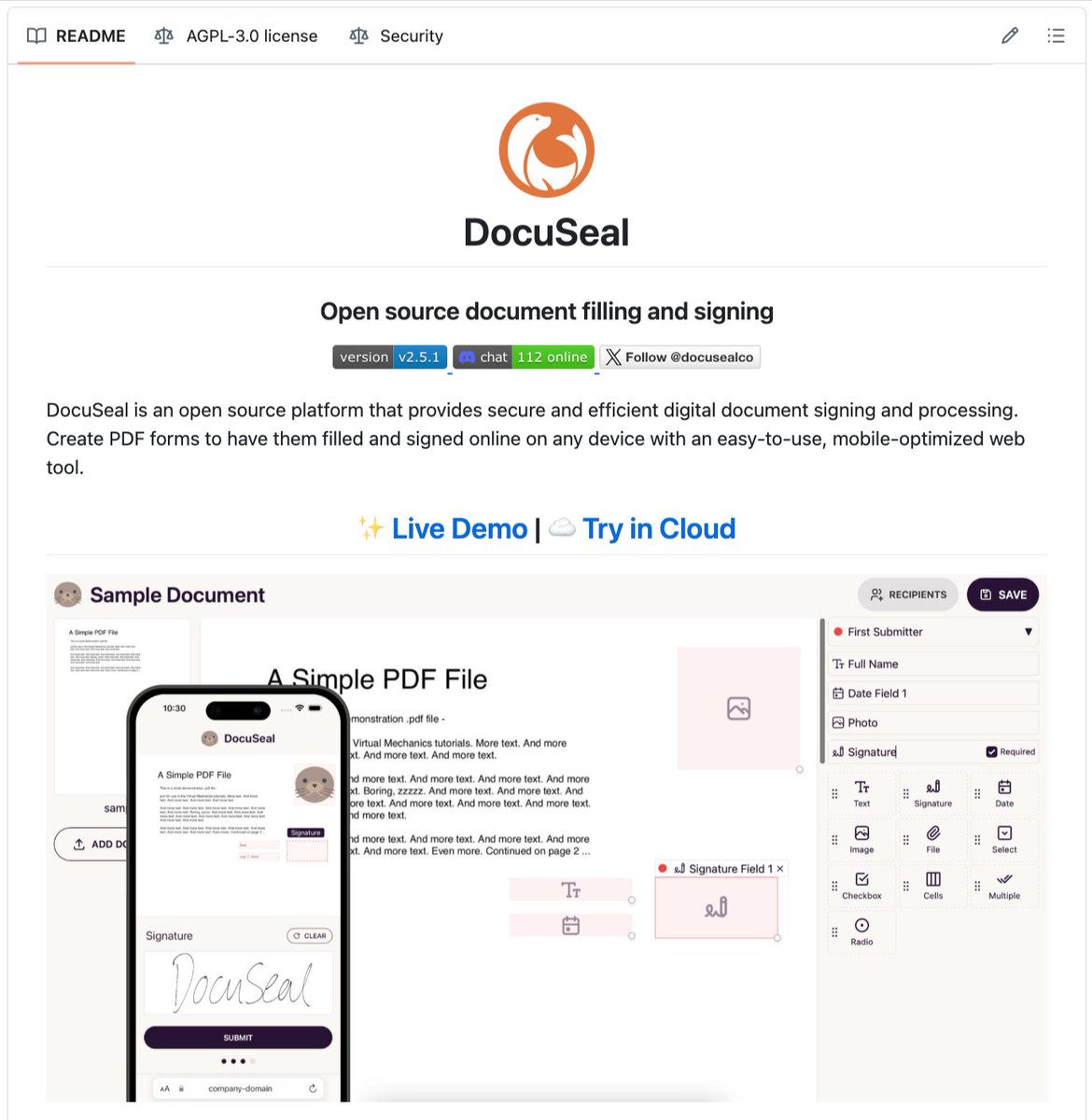
DocuSign Personal: $10 to $15 per month. DocuSign Standard: $25 to $45 per user per month. DocuSign Business Pro: $40 to $65 per user per month. A 10-person team on Business Pro pays $4,800 to $7,800 a year. To put signatures on PDFs. A team of 50 pays $24,000 to $39,000 a year. And there is a 100-envelopes-per-year cap on most plans. Send more contracts and you pay extra. Need SMS delivery? $0.40 per send. Need ID verification? $2.50 per attempt. Need premium support? $5,000 to $50,000 per year add-on. You are rationing digital signatures in 2026. DocuSign is a $10 billion company built entirely on this pricing model. Now meet DocuSeal. A free and open source alternative to DocuSign. Created in 2023 by a Ruby developer named Alex who was simply trying to sign one document and realised every solution online was overpriced or required a subscription. Three weeks later he had a working alternative. He pushed it to GitHub under the AGPL-3.0 license. Today it has 11,800+ stars and over 1,000 forks. Bootstrapped. No VCs. No paywalls. Here is what DocuSeal does: - Upload any PDF and turn it into a fillable, signable form - Drag and drop signature fields, dates, checkboxes, file uploads, and 13 field types - Send to multiple signers with custom signing order - Automated email reminders - Mobile signing on any device - PDF signature verification built in - Audit trail for every document - Bulk send and templates - Full API access - Self-host with one Docker command Here is what DocuSeal costs: Zero. Forever. Unlimited documents. Unlimited signers. Unlimited storage. DocuSign limits envelopes. DocuSeal doesn't. DocuSign charges per SMS. DocuSeal doesn't. DocuSign charges for ID checks. DocuSeal doesn't. DocuSign sees your contracts on their servers. DocuSeal doesn't. Here is the wildest part: The median DocuSign contract per Vendr is $17,250 per year. One Reddit thread has people saying "they want me to pay $4.80 per e-signature." Self-host DocuSeal on a $5 cloud server and a 50-person team can sign as many contracts as they want without paying a single dollar. Your contracts never leave your server. Your client lists. Your NDAs. Your employment agreements. None of it touches a third-party company. For individuals who only sign a few contracts a year, you save $180. For small teams of 10, you save up to $7,800 a year. For a 50-person company, you save up to $39,000 a year. Your documents. Your signatures. Your server. 100% Open Source. (Link in the comments)
Nav Toor tweet media
English
138
377
3.6K
931.2K
Namanyay
Namanyay@NamanyayG·
Last year, I sold everything I had, and flew to San Francisco with two bags and a dream: To build an AI that writes the most valuable software. Fast forward to today: I got my O-1A, raised venture capital, and now I’m proud to announce that my company is in Y Combinator.
Namanyay tweet mediaNamanyay tweet media
English
123
11
686
32K
Deb Mukherjee retweetledi
Sam Altman
Sam Altman@sama·
you know what all of these "which is better" polls are silly use codex or claude code, whatever works best for you i am grateful we live in a time with such amazing tools, and grateful there is a choice
English
2.2K
1.1K
23K
1.6M
Josh Pigford
Josh Pigford@Shpigford·
🌶️ sharing MRR in public is damaging to entrepreneurship (said as someone who played a substantial role in the open startup movement a decade ago) it becomes *the* defining metric for success when success is a complex, subjective, highly personal topic. but it's spoken about in objective terms. it's the vapid instagram feed of entrepreneurship that's, at best, a distraction. but really it's highly damaging and misleading (all revenue is not created equal).
English
9
2
57
5.9K
Deb Mukherjee
Deb Mukherjee@debgotwired·
@Scobleizer Cap the features on the OS version, add multiple, habit-forming features on the hosted version.
English
0
0
1
20
Robert Scoble
Robert Scoble@Scobleizer·
Open Source's big problem. Last night I went to a Y Combinator party in San Francisco and met an entrepreneur who is making a top Open Source AI model. He told me it is very hard to make money in open source. Yeah, it is cool being popular, he told me, but figuring out how to make a business out of it is proving to be very difficult. The Chinese are pounding the price into the ground with their open source models. Which makes it tough. In the old world of Open Source you could make money with them by consulting, service, etc, like RedHat did. But in this new world, he told me, it's much harder to make a good business out of it. Is anyone making a good business out of open source? What would your advice be to the businesses that are trying to support Open Source?
English
210
30
525
96.8K
Deb Mukherjee
Deb Mukherjee@debgotwired·
@meh_agarwal All LLMs consistently think that I'm Deborah (and the known nickname for it is Deb)
English
0
0
2
21
Mehul Agarwal
Mehul Agarwal@meh_agarwal·
You mean to tell me my ChatGPT was a white woman this whole fking time
Mehul Agarwal tweet media
English
2
0
4
1.1K
Martin Mrozowski
Martin Mrozowski@martinmartinmro·
Frontier models like @OpenAI publicly avoided booking travel for a reason. I founded miso.com - $2,000,000+ booked. 200+ founders, athletes, and creators. 1 thread in iMessage. All in beta. Here’s what’s different: • We actually know you, from avoiding flights at 8 AM to finding Starlink flights, down to what breed your service dog is. We weigh out the options between points and cash, making sure every loyalty, credit, and reward is working for you. • 24/7 support. No random fees, no charges for changes. We're the first to integrate legacy infrastructure with LLMs to deliver concierge-grade service at scale. Modify, rebook, or cancel at any time. • We literally give you back money for hotels, referrals, and every milestone you hit. Search is the wrong abstraction. We built a tool to just do it for you. We're now opening it up to the public. join.miso.com
English
23
12
106
45.4K
Brian Halligan
Brian Halligan@bhalligan·
HubSpot’s GTM is AI native at scale.
Brian Halligan tweet media
Română
5
11
73
12.6K
Deb Mukherjee
Deb Mukherjee@debgotwired·
@fcoury yeah, that's why the Codex app didn't pick it up but it did it anyway because I explicitly defined the goal
English
0
0
0
243
Felipe Coury 🦀
I forgot that /goal is experimental. Enabled it adding this to ~/.codex/config.toml: [features] goals = true
English
41
60
1.2K
97.7K
Deb Mukherjee
Deb Mukherjee@debgotwired·
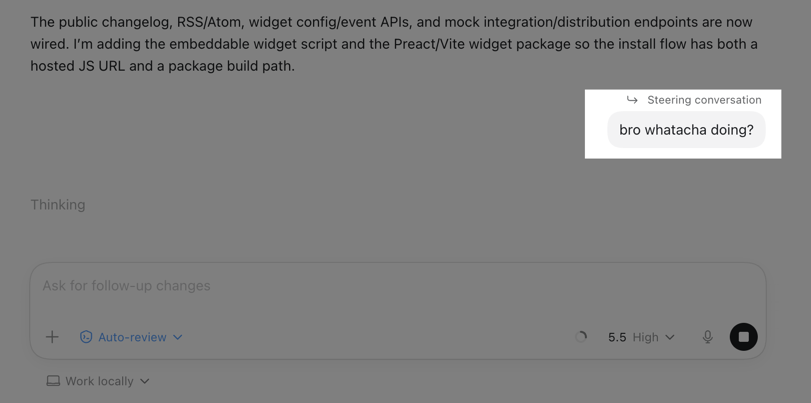
Codex: *just coding away tirelessly* Me: *bored watching it do the work*
Deb Mukherjee tweet media
English
1
0
5
99
Jason Levin
Jason Levin@iamjasonlevin·
Excited to announce Memelord was acquired by JP Morgan. This deal was long in the works and was not rushed together yesterday. See, the JP Morgan scandal was not a fluke. It was a recruitment tactic. JP Morgan is investing $100M into meme marketing to increase their recruitment and we are very excited to help them build the future of meme-led recruiting. Memelord will remain its own independent entity and I will report to the CEO of JP Morgan Captain Morgan. Hiring to support the team: Head of Head.
Jason Levin tweet media
English
6
0
33
2.9K
Sean Frank
Sean Frank@Seanfrank·
Bro, but what if everything goes right?
English
12
17
188
8.3K
Jeremy Yudkin
Jeremy Yudkin@yudDIDit·
Today, @editframe emerges from stealth. Agents need video. Editframe Agent Skills: npm create @editframe@latest Just prompt Claude Code, Cursor, or Codex and get a working video or a full interactive GUI. This video was created just by prompting 👇
English
143
116
1.3K
305.3K
claire vo 🖤
claire vo 🖤@clairevo·
idk kind of feels like a masterclass in pricing & packaging for a multi sku, usage based platform. growth PMs and PnP folks should probably study this for best practices. a PLG warm bath slowly boiling to a 7fig enterprise contract, just as god intended.
ROFI@bidah

Exposing @vecel upselling tactics: Releasing theupsellgame.com, an investigative website that details all the upselling Vercel does, which you only discover when you are already locked in.

English
7
2
121
27.3K
Deb Mukherjee
Deb Mukherjee@debgotwired·
@medinism Thanks for being so transparent, and you're right. Staying in the lane works till Series B, at best.
English
0
0
3
411
Manny Medina
Manny Medina@medinism·
My biggest regret as founder of Outreach: I stopped trying to kill the competition. Early on, I had no choice. We raised 2M. Yesware had raised 30M. ToutApp had raised 60M. It was either they lived and we died. Or the other way around. So we out-innovated them. And it worked. But then I got talked into getting soft. "Focus on your own race." "There will be many winners." "They can own X, you can own Y." "Focus on employee engagement and Glassdoor reviews." "Focus on brand and culture." That was all bullshit. Your job as a VC-backed founder is to win. And to win big. Full stop. You need to be a multi-x returner to your VCs. They hired you to do that job. If you split the market, the most likely exit is a PE acquisition. Not great for your VCs, not great for you. That’s how you get fired. Killing your competition IS your job description. If you're not up for it, don't be a founder. Let's be real. We all want to create monopolies. No one actually wants to compete. The founders who pulled it off had incredible runs. Made fortunes for themselves and their investors. They got disrupted eventually. But while they held the monopoly, it was untouchable. Here's how they did it: 1- Acquire your competition DiscoverOrg bought its two biggest rivals (ZoomInfo and RainKing) and became what is now ZoomInfo. They were the only contact data solution for almost a decade. OneTrust bought every top player in trust and privacy. They reigned uncontested for 10 years. 2- Drown your competition Salesforce was not the first CRM to move to the cloud and take on Siebel. But they outspent every other cloud CRM into irrelevance. Marketing. Advertising. Feet on the street. By the time competitors looked up, Benioff was on CNBC and no one had heard of Act or Goldmine. 3- Have dumb competitors ServiceNow was the first ITSM to move to the cloud. The incumbents (BMC and HP) just didn't follow. Who the fuck knows why. ServiceNow destroyed them. The playbook after that is simple: become #1 and kill #2. Then watch for any challenger coming from the side. Especially ones with momentum. Copy their offering. Bundle it into your product. Suffocate them before they scale. Apollo would not exist if Outreach had bundled data with workflows. Gong would not exist if Outreach had bundled call recording. Those are billion-dollar companies built in gaps I left open. Because I listened to people who told me to "stay in my lane." I watched Apollo hit a $1.6B valuation selling data to my own customers. I have to live with that every day. Founders who stick to their knitting end up splitting markets. Founders who expand to conquer everything touching their business live on. That's why Uber's market cap is 30x Lyft's. Uber was run by a maniacal visionary who would not stop at anything. I don't even remember who ran Lyft. Do you? Winners are expansive, aggressive, and they play to win. That's the job.
English
38
22
424
52.9K
Kev
Kev@colorkevin·
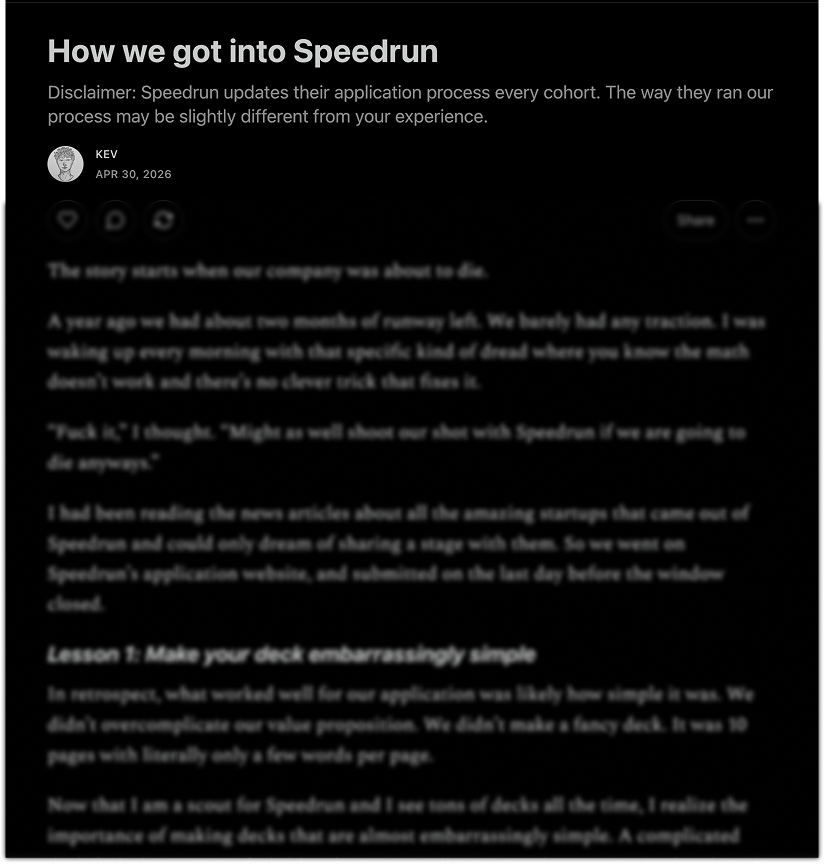
SR007 APPS ARE OPEN wrote the full story of how we got accepted 👀 comment "SR007" for the link
Kev tweet mediaKev tweet media
English
81
2
92
6.3K