
Sabitlenmiş Tweet
Blync AI
296 posts


Blync AI
@BlyncAI
Building at the intersection of AI, churn, and context.
Katılım Ocak 2025
91 Takip Edilen46 Takipçiler

Blync AI retweetledi

Come hack with us this Saturday!
We’re hosting the OpenClaw Hackathon w/ @hyperspell and @EragonAI.
Teams will build agents that operate with minimal human oversight, showing how autonomous agents can enable founders to scale businesses fast.
We're giving away a Mac Studio, cash prizes, and credits.
Look forward to seeing you there!
Register here: luma.com/w68ph5fe
English
Blync AI retweetledi
I took @danshipper’s AI style guide and @blader’s humanizer to create the de facto skill for AI writing.
Humanize: github.com/debgotwired/hu…
Dan Shipper 📧@danshipper
we just published the definitive guide to writing good prose with your AI read it on @every: every.to/guides/ai-styl…
English
Blync AI retweetledi

Not many know this, but @uselayers_ started as an agency workaround.
It became a product because the problem kept repeating itself.
At the time, we were running an agency and integrating many search solutions across various ecommerce stores.
That meant we saw the entire market from the inside: the big platforms, their pricing models, their implementation requirements, and the frustration many merchants had with them.
We then started working with a brand that needed something better than the default Shopify search, but the next step up in the market was far outside their budget.
Tools like Algolia worked well, but the pricing and operational overhead made them difficult for many growing brands to justify.
So we began experimenting with open-source search infrastructure and built a thin layer on top of it to give them the functionality they needed.
That internal system became known as Proton Search.
At first, it was nothing more than an internal tool that allowed us to tune search results and control product visibility more precisely for that one store.
But once it existed, we started deploying it across other merchants.
And almost immediately, we realized the same issue existed everywhere.
Over several years, the system evolved into something far more capable than the original experiment.
Eventually, it reached a point where it could compete directly with the platforms we had previously been integrating.
At that stage, we started testing the product with larger merchants through private betas.
The feedback was strong enough that we decided to take the project seriously as a standalone product.
The go-to-market effort began roughly a year ago, although the underlying system had already been in use across multiple stores long before that.
What started as a side project solving a single merchant’s problem gradually became Layers.
English
Blync AI retweetledi
I don’t think ecommerce websites are disappearing.
But I do think they will no longer be the first step in the shopping process.
There is a lot of excitement around new shopping form factors, whether that means conversational interfaces, voice assistants, wearable devices, or agents that buy things on your behalf.
All of those will likely exist.
But the structural change happening right now is simpler and more immediate.
1. The “shopping around” phase is disappearing
A few years ago, a typical ecommerce behavior looked like this: someone searched a product name, opened five tabs, compared the same SKU across different sites, and then picked the best option.
That behavior is becoming rare.
When we analyze referral data across many stores, it is very uncommon to see someone arrive from another brand’s website.
They arrive from search engines, from ads, or from recommendation systems.
That suggests the comparison step is already happening somewhere else.
2. Search engines and AI assistants will do the comparison
Traditional ecommerce browsing assumed that the customer would perform the comparison themselves.
They would visit multiple sites, check prices, evaluate options, and then decide.
Now those comparisons are increasingly being handled by algorithms that present the top few choices immediately.
3. The brand site becomes the destination, not the discovery layer
Even if discovery happens somewhere else, the brand website still serves a unique purpose.
Customers who care about a specific brand tend to go directly to that brand’s site because that environment communicates trust, identity, and product depth in ways intermediaries cannot replicate.
It would not make sense for a search engine or an AI assistant to generate a full brand experience for every company.
AI may compress discovery and comparison into a single interaction, but the brand relationship still lives on the brand’s own property.
The future probably looks like this:
AI helps customers decide what to buy.
Brand websites remain where they decide who to buy from.
English
Blync AI retweetledi
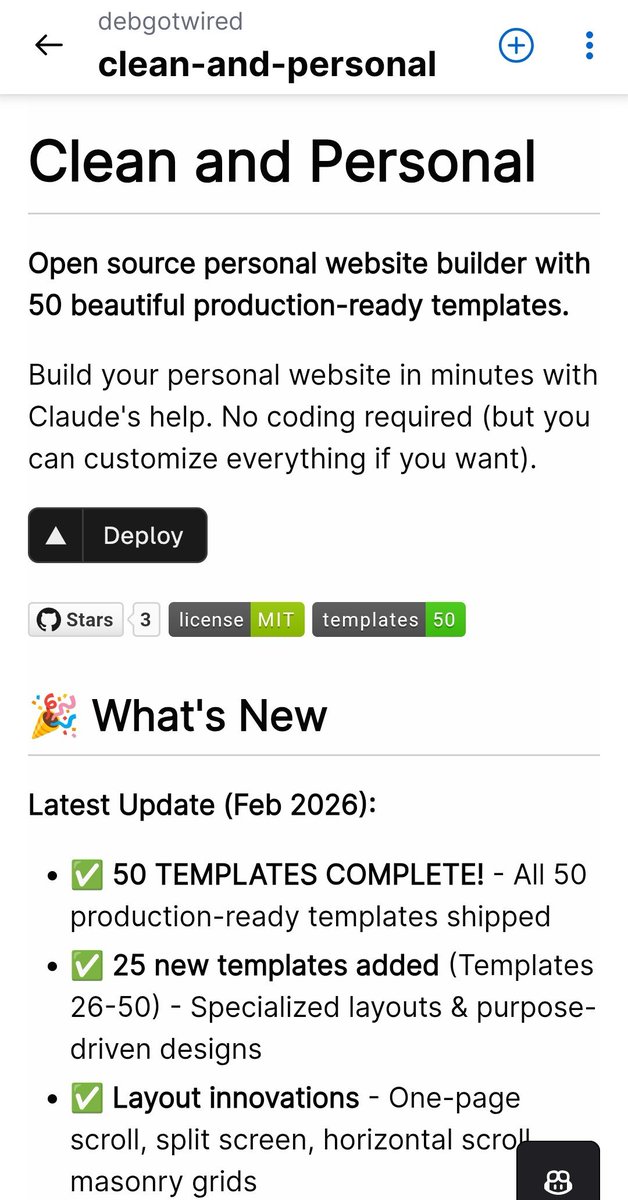
@GithubProjects A simple OS personal website builder (example: debmukherjee .com)
github.com/debgotwired/cl…
English
Blync AI retweetledi

Blync AI retweetledi
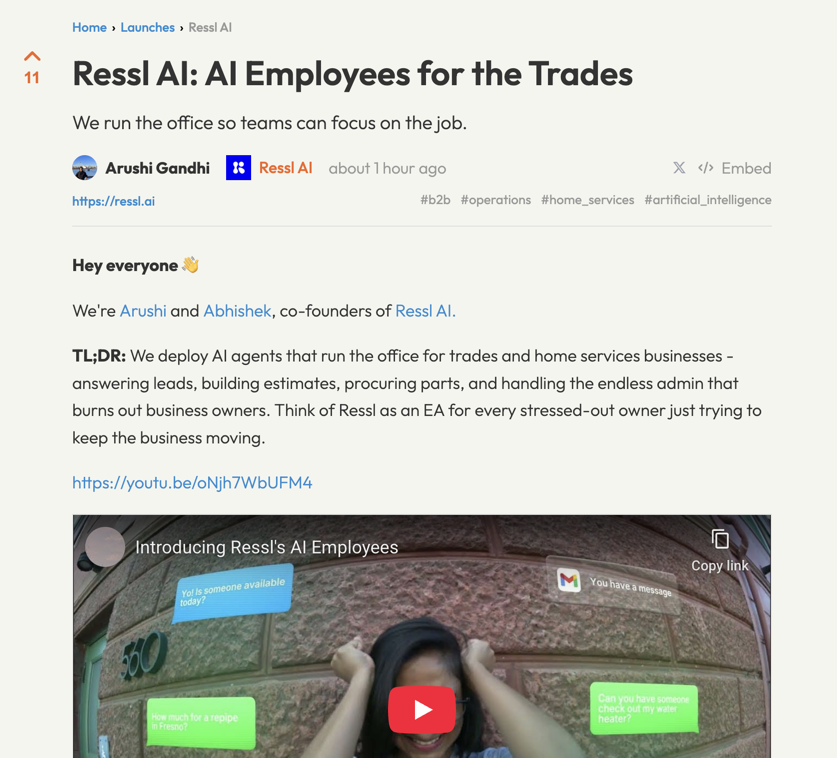
okay y'all, Ressl.ai just went live on Launch YC - give them a shout and upvote!
btw, if you haven’t met @arushi_ressl, she’s awesome!
ycombinator.com/launches/PXv-r…
English
Blync AI retweetledi
Today’s 14th Feb.
Valentine’s Day for others.
@joinodf kick-off for me and 100 others!
English
Blync AI retweetledi
@benln I built my personal website and then took the same principles and turned it into an OS personal website builder!
Please ⭐️ if you like it!
github.com/debgotwired/cl…
English


@debgotwired Makes a ton of sense! The competition with low-end AI/SaaS tools is intense and people jump on a whim.
English
Pricing is far more than just a revenue lever; it acts as a quality filter for your customer base.
The data on churn by price point confirms that "accessibility" is often just a synonym for low commitment.
- Under $25/month: A massive churn cliff, where companies are forced to replace half their customers each year just to stay flat.
- Over $500/month: Enterprise retention rates comparable to those of healthy, traditional B2B SaaS.
If you are selling a cheap AI tool, you aren't building a recurring revenue business.
You are building a leaky bucket filled with tourists looking for a cheap toy, and you need to price your product accordingly to weed them out.
English
Blync AI retweetledi
I got into @joinodf, cohort 27.
2025 was a shitshow - worked on an idea with no legs, made bad bets, learned what not to do the hard way.
This is the first real signal in a while that I'm pointed in the right direction.
Not the label, but the people and the standard I'll be surrounded by.
Excited to build!

English
The problem I'm trying to solve has no expiry date.
That's all the dopamine I need to keep going!
English