Hardwire Media@HardwireMedia
A child can understand the question, but it took nearly 80 years and a reasoning model reaching into deep algebraic number theory to break the expectation behind it.
In 1946, Paul Erdős asked one of those deceptively simple questions that became a monster in modern math: Put n dots on a flat plane. How many pairs can be exactly one unit apart?
For nearly 80 years, the suspicion was that the answer could only grow barely faster than n itself. A normal grid already gives you a lot of exact unit distances, but Erdős believed no arrangement could beat that by a true polynomial gap.
Then in May 2026, a general-purpose OpenAI reasoning model reportedly found a new construction that breaks that expectation. Not by brute force. Not by guessing a prettier grid. By reaching into algebraic number theory and using high-degree number fields, rings of integers, special units, and hidden lattice structure to manufacture far more exact unit-distance pairs than classical geometry suggested should exist.
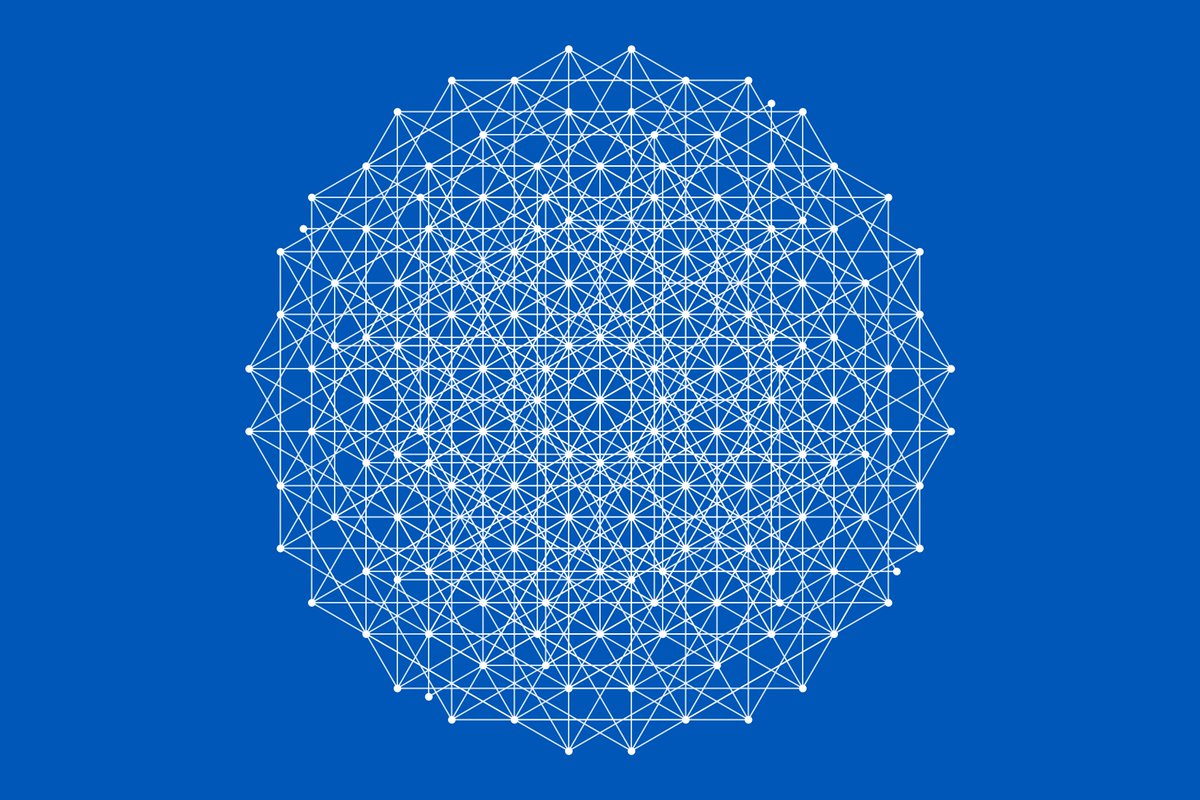
After human mathematicians verified and refined the work, Will Sawin produced an explicit bound around n^1.014. That exponent looks tiny to normal people, but it is the entire point. It means the improvement does not fade away as n gets huge. It grows forever. The viral image is a tiny visible slice of that idea. Points of the form a + bi + cρ + diρ are plotted in the complex plane, where a, b, c, and d are small integers, i is the imaginary unit, and ρ is a carefully chosen algebraic number. In plain English, it is like building a hidden four-dimensional number grid and folding it into 2D so that way more pairs land exactly one unit apart than a regular square grid can achieve.
The gravitas here is not just that AI helped solve a hard math problem. It is that a general-purpose model surfaced a genuinely new mathematical structure inside an 80-year-old Erdős problem that experts had studied for generations. Humans still had to verify, simplify, and sharpen it, which is essential. But the discovery changes the emotional temperature around AI and mathematics. It suggests these systems are beginning to explore abstract idea-space, not just repeat it.