Frank Lin
1.8K posts

Frank Lin
@developerlin
Create Limitless Value with AI | Exploring AI’s Future


I'm excited about voice as a UI layer for existing visual applications — where speech and screen update together. This goes well beyond voice-only use cases like call center automation. The barrier has been a hard technical tradeoff: low-latency voice models lack reliability, while agentic pipelines (speech-to-text → LLM → text-to-speech) are intelligent but too slow for conversation. Ashwyn Sharma and team at Vocal Bridge (an AI Fund portfolio company) address this with a dual-agent architecture: a foreground agent for real-time conversation, a background agent for reasoning, guardrails, and tool calls. I used Vocal Bridge to add voice to a math-quiz app I'd built for my daughter; this took less than an hour with Claude Code. She speaks her answers, the app responds verbally and updates the questions and animations on screen. Only a tiny fraction of developers have ever built a voice app. If you'd like to try building one, check out Vocal Bridge for free: vocalbridgeai.com


Wow, this tweet went very viral! I wanted share a possibly slightly improved version of the tweet in an "idea file". The idea of the idea file is that in this era of LLM agents, there is less of a point/need of sharing the specific code/app, you just share the idea, then the other person's agent customizes & builds it for your specific needs. So here's the idea in a gist format: gist.github.com/karpathy/442a6… You can give this to your agent and it can build you your own LLM wiki and guide you on how to use it etc. It's intentionally kept a little bit abstract/vague because there are so many directions to take this in. And ofc, people can adjust the idea or contribute their own in the Discussion which is cool.

Excited to share our work InfiniDepth (CVPR 2026) — casting monocular depth estimation as a neural implicit field, which enables: 🔍 Arbitrary-Resolution 📐 Accurate Metric Depth 📷 Large-View Novel View Synthesis Feel free to try our code: github.com/zju3dv/InfiniD…

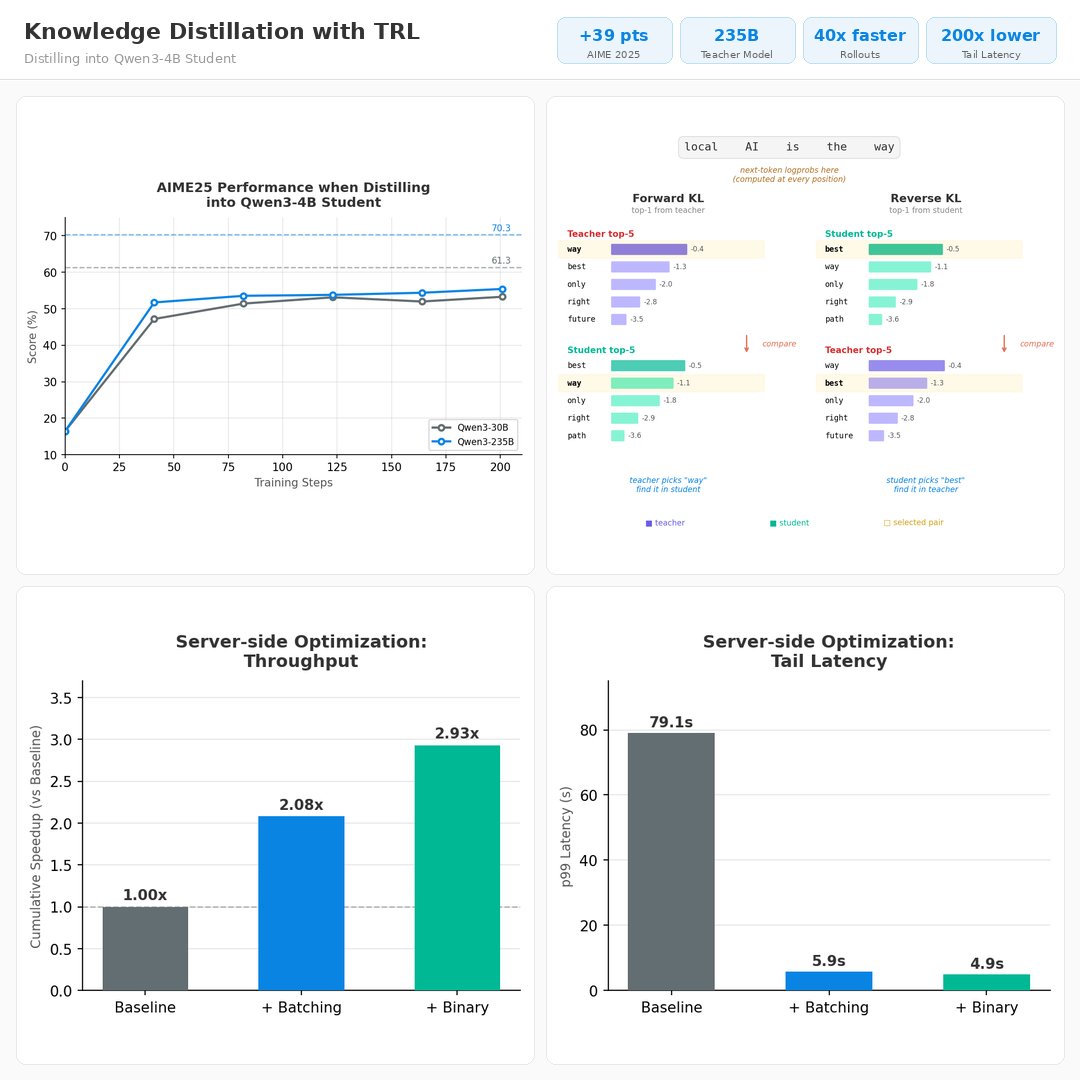
Apple Research just published something really interesting about post-training of coding models. You don't need a better teacher. You don't need a verifier. You don't need RL. A model can just… train on its own outputs. And get dramatically better. Simple Self-Distillation (SSD): sample solutions from your model, don't filter them for correctness at all, fine-tune on the raw outputs. That's it. Qwen3-30B-Instruct: 42.4% → 55.3% pass@1 on LiveCodeBench. +30% relative. On hard problems specifically, pass@5 goes from 31.1% → 54.1%. Works across Qwen and Llama, at 4B, 8B, and 30B. One sample per prompt is enough. No execution environment. No reward model. No labels. SSD sidesteps this by reshaping distributions in a context-dependent way — suppressing distractors at locks while keeping diversity alive at forks. The capability was already in the model. Fixed decoding just couldn't access it. The implication: a lot of coding models are underperforming their own weights. Post-training on self-generated data isn't just a cheap trick — it's recovering latent capacity that greedy decoding leaves on the table. paper: arxiv.org/abs/2604.01193 code: github.com/apple/ml-ssd

EUPE: Efficient Universal Perception Encoder👋 Looking for the most powerful small image models today? Guess what: researchers at @AIatMeta cooked again!🍳 This time around, not some large vision encoder. Instead, a set of lightweight and efficient ones, both ViTs and ConvNeXts, all under 100M. The smallest is a ViT-Tiny at just 6M params! But hear me out: this is the COOLEST thing ever...


🚨 CRITICAL: Active supply chain attack on axios -- one of npm's most depended-on packages. The latest axios@1.14.1 now pulls in plain-crypto-js@4.2.1, a package that did not exist before today. This is a live compromise. This is textbook supply chain installer malware. axios has 100M+ weekly downloads. Every npm install pulling the latest version is potentially compromised right now. Socket AI analysis confirms this is malware. plain-crypto-js is an obfuscated dropper/loader that: • Deobfuscates embedded payloads and operational strings at runtime • Dynamically loads fs, os, and execSync to evade static analysis • Executes decoded shell commands • Stages and copies payload files into OS temp and Windows ProgramData directories • Deletes and renames artifacts post-execution to destroy forensic evidence If you use axios, pin your version immediately and audit your lockfiles. Do not upgrade.