Digital Cardiology Association

44 posts

Digital Cardiology Association banner
Digital Cardiology Association

Digital Cardiology Association

@dikadernegi

İstanbul, Türkiye Katılım Haziran 2024
48 Takip Edilen61 Takipçiler
Digital Cardiology Association retweetledi
I.H.Tanboga, MD, PhD
I.H.Tanboga, MD, PhD@ihtanboga·
Yes, it is a difficult mission.🙄 But I will try to show, through simulation, how the ORBITA-CTO results might turn out. 1/
I.H.Tanboga, MD, PhD tweet media
Salman Arain@realarainmd

Mission Impossible - The ORBITA CTO Reckoning! Your mission agent @ihtanboga, should you choose to accept it, is to predict the results of ORBITA-CTO using any Bayesian and non-Bayesian tools at your disposal. You may use any data from the ORBITA trials and prior CTO RCTs. Good luck! ⚠️ This message will self destruct in 7 days - when the results come out! 😂

English
3
7
21
9.1K
Digital Cardiology Association retweetledi
Davide Capodanno
Davide Capodanno@DFCapodanno·
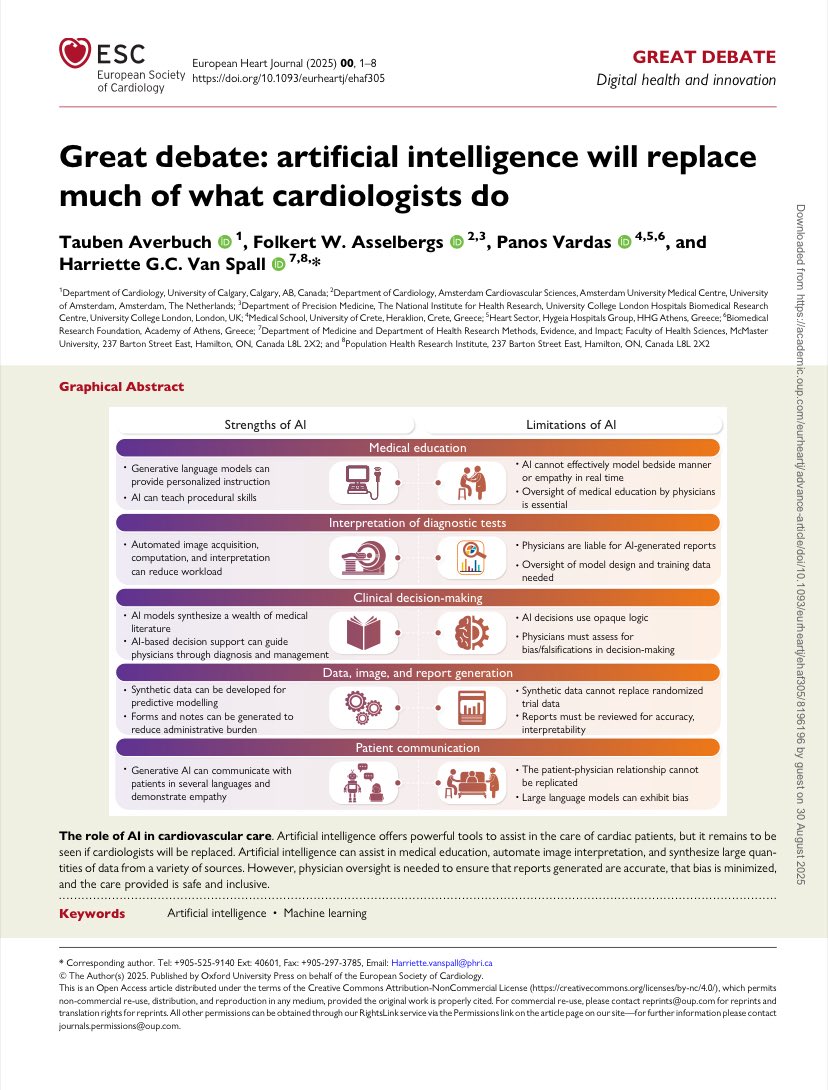
#cardioX is more alive than ever. On the same day that @ihtanboga delivers two incredible articles on COBRRA and SELUTION DeNovo, and a masterclass no one interested in biostatistics and trial interpretation should miss, @ehj_ed publishes a debate I joined with @thiele_holger, @cvrints, and others on the significance of the RF-CL model for estimating pre-test probability of coronary artery disease. This article actually originated from the X discussion shown below, where @ihtanboga had also shared a valuable calculator, and I learned a lot from @cvrints as well. These coincidences close the circle. Long live the sparks between scientific literature and social media that keep the debate alive. academic.oup.com/eurheartj/adva…
Davide Capodanno@DFCapodanno

There is one thing that, even as a reviewer and despite having pointed it out during the process, I really haven't understood about the new ESC guidelines for chronic coronary syndromes. Using the new Risk factor-weighted clinical likelihood (RF-CL) model, one can calculate individual risk based on symptoms, sex, and the number of cardiovascular risk factors, and so far so good. In this way, the calculable pre-test probability scores range from 0 to 45%. However, the recommendations for additional diagnostic tests are also applicable to patients with a risk higher than 45%. Now, how does one calculate a pre-test probability higher than 45% based on the RF-CL? With risk enhancers like PAD, resting ECG, etc.? With the calcium score? In fact, the calcium score can be used to determine the new pre-test probability, but I don’t think this is a good reason to perform it on everyone, also because its value lies mainly in recategorizing patients into the very low-risk group when it is zero. However, it seems you cannot determine the new pre-test probability with risk enhancers, unless it is meant that the presence of one of these factors automatically shifts the patient into at least the moderate-risk category. In short, if anyone has figured out how to arrive at the precise number for values above 45%, they’d be doing me a favor, because I can't understand it from the text.

English
5
19
65
17.5K
Digital Cardiology Association retweetledi
I.H.Tanboga, MD, PhD
I.H.Tanboga, MD, PhD@ihtanboga·
7. and summary
I.H.Tanboga, MD, PhD tweet media
English
1
6
22
4.2K
Digital Cardiology Association retweetledi
I.H.Tanboga, MD, PhD
I.H.Tanboga, MD, PhD@ihtanboga·
1. Excellent questions, @realarainmd . And I suspect many people are thinking the same thing. The key issue in SELUTION is the difference between a strategy trial and a device trial. Let me address your points in order.
Salman Arain@realarainmd

Free fall down the ITT vs. PP rabbit hole! Two questions for the master. I have been reviewing the discussion around SELUTION DeNovo. After reviewing the thorough (and must read!) analysis by @ihtanboga, I have a couple of follow up questions. I am going to state them as two separate questions here, so that we can all benefit from his wisdom - and of anyone else who weighs in! 🙏🏼

English
1
12
26
7.5K
Digital Cardiology Association retweetledi
I.H.Tanboga, MD, PhD
I.H.Tanboga, MD, PhD@ihtanboga·
1. We all ask this every single day: "Can this stent actually reach my target diameter?" This tool answers in seconds. 👇 🔗 tanboga.netlify.app/stent-app/
English
3
8
22
2.1K
Digital Cardiology Association retweetledi
I.H.Tanboga, MD, PhD
I.H.Tanboga, MD, PhD@ihtanboga·
If the SELUTION DeNovo trial yields positive results, could it represent a paradigm shift in interventional cardiology practice? #TCT2025
English
2
2
4
409
Digital Cardiology Association retweetledi
I.H.Tanboga, MD, PhD
I.H.Tanboga, MD, PhD@ihtanboga·
RCT_Eval (1): SLIM trial FFR-guided complete PCI reduced 1-year MACE (5.5% vs 13.6%) 🔹 Very slow recruitment/lack of screening → strong selection bias 🔹 Open-label + “any revascularization” → bias-prone endpoint Apparent benefit may reflect methodological artifact, not true clinical effect. metastata.substack.com/p/a-critical-a…
English
1
7
15
2K
Digital Cardiology Association retweetledi
I.H.Tanboga, MD, PhD
I.H.Tanboga, MD, PhD@ihtanboga·
I have a Q regarding the choice of the primary endpoint in the MAPLE-HCM trial. I do believe these drugs work in HCM. However, in MAPLE-HCM, could the selection of the primary endpoint (peak VO2) have introduced bias? Because it is already known that beta-blockers can reduce VO₂. For example, in some HCM studies, VO₂ remained unchanged with placebo, but decreased with beta-blockers — could this be the reason the endpoint turned out more positive? Meanwhile, VO₂ may have prognostic value, but it is not a good surrogate for hard outcomes (at least HFREF trials suggest so). For symptoms/quality of life, it may be a moderate surrogate. This seems to resemble an objective proxy for a subjective endpoint. @drjohnm @venkmurthy @MasriAhmadMD @kaulcsmc @djc795
English
3
3
12
2.1K