
Sabitlenmiş Tweet
Dirk Moses
9.8K posts

Dirk Moses
@dirkmoses
@CityCollegeNY, edits @journalgenocide. Here privately.
New York, USA Katılım Mart 2009
2.9K Takip Edilen10.8K Takipçiler
Dirk Moses retweetledi

A. Dirk Moses "Education after Gaza after Education after Auschwitz" を再読。これはやはり重要なテキスト。アドルノの精神を引き継ぎつつ、乗り越えながら、ガザ以降の世界について考える。
blnreview.de/en/ausgaben/20…
日本語
Dirk Moses retweetledi
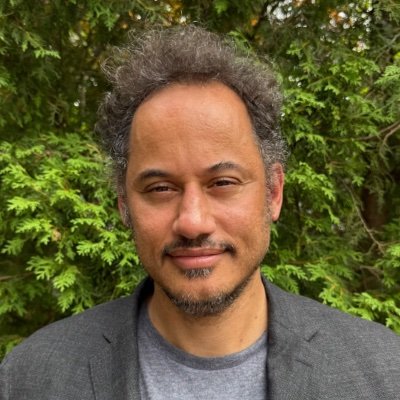
"The ‘Crime of Crimes’? Dirk Moses and the Problems of Genocide": tandfonline.com/doi/full/10.10…
English
Dirk Moses retweetledi

The genocide scholar A. Dirk Moses has argued that genocidaires seek to achieve permanent security for their group by preventively eliminating whatever rival group asserts a competing claim to the economic or political resources the first group claims as its own. Bluth's words epitomize this logic.
English
Dirk Moses retweetledi
A. Dirk Moses makes an interesting observation
Increasingly, the Holocaust narrative seems to be giving way to a new understanding of evil for two reasons: because the Holocaust narrative has been conscripted to justify Israel's destruction of Gaza…and because observers [now] understand colonial occupations, rather than the Holocaust, as the prime historical evil.
journals.sagepub.com/eprint/GRB3NQQ…
English
Dirk Moses retweetledi
Someone should write a book about what happens when a population “only wants security” at any cost no matter what, @dirkmoses! Maybe it could explain a lot of things about genocidal mindsets. Just saying!
/s
Seth Frantzman@sfrantzman
The Israeli public only wants security. This is the sole thing that interests the vast majority, like at 95% They only want a normal life, there is zero interest in “expansion”; but if they believe a buffer zone brings security they are ok with it. Considering the sirens in Kiryat Shmona today it hasn’t brought security completely. Whatever “talk” there is from some politicians and a few fringe folk, the vast majority just want to go back to a normal life and no sirens and security
English
Dirk Moses retweetledi

I describe in the introduction to our Germany's History Wars how Staatsräson took a voelkisch (racist) turn after Oct 7th. 👉Here for a free download:
degruyterbrill.com/de/document/do…
Hanno Hauenstein@hahauenstein
A. lived in Germany since he was 2 months and last year gained German citizenship. Now he’s been stripped of it because of pro-Palestinian Instagram posts, in a disturbing legal case that points to the rise of citizenship-on-probation. My latest @jacobin jacobin.com/2026/05/german…
English
Dirk Moses retweetledi

Dirk Moses retweetledi

Israel's drive to deal with its enemies 'once and for all' targets not only current foes, but also potential and future threats. The result is incalculable civilian destruction.
My latest for @RStatecraft, as I draw on @dirkmoses important work:
responsiblestatecraft.org/israel-permane…
English
Dirk Moses retweetledi

NEW @MartinDiCaro on @dirkmoses "permanent security": "a policy aspiration with sinister implications: to eliminate any potential or future threats, real or imaginary, internal or external." responsiblestatecraft.org/israel-permane…
English
Dirk Moses retweetledi
As @dirkmoses has shown, the majority of states deliberately narrowed the legal definition of genocide to preserve their ability to use genocidal levels of violence against national groups under a security or military logic. For instance, to crush insurrections by targeting entire populations. The UN Convention of 1948 was thus “depoliticized.”
Russell Blackford@Metamagician
I wonder how many people have actually read Lemkin's chapter on genocide. If you read it, you'll find that he wanted to use the word in a way that was much broader than either its popular or its legal meaning. Lemkin fought for his broad meaning after World War II, but by the time of the Genocide Convention a much narrower meaning - a subset of the very worst of what Lemkin had in mind - became the meaning that prevailed. The thing is, you can't have it both ways. What makes genocide so horrifying is that it's a (serious) effort at physically exterminating an entire people, or at least the entirety of them who are in your power. Contrary to what Lemkin had in mind - and even Lemkin admitted there were conceptual problems with this - it doesn't mean cultural assimilation of the people of a nation you've conquered, such as efforts by the Nazis to "Germanify" Poland. We can praise Lemkin for actually coining the word, but no one now uses it the way he originally wanted, and that's a good thing. As a result of the wrangling in the late 1940s, we have a perfectly good word that stands for the crime of crimes: an attempt at physically exterminating the people of an ethnic, racial, religious, or national group, as Hitler attempted (with considerable success) with the Jews of Europe. It doesn't mean being the more powerful participant in an asymmetrical war; it doesn't mean breaching IHL; it doesn't even mean large-scale war crimes. It means something more specific, the very worst of the worst of international crimes, with the Holocaust as the paradigm. The concomitant of all this is that the word, with its suggestion of ultimate evil, should not be thrown around loosely. If we want to say that someone has gone to war in circumstances that will inevitably lead to a lot of civilian deaths, we can say that (and we're entitled to be critical of it if we think there was an alternative). If we think someone has committed war crimes such as aerial bombardment deliberately targeting civilians (as happened on both sides during World War II), we can say that. There are lots of things we can say to make very serious accusations connected with war. But genocide is something beyond any of that, and its connection to the supreme evil of the Holocaust in the popular understanding should not be taken lightly. When someone makes an accusation of genocide that clearly doesn't match either the popular understanding or the legal definition, you know you're dealing with someone who is either a propagandist who is deliberately lying or someone who is simply ignorant of what the term means. I assume that it's usually the latter - there are many well-intentioned people who are not knowledgeable about any of this and can be swayed by others who seem like experts - but there's also plenty of the former around.
English


QME
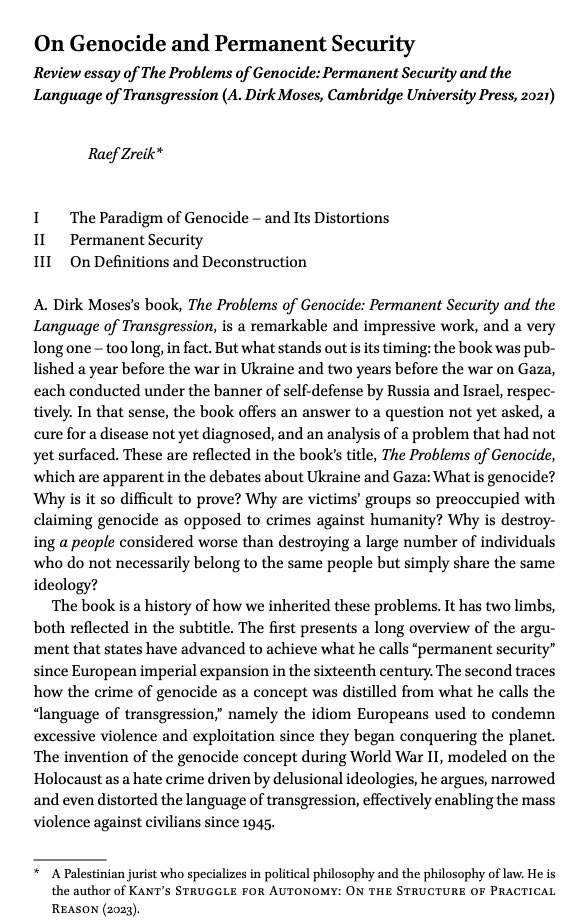
Just out in the Palestine Yearbook of International Law, Raef Zreik’s review article on The Problems of Genocide brill.com/view/journals/…
English
I’ve been invited by @simonforco to address the Armenian community on this special commemoration event today in Denver. It’s a great honour. l will speak about the significance of the Armenian genocide in history and memory today armeniansofcolorado.org/events/aoc-gen…
English
@972mag @MeronRapoport It would be good of you acknowledged where you got the idea of permanent security from. Yigal Levy didn’t introduce it into current discussion and you know it. He says where he gets the idea from in the article you link. cambridge.org/universitypres…
English

The beginning of the end of Israel’s ‘permanent security’ doctrine
Israel’s relentless pursuit of ‘total victory’ has entangled it in an unwinnable war with Iran, eroding legitimacy abroad and deepening moral decay within.
@MeronRapoport, Ameer Fakhoury
972mag.com/israel-iran-pe…
English
Good discussion about about illegality and illegitimacy of permanent security
Janina Dill@JaninaDill
It is always fun to be on @JIBJABPodcast - this time with the inestimable Monica Hakimi, discussing what follows from the attacks on Iran for international law and what responsibilities legal scholars might have. Thanks @craigxmartin
English
@JaninaDill @JIBJABPodcast @craigxmartin Good discussion about about illegality and illegitimacy of permanent security
English

It is always fun to be on @JIBJABPodcast - this time with the inestimable Monica Hakimi, discussing what follows from the attacks on Iran for international law and what responsibilities legal scholars might have.
Thanks @craigxmartin
JIB-JAB - The Laws of War Podcast@JIBJABPodcast
New episode of JIB/JAB - a fascinating and important discussion with @JaninaDill and Monica Hakimi on how the attacks on Iran impacted the crisis in int'l law, what follows, and how legal scholars and states should respond. Wherever you get your podcasts, or link below:
English
English

In other exciting news, I can't wait to join faculty dedicated to studying Genocide & the Holocaust when I start my new position of Cohen Endowed Chair of Holocaust and Genocide Studies this August at @KeeneState_! @GSPJournal
English
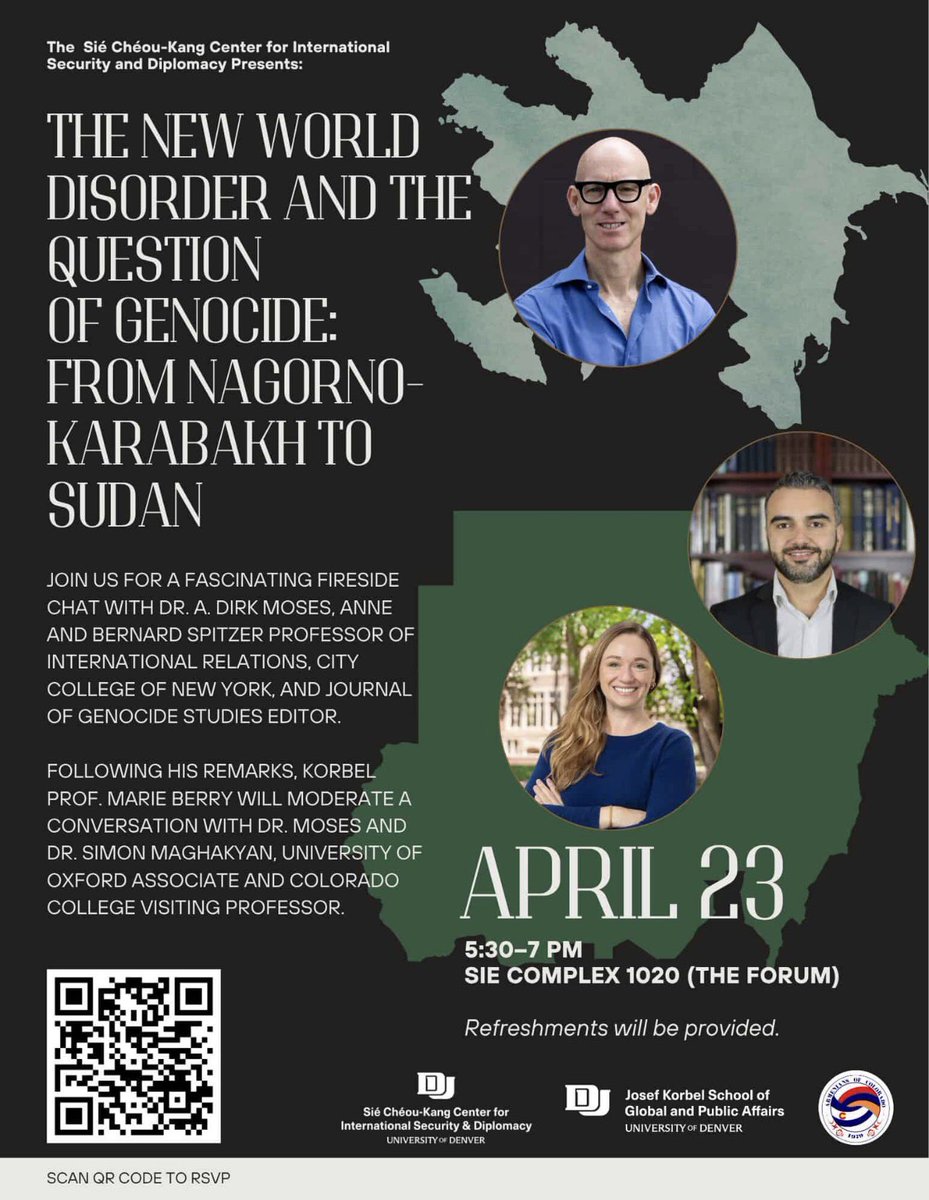
Tonight with @marieeberry and @simonforco at @josefkorbel we discuss global conflict korbel.du.edu/event/the-new-…
English
@DavidGAPerry @aarongell @bartov_omer @guardian Can you correct Journal of Genocide Studies (no such journal) to Journal of Genocide Research = @JournalGenocide ?
Thank you @BoulosSonia
English

What Went Wrong
@aarongell with @bartov_omer @guardian
"It wasn’t a pleasant trip..(his last to Israel). It was hard even just to sit in a cafe..People were sitting around, having fun,living a normal life, while there was genocide happening down the road"
theguardian.com/world/2026/apr…
English