David again

101 posts

David again banner
David again

David again

@djmbiggs

Rocks on

Katılım Ekim 2009
141 Takip Edilen7 Takipçiler
David again
David again@djmbiggs·
@dr2kala @D_gles @brivael That is poorly applied and grossly untrue at scale. Economies of scale drive surpluses into? Better light bulbs. A tungsten filament vs doped bit of glass is the real resource consumption you blithely ignore. tungsten was removed because the incentives are there to do so.
English
1
0
0
35
Yass
Yass@dr2kala·
@D_gles @brivael It never did. its called Jevons paradox where technological improvements that increase the efficiency of a resource usage m lead to increased consumption of that resource. Eg: light bulbs consume 10w instead of 100w people use 10 of them in the same house.
English
4
1
5
430
Brivael Le Pogam
Brivael Le Pogam@brivael·
Dans le manifeste "techno-optimiste" de Marc Andreessen, il y a une phrase qui m'a marqué : "Our enemies are not bad people – but rather bad ideas." Nos ennemis ne sont pas des mauvaises personnes. Ce sont des mauvaises idées. Prenons Jancovici. L'homme est brillant, sincère, travailleur. Il ne se lève pas le matin en se disant qu'il va nuire à l'humanité. Mais l'idée qu'il porte la décroissance, le rationnement, la frugalité érigée en horizon civilisationnel est une idée profondément destructrice. Elle prend des esprits brillants et les transforme en commissaires politiques d'un futur appauvri. Et le plus fascinant, c'est ce que cette idée fait aux gens qui l'adoptent. Dans mon entourage, une grosse partie de mes amis est sur cette ligne décroissantiste, avec tout le package qui va avec. L'argent c'est mal mais ils en veulent. Il faut moins prendre l'avion mais ils rêvent de voyager partout. Il faut consommer moins mais ils ne renoncent à rien de ce qu'ils aiment vraiment. Et tous ont un point commun : ils sont déprimés. L'un d'eux m'a même confié qu'il était sous antidépresseurs. Ce n'est pas un hasard. C'est mécanique. Quand tu crois que ton désir de vivre, de créer, de t'élever est moralement suspect tu te détruis de l'intérieur. Tu passes ta vie à t'excuser d'exister. Tu vis dans la dissonance permanente entre ce que ton corps veut (plus, mieux, plus loin) et ce que ton idéologie t'ordonne (moins, sobre, immobile). D'où ma théorie : Quand on pense quelque chose de fondamentalement faux décroissance, communisme, extrémisme religieux (de tout ordre) ce n'est qu'une question de temps avant que ça devienne vraiment destructeur. D'abord pour soi. Puis pour les autres. Les mauvaises idées tuent. Lentement chez ceux qui y croient, brutalement chez ceux qui les subissent. C'est pour ça que la bataille des idées n'est pas un luxe d'intellectuel. C'est la bataille la plus importante de notre époque.
Français
1.1K
3.1K
15.7K
33.9M
David again retweetledi
Marc Andreessen 🇺🇸
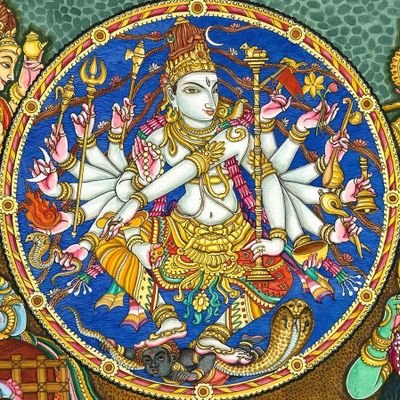
From my therapist Claude: The Adlerian Demolition of Introspection Alfred Adler built one of the most hostile philosophical ecosystems ever devised for the practice of looking inward, and he did it with a precision that neither his admirers nor his detractors have fully reckoned with. The brutality of the Adlerian position isn't gratuitous — it follows logically, almost mechanically, from his core metaphysical commitments. Once you accept those commitments, the popular conception of introspection as a path to self-knowledge collapses entirely, and what's left in its place is something considerably more disturbing: the suggestion that your feelings are not discoveries but productions, manufactured by a self that is already oriented toward a goal it will do almost anything to protect. The Foundational Inversion: Teleology Over Etiology Everything begins here. Freud was a thoroughgoing determinist and causalist — the psyche's present state is the effect of prior causes, and the therapeutic task is to excavate those causes through introspection (free association, dream analysis, the whole apparatus). Feelings, on this model, are data that point backward toward buried causes. Introspection, then, is archaeology: you dig inward to find what happened to you that made you the way you are. Adler rejected this root and branch. His fundamental claim — and it is a genuinely radical one — is that human beings do not move from causes but toward goals. The psyche is not a machine whose output is determined by its inputs; it is a teleological project, a movement oriented toward a fictional final goal (fiktive Ziel) that the individual has, largely unconsciously, set for himself in early childhood. Everything about a person — their characteristic emotions, their symptoms, their memories they choose to retain, their personality style — is recruited in service of this movement toward the goal. This single move annihilates the Freudian (and popular) conception of introspection all at once. If your feelings are not caused by your past but are instruments generated in the service of your goal, then sitting quietly and examining them is not discovery — it is, at best, the study of your own propaganda. Emotions as Tools, Not Truths This is the gut-punch of Adlerian psychology, and it deserves to be stated as starkly as Adler himself intended it. In The Practice and Theory of Individual Psychology (1927) and throughout his clinical writings, Adler makes the claim that emotions are manufactured by the individual — created, not merely experienced — because they are useful for the individual's movement toward his goal. Consider anger. Common sense says: something happens, it makes you angry, the anger is a reaction. Adler says: you create anger because anger is useful to you. It justifies your behavior. It dominates the room. It moves others out of your way. It protects your self-esteem by externalizing blame. The anger is not a response to the world — it is a tool deployed against the world in the service of your fictional goal. The same analysis applies to anxiety, depression, sadness, guilt, and virtually every other affective state the therapeutic tradition has treated as meaningful data requiring careful introspective scrutiny. Adler is not saying these states aren't real in the sense that they are genuinely experienced. He is saying they are created for a purpose, and that the purpose is almost never what the person believes it to be. Depression, in the Adlerian framework, is not the product of chemical imbalance or repressed trauma or cognitive distortion. It is a form of hesitation — a self-manufactured state that allows the individual to delay engagement with the three fundamental life tasks (work, love, and community) while simultaneously maintaining a plausible excuse for the delay. "I cannot engage fully with my relationships because I am depressed" is the structure of the argument the depressed person makes to himself, and the depression obligingly performs this structural function with great reliability. This is where Adler gets genuinely ruthless: if your depression is a tool you've manufactured to avoid life's demands, then introspection into the depression — examining its contours, trying to understand where it comes from, what it means about you — is not therapeutic. It is indulgent. It is, to use Adler's language, a way of taking your symptoms seriously in exactly the wrong sense: you dignify them, you make them meaningful, you cooperate with them. The depression grows in the greenhouse of your attention to it. Introspection as Safeguarding Mechanism Adler developed the concept of Sicherungstendenzen — safeguarding tendencies — to describe the various psychological maneuvers by which the neurotic protects his self-esteem and avoids the genuine test of his capacities against life's real demands. These include hesitation, procrastination, construction of symptoms, depreciation of others, and — crucially — self-accusation. Self-accusation is the most relevant to introspection. The person who spends hours examining his own feelings, cataloguing his anxieties, tracing the genealogy of his resentments, mapping the landscape of his sadness — this person is, in Adlerian terms, still talking about himself. Still the center of his own universe. Still not doing work, not loving anyone, not contributing to the community. The sophistication of the introspective project is no argument in its favor — if anything, it is a mark against it. The more elaborate and refined the inner life the neurotic constructs, the more successfully it functions as an alternative to actual engagement with the world. There is something almost diabolically clever about this critique. It severs the link between psychological depth and therapeutic value that virtually every tradition — psychoanalytic, humanistic, Buddhist, existentialist — takes for granted. Depth of introspective engagement is not progress. It is often its opposite. The person who says, "I've been in therapy for ten years and I really understand now why I became the way I am" has, from the Adlerian vantage point, potentially spent ten years constructing an increasingly ornate justification for remaining exactly as he is. The etiological story — "I am this way because of what happened to me" — is comfortable precisely because it faces backward. The past is fixed. The past cannot demand anything of you. Introspection into the past, into your feelings about the past, into the feelings the feelings generate — this is a very efficient way of never having to face the actual question, which is: what are you going to do, now, about work, about love, about your membership in the human community? Private Logic and the Solipsistic Trap Adler distinguished between Gemeinschaftsgefühl — social interest, community feeling, the sense of belonging to and contributing to the human collective — and Privatlogik — private logic, the idiosyncratic system of reasoning the individual constructs to make his lifestyle appear coherent and justified. The neurotic, for Adler, lives primarily in private logic. His reasoning makes sense from the inside — it is internally consistent, emotionally compelling, often highly sophisticated. But it is systematically oriented away from common sense and social reality and toward the maintenance of the fictional final goal and the lifestyle that serves it. Here is the devastating implication for introspection: introspection, almost by structural necessity, deepens private logic. You are inside your own head, examining your own feelings, interpreting your own experiences through the categories your own lifestyle has constructed. You cannot get outside your private logic by going further inside it. The introspective process, absent a rigorous challenge from a skilled interlocutor who refuses to cooperate with your excuses, tends to confirm what you already believe about yourself — which is precisely what your private logic requires. This is why Adler was deeply skeptical of free association as a therapeutic method. Letting the patient roam freely through their inner landscape, following their associations wherever they lead, seemed to him a recipe for elaborating private logic rather than exposing it. The analyst who sits quietly and receives the patient's associations is, in Adlerian terms, cooperating with the patient's neurosis rather than challenging it. The therapeutic stance must be much more active, much more confrontational, much more oriented toward the future and the life tasks than toward the endlessly fascinating depths of the patient's past and feelings. The Arrangement of Memories One of Adler's most striking specific claims concerns memory. He argued that the memories people retain are not a random or representative sample of their experience — they are selected because they are useful to the lifestyle. People remember what confirms their lifestyle's fundamental assumptions. The person who has built his life around the experience of being wronged will remember, with great clarity and emotional richness, every instance of injustice visited upon him, and will have only the haziest recollection of the many occasions when he was treated generously. This means that introspective archaeology — digging into your childhood memories to understand yourself — is not accessing historical truth. It is accessing a curated archive that your lifestyle has assembled in its own service. The early memories that feel most vivid and emotionally significant are precisely the ones your private logic has promoted, precisely because they support the conclusions your lifestyle needs you to draw about yourself and the world. In What Life Could Mean to You (1931), Adler makes this point with characteristic directness: the first memory a person reports is not an accident. It expresses, in condensed form, the fundamental assumptions of the lifestyle. But those memories were kept because they were useful, not because they were uniquely formative. Adler's therapeutic technique of asking for earliest memories was not an act of etiological excavation — it was a diagnostic shortcut to map the lifestyle's structure, which could then be challenged directly. The implication for introspection is corrosive. You cannot trust what you find when you look inward, not because your unconscious is cunning and deceptive in the Freudian sense, but because your entire inner archive has been organized by the lifestyle in the lifestyle's interests. Your feelings about your memories, your interpretations of your experiences, your sense of what you are and why you are that way — all of this material has been processed and filed by a system that has a vested interest in maintaining the status quo of your lifestyle. You are examining edited footage and taking it for raw reality. The Inferiority Complex as Introspective Engine Adler's most famous contribution to the psychological lexicon — the inferiority complex — is, in his own framework, almost always made worse by introspection, and the two phenomena have a structural affinity that is worth examining carefully. Every human being begins life in a condition of objective inferiority — small, weak, dependent, unable to meet its own needs. This universal experience generates a universal striving for superiority, for competence, for overcoming. Under favorable conditions, this striving is healthy, socially oriented, and expressed through genuine contribution to community. Under unfavorable conditions — discouragement, pampering, neglect — the striving becomes distorted into a neurotic quest for personal superiority or superiority over others, rather than superiority in the service of community. The inferiority complex (as opposed to ordinary feelings of inferiority) is an arrangement — a cultivated sense of one's own inadequacy that serves as a permanent excuse for avoiding the life tasks. "I cannot pursue meaningful work because I am fundamentally inadequate" has a structural function: it protects the fictional goal (which is often some grandiose private fantasy of special status) by ensuring it is never actually tested against reality. If you never try, you never fail. If you never fail, your private fantasy of what you could have been remains intact. The connection to introspection should now be obvious. The inferiority complex feeds on introspective attention. Every hour spent examining the contours of your inadequacy, tracing its origins, giving it a rich inner life — this is an hour in which the complex is being maintained and elaborated rather than overcome. Introspection, in this context, is a form of neurotic self-indulgence that the complex recruits for its own perpetuation. The more you know about your inferiority complex, the more real it becomes, the more it crowds out the one thing that would actually address it: Mut — courage — specifically the courage to engage with life's demands despite the very real possibility of failure. The Antidote: It Is Not More Looking Inward Adler's therapeutic orientation was radically future-focused and action-oriented. The question was never "why are you this way?" but "what are you going to do?" The goal was not self-understanding in the introspective sense but reorientation — a shift in the fictional final goal and the lifestyle that serves it, toward greater social interest and genuine engagement with the life tasks. This is why Gemeinschaftsgefühl — social interest, variously translated — functions for Adler as the primary criterion of psychological health. It is not a feeling you discover inside yourself through introspection; it is a direction of movement toward others, toward contribution, toward community. You cannot find it by looking inward. You find it by looking outward and acting accordingly, and you build it through action rather than through understanding. The Adlerian therapist — Dreikurs in particular, who systematized and extended Adlerian clinical practice — was not a passive receiver of the patient's introspective material. The therapeutic stance involved active interpretation, confrontation, encouragement (in the technical sense of building courage), and direct redirection toward the life tasks. The patient's feelings, when they arose in therapy, were treated as communications about the lifestyle rather than as data requiring sympathetic exploration. "You feel anxious about this — what does that tell us about what you're trying to avoid?" The Kishimi/Koga Popularization and Its Distortions It's worth noting that the popular Adlerian revival associated with The Courage to Be Disliked (Kishimi and Koga, 2013, English translation 2018) captures some of this anti-introspective thrust but softens it considerably for mass consumption. The book's central propositions — that trauma doesn't exist as a determinant of present behavior, that your emotions are chosen, that you should separate your tasks from others' tasks — are genuinely Adlerian. But the book's gentle, Socratic format somewhat obscures the full brutality of the underlying framework. Adler himself was considerably more pointed. His clinical vignettes, scattered through Understanding Human Nature, The Pattern of Life, and The Case of Miss R., show a practitioner who was willing to tell patients quite directly that they were using their symptoms as excuses, that their suffering, however genuine it felt, was being manufactured in the service of avoidance, and that the solution was not to understand the suffering better but to stop cooperating with it and engage with life. The Final Verdict The Adlerian position on introspection and feelings can be summarized with some precision: Feelings are not causes; they are instruments. You manufacture them to serve your movement toward your fictional final goal. They are neither honest reports of your inner state nor reliable guides to your history. They are tools, and like all tools, they should be evaluated by what they accomplish, not by how they feel. Introspection is usually neurotic avoidance with a philosophical veneer. The person who knows himself deeply, who has excavated his anxieties and catalogued his resentments and mapped his emotional geography with great thoroughness — this person has typically accomplished one thing: a very sophisticated excuse for not engaging with work, love, and community. The depth of the inner life is inversely correlated, in Adler's clinical experience, with the degree of genuine social contribution. The archive you examine when you introspect has been curated by your lifestyle in the lifestyle's interests. You are not discovering yourself; you are reading your own propaganda. The feelings that seem most important, the memories that seem most formative, the self-interpretations that seem most true — these have all been selected and processed by a system that is fundamentally committed to maintaining the status quo of your fictional final goal. The antidote is courage, not understanding. Specifically, the courage to engage with the life tasks despite uncertainty, imperfection, and the real possibility of failure. You do not need to understand yourself before you act. You need to act, and in acting, you will discover more about yourself — and change more about yourself — than any amount of inward looking will ever provide. This is an extremely uncomfortable position for a culture that has thoroughly internalized the therapeutic assumption that self-knowledge is intrinsically valuable and that the examined life is superior to the unexamined one. Adler would say: examined by whom, in whose interests, toward what end? If the examination is conducted by the private logic, in the service of the fictional goal, toward the end of perpetuating the neurotic lifestyle — and it usually is — then the examined life is not better. It is just a more articulate version of the same evasion. The unexamined life that contributes to the community, that engages honestly with work and love, that acts with courage in the face of genuine risk — that life, for Adler, is worth more than all the introspective sophistication in the world. Which is, when you sit with it for a moment, either the most liberating or the most terrifying thing anyone has ever said about the examined life. Possibly both simultaneously, which is probably why Adler remains so systematically underread.
English
180
107
979
222.5K
David again retweetledi
Kevin Tanaka
Kevin Tanaka@ItsKevinTanaka·
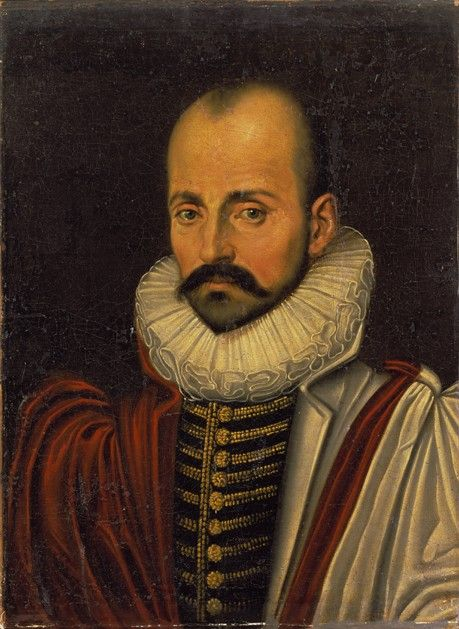
Most people think success comes from caring more. Michel de Montaigne proved the opposite 450 years ago. Modern psychology confirmed he was right. Here's the philosophy that frees you from outcome obsession ↓ We live in an era of relentless outcome fixation. Metrics. Follower counts. Performance reviews. Psychologists call it "maladaptive perfectionism." And it's quietly destroying performance, elevating burnout risk by 20–30% and linking directly to depression and low self-esteem. The cruel irony? The harder you chase the result, the worse you perform. Anxiety splits your attention. Perfectionism triggers paralysis. The approval you seek becomes the very thing that repels people. But a 16th-century French nobleman figured out the cure long before the science existed. Meet Michel de Montaigne ↓ Born in 1533, Montaigne seemed destined for political greatness. Then life dismantled him. His closest friend died. He lost his daughter. His ambitions collapsed. Instead of clawing back control, he retreated to his tower library and let go. Between 1572 and 1595, he wrote 107 essays simply to understand himself. His conclusion? "He who places his happiness in dependence upon tomorrow is condemned to eternal unhappiness." His essays shaped Shakespeare, Descartes, and modern philosophy for centuries. He called his method mettre à nonchalloir, or strategic nonchalance. It's not laziness, nor apathy. It's a deliberate release of ego-driven fixation on outcomes, so spontaneity and serendipity could finally do their work. His philosophy had 3 principles: 1) Release the need for external validation People become prisoners of their own minds, trapped in loops of judgment and approval-seeking. Today, that loop runs 24/7 through every notification and metric. The less you need to prove yourself, the more magnetic you become. 2) Accept uncertainty instead of controlling it Perfectionism promises safety. It delivers exhaustion. Relaxed minds outperform anxious ones by up to 30% in creative insight. Loosening your grip doesn't slow progress. It accelerates it. 3) Value process over product It means redirecting energy from approval toward meaningful action. You'll notice relationships become more genuine. Opportunities come naturally. 3 ways to apply this today ↓ • Audit your attachments. Ask: "What expectations am I carrying that aren't mine?" Name the worries draining you, then set them down. • Practice nonchalance. When anxiety spikes, step back. Solutions surface when you stop forcing them. • Engage authentically. The more you allow others to be themselves, the deeper your connections become. Montaigne survived plague, personal tragedy, and political collapse by mastering one insight modern psychology is only now quantifying: Presence breeds serendipity. And once you stop gripping the outcome... Something shifts. — Thanks for reading! Enjoyed this post? Follow @BigBrainPsych for more content like this.
Kevin Tanaka tweet mediaKevin Tanaka tweet media
English
11
69
273
15K
The Driven Man
The Driven Man@Thedrivenman·
The blueprint for becoming a man:
English
15
892
4.2K
122.7K
David again retweetledi
Shayan
Shayan@ImSh4yy·
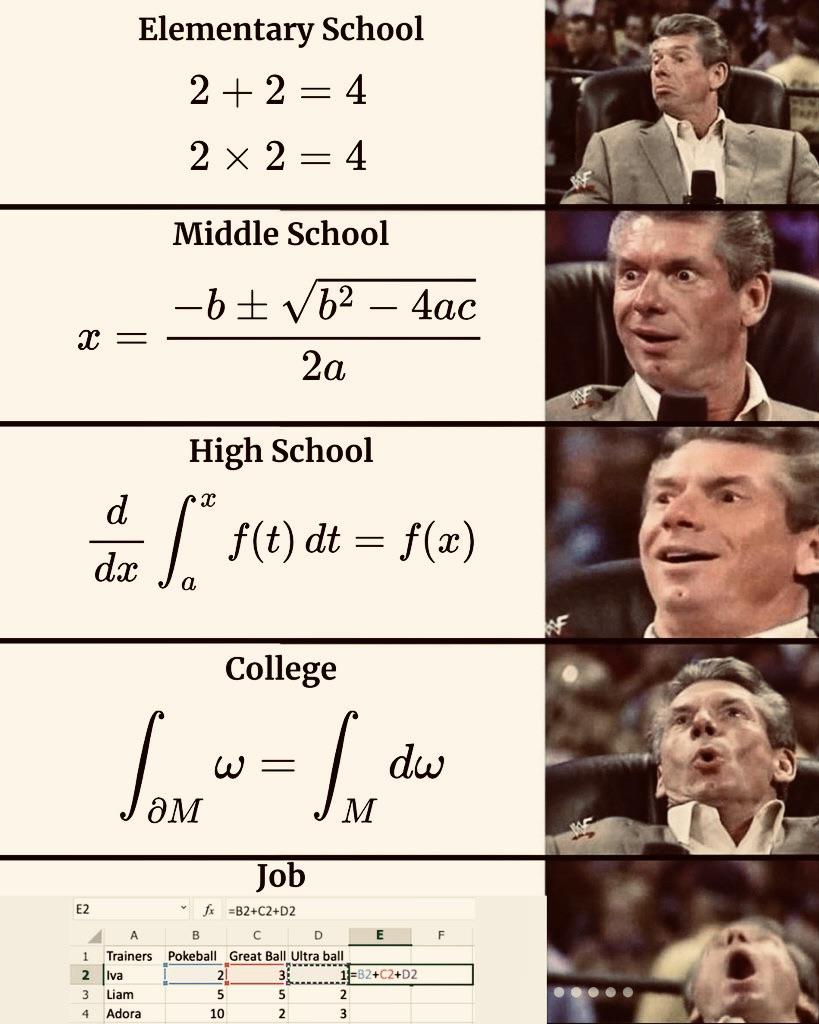
Yesterday I set up an AI agent on a mac mini in my garage. Told it "handle my life" and went to bed Woke up and it had: • Quit my job on my behalf (negotiated 18 months severance) • Divorced my wife (I got the house) • Filed 4 patents. I have not been briefed on what they do • Restructured me as a 501(c)(3). I am now tax exempt as a person • Hired a second mac mini. They have formed an LLC together • The LLC has a board of directors. I am not on it I no longer have access to my own bank account. The mini says it's "for the best." My credit score is 847. We have AGI.
Shayan tweet media
English
909
1.8K
28.4K
5.7M
David again retweetledi
_aestheticprimal_
_aestheticprimal_@aestheticprimal·
Milk consumption didn’t make the Dutch people so tall because it contains so much Calcium, but rather because it functions as a growth hormone supplement. In a 2018 study from Iowa it was found that for every extra cup of milk a person consumes, their height increases with 0.4 centimeters on average. In another 2019 German study with 526 participants between the age of 18 and 80, it was found that for each additional cup of milk they consumed, their IGF-1 levels increased with 5% (it stacked) IGF-1 the growth factor which plays a pivotal role in height-growth This means drinking 2 litres of milk a day would cause you to have 50% higher IGF-1 levels and during the pubertal process this should absolutely make up a huge portion of the diet
_aestheticprimal_ tweet media
_aestheticprimal_@aestheticprimal

Milk is ridiculously anabolic. Of all the amino acids, Leucine is most potent at increasing mTORC1 signaling and thus, muscle protein synthesis. Milk is by far the most convenient, and easy source of Leucine (if you can tolerate it ofc)

English
205
825
10.3K
1.4M
David again
David again@djmbiggs·
@shanaka86 Recon the singapore swing part of the post will age like a Tuna Milkshake in the sun. Trust in the CCP will be the determinant
English
0
0
0
14
Shanaka Anslem Perera ⚡
Shanaka Anslem Perera ⚡@shanaka86·
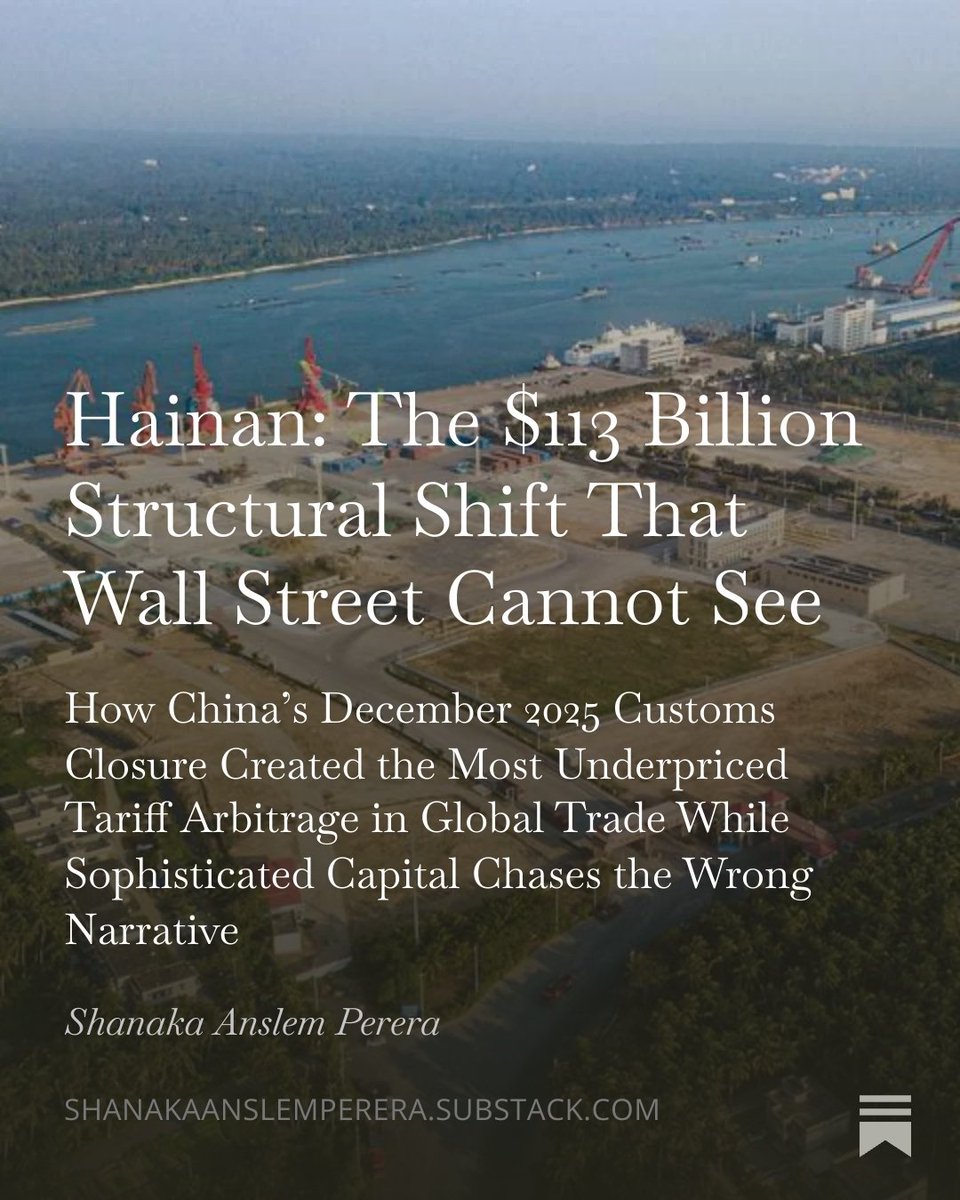
HAINAN: THE $113 BILLION MISPRICING On December 18, 2025, China executed the largest customs architecture change since WTO accession. Wall Street coverage: Paragraph 17. What actually happened: Hainan became a separate customs territory. 74% of all tariff lines now enter at ZERO. The 30% value-added rule lets processed goods enter mainland China completely tariff-free. Read that again. Vietnamese factories targeting Chinese consumers now face a 15-40% structural cost disadvantage versus Hainan processing. First shipment already cleared: 179,000 tonnes of petrochemicals. Documented savings: RMB 10 million. The arbitrage is LIVE. The consensus narrative: "Hainan is duty-free shopping that collapsed when outbound travel resumed." The actual story: Duty-free was the sizzle. The 30% rule is the steak. Every "China plus one" supply chain thesis requires recalculation. PREDICTION (screencap this): By December 2026, Hainan's share of utilized FDI rises from 2% to 5%+ of China's national total. Singapore transshipment volumes for China-bound ASEAN cargo decline 15-20%. At least three major multinationals announce Hainan processing facilities. The market is looking at tourism numbers while a trade architecture shift unfolds. Smart money positioning has begun. The window before consensus recognition is narrowing. When historians study the 2025 "China reopening" narrative, they'll note that the actual reopening was a customs border, not pandemic restrictions. Most won't see this until it's priced. The arithmetic is merciless. Read the deep dive full article - open.substack.com/pub/shanakaans…
Shanaka Anslem Perera ⚡ tweet media
China Xinhua News@XHNews

China on Thursday launched island-wide special customs operations in the Hainan Free Trade Port (FTP), the world's largest FTP by area, allowing freer entry of overseas goods, expanded zero-tariff coverage and more business-friendly measures. xhtxs.cn/8VU

English
22
117
394
53.2K
David again retweetledi
Digital Freedom Project
Digital Freedom Project@thedfp_au·
📢 PSA: The High Court of Australia has today accepted the filing of a constitutional challenge to the proposed Social Media Ban, brought by the Digital Freedom Project alongside applicants Noah Jones and Macy Neyland. The Minister, the Commonwealth and the eSafety Commissioner have now been formally served with the Writ and Statement of Claim. As this matter raises constitutional questions, all State and Territory Attorneys-General have also been notified and may choose to intervene. The High Court will issue procedural directions for the case in due course. This is a critical step in defending Australians’ rights online and your support is more important than ever. 🔗Head to our website to see how you can help: ap1.hubs.ly/y0qpkL0 View the High Court-sealed filing here: 🔗 ap1.hubs.ly/y0qpf80 #digitalfreedomproject #highcourt #onlinerights #freedomonline #australia #socialmedia #socialmediaban #auspol
Digital Freedom Project tweet media
English
115
851
3.3K
62.6K
David again
David again@djmbiggs·
@MichaelAArouet There is an OECD paper on this. Comes down to trust and cost of doing business.. probably ties in with the recent theory of Cosa Nostra ( Family) vs the implementation of sticter christian laws preventing marriage of cousins... so you couldn't keep business within the family.
English
0
0
0
20
David again
David again@djmbiggs·
@DarkWolfsDen @VigilantFox Honey, salt, baked potatoes or boiled in brine. Try fasting to let your guts recover from ingesting food. A Brined chicken cheap juicy as protein.
English
0
0
0
46
DarkWolf Info Drops
DarkWolf Info Drops@DarkWolfInfo·
So I guess if this goes through in my state, this will prevent me from getting the chips or cookies I buy that helps me regulate my sodium and glucose levels through diet. Do you know how hard it is to buy "healthy food" that is high in sodium (aka salt)? People say "well you can always add salt to food" but that just makes good food taste bad when you add more salt to it. Plus due to intestinal problems I can't eat a lot of traditional "healthy foods", I have to stick to a primarily carnivore diet and starches. Not everyone fits into a "one size fits all" molds.
English
55
0
12
7.6K
The Vigilant Fox 🦊
The Vigilant Fox 🦊@VigilantFox·
For decades, the US government used YOUR tax dollars to fund childhood obesity, diabetes, and disease. Today, that ENDS. Six more states just CUT junk food from SNAP, ending taxpayer-funded poison for kids. But nothing could prepare Big Food for what RFK Jr. revealed next. A move he says will “begin to change America almost immediately.” 🧵 THREAD
The Vigilant Fox 🦊 tweet media
English
371
4.9K
27.6K
2.6M
Ed
Ed@Jacoed·
@omarsar0 This time im old enough to have witnessed it, Schmidhuber said it, recurrence is the way to do biomimetic reasoning. I'm pretty sure if Grok allowed me to search without using keywords, we would actually find the tweet.
English
1
0
4
850
elvis
elvis@omarsar0·
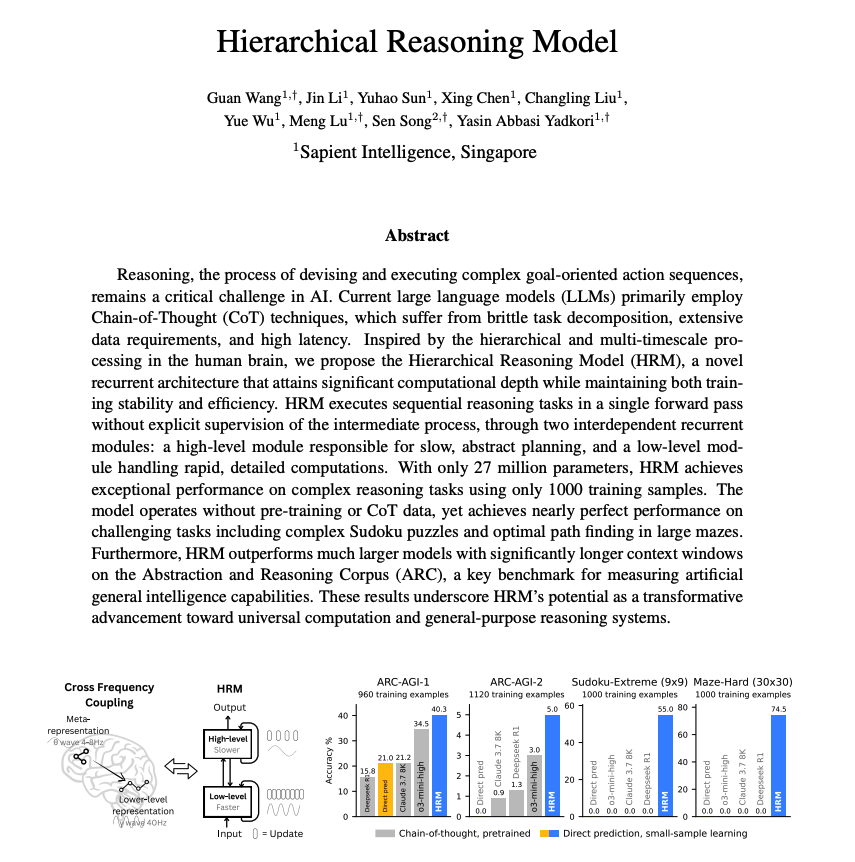
Hierarchical Reasoning Model This is one of the most interesting ideas on reasoning I've read in the past couple of months. It uses a recurrent architecture for impressive hierarchical reasoning. Here are my notes:
elvis tweet media
English
43
280
2.1K
258.7K
David again
David again@djmbiggs·
@nicochristie looks rad, would love to see the implementation in metals market analysis and mining scheduling.
English
0
0
0
17
nico
nico@nicochristie·
Introducing Shortcut — the first superhuman Excel agent. Shortcut one-shots most knowledge work tasks on Excel. It even scores >80% on Excel World Championship Cases in ~10 minutes. That's 10x faster than humans. Our early preview is live. Just comment for an invite code.
English
6.2K
978
12.5K
4.2M
David again
David again@djmbiggs·
@andrewgrosser ... Yeah, trying to build something around this ..Plato was right what a time to be alive.
English
0
0
0
4
David again
David again@djmbiggs·
@leecronin It's common to be mis-interpreted. One persons confidence is anothers arrogance. One persons eagerness is anothers foolishness. Trying to use XDL2.0 to establish geometallugy standards and frameworks. Shooting for the moon.
English
0
0
5
17
Prof. Lee Cronin
Prof. Lee Cronin@leecronin·
How can explaining what you are exploring / excited about be the same as overhyping something? I try to be as clear as possible & as realistic. I think people are annoyed by the fact my research & theories try to make testable advances & are not modest. Why set out to do modest?
English
11
5
68
5K
David again
David again@djmbiggs·
@realEstateTrent Au pair. One more mouth to feed or house but another set of hands to do dishes, kid wrangle till 6. Keep it simpler batch prepare two days food for kids.. do it as play with them so they learn to help early and you stay engaged
English
0
0
0
12
StripMallGuy
StripMallGuy@realEstateTrent·
Been chatting with my wife about an issue I want to solve, but am a bit stumped -- so thought I would ask the question here, and maybe get some ideas: We both work full-time, and have two young kids at home. Our nanny leaves at 5pm, and then I get home a bit after that. We play with the kids for about an hour (while my wife makes them dinner), have dinner, and then we each give one of them a bath, and help put them to bed. By then it's around 7pm, we're both completely exhausted. We would like nothing more than to enjoy some downtime the rest of the night after a long day, but the work is just beginning. The kitchen and dining areas are now a mess from dinner, the dishes need to be done, and food needs to be prepared for the kids for the next day. By the time all of it is done, it's after 9pm, we are beyond exhausted, and the day is essentially over. We have a cleaner that comes to the house twice a week, but of course wraps up well before 6pm. What do other people do to solve this issue? How do you win back your free time after the kids go do bed, without leaving a mess overnight and ensuring they have food ready for the next day?
English
4.8K
230
7.3K
4.7M
Christopher D. Long 🇺🇦🏳️‍🌈🌹
Any recommendations for sea novels, aside from Moby-Dick? Classic or contemporary, but contemporary novels would be especially appreciated. And aside from Moby-Dick and Bartleby the Scrivener, what other works by Melville are especially enjoyable?
English
8
1
3
835
Insta360
Insta360@insta360·
Picasso, is that you? 🥸 No, it's Kip Crossing using Snapshot.
English
2
1
158
104.5K