@C2Antiquity Gee, good thing the Protestant Reformation paved the way for the secular nation state, thus preventing him from going through with such a thing!
Christians: "Trust in Jesus in what he has DONE for you."
Catholics: "Trust in Jesus in what he tells YOU to do."
Which one is relying on themselves to save them?
My takeaway from the Tucker Dyer interview. If you believe like Jay Dyer that a monarchy is central to the shape of church governance, the fall of the Byzantine Empire is a judgement against Orthodoxy by God.
Every interaction with a Jay Dyer fan ends in either them saying "cope" or "Debate him," and then blocking you.
A community of scholars and intellectuals.
Look at this absolute theological illiteracy.
Hey genius, learn the difference between worship (latria) and veneration (hyperdulia). Honoring Christ's mother isn't idolatry.
Do you worship the framed photo of your grandma on your desk? No? Then shut up.
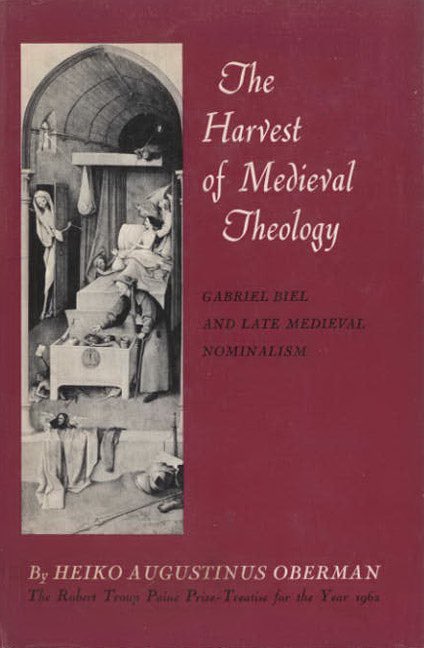
If Dyer really means "nominalism came from Protestantism" it's strange to invoke Oberman. Nothing in the book says this.
But even if Dyer means the opposite (i.e. that Protestantism came from nominalism), it's still not what Oberman is saying. The implication is that nominalism is the bad root of the Protestant reformation. For that thesis and implication, Harvest is possibly the worst book he could cite because Oberman's closing chapter is dedicated to refuting that narrative. Oberman lines up the "nominalism is uncatholic/corrupt" scholars (e.g. Denifle, Lortz's "the occamistic system is radically uncatholic"), de Wulf, van de Pol, and above all Bouyer's "the utter corruption of Christian thought as represented by nominalist theology"), and then he rejects them.
Oberman also says that he will defer the nominalism-to-Reformation question to a later study: "In a subsequent study, we hope to investigate the relation of nominalistic theology to the beginnings of Reformation theology" (p. 428). The thesis that Dyer puts forward is not Oberman's. In fact, the focus of Harvest is Ockham and mostly Biel. There is not much of an analysis of Luther's own thought in this book.
Where the analysis of Luther does occur, many times in the footnotes, they always lean toward contrasting them, not comparing their nominalism (e.g. Oberman says this about Weijenborg's error on p. 176 : "Since according to Luther grace transforms the human will while for Biel grace exists alongside the free will, merely assisting it, Weijenborg has misunderstood both to such an extent that he has had them reverse positions." This pits Luther against Biel when it comes to an inner change that grace provides).
Oh, and Oberman is in the Reformed/Calvinist tradition. He isn't a Lutheran scholar.