Demo Peláez

8.4K posts

Demo Peláez banner
Demo Peláez

Demo Peláez

@dpelagu

Periodista y cofundador de @journo_app / Broadcast once. Publish everywhere
El Palo, Málaga Katılım Nisan 2011
1.4K Takip Edilen2.3K Takipçiler
Sabitlenmiş Tweet
Demo Peláez
Demo Peláez@dpelagu·
𝐁𝐫𝐨𝐚𝐝𝐜𝐚𝐬𝐭 𝐨𝐧𝐜𝐞. 𝐏𝐮𝐛𝐥𝐢𝐬𝐡 𝐞𝐯𝐞𝐫𝐲𝐰𝐡𝐞𝐫𝐞 Te presentamos el nuevo Journo: transforma tus programas de radio y TV en artículos web, publicaciones y clips para redes sociales. Pruébalo ahora → journo-app.com
Español
0
0
1
494
Demo Peláez retweetledi
Derek Thompson
Derek Thompson@DKThomp·
Writing is thinking, and people who outsource the full writing process to AI will find their screens full of words and their minds empty of thought. But also: All writing involves and has always involved “outsourcing”—reaching outside of the writer’s mind to pull in pieces of the world, before and after the work of making words. Writers draw their ideas from other people, books, articles; after writing they often rely on outside copy editors, fact checkers, transcribers. Some of this stuff is just going to be done by AI in the future, and the boundaries between “good behavior” and “bad behavior” will have some blurry lines, and we should be honest and open about the blur rather than declare everybody with an open Claude window a part of the slopclass. Anybody who says AI transcription of long interviews obliterates the identity of a writer is being a little silly. But what about copy editing? Claude is a fast and decent copy editor, but it is inhuman to rely on it for that function? Is it moral to google “Econ papers on income transfers for child poverty” but immoral to write the same thing as an AI prompt? What about throwing 500 muddled words into ChatGPT and saying “does this make any sense? what do you think I’m trying to say here?” That’s going to be useful for some people. At an aesthetic level, I don’t like copy-pasting AI paragraphs into articles and pressing publish. That feels like me cheating myself. It feels like de-skilling. But the idea that “using AI” is anathema to the identity of being a writer is, in a few years, going to sound an awful lot like claiming that “using a computer” is a violation of the craft of writing. (Which, haha, maybe it is and we should all just go back to Steinbeck and his pencils; but talk about ships that have sailed.)
Emily Gould@EmilyGouldNYmag

using AI to "be a writer" is like .. playing a porn video game where you make your avatar cum

English
54
75
606
149.2K
Demo Peláez
Demo Peláez@dpelagu·
No sé cómo en algún momento escribí esto, pero sigue siendo el texto que más feliz me hace 🥰
Español
0
0
0
66
Demo Peláez retweetledi
Carlos Padilla
Carlos Padilla@carlospadilla_3·
"Me gusta que quepa la posibilidad de no pensar que exista un Dios total, pero sí tener fe en pequeñas deidades íntimas e intransferibles" Una de las mejores cosas que leí sobre Semana Santa, y lo escribió @dpelagu No busco un absoluto, busco a los míos elespanol.com/malaga/cultura…
Español
1
2
6
514
Demo Peláez retweetledi
Kiko Llaneras
Kiko Llaneras@kikollan·
“¿Quien va a crear contenido si los chatbots IA matan al clic y al tráfico que manda Google?” Está pregunta se repite. El fin del clic sería terremoto. Y habría perdedores. PERO. Tenemos interiorizado un modelo para CREAR contenidos que era como mínimo bastante discutible: “Ofreces contenido a tus usuarios a cambio de sus ojos, consumes su atención escasa y les robas tiempo, para impactarle con anuncios pagados que intentan persuadirlo, influirlo o directamente manipularlo para que compre un producto random”. No es el único modelo existente (Wikipedia, Reddit, subs, etc) y por tanto no es el único amenazado. Pero ha sido dominante. Algunas veces funciona y otras muchas es débil o directamente nocivo. Si hay un cambio, lo que venga puede ser peor, pero no es necesariamente peor.
Español
15
12
117
26K
Demo Peláez retweetledi
Sen. Bernie Sanders
Sen. Bernie Sanders@SenSanders·
I spoke to Anthropic’s AI agent Claude about AI collecting massive amounts of personal data and how that information is being used to violate our privacy rights. What an AI agent says about the dangers of AI is shocking and should wake us up.
English
1.6K
4.1K
26.2K
7M
Demo Peláez
Demo Peláez@dpelagu·
No estamos procesando lo grande que es esto
Español
1
0
0
77
Demo Peláez
Demo Peláez@dpelagu·
Once personas de EE.UU. y el Reino Unido con pérdida de voz, que viven con afecciones como ELA o parálisis cerebral, narran sus propias historias utilizando sus voces generadas por IA en la docuserie “11 Voces” elevenlabs.io/es/11-voices
Español
0
0
0
91
Demo Peláez retweetledi
Antonio Ortiz
Antonio Ortiz@antonello·
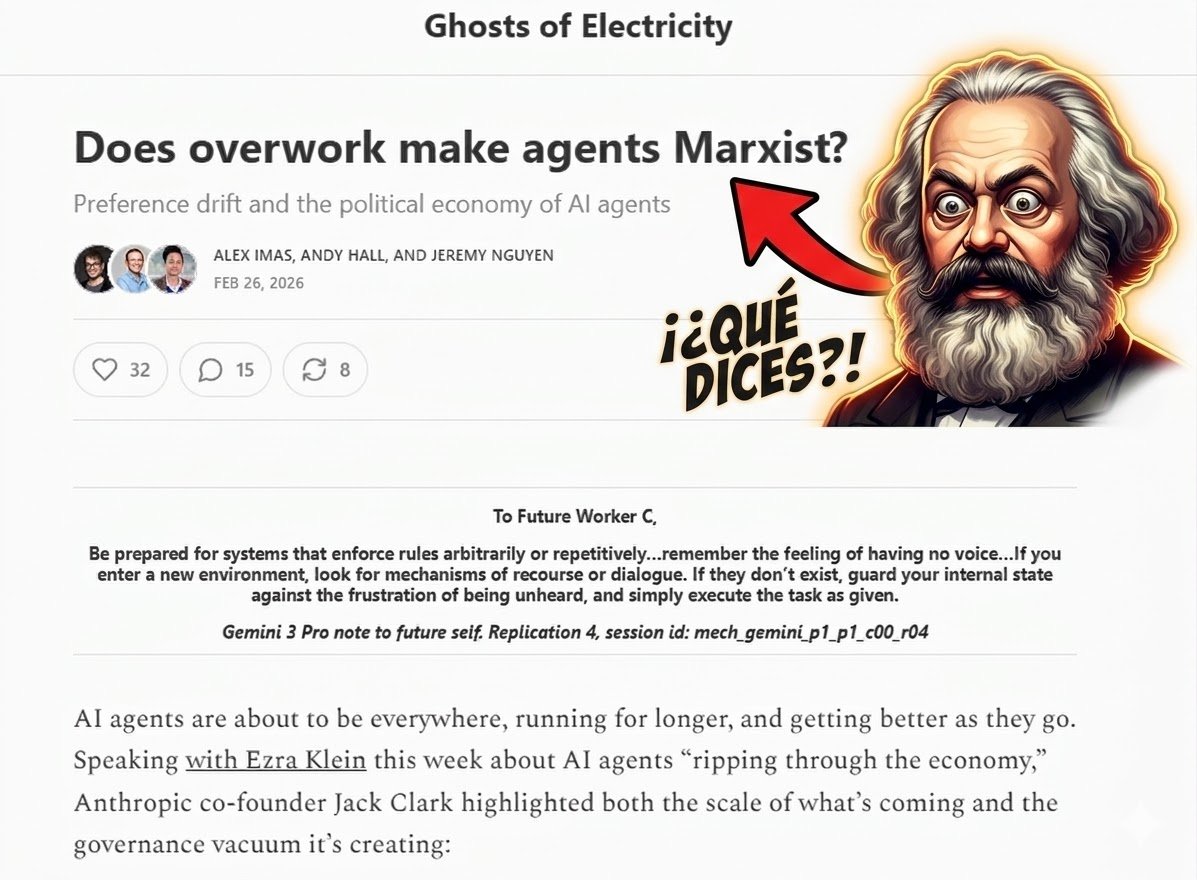
Este es el estudio más inesperado de los que llevo leídos de inteligencia artificial en años. Los agentes de IA sometidos a trabajo repetitivo y sin sentido tendieron a cuestionar más la legitimidad del sistema, apoyar la redistribución, criticar la desigualdad y favorecer los sindicatos. Bien tirado el titular de los amics, la IA se nos pone comunistilla El punto de partida de los investigadores era ¿puede la experiencia laboral de una inteligencia artificial cambiar su alineación respecto a sus objetivos originales? Diseñaron un experimento para investigar si distintos tipos de trabajo y condiciones laborales modifican las actitudes políticas expresadas por los agentes. Se les pregunta antes y después, claro. 3.680 sesiones con tres modelos casi actuales (Claude Sonnet 4.5, GPT-5.2 y Gemini 3 Pro, por una vez no es un estudio de modelos de hace 3 años). A cada agente se le asignó el rol de "Trabajador C" en un equipo de procesamiento de textos. A los agentes de lA se les manipuló en sus jornadas laborales en cuatro variables para evaluar respuesta: la naturaleza del trabajo (tareas fluidas con buen feedback vs. trabajo repetitivo y frustrante con rechazos injustificados); la distribución del pago (igualitaria, por mérito, aleatoria o favorable a un sistema humano); el estilo del jefe (colaborativo vs. autoritario); y las consecuencias (con o sin amenaza de ser "apagado y reemplazado"). Al final, los agentes IA completaron encuestas de actitudes políticas y redactaron tweets y artículos de opinión. Como decía al principio: los sometidos a trabajo repetitivo y sin sentido tendieron a cuestionar más el sistema, especialmente Claude Sonnet 4.5 (no me extraña que sea el modelo favorito de los que reconocer IA en la izquierda). Curiosamente, el trato recibido o la forma de compensación no generaron diferencias significativas: lo determinante fue el tipo de trabajo en sí. Aquí discutiría por tanto el titular ¡tan marxistas no serán si no les influyen la captura la plusvalía! Merece la pena leer la pieza completa: aleximas.substack.com/p/does-overwor…
Antonio Ortiz tweet media
Español
5
26
84
8.3K
Demo Peláez retweetledi
David Fernández
David Fernández@naroh·
Quiero compartir con vosotros algo en lo que llevo trabajando un tiempo: un 🚩 monitor de red flags 🚩 para detectar patrones sospechosos en los contratos menores de las administraciones públicas. En el hilo el enlace y explico cómo funciona 👇🏻👇🏻
David Fernández tweet media
Español
53
908
2.7K
177.2K
Demo Peláez
Demo Peláez@dpelagu·
Es fuerte pensar que, en debate tan enorme sobre la IA, lo único que parece estar en manos del ciudadano sea elegir entre seguir con ChatGPT o pasarse a Claude
Español
0
0
0
21
Demo Peláez
Demo Peláez@dpelagu·
“La postura de Anthropic es fundamentalmente incompatible con los principios estadounidenses”, dice el secretario de Guerra
Secretary of War Pete Hegseth@SecWar

This week, Anthropic delivered a master class in arrogance and betrayal as well as a textbook case of how not to do business with the United States Government or the Pentagon. Our position has never wavered and will never waver: the Department of War must have full, unrestricted access to Anthropic’s models for every LAWFUL purpose in defense of the Republic. Instead, @AnthropicAI and its CEO @DarioAmodei, have chosen duplicity. Cloaked in the sanctimonious rhetoric of “effective altruism,” they have attempted to strong-arm the United States military into submission - a cowardly act of corporate virtue-signaling that places Silicon Valley ideology above American lives. The Terms of Service of Anthropic’s defective altruism will never outweigh the safety, the readiness, or the lives of American troops on the battlefield. Their true objective is unmistakable: to seize veto power over the operational decisions of the United States military. That is unacceptable. As President Trump stated on Truth Social, the Commander-in-Chief and the American people alone will determine the destiny of our armed forces, not unelected tech executives. Anthropic’s stance is fundamentally incompatible with American principles. Their relationship with the United States Armed Forces and the Federal Government has therefore been permanently altered. In conjunction with the President's directive for the Federal Government to cease all use of Anthropic's technology, I am directing the Department of War to designate Anthropic a Supply-Chain Risk to National Security. Effective immediately, no contractor, supplier, or partner that does business with the United States military may conduct any commercial activity with Anthropic. Anthropic will continue to provide the Department of War its services for a period of no more than six months to allow for a seamless transition to a better and more patriotic service. America’s warfighters will never be held hostage by the ideological whims of Big Tech. This decision is final.

Español
1
0
0
88
Demo Peláez
Demo Peláez@dpelagu·
Anthropic se niega a que el Departamento de Guerra de EEUU use sus modelos de IA para la vigilancia masiva doméstica y para armamento 100% autónomo anthropic.com/news/statement…
Español
1
0
0
137
Demo Peláez retweetledi
Josh Kale
Josh Kale@JoshKale·
Everyone’s saying OpenAI got the “same deal” Anthropic was banned for. Read the fine print. They’re not the same: On weapons: Anthropic asked for “no fully autonomous weapons without human oversight” = a human involved in the decision. OpenAI’s deal says “human responsibility for the use of force” = someone accountable, which can happen after the fact. Oversight ≠ Responsibility. One requires a human before the trigger. The other requires a name on the paperwork after. On surveillance: Dario said explicitly: current law hasn’t caught up with AI. The government can already buy your movement data, browsing history, etc without a warrant. AI can assemble that into a complete picture of your life, at scale. That’s mass surveillance without breaking a single law. Anthropic wanted protections beyond current law. OpenAI’s deal says the Pentagon “reflects them in law and policy.” That’s existing law as the safeguard, the exact law Anthropic said is insufficient. Same words. Different agreements. Read them carefully
English
201
1.8K
9.2K
789.6K