b!tchcoin

4.1K posts

b!tchcoin banner
b!tchcoin

b!tchcoin

@drGhostinOO7

DoubleO7cap

Global Katılım Haziran 2019
74 Takip Edilen39 Takipçiler
jormpt
jormpt@jormpt·
Kraken launched in 2011 with a crypto-focused mission. Robinhood launched in 2013, gaining popularity with stock trading until it began supporting crypto in 2018. It took Kraken's Ink Chain 303 days to reach $140M TVL ($120M today). Robinhood Chain is almost there ($134M) in just 12 days. 572 days in and Ink has 44% the total DEX volume that Robinhood Chain has already. Obviously not apples to apples: Robinhood is a publicly-traded US company that swam the streamlined waters of an evolving digital stock-trading ecosystem along with a cohort including Webull and Fidelity that now serves over 150M retail users worldwide. Kraken swam upstream its entire life in a fledgling ecosystem, fighting anti-crypto campaigns and SEC lawsuits along the way. It's tough to see TradFi continually eat a crypto native's lunch. But this is the way the cookie crumbles when you are in league with Wall Street titans.
jormpt tweet mediajormpt tweet media
English
7
1
15
2.2K
venturefounder
venturefounder@venturefounder·
No one is going to listen to me. But @sandeepnailwal @0xMarcB fix the supply cap/tokenomics, $POL will be back in top 20 tokens in no time (90 days) You will print $3-$4b value in token market cap Don’t you remember how strong $MATIC was in the last 2022 bearmarket (top 10)
venturefounder tweet media
English
11
8
64
5.2K
b!tchcoin
b!tchcoin@drGhostinOO7·
@LorenzoARK @richwgalvin The delta between assets secured and market cap has an asymptote. The moment reorg is economically viable through stake, it will happen.
English
0
0
1
23
Lorenzo Valente
Lorenzo Valente@LorenzoARK·
@richwgalvin I think the worst outcome here would be Ethereum securing 10T of assets, and ETH being worth 300B like today. Not an impossible outcome, I see it unlikely, but possbile
English
2
0
2
377
Richard Galvin
Richard Galvin@richwgalvin·
ETH is unfortunately trending the way of a public good - incredible technology, but becoming the internet of crypto, where the Amazons and Googles capture the value. From an investment perspective, agree with the below, money-ness is one path out. The second - and probably the more likely longer-term - is the sheer weight of TVL dragging ETH higher which has to scale (eventually) with the value it secures. The mechanism that makes this happen isnt entirely clear to me though...
Lorenzo Valente@LorenzoARK

The Robinhood Chain is the cleanest case study of what happened to ETH's economics over time. Since inception, @RobinhoodApp Chain has grossed ~$816K in revenue. @Arbitrum, the middleware provider, takes 10%: ~$80K. Arbitrum then pays Ethereum for settlement: $1,538. The margin profile roughly: Robinhood: 89% Arbitrum: 10% Ethereum: 0.15% If your thesis is "ETH is money," Robinhood building here is ultra bullish. More activity, more ETH collateral, more lindyness. If your thesis is "ETH is a revenue generating asset," this is the ultra-bear case. And here's the uncomfortable truth: Robinhood was never going to build on Solana, Sui or any monolithic L1. They want the stack customization. They want to be landlords, not renters. Ethereum won this deal on merit. It's just not pricing it right. A healthy split to me looks more like: Robinhood: 75% Arbitrum: 10% Ethereum: 15% Ethereum sells the most valuable settlement layer in crypto at marginal cost. Things need to change. @ethlabs_org

English
19
2
28
9.1K
b!tchcoin
b!tchcoin@drGhostinOO7·
@arthur0x $AMC did this and I believe lots of hedge funds will do wonders w this piece of inhabitable stock
English
0
0
0
63
Ethan DeFi
Ethan DeFi@EthanDeFi_·
Kamino's Steakhouse USDG High Yield vault looks interesting here. USDG lenders are earning 23% APY. It's not the lowest risk vault out there as it has exposure to dozens of collaterals (some riskier than others). But the high lending APY makes it very attractive for now.
Ethan DeFi tweet media
Kamino@kamino

The new incentives campaign for the USDG High Yield Vault is live. We are launching a joint growth campaign for USDG on Solana in collaboration with @SteakhouseFi and @global_dollar, with $300,000 in rewards on USDG deposits distributed over 3 months. Curated yield from one of DeFi's largest vault curators on Solana's largest lending protocol.

English
6
2
30
5.7K
0xWizard
0xWizard@0xsubwizard·
tori's vault yields 12.21%, with an allocation of 59% in money markets, 30% in basis trading, and 12% cash assuming that they're getting 8% from money markets (being generous here) and 0% from cash, this means they're yielding upwards of 25% from basis trading strategies what kind of markets do you need to be shorting to consistently earn 25% annualized? not saying it's a $LAB piggybank situation but hmmm app.tori.finance/transparency
0xWizard tweet media
Tori Finance@tori_finance

The pre-deposit vault is now full. Yield starts accruing today.

English
1
0
6
1.1K
b!tchcoin
b!tchcoin@drGhostinOO7·
@cptgrumpus The distillation has slowed after mythos, it’ll not catch up as fast. Chinese labs are now needing to build and train without Anthropic as a teacher
English
0
0
0
18
cpt.grumpus
cpt.grumpus@cptgrumpus·
At some point, you won’t need the most intelligent models. If open source is always 6 months behind frontier, and frontier keeps moving, the open source ones will be incredibly smart, and the costs so low that the real leverage just comes down to giving them good targets and general orchestration sure the most intelligent models might need to do PhD level work and cure cancer but most users don’t need it for that. I don’t see how the real spend is justified for so long. Good to see grok model trying to cut costs and put pressure on frontier at the same time. you need a balance
Gavin Baker@GavinSBaker

The mega bull case for AI infrastructure would be *if* market share shifted away from certain frontier labs with 90%+ inference margins toward cheaper models, whether open-source or closed. It would increase the ROI on AI spend for end customers by increasing intelligence per dollar, which would drive incremental token demand. Margin dollars would effectively get redistributed from the frontier labs to AI infrastructure providers. The infra winners would be those with the lowest per token cost and the winners at the model layer would be those with the highest token efficiency. There are many reasons Jensen is so focused on open source, but this is likely the most important one as I think he is probably less worried about a monopsony these days. Lower margin % at the model layer = more margin $ at the infra layer all else equal. With SpaceX and Meta being vertically integrated and possessing the #3 and #4 models respectively it is more possible than ever. Note that Grok 4.5 is ahead of Fable for some useful tasks at a much lower cost, so ranking them #3 is conservative. This is not happening yet. Cheap, mostly open source tokens are likely the majority of volume today but the majority of economic value is still accruing to the most intelligent models. Might change though. We will see.

English
1
0
6
1.3K
usmann
usmann@usmannk·
rough one. looks like @SUPRA_Labs actually knew about this exploit in their oracle. on more important networks like Arbitrum they upgraded their impls over the last 2wks (previously untouched for years). someone must have noticed this and found the forgotten Hedera instance
usmann tweet media
Hedera@hedera

Hedera is aware of the incident affecting Bonzo Lend, an independently operated DeFi application built on Hedera. Based on the findings to date, Hedera’s consensus mechanism and core network services were not compromised, and mainnet remained operational. Bonzo’s preliminary report points to an issue involving a third-party oracle verifier.

English
19
19
136
47.9K
Naeven
Naeven@Naeven_0·
if anyone wonders why megaeth tvl plunged they removed aave incentives so ethena pulled most of its supplied usdm while other addresses withdrew usde usdm supply is now around 40m below pre tge levels (~60m) their economic engine "megaavethena" has completely collapsed since mainnet its been nothing but failure after failure MEGA (useless tge kpis), megamafia dapps, communication, defi, moss distribution, terminal everything has fallen flat & now robinhood has all the mindshare and liquidity at this point its an uphill battle for the megaeth team and the hill keeps getting steeper with each passing day
Naeven tweet media
English
41
4
115
9.1K
jacobruh 🚀
jacobruh 🚀@jrxcket·
The Chinese method of catching boosters using the wires is actually kinda cool lmao
English
865
1.5K
34.4K
2.6M
b!tchcoin
b!tchcoin@drGhostinOO7·
@proofofjake_ In search etherscam on Google and well there’s no other result other than etherscan
English
1
0
0
916
proofofjake.eth
proofofjake.eth@proofofjake_·
its 2026 and we’re still debating the worth of etherscan lol
proofofjake.eth tweet media
English
7
0
75
12K
b!tchcoin
b!tchcoin@drGhostinOO7·
@rami_poker Airdrop scamming is negative ROI for the team, they are leaving money on the table and tbh is a trait of short sightedness. Teams that do airdrops well usually succeed and make a sustainable cash cow.
English
0
0
0
80
Rami
Rami@rami_poker·
Faithful followers know I've talked about the nature of alpha, how the difficulty always adjusts upwards. It's just the way it is. Alpha is not sustainable by definition, and games where most participants lose money consistently are not sustainable; talked about it many times. Also, this farmer has had the conviction over the last years that airdrop farming outperforms real yield under almost any circumstances, and such has been the case over the last 3 years. With that frame in mind, lets look at how the the game of airdrop farming: 0-extremely early: uniswap, ribbon was the name?, dydx. 99.9% didnt farm them, and many users got rich. 0 (or almost 0) smart players gaming them. 1-very early: arbitrum, jito and others. very few people tried to game them, and everyone that happened to use those protocols got incredible rewards for basically doing nothing (which attracts smart money that decides to game them). 2-not so early bit still plentiful, especially given market was very good in 2024: other solana airdrops like tnsr, parcl, kamino, and many many more in EVM: etherfi, ethena, and of course TIA/DYM cosmos ecosystem. This was pretty much the top for smart players (sybils): they got massive (massive is an understatement) ROIs for staking 1$, buying 10$ in YTs or adding 100$ in TVL in dozens or hundreds of wallets. Insane. 3-middle in the game: It's late 2024 or early-middle 2025, and the game now is more balanced: resolv, ethena, usual, openeden, and many others, do points campaigns, but they have realised low value users are massively sybilling, therefore they reward real support that can't be gamed: TVL. This was more or less some equilibrium. Teams were still relatively generous in my opinion. But as soon as tge happens, tvl flees for the next opportunity. (a few exceptions here, with perps, as they still could be somewhat gamed, but airdrops such as hype or lighter rewarded metrics that are harder to game such as OI or real dollars spent). 4-Late in the game: now it's late 2025 or early 2026, and we start to see a shift in balance: teams start getting more greedy, with tiny liquid allocations. Small dropped %, huge % of vesting (and then some teams crime the coins before vesting unlocks), somewhat harsh vesting requirements, and the latest one seems to be a big go fuck yourself to users, with @CapApp scamming their regular users. I remember some teams like polyhedra were extremely early to the 'team scamming users' trend (they farmed the whole airdrop themselves and gave ridiculous amounts for real users). A few thoughts: -This trend imo will only consolidate and grow. Is the nature of the game, it's to some extent 'fair' because teams have realized they have the last word and can indeed scam lol So if skill in airdrop selection has been very important so far (it was not the same farming lighter than paradex, right? or predepositing in plasma than in boyco, or etherfi vs karak, or LPing in scroll for 10% APR vs looping for 150%), it's even more important now. -From mid 2024 I started being of the opinion that burning money for airdrops was overall a not so great idea. My memory might fail, but the only exception to this was burning at 100% APR on ethena s4 PT-USDe/USDe loops, waiting for a 300-400% apr (that we sort of got). I also burned farming openeden, but the burn was really low, I was burning at 10-15% APR hoping for a 50%+ (in the end I got a little bit more than that). I think burning money is overall an even bigger risk now: buying YTs, burning fees on perps, or simply doing negative carry loops hoping the points will cover the negative APR. This obviously is bad, as it limits the possibilities and increases risks if you want to get high APRs. As with any alpha that attracts smart players (both users and teams), the game gets tougher over time.
Rami tweet media
English
8
3
74
6.9K
b!tchcoin
b!tchcoin@drGhostinOO7·
@ImperiumPaper @aave Headline apy is not useful, the derivation of yield and assets quality + counterparty disclosure should also be a factor. With tokenized funds, why is stcusd a choice megaUSD have taken? These are similar yield of us treasuries so cap isn’t as good a counterparty than say maple?
English
1
0
0
272
PaperImperium
PaperImperium@ImperiumPaper·
And just like that, MegaETH’s @aave deployment enters an unsubsidized, sustainable era, only a calendar quarter after TGE. We see today a completely borrower-funded lending APY on par with Ethereum Aave. Rewards distributed by Merkl had been tapering for some time, as the deployment ended up with excess liquidity compared to demand, and with its major collateral, which could not support Aave’s targeted 90% utilization. The tapering of those rewards finally hit the elastic point in some large LPers’ demand to lend USDM, resulting in a more rational size. Simultaneously, the introduction of stcUSD from @CapApp as collateral meant there was finally a yield bearing collateral able to sustain borrowing at the traditional Aave utilization target (borrow ~4%), which boosted rates as well. There are a couple lessons I think we should take away from this. 1) In a post-Kelp world, it’s a long process for Aave to onboard new collateral assets. I personally think they need to find ways to streamline this, because much of Morpho’s success has been the ceding of vast swaths of the lending market to them voluntarily. This is good and bad for them - they have kept their nose clean about onboarding *financially weak* assets, unlike the independent curators. But it also leads them to existential risk-level concentration for rail risks, as we saw with Kelp. An Aave with 50 collaterals that builds in an expectation of some losses as part of the business is stronger than an Aave with 10 collaterals and needs to seek external financing in my opinion. 2) This is a low-yield environment, and even many moderate-risk assets simply can’t support borrowing even below the risk-free rate. (s)USDe is an excellent example. You have what is a multi-strategy, actively managed credit fund, and it can only pay a few bps premium over a 4-week tbill? Even if you are willing to sit with that risk-reward on the belief the team will bring you better days in the future, it’s just not an asset you can borrow against at any reasonable rate. Even assets like syrupUSDC/T and stcUSD only get you to a modest rate in lending markets. 3) On rewards: MegaETH Aave rewards worked fairly rationally, but not perfectly so. Initially begun in a world where Aave could/would onboard multiple collaterals and e-modes, it was rational for a new deployment to err on the side of oversupply of stablecoin inventory, since no supply means no lending. (s)USDe also had higher yield 3 months ago, and a softening of the returns from the workhorse collateral on the deployment made the slow speed of post-Kelp asset listing even more painful. 4) Collateral uniqueness. For any market not named Ethereum, Aave really needs more differentiation. stcUSD is only listed in MegaETH Aave, so there is no other venue. But when you look at the most recent deployment, on Monad, you only see MM USD as a novel asset, which is not yield bearing. You can see the ossification of Aave risk tolerance in real time, as Monad launched with only familiar assets otherwise. That those familiar assets listed even in the face of literally zero liquidity is an indicator that Aave risk tolerance is very low, and makes the future of non-Ethereum deployments a question mark. If those deployments only offer leverage against assets all competitors take, and any given deployment is unlikely to have an asset different from the mainnet Aave, what is the competitive advantage? Add in that the typical interest rate curve on stablecoins only gets lenders to the risk-free rate at 90% utilization, and there is no room for a risk premium, except in the form of rewards. And all rewards have to be planned with their sunset in mind. But mostly? Low rate environments are just really challenging for everyone until DeFi discovers a way to lend to someone for purposes other than leveraged crypto exposure (whether asset price or asset yield)
PaperImperium tweet media
English
15
3
82
20.8K
b!tchcoin
b!tchcoin@drGhostinOO7·
@Andercot Could it be that they knew how to do this before steam engine and the only logical way is to adopt this to the steam engine?
English
0
0
0
159
b!tchcoin
b!tchcoin@drGhostinOO7·
@Object_Zero_ @SteveJabs That’s not the main reason. I think general purpose means ur users will find a way to use them similar to how chatgpt first started out. Emerging use cases from their paying customers. Whereas a purpose built doesn’t have that convenience or expansion strategy to tap on
English
0
0
3
203
Object Zero
Object Zero@Object_Zero_·
Market size for any purpose-built robot = 10^3 Market size for a general-purpose robot = 10^9 Wright’s Law says you get about 10-20% cost reduction for every doubling of production. 10^9 / 10^3 = 10^6 10^6 ≈ 2^20 So 20 doublings is… 0.8^20=0.0115 0.9^20=0.122 … So the general purpose robot can be 8-80x more expensive than the purpose built robot, and when both are mass produced general-purpose can still come out cheaper.
English
11
5
222
17.5K
Steve Jabs
Steve Jabs@SteveJabs·
Neat. Now again... can someone please give me the practical purpose of robot hands with infinite points of failure over just purpose-built robots?
dar@radbackwards

Alien Technology

English
341
16
880
213.1K
b!tchcoin
b!tchcoin@drGhostinOO7·
@QiaochuYuan I like to think generations of students trying to hit word count has somewhat caused this!
English
0
0
0
20
QC
QC@QiaochuYuan·
interesting hypothesis that the "not X, but Y" LLMism is an artifact of "not" being a high-probability completion since it can continue in so many different ways, and that other LLMisms can be understood similarly. anyone know if any work has been done on this?
QC tweet media
English
26
17
326
22.7K
b!tchcoin
b!tchcoin@drGhostinOO7·
In nature, wetland shares one river across many floodplains. Water moves quietly with every marsh having interdependency on the others. Liquidity in defi behaves the same and risk must be measured across the entire system. Fragmented liquidity is natural, concentration is unwise
English
0
0
0
14
b!tchcoin
b!tchcoin@drGhostinOO7·
@alz_zyd_ Everyone still hates crypto regardless
English
0
0
1
23
alz
alz@alz_zyd_·
another way to put it, this could have been a perfect description of finance in the eyes of the public around 08 or so, now everyone hates tech and nobody cares about finance
English
2
0
13
920
alz
alz@alz_zyd_·
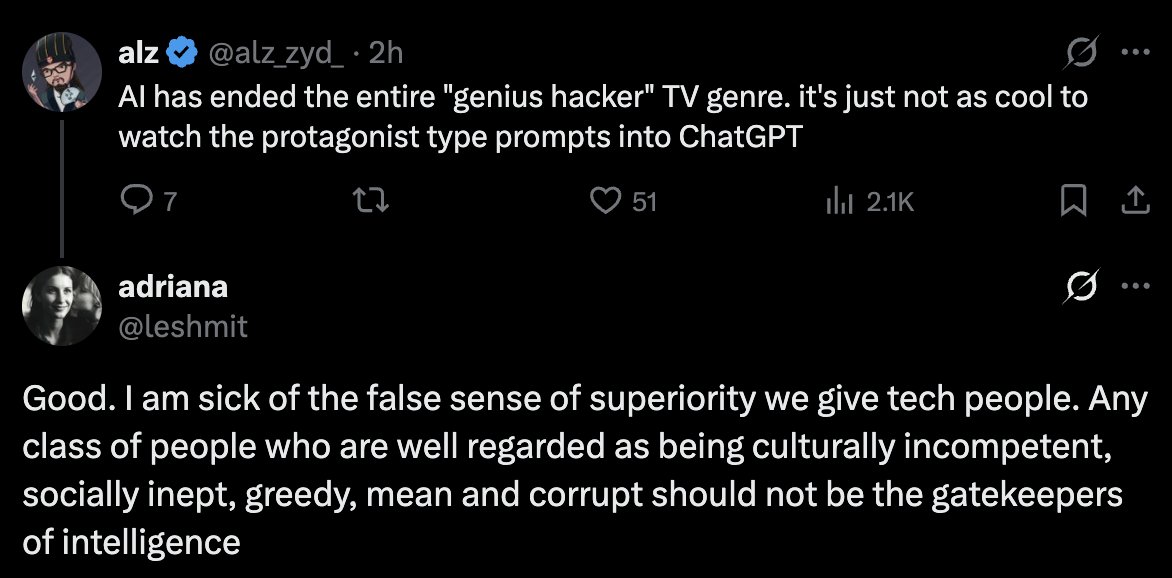
It's funny how, culturally, it took like 20 years for tech and tech workers to go from the cool new upstarts to the evil incumbents
alz tweet media
adriana@leshmit

@alz_zyd_ Good. I am sick of the false sense of superiority we give tech people. Any class of people who are well regarded as being culturally incompetent, socially inept, greedy, mean and corrupt should not be the gatekeepers of intelligence

English
4
0
58
5K