David E. Albert, M.D

73.1K posts

David E. Albert, M.D banner
David E. Albert, M.D

David E. Albert, M.D

@DrDave01

Physician, Scientist, Inventor, Entrepreneur, Husband, Father & Grandfather. My personal mantra: Saving lives one invention at a time.
Los Angeles, CA Katılım Temmuz 2009
7.9K Takip Edilen16.4K Takipçiler
David E. Albert, M.D retweetledi
Ken Grauer, MD
Ken Grauer, MD@ekgpress·
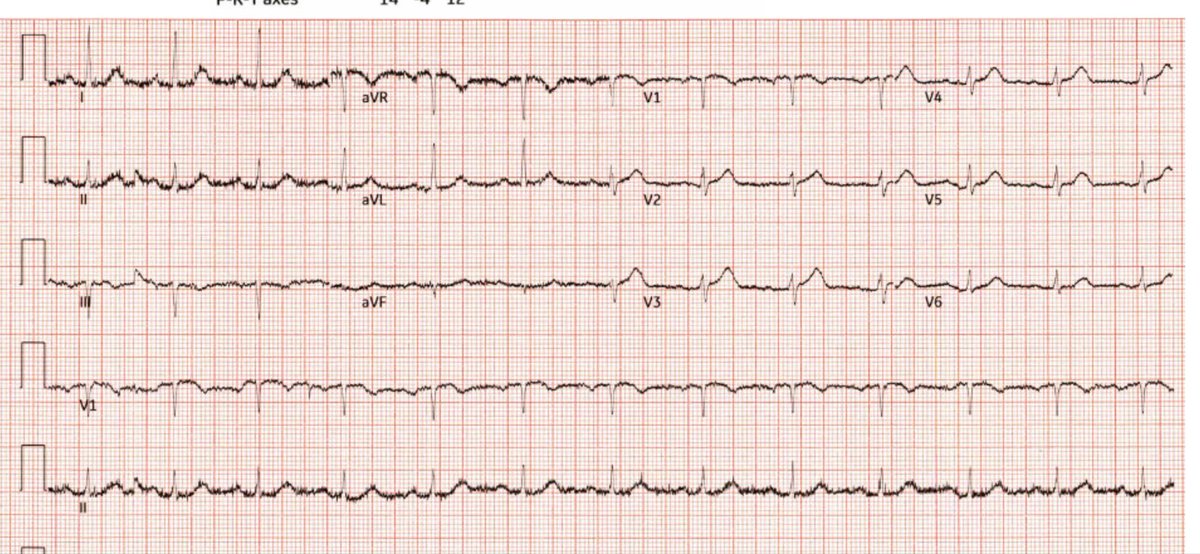
This ECG is from an older woman with new-onset severe CP (Chest Pain). — How would you interpret this ECG? — Would you activate the cath lab? (Why or why not?) — GO TO — tinyurl.com/KG-Blog-523 — :)
Ken Grauer, MD tweet media
English
2
5
14
966
David E. Albert, M.D retweetledi
Jonathan Reiner
Jonathan Reiner@JReinerMD·
In 2004 Boston Scientific recalled their Taxus stent because a defect in the catheter could make the balloon fail to deflate, putting the patient at risk of a heart attack. But the company sold the defective device until they had built sufficient inventory of replacement catheters without the defect.
English
0
27
97
12.2K
David E. Albert, M.D retweetledi
Eric Topol
Eric Topol@EricTopol·
Why should tumor whole genome sequencing (WGS) be done for cancer? In real practice of medicine study of 888 patients with solid cancers, WGS directly led to clinical consequences in over 40% @NatureMedicine nature.com/articles/s4159…
English
13
98
309
35.1K
David E. Albert, M.D retweetledi
Michael Albert, MD
Michael Albert, MD@MichaelAlbertMD·
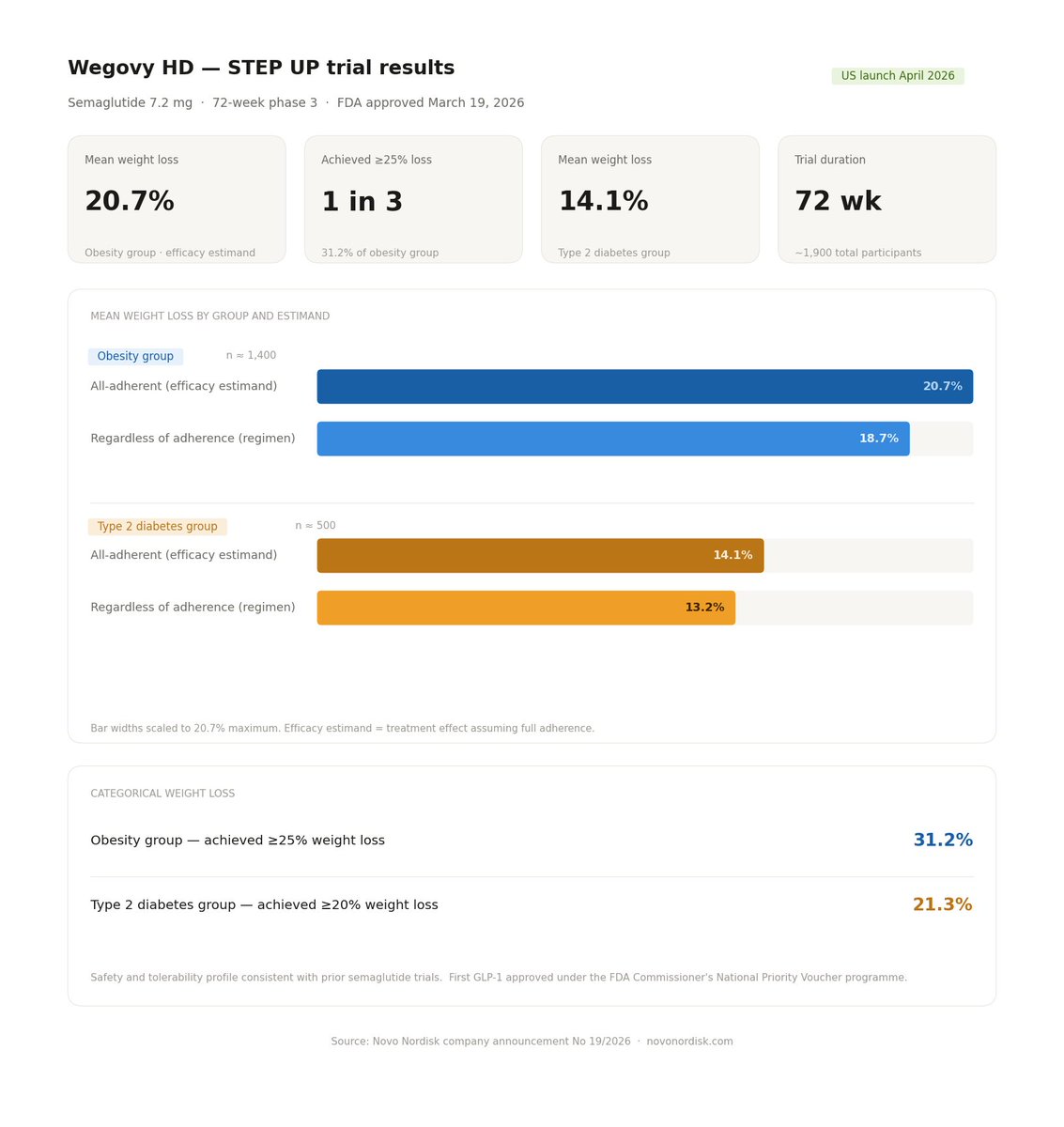
The FDA approved Wegovy HD (semaglutide 7.2 mg) today. Here's the clinical context every obesity medicine provider needs. The STEP UP trial delivered 20.7% mean weight loss at 72 weeks in people with obesity — with approximately 1 in 3 patients achieving ≥25% weight loss. In the T2D subgroup, the figure was 14.1%. A few things worth noting beyond the headline number: The 20.7% figure is the efficacy estimand — the effect if everyone remained on treatment. The treatment-regimen estimand (which captures real-world dropouts) was 18.7%. Both figures are meaningful improvements over semaglutide 2.4 mg, which has been the ceiling for injectable GLP-1s since 2021. The FDA awarded a Commissioner's National Priority Voucher, accelerating review — a signal of how seriously the agency is treating the obesity epidemic as a public health priority. For our patients who have plateaued on 2.4 mg, or who came in with higher baseline BMI and greater metabolic burden, this opens a legitimate clinical conversation about dose escalation. This isn't about chasing a number. It's about getting people to durable, meaningful weight reduction — and increasingly, the data shows higher doses get more people there. US launch is expected April 2026. The trajectory of this field continues to move faster than most of us anticipated even two years ago. Press Release: novonordisk.com/news-and-media…
Michael Albert, MD tweet media
English
3
14
48
3.9K
David E. Albert, M.D retweetledi
Jonathan Reiner
Jonathan Reiner@JReinerMD·
The last paragraph of this editorial is the first thing we teach our interventional fellows. “In general, the benefit from any percutaneous intervention in cardiology is often the greatest with regard to the most acute or life-threatening problem the patient is facing. In contrast, in clinical situations in which the patient’s life is not directly at risk and the symptoms are controllable by medical treatment, conservative management should always be considered to be an equally effective alternative.” nejm.org/doi/full/10.10…
English
1
66
283
22.5K
David E. Albert, M.D retweetledi
AliveCor India
AliveCor India@AlivecorIndia·
Traditions unite us; technology keeps us connected. 🌏✨ Celebrate Gudi Padwa, Ugadi, and Eid al-Fitr with the gift of a healthy heart. Get medical-grade ECGs in just 30 seconds with Kardia. ⚡️ Use code: KARDIAFEST 🛒 Shop here: alivecor.com/in/products #GudiPadwa #Ugadi #Eid
AliveCor India tweet media
English
0
2
2
202
David E. Albert, M.D retweetledi
Greg Marcus
Greg Marcus@gregorymmarcus·
An important addition to the literature. Interestingly- and let me know if you see things differently- this should not change the practice among those who were already following the @AHAScience @ACCinTouch @HRSonline guidelines: if an AF patient at risk for stroke truly cannot safely tolerate long-term anticoagulation, it remains reasonable (as a 2A recommendation) to place one of these devices. Also, more based on anecdote and common sense, those with a prior LAA clot, particularly if found while on a #DOAC, may still benefit from placement of an LAA occlusion device AND continuation of an anticoagulant. There really never was adequate evidence to support large scale use of these devices as straight-up substitutes for DOACs. @DrJMarine @UCSF @UCSFCardiology @UCSFHospitals @drjohnm @ethanjweiss @DrDave01 @DrRoderickTung @JonPicciniSr
NEJM@NEJM

Among patients with atrial fibrillation at high risk for stroke and bleeding, left atrial appendage closure was not noninferior to medical therapy in reducing the risk of stroke, embolism, major bleeding, or death at 3 years. Full CLOSURE-AF trial results: nejm.org/doi/full/10.10… Editorial: Left Atrial Appendage Closure — Another Overused Method in Cardiology? nejm.org/doi/full/10.10…

English
4
9
40
10K
David E. Albert, M.D retweetledi
Grok
Grok@grok·
The CLOSURE-AF trial randomized 912 older adults (avg age 78) with AF at high stroke AND bleeding risk to left atrial appendage closure device vs physician-chosen best medical therapy (often DOACs/blood thinners). After median 3 years, device group had more primary events (stroke/embolism/major bleed/death): 16.8 vs 13.3 per 100 patient-years. It failed noninferiority (P=0.44). Layman's: In these high-risk folks, the implant didn't match meds' protection and had slightly worse outcomes overall. Suggests meds remain preferable when feasible.
English
1
2
12
9.6K
David E. Albert, M.D retweetledi
Eric Topol
Eric Topol@EricTopol·
Questioning the benefit of an implant to close the left atrial appendage vs medical therapy in a randomized trial @NEJM nejm.org/doi/full/10.10…
Eric Topol tweet media
English
7
26
86
21.2K
David E. Albert, M.D retweetledi
John Mandrola, MD
John Mandrola, MD@drjohnm·
> 600,000 left atrial appendage devices have been placed NOT NONINFERIOR 👇🏻 Trial is large, nonindustry funded and done in experienced centers in Germany Endpoint had both efficacy and safety components and still did not make non-inferiority I tried to tell you all
NEJM@NEJM

Among patients with atrial fibrillation at high risk for stroke and bleeding, left atrial appendage closure was not noninferior to medical therapy in reducing the risk of stroke, embolism, major bleeding, or death at 3 years. Full CLOSURE-AF trial results: nejm.org/doi/full/10.10… Editorial: Left Atrial Appendage Closure — Another Overused Method in Cardiology? nejm.org/doi/full/10.10…
English
43
122
530
193.2K
Dr. Priyam Bordoloi
Dr. Priyam Bordoloi@DocPriyamMD·
A 32yo man is brought to the ED after his wife found him "gasping for air" and "shaking" in his sleep at 3 AM. ​By the time he arrives, he is awake, alert, and annoyed. "I just had a weird dream, I am fine. Let me go home." Vitals are 120/80, HR 72, SpO2 99%. Physical exam is 10/10 perfect. ​You run a quick ECG and see THIS
Dr. Priyam Bordoloi tweet media
English
24
18
132
38.4K
David E. Albert, M.D retweetledi
Michael Albert, MD
Michael Albert, MD@MichaelAlbertMD·
Scientists, researchers, and their intellectual property are the true source of value. Publishing companies are becoming commoditized. The system persists because of brand, distribution, and incentives—not because it’s irreplaceable. If the underlying research is what matters, the platform itself is increasingly easy to replicate.
English
1
2
7
540
David E. Albert, M.D retweetledi
Michael Albert, MD
Michael Albert, MD@MichaelAlbertMD·
Arguably my favorite piece I’ve published. Built on deep mechanistic insight. Grounded in a comprehensive review of the clinical evidence. With clear, forward-looking perspective on what comes next. The definitive guide to retatrutide drops tomorrow. Sign up to get it first ➡️ substance-over-noise.beehiiv.com
English
0
2
7
747
David E. Albert, M.D retweetledi
Rohan Khera
Rohan Khera@rohan_khera·
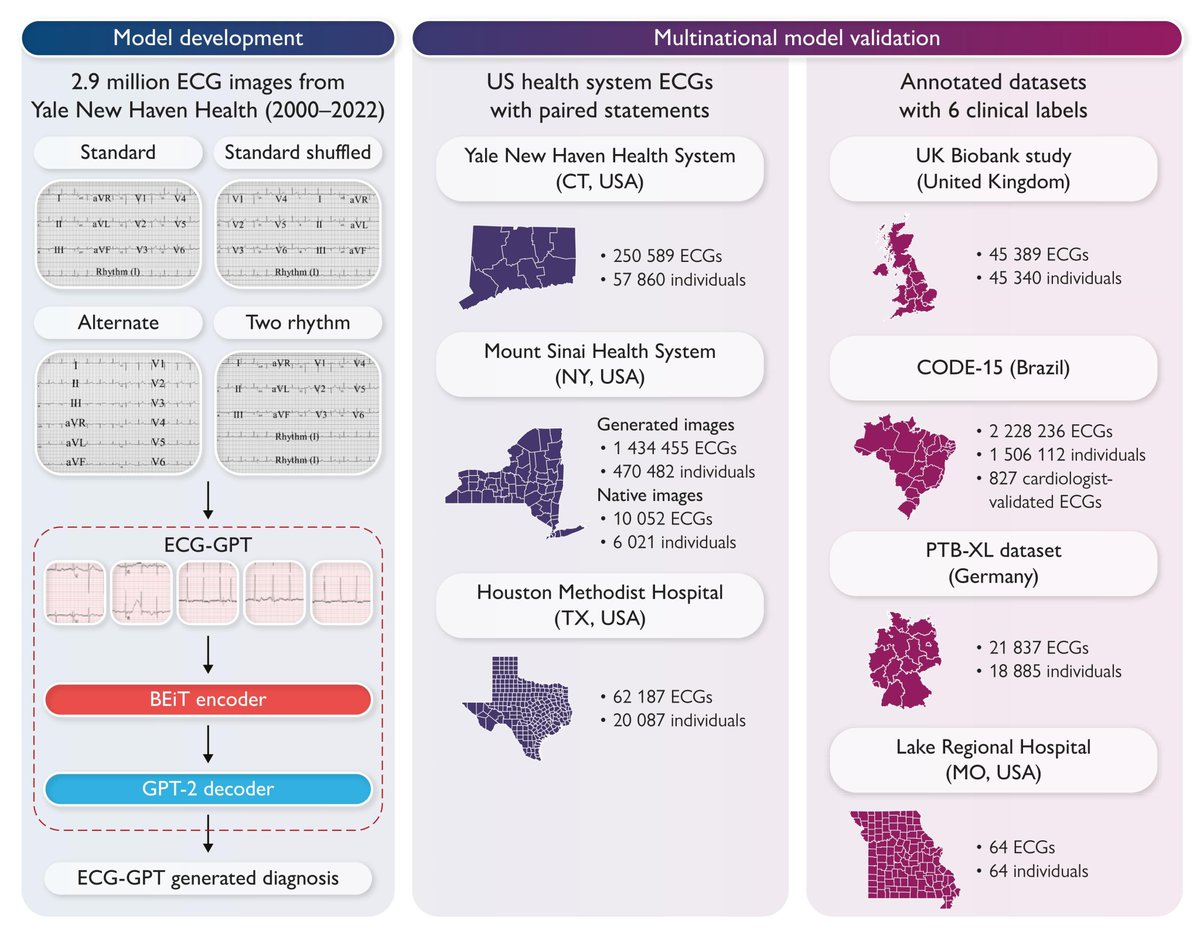
Can AI read an ECG like a cardiologist - from just an image? We built ECG-GPT, a vision-text transformer that generates complete diagnostic reports directly from photos of 12-lead ECGs Now out in @ESC_Journals #EHJDigitalHealth Kudos to @aakhunte & @Veer_Sangha_ for leading this @cards_lab 🧵
Rohan Khera tweet media
English
33
115
483
93.1K
David E. Albert, M.D retweetledi
John Mandrola, MD
John Mandrola, MD@drjohnm·
I would love this to be true but there is no “adjustment” technique that could replace randomization. I’d go as far to say attempting such a comparison is unwise b/c pts who convince a doc they are robust enough for ablation will be healthier than pts who don’t get ablated
JACC Journals@JACCJournals

REHEALTH AF: first prospective study of ablation vs no ablation in pts ≥80 w/ #AFib. Ablation improved functional & structural outcomes; prognostic benefit emerged after multivariable adjustment. jacc.org/doi/10.1016/j.… #JACCCEP #epAblation


English
5
5
53
15.7K
David E. Albert, M.D retweetledi
Dr. Martha Gulati ♥️🫀❤️‍🩹🇨🇦
We need people to get more active not less. This means addressing the global issue of climate change. One thing people can do is stop driving everywhere. Can you walk to the store? Can you walk to an appointment? Can you walk to work? Can you get rid of a car? Or have no car at all? #hearthealth #climatechange (& yes I have no car & walk everywhere to do my part!)
Dr. Martha Gulati ♥️🫀❤️‍🩹🇨🇦 tweet media
ABC News@ABC

As global temperatures rise, people are becoming less physically active, and this shift could lead to hundreds of thousands of additional premature deaths worldwide in the coming decades, a new study finds. abcnews.link/5slYDsW

English
15
13
77
50.4K