Robin Ince

432 posts

Robin Ince

Robin Ince

@drrobinince

Not the Robin Ince from the radio! @robince.bsky.social

Glasgow, Scotland Katılım Haziran 2018
813 Takip Edilen571 Takipçiler
Sabitlenmiş Tweet
Robin Ince
Robin Ince@drrobinince·
“Within-participant statistics in cognitive science”, new Forum in @TrendsCognSci with Jim Kay, @schynsphilippe doi.org/10.1016/j.tics… Statistics in psychology and neuroimaging focus on the average. But this can miss important differences between individuals. 1/5
English
1
52
160
0
Robin Ince retweetledi
Sander van Bree
Sander van Bree@sandervanbree·
New preprint w/ Malin Styrnal & @martin_hebart Have you ever computed noise ceilings to understand how well a model performs? We wrote a clarifying note on a subtle and common misapplication that can make models appear quite a lot better than they are. osf.io/preprints/psya…
English
1
12
24
4.4K
Robin Ince retweetledi
Atlas
Atlas@atlaswearable·
What if more information had the potential to actually make us less intelligent? Often we assume the cure for uncertainty, confusion, and knowledge gaps is more information. But recent neuroscience suggests the opposite might be true. A 2022 study published in the Journal of System and Management Sciences examined what happens when people are flooded with information. AKA the constant scrolls, pings, and contradictory opinions on social media that define everyday modern life. These researchers found that information overload triggers measurable “technostress” and information anxiety, a type of mental strain that blurs focus, drains emotional energy, and erodes decision quality. The result? We become scattered. Clarity doesn’t come from adding more inputs. It comes from learning what to ignore. 4 key insights you’ll want to know from this study: 1. Information anxiety feeds itself. When we feel unsure, we seek more data. The very thing making us unsure in the first place. 2. Your brain treats excess input like a threat. 3. Decision fatigue isn’t a weakness. It’s a sign you’ve hit your mental bandwidth. 4. Clarity requires constraint. What you choose NOT to engage with is the real modern skill. So maybe we don’t need better algorithms. Maybe we need better filters. The ability to pause, parse through the noise, and think for yourself. At Atlas, we’re building technology that helps you choose and strengthen those filters in real time. So you can stay connected to what matters most, and tune out what doesn’t. Join us – link in the replies below.
Atlas tweet media
English
1
3
5
800
Robin Ince retweetledi
Atlas
Atlas@atlaswearable·
The human brain wasn’t built for the world we live in today. Evolution refined our ancestors’ minds to filter crucial information from the outside world: a sound in the forest, a shift in the wind, the alert look on another person’s face. Now, that same circuitry is firing nonstop over the news, a friend’s vacation photos, and cat videos.
Atlas tweet media
English
1
3
13
852
Robin Ince retweetledi
Atlas
Atlas@atlaswearable·
We track steps, heart rate, sleep… But nothing has ever helped us understand the mind, our most vital organ. Until now.
Atlas tweet media
English
21
16
116
80K
Robin Ince retweetledi
Atlas
Atlas@atlaswearable·
We've never had access to so much knowledge with so little effort. But access to everything often means a focus on nothing, and the cost of all that access is mental overload and constant distraction.
Atlas tweet media
English
1
4
7
673
Robin Ince retweetledi
James V Stone
James V Stone@jgvfwstone·
Now $9.99 on Amazon. The Artificial Intelligence Papers: Original Research Papers With Tutorial Commentaries Note that the ebook format is basically a pdf, so a computer screen is required to read it properly. Table of Contents follows ...
James V Stone tweet media
English
1
2
4
715
Robin Ince retweetledi
Andres Canales-Johnson
Andres Canales-Johnson@canalesjohnson·
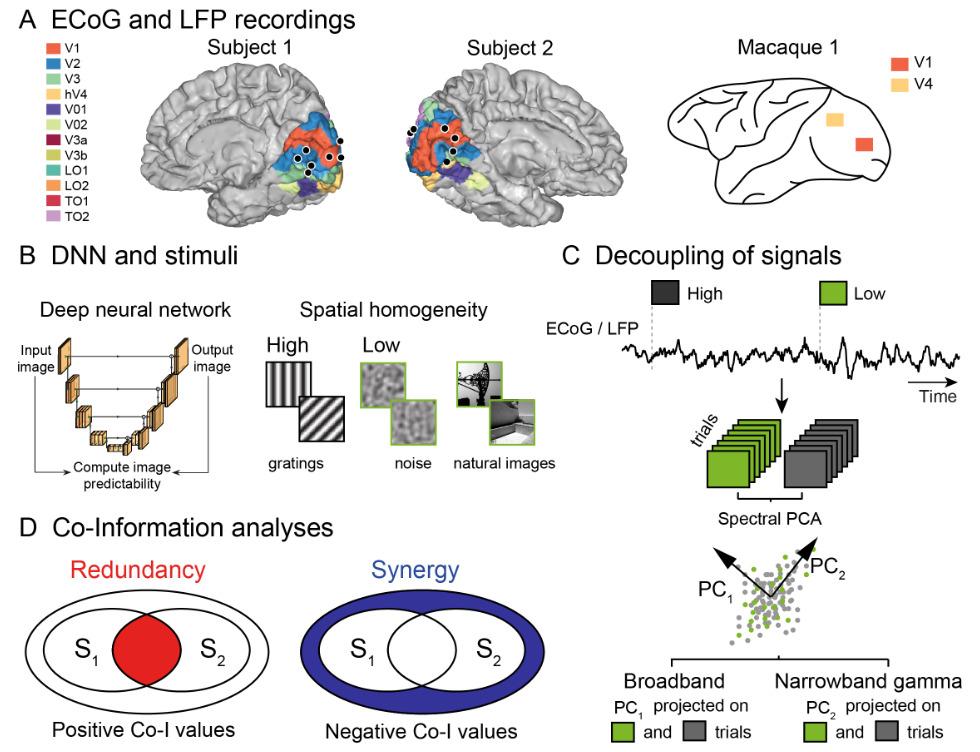
I am opening one PhD position at the Neuroscience Center @HiLIFE_helsinki, focusing on large-scale neural interactions in perception and prediction (ECoG/LFPs/MEG) across human and non-human primates using comp. modeling and information theory. Contact: helsinki.fi/en/hilife-hels…
English
0
6
18
1.6K
Robin Ince retweetledi
Andres Canales-Johnson
Andres Canales-Johnson@canalesjohnson·
Happy to share our Opinion piece @TrendsCognSci "Large-scale interactions in predictive processing: oscillatory versus transient dynamics" with @martin_a_vinck, @uran_cem, Jarrod Dowdall & Brian Rummell. Check our thread below 🧵👇
English
1
31
82
18.3K
Robin Ince retweetledi
Renzo Lanfranco
Renzo Lanfranco@Renzo_Lanfranco·
In our new @NatureComms paper, we investigate the visual system's priorities for extracting meaningful information from faces and bringing it to conscious awareness. We use a new tachistoscope that enables visual presentations as short as 0.002 ms: nature.com/articles/s4146… (🧵👇)
English
4
64
141
27.5K
Robin Ince retweetledi
Denis A. Engemann
Denis A. Engemann@dngman·
To preprocess or not to preprocess your #EEG 🔮when using #ML? 💫An enhanced version of our latest work at @Roche is now published in @eBioMedicine thelancet.com/journals/ebiom… #DeepDive #Thread 🧵in next post 👉👉🏾👉🏻
Denis A. Engemann tweet media
Denis A. Engemann@dngman

To preprocess or not to preprocess your #EEG (when building #ML models) 🔮? 💫We are thrilled to share our latest #preprint, studying the challenge of learning brain-specific biomarkers from EEG 🧠📶 using #ML ⚙️🖥️: biorxiv.org/content/10.110… We compile arguments and evidence from benchmarking age- & sex-prediction on > 2600 EEGs from two large public datasets. We found that basic artifact rejection consistently led to better model performance, whereas removal of ocular and muscle artifacts hampered performance. As it turns out that those peripheral signals are predictive themselves! Our results therefore argue in favor of the need to diligently process EEG data, if the goal is to have brain-specific biomarkers (and if prediction is not the only objective). Our efforts to build more interpretable #ML models for EEG led us to extending the established Morlet wavelet methodology for spectral analysis of EEG to accommodate state-of-the-art ML models based on covariance matrices. This allowed us to perform head-to-head comparisons between classical EEG features and frequency-specific model predictions for, both, brain and artifact signals. Compared to classical band-pass filtering, wavelets even led to improvements in prediction performance. Joint work with Philipp Bomatter, @JP4illard, Pilar Garces & Jörg F Hipp.

English
4
39
112
14.2K
Robin Ince retweetledi
Yaocong Duan
Yaocong Duan@YaocongDuan·
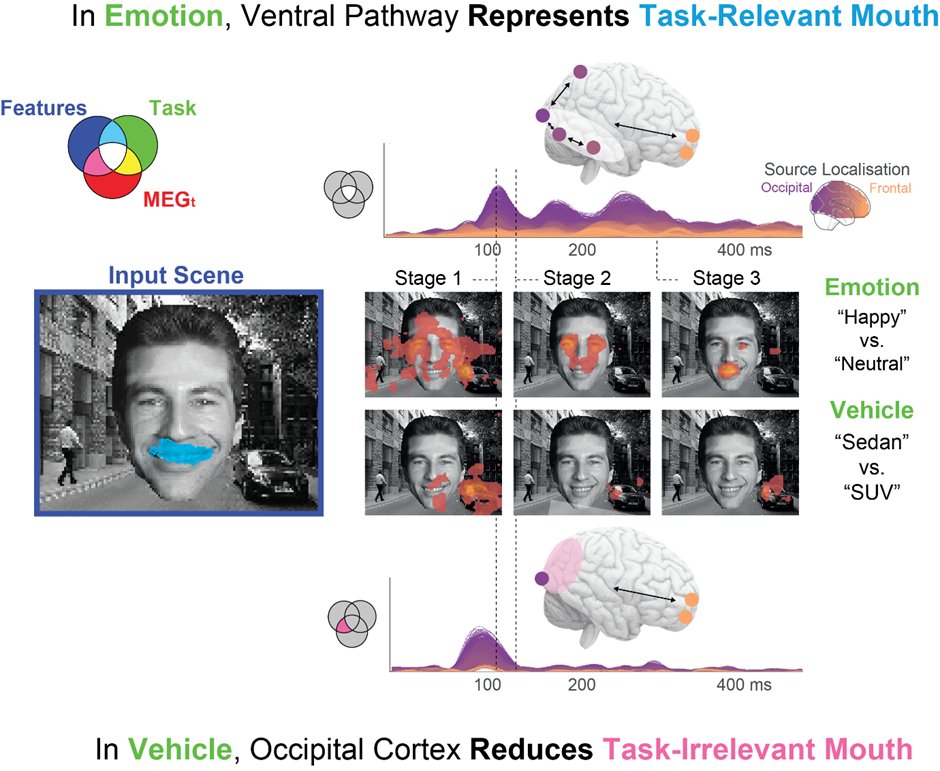
New @CurrentBiology paper from @SchynsPhilippe lab funded by @wellcometrust: “Pre-frontal cortex guides dimension-reducing transformations in the occipito-ventral pathway for categorization behaviors” with @JiayuZhan @Joachim__Gross @drrobinince. We investigate how brain networks actively transform the same complex input scene images into their task-specific lower-dimensional manifolds to support flexible categorization behaviors. Read more from doi.org/10.1016/j.cub.……1/5
Yaocong Duan tweet media
English
2
14
25
3.6K