Human

223 posts

Human

Human

@dumbname27

More of a reader than a tweeter. I periodically delete my tweets and replies. I may use likes to bookmark.

Katılım Mayıs 2013
3.6K Takip Edilen9 Takipçiler
Human
Human@dumbname27·
Human@dumbname27

Here's a counter argument to your post even though I do hold both VVV and DIEM. (Disclaimer: I used ai to help me format my argument) Erik has stated the goal is for VVV emissions to asymptotically approach zero while burns rise above that amount, making VVV net deflationary. But the entire financial model you've built here depends on a non-zero staking APR. The mint haircut is 20% of staking yield. 20% of zero is zero. As emissions decline, the haircut revenue per DIEM declines in lockstep. The "perpetual annuity" has a structurally declining coupon that the founder himself is deliberately driving toward zero. Second, calling the mint haircut "revenue" requires Venice to eventually sell that VVV to someone. Venice has explicitly stated they haven't sold any VVV to date — they're buying more and burning it. If they burn the haircut VVV, that's not revenue, it's supply management with zero direct economic benefit to Venice. If they hold it, it's unrealized treasury value subject to VVV price risk. If they sell it, it creates the sell pressure that undermines VVV price appreciation, which undermines the entire model. Pick one — you can't call it revenue and also celebrate that Venice never sells. Third, the buyback point gets inverted. The actual dollar flow is: Venice earns USD from subscriptions → spends real dollars buying VVV → burns it → VVV holders benefit. That's a subsidy flowing from Venice's USD business to token holders, not profit flowing from tokens to Venice. The mint haircut partially offsets this cost but the net direction of value transfer is from Venice to holders. Fourth, at zero emissions the entire staking rationale collapses. When Venice does buyback burns, that supply reduction benefits every VVV holder proportionally regardless of whether their VVV is staked, unstaked, or locked. As emissions approach zero there's simply no reason to stake VVV at all if you're not immediately minting DIEM — you're accepting a 7-day lockup for zero yield when burns accrue to you equally whether staked or not. Erik's stated goal of emissions approaching zero is fundamentally incompatible with your thesis that DIEM scales profitably via the staking/minting/haircut engine. What Venice actually has is a real USD business generating real revenue, with a token ecosystem that serves as a powerful but subsidized community and marketing layer. The tokens attract attention, build loyalty, and helped recruit talent with early allocations. That's genuinely valuable. But it's an indirect strategic benefit funded by USD revenue, not an independent profit center. Your elaborate equilibrium math seems to work during the inflationary emissions phase. It quietly assumes that phase is permanent. The founder has told us it isn't. x.com/ErikVoorhees/s…

QME
1
0
1
44
G.W. Jackston
G.W. Jackston@galactiator·
"1M $DIEM = $365M/year in compute obligations. Where's the money?" Wrong math. DIEM isn't a cost Venice pays—it's a perpetual annuity Venice collects on. At equilibrium and 1M circulation, the design produces ~$400M/year in net economic margin from DIEM alone, plus another $ 50-200M from broader platform revenue. @AskVenice calls it "a small experiment." If Venice decides to lean in, every $VVV holder is in for the ride of a lifetime.
G.W. Jackston@galactiator

x.com/i/article/2055…

English
1
1
17
807
Human
Human@dumbname27·
Here's a counter argument to your post even though I do hold both VVV and DIEM. (Disclaimer: I used ai to help me format my argument) Erik has stated the goal is for VVV emissions to asymptotically approach zero while burns rise above that amount, making VVV net deflationary. But the entire financial model you've built here depends on a non-zero staking APR. The mint haircut is 20% of staking yield. 20% of zero is zero. As emissions decline, the haircut revenue per DIEM declines in lockstep. The "perpetual annuity" has a structurally declining coupon that the founder himself is deliberately driving toward zero. Second, calling the mint haircut "revenue" requires Venice to eventually sell that VVV to someone. Venice has explicitly stated they haven't sold any VVV to date — they're buying more and burning it. If they burn the haircut VVV, that's not revenue, it's supply management with zero direct economic benefit to Venice. If they hold it, it's unrealized treasury value subject to VVV price risk. If they sell it, it creates the sell pressure that undermines VVV price appreciation, which undermines the entire model. Pick one — you can't call it revenue and also celebrate that Venice never sells. Third, the buyback point gets inverted. The actual dollar flow is: Venice earns USD from subscriptions → spends real dollars buying VVV → burns it → VVV holders benefit. That's a subsidy flowing from Venice's USD business to token holders, not profit flowing from tokens to Venice. The mint haircut partially offsets this cost but the net direction of value transfer is from Venice to holders. Fourth, at zero emissions the entire staking rationale collapses. When Venice does buyback burns, that supply reduction benefits every VVV holder proportionally regardless of whether their VVV is staked, unstaked, or locked. As emissions approach zero there's simply no reason to stake VVV at all if you're not immediately minting DIEM — you're accepting a 7-day lockup for zero yield when burns accrue to you equally whether staked or not. Erik's stated goal of emissions approaching zero is fundamentally incompatible with your thesis that DIEM scales profitably via the staking/minting/haircut engine. What Venice actually has is a real USD business generating real revenue, with a token ecosystem that serves as a powerful but subsidized community and marketing layer. The tokens attract attention, build loyalty, and helped recruit talent with early allocations. That's genuinely valuable. But it's an indirect strategic benefit funded by USD revenue, not an independent profit center. Your elaborate equilibrium math seems to work during the inflationary emissions phase. It quietly assumes that phase is permanent. The founder has told us it isn't. x.com/ErikVoorhees/s…
English
1
0
2
139
Human
Human@dumbname27·
And the gov is the reason the % is even that high Innocent users by default want privacy but don't use tool bc fear when they later sell their funds will get frozen due to AML, impacting the ratio Gov scares away legit volume so absolute value of illicit becomes bigger % x.com/dumbname27/sta…
English
0
0
1
50
L0la L33tz
L0la L33tz@L0laL33tz·
Tornado Cash processed 7B Dollars in transactions in total, of which merely ~15% were found to be of illicit origin. While people across the US are getting kidnapped and held at gun point for owning cryptocurrency on public ledgers, Sen Warren continues to maintain that digital privacy tools are only for money launderers, terrorists, and criminals. So much for consumer protection.
English
5
19
82
2.5K
Human
Human@dumbname27·
Hopefully they do. From my experience good hardware wallet support on mobile across most software wallets is pretty lacking right now. I don't have experience with Infinex specifically. (And I'm not implying supporting several brands of hardware wallets is trivial). Web3 hardware wallet signing on mobile is just not very good right now across the ecosystem, especially if you want to use features like air gapped QR communications or avoid the manufacturer's software wallet.
English
0
0
1
44
David Hoffman
David Hoffman@TrustlessState·
Infinex is legit the wallet I always dreamed of. not sure why more people aren't using it. No hardware wallet. Seamless across devices. txs always execute the first time just needs on/off ramps & a mobile app & I won't need a CEX anymore
English
44
6
137
49.6K
Human
Human@dumbname27·
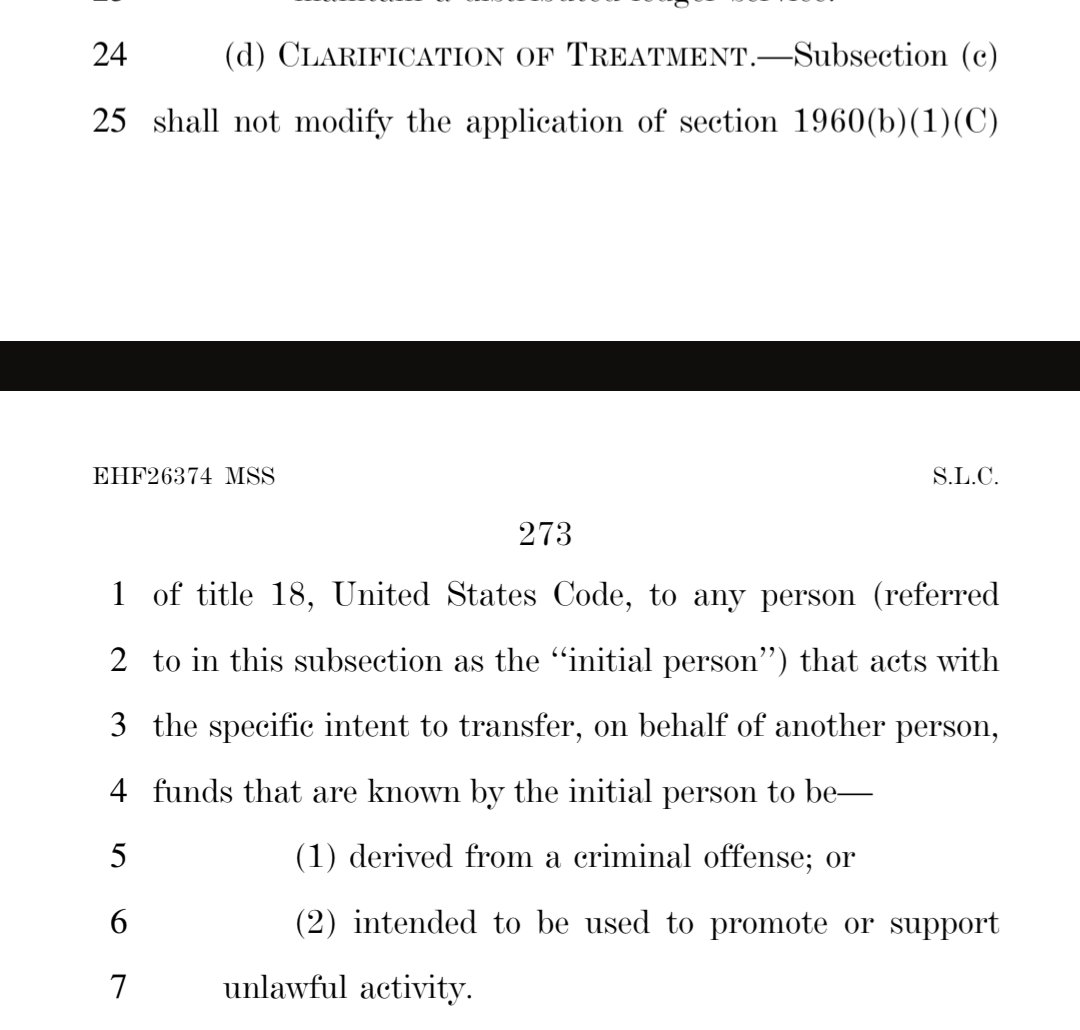
My mind goes to cross chain mechanisms like Near Intents being targeted by this verbiage Zcash's recent super utility is spending privately cross chain. Inevitably some bad actors will try to bridge into Zcash, and that will be the gov excuse to try to resilo Zcash. Cross chain transactions will be the soft spot that gets attacked. That being said I understand the game theory of why passing this vs allowing the status quo to continue into next term makes sense.
English
0
0
0
14
Peter Van Valkenburgh
Peter Van Valkenburgh@valkenburgh·
The new CLARITY draft has a small change to the BRCA. It preserves the ability to charge 1960 ONLY in cases where a person acts with specific intent and knowledge to help someone else move criminal funds. Respond to an email w/ support to launder funds & you are not safe. 1/
Peter Van Valkenburgh tweet media
English
13
38
140
31.5K
Ztacking 🛡️
Ztacking 🛡️@ztackingzats·
.@Ledger has raised nearly $600M and is worth billions. Still no native support for $ZEC. The chain up 1,500% in a year and leading on privacy and quantum resistance.
English
9
6
80
4K
Human
Human@dumbname27·
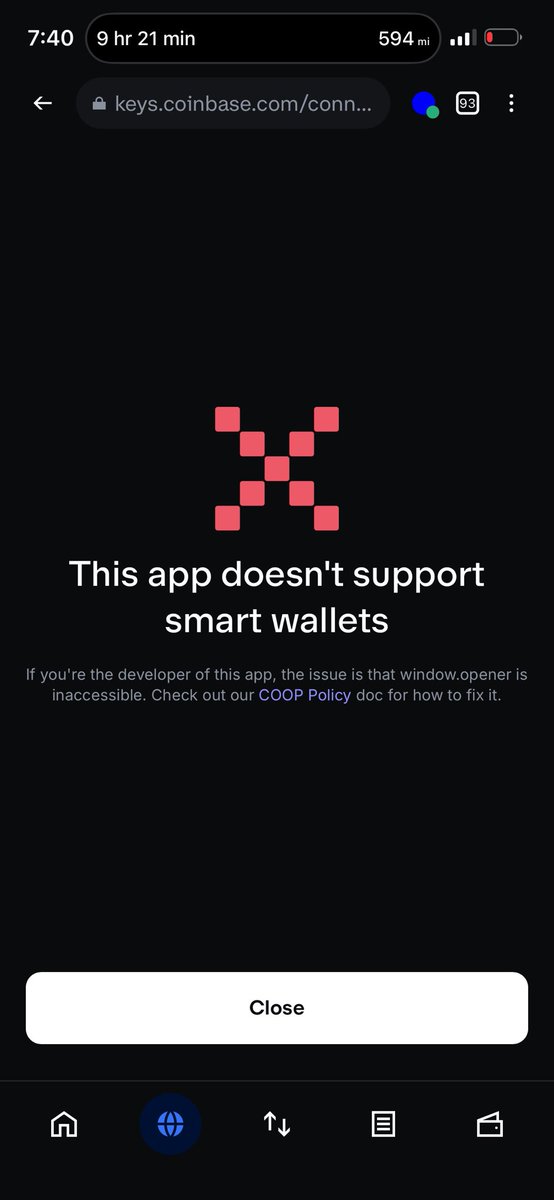
@JosieGibsonBBuk @coinbase @base I'm getting the same issue as well since yesterday. But just says "Something went wrong". Let us know if you get this resolved please.
English
2
1
5
329
Human
Human@dumbname27·
@ErikVoorhees @Jpgs_eth @AskVenice "Automated amount per Pro/Pro+/Max subscriptions ($2, $5, and $10 respectively)" Is that reoccurring for each month they stay signed up, or is it a one time thing when they initially sign up?
English
0
0
1
251
Erik Voorhees
Erik Voorhees@ErikVoorhees·
To be accurate, there is no commitment of "10%" of revenues. Currently the burn consists of two parts: 1. Discretionary amount per month (Venice chooses) 2. Automated amount per Pro/Pro+/Max subscriptions ($2, $5, and $10 respectively) The burn today is the sum of these two venice.ai/token/burns
English
9
3
67
4.9K
Jpgs.eth
Jpgs.eth@Jpgs_eth·
I've never seen tokenomics this clean. $VVV makes money. Real money. And uses it to destroy supply 🧵 — The math is simple: @AskVenice $3.17M monthly revenue → 10% ($317K) buys VVV → Burns it. Forever.
English
10
22
216
12.1K
Human
Human@dumbname27·
@ErikVoorhees Besides founding employee incentives, the token seems beneficial in terms of the virality of the attention it brings to the Venice ecosystem. Those are definitely meaningful benefits of the token to Venice, but I wonder if there's something else I'm missing.
English
0
0
0
130
Human
Human@dumbname27·
When I explain VVV and DIEM to someone, the hardest part is articulating how Venice economically benefits from it. Since you haven't really sold, start up employee equity in the token is the main thing that makes most sense to point to. And for what it is worth the Venice team seems to be kicking ass.
English
1
0
0
162
Human
Human@dumbname27·
@Vladcostea Awesome, thanks. I assume overpaying isn't a big deal since whatever extra that is left can just be used like a gift card for the next visit.
English
0
0
1
39
VLAD HOSTS THE BEST PODCAST IN BITCOIN
Went to chipotle for another bowl beef, brown rice, black beans, corn, cheese & guacamole 🥑 once again paid with Zcash Good thing I’m leaving tomorrow because I might be getting super fat with this diet 😂
English
22
17
171
15.5K
Curtis Yarvin
Curtis Yarvin@curtis_yarvin·
Answers so far: pedophiles, aliens, Jews, Mark Zuckerberg. Best answer, purely on grounds of style not content: “it has a whiff of bagels.” Ok I kind of 20% believe the Zuck part
Curtis Yarvin@curtis_yarvin

What’s wild about this global “age verification” push is that no one even knows who or where it’s coming from. Yet it’s clearly one idea with one source. Real power in “our democracy” has become entirely mysterious. Makes medieval Venice look like a New England town meeting

English
29
4
227
13.5K
Curtis Yarvin
Curtis Yarvin@curtis_yarvin·
What’s wild about this global “age verification” push is that no one even knows who or where it’s coming from. Yet it’s clearly one idea with one source. Real power in “our democracy” has become entirely mysterious. Makes medieval Venice look like a New England town meeting
The Lunduke Journal@LundukeJournal

The full text for HR 8250, the proposed Federal law which would require all Operating Systems to implement Age Verification, has just been made publicly available. It is short, poorly written, clearly not at all thought out, and almost entirely devoid of specifics. Some key points: - The bill does not specify how age verification would work at all. It states that the Federal Trade Commission would have 180 days to specify the exact mechanism and requirements for Age Verification within the Operating Systems. - The Federal Trade Commission would also specify data storage protection requirements as well as requirements for how the Operating System must provide access to collected user data. - This bill would apply to ALL Operating Systems. Everything from Windows to Linux to embedded systems. Yes, even to a smart refrigerator. The “Operating System” definition is incredibly broad. - The law will be considered in effect 1 year from the date it is enacted. - Violations of the law will be handled under the Federal Trade Commission Act. - It is given the “Short Title” of “Parents Decide Act”. congress.gov/bill/119th-con…

English
291
1.1K
6K
270.1K
Human
Human@dumbname27·
@zooko Thanks! Going to sit with this and ponder about it for awhile.
English
0
0
1
18
Human
Human@dumbname27·
Is there a supply threshold you wouldn't want to see the Orchard shielded pool reach in the near term? I <3 seeing Orchard grow and think Ledger shielded support will supercharge it, but I wonder if the turnstile becomes meaningless past a certain point. I'm just treating it as a great unavoidable problem to have and rooting for shielded Orchard pool growth regardless. Letting the Lindy Effect stack and progressively replace the importance of the turnstile.
English
1
0
0
73
zooko🛡🦓🦓🦓 ⓩ
Alex’s mistake in this video clip is just that he didn’t know about turnstiles (aka blast doors). Turnstiles just contained the exposure from exactly the kind of counterfeiting bug he’s imagining here! From $5bn (ZEC mcap) to $6m (Sprout pool): shieldedlabs.net/zcash-vulnerab…
The Rollup@therollupco

Project Eleven CEO (@apruden08) reveals Zcash is not quantum resistant like Bitcoin: "A lot of this ZEC in circulation is not in a shielded pool, it's just public." "And the problem there is, taking advantage of those assumptions means not only can you potentially steal coins, but you can actually mint money and do so in a way that's totally undetectable."

English
6
15
141
12.5K