Mátyás Andorka

3.3K posts

Mátyás Andorka banner
Mátyás Andorka

Mátyás Andorka

@easypocus

consultant in ICM&anaesth.; POCUS: FAMUS+FUSIC supervisor, FUSIC heart, CACTUS lung mentor; regional anaesth.; airway lead; retired ATLS/ETC/ALS/GIC instructor

Redhill, England Katılım Kasım 2018
279 Takip Edilen533 Takipçiler
Mátyás Andorka retweetledi
CardiovascularCorner
CardiovascularCorner@TrackYourHeart·
Striking case of ventricular fibrillation during CPR, followed by successful return of spontaneous circulation
English
7
85
466
59.5K
Mátyás Andorka retweetledi
Dr. Chacón-Lozsán F .'.
Dr. Chacón-Lozsán F .'.@franciscojlk·
🧠 Coma of unknown origin: from chaos to structured diagnosis One of the most challenging scenarios in critical care is not the unstable patient It is the unexplained coma This new review proposes something we have all needed for years: 👉 A stepwise, physiology-driven diagnostic strategy ⚠️ Key shift: from “order tests” → to “follow a structured pathway” The approach is simple in concept but powerful in execution: 1. Stabilize first 2. Identify reversible causes immediately 3. Localize dysfunction clinically 4. Guide diagnostics, not shotgun them 5. Reassess continuously 👉 Coma is not static 👉 It is a dynamic process requiring iterative decisions 🧠 1. Clinical examination is still king Despite all technology: ✔️ Brainstem reflexes ✔️ Motor patterns ✔️ Respiratory patterns → These define localization and urgency 👉 Imaging confirms 👉 Exam directs 🧬 2. Think in two axes: structural vs non-structural This is a critical diagnostic mindset: 🟥 Structural • Hemorrhage • Stroke • Mass lesions 🟦 Non-structural • Metabolic • Toxic • Infectious • Endocrine 👉 First rule Exclude what you can treat immediately ⚡ 3. EEG is not optional anymore A major modern message: ✔️ Detect non-convulsive seizures ✔️ Assess thalamocortical integrity ✔️ Stratify prognosis 👉 Up to 18% of coma patients have subclinical seizures Without EEG, you miss them 🧠 4. CT is first, but MRI is truth ✔️ CT → fast, rules out catastrophic lesions ✔️ MRI → detects subtle and diffuse injury 👉 Normal CT ≠ normal brain 🧪 5. Labs are not routine, they are lifesaving Must not miss: • Hypoglycemia • Electrolyte disorders • Hyperammonemia • Toxic exposures • Endocrine crises 👉 Many “coma” cases are reversible within minutes if recognized early 💉 6. CSF: timing is critical ✔️ Early lumbar puncture when infection suspected ✔️ PCR panels accelerate diagnosis 👉 Delay = neurological damage 🔁 7. Reassessment is the real algorithm This is the most important concept: ✔️ Every intervention changes the diagnosis ✔️ Every hour changes the patient 👉 Recommended early reassessment Every 15-30 minutes initially 🚀 8. The future is already here Emerging tools: • Advanced MRI • Continuous EEG analytics • Automated pupillometry • Multimodal AI 👉 Moving from: Phenotype → Endotype Protocol → Precision neurocritical care ⚠️ Final thought Coma management is not about ordering more tests It is about asking the right question, in the right order, at the right time 📚 Silva S et al. Intensive Care Medicine 2026 DOI: 10.1007/s00134-026-08418-1
Dr. Chacón-Lozsán F .'. tweet media
English
1
16
57
2.6K
Mátyás Andorka retweetledi
Dr. Chacón-Lozsán F .'.
Dr. Chacón-Lozsán F .'.@franciscojlk·
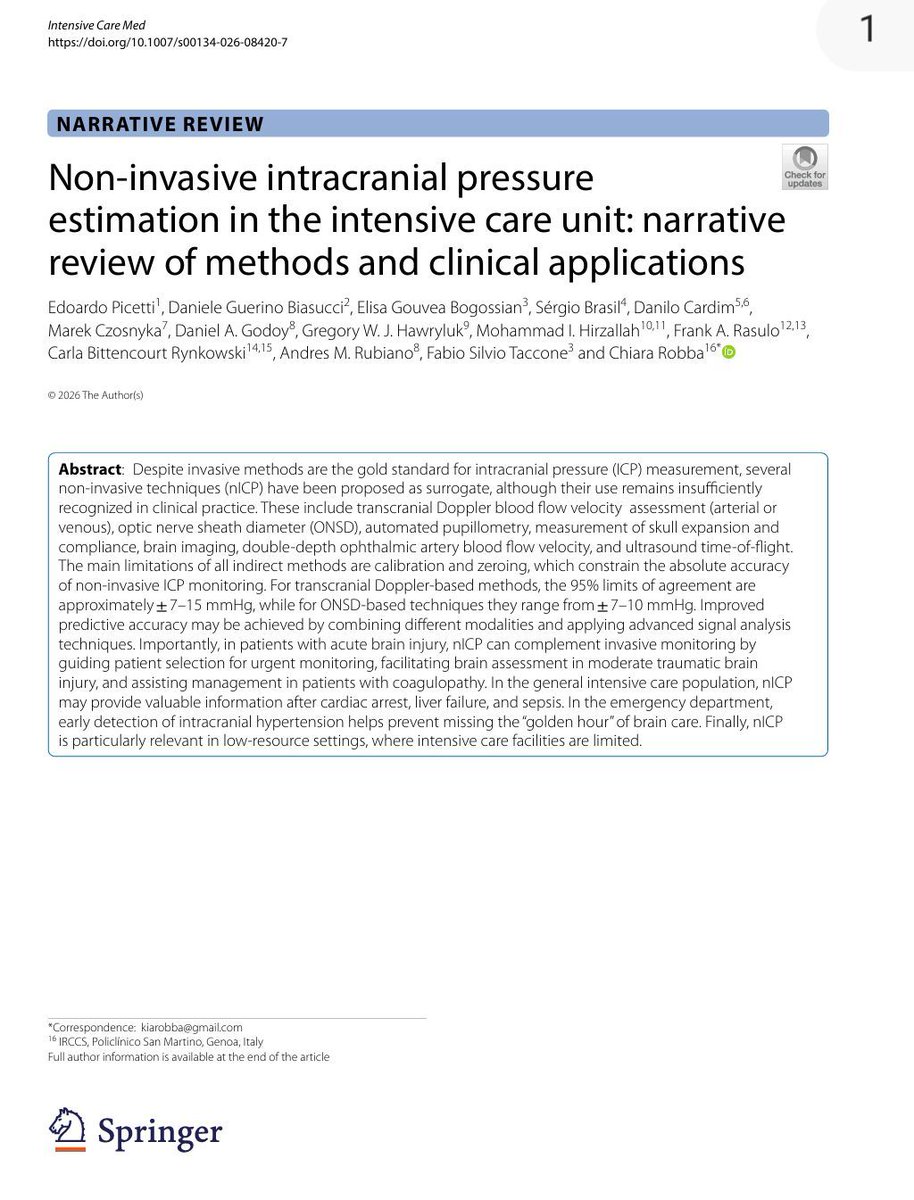
🧠 Intracranial pressure without a catheter? Yes… but not as you think Invasive monitoring remains the gold standard for ICP. But in daily ICU reality: • Contraindications exist • Resources are limited • Decisions cannot wait 👉 This is where non invasive ICP (nICP) becomes clinically relevant ⚠️ First principle nICP is NOT a replacement 👉 It is a decision support tool 🧠 What are we actually measuring? Not ICP directly. 👉 We are capturing physiological surrogates • Cerebral blood flow dynamics • Optic nerve sheath expansion • Brainstem reflexes • Intracranial compliance ⚙️ Main modalities 1️⃣ Transcranial Doppler (TCD) • Pulsatility index • Diastolic flow reduction • nCPP derived formulas ➡️ Best for trend monitoring and screening 2️⃣ Optic nerve sheath diameter (ONSD) • Direct continuity with CSF ➡️ >5.8-6 mm suggests intracranial hypertension 3️⃣ Automated pupillometry • NPi < 3 → concerning ➡️ Reflects brainstem compression, not ICP itself 4️⃣ Skull compliance monitoring (waveform based systems) • P2/P1 ratio ➡️ Gives insight into intracranial compliance, not just pressure 📉 The reality check Accuracy limitations: • TCD: ±7-15 mmHg • ONSD: ±7-10 mmHg 👉 Compare that with invasive ICP: ±2 mmHg 🧠 So why use it? Because it answers a different question: ❌ “What is the exact ICP?” ✔️ “Is ICP probably high, rising, or dangerous?” 🔥 Clinical impact In acute brain injury: • Select patients for invasive monitoring • Detect early intracranial hypertension • Guide urgency of CT and escalation In general ICU: • Cardiac arrest • Liver failure • Sepsis 👉 Brain injury is often silent and underestimated 🚑 In emergency and prehospital care Early detection of intracranial hypertension: 👉 Prevents missing the golden hour of brain care 🌍 In low resource settings This is where nICP becomes critical: • No invasive monitoring available • Limited imaging access 👉 It becomes a lifeline for decision making 🧠 Key takeaway No single method is enough 👉 The future is multimodal nICP • TCD + ONSD + pupillometry • Integrated with clinical exam and imaging ⚡ Final thought ICP is not just a number 👉 It is a dynamic, time dependent physiological process And non invasive monitoring: ✔️ Will not replace invasive tools ✔️ But will redefine how we screen, triage, and monitor patients 📚 Picetti E et al. (2026) doi.org/10.1007/s00134…
Dr. Chacón-Lozsán F .'. tweet media
English
2
22
91
3.9K
Mátyás Andorka retweetledi
Dr. Chacón-Lozsán F .'.
Dr. Chacón-Lozsán F .'.@franciscojlk·
More about VAC in sepsis... 🤓 🫀 Why do some septic shock patients respond to treatment… and others don’t? We often blame: • “Refractory shock” • “Severe sepsis” • “Late presentation” But physiology tells a different story. ⚙️ The real problem: ventriculo-arterial decoupling Septic shock is not only vasodilation or myocardial depression. 👉 It is a failure of interaction between the heart and the arterial system This interaction is called: ➡️ Ventriculo-arterial coupling (VAC) And it defines: ✔️ Cardiac output ✔️ Arterial pressure ✔️ Perfusion efficiency 🧠 What can be often ignored in daily ICU practice You can have: ✔️ Normal cardiac output ✔️ Acceptable MAP ❗ And still have inefficient circulation Because: 👉 Energy transfer from the ventricle to the arterial system is impaired 📉 What happens in septic shock? • Decoupling is common • LV ejection becomes inefficient • Cardiovascular treatments become less effective 💉 Clinical paradox Same intervention. Different outcomes. Example with norepinephrine: 🔵 Patient A → Adequate contractility (Ees preserved) → ↑ arterial tone → VAC improves → ↑ CO 🔴 Patient B → Depressed contractility → ↑ arterial tone (afterload) → VAC worsens → ↓ stroke volume 🔥 This explains a lot of what we see • Why MAP increases but CO drops • Why some patients “fail” vasopressors • Why fluids work in some and not others • Why lactate persists despite “normal numbers” 🧬 Even more important VAC is: 👉 A determinant of treatment responsiveness, not just a descriptor of physiology 📊 Bedside implication We should stop asking only: ❌ “What is the MAP?” And start asking: ✅ “Is the system coupled?” ✅ “Are we improving efficiency or just pressure?” ⚡ Practical shift Instead of protocol-only resuscitation: ➡️ Move toward physiology-guided resuscitation Using: • Ea (arterial load) • Ees (contractility) • VAC (their interaction) 🧠 Final thought Septic shock is not just: ❌ A pressure problem ❌ A volume problem 👉 It is an interaction problem And until we treat it as such: ➡️ Some patients will continue to “not respond” 📚 Pinsky MR, Guarracino F. (2023) Intensive Care Medicine Experimental doi.org/10.1186/s40635…
Dr. Chacón-Lozsán F .'. tweet media
English
2
53
170
7.8K
Mátyás Andorka retweetledi
Nick Mark MD
Nick Mark MD@nickmmark·
TIL a DuCanto catheter can deliver a bougie. Obviously not what you would *plan* to do but useful if you find yourself with suction in the trachea and a contaminated airway. This is also why you need to have TWO suction catheters. Demo at @TheAirwaySite difficult airway course:
English
4
32
183
20.3K
Mátyás Andorka retweetledi
Jamal Ali
Jamal Ali@The_sonoguy·
It’s live 🎉 I built a bowel ultrasound masterclass. Here’s why: 🧵 1/ I’m a gastroenterologist. I scan every day IBD patients, acute abdomens, ward emergencies. 2/ Bowel ultrasound saved my patients from unnecessary CTs more times than I can count. sonoguy.thinkific.com/courses/BowelU… ⬇️
English
1
19
85
5.2K
Mátyás Andorka retweetledi
Dr. Chacón-Lozsán F .'.
Dr. Chacón-Lozsán F .'.@franciscojlk·
💧 DKA resuscitation: Normal Saline vs Ringer’s Lactate, does it really matter? For decades, 0.9% NaCl has been the default fluid in diabetic ketoacidosis. But… is it still the best choice? 🧪 New randomized ICU data (2025-2026) 👉 88 patients with severe DKA 👉 Ringer’s Lactate (RL) vs Normal Saline (NS) 👉 Same insulin protocol 📊 Primary outcome: DKA resolution at 48h ➡️ No difference • RL: 56.5% • NS: 50% (p = 0.66) ⚖️ So… clinically equivalent? Not exactly. The physiology tells a different story 👇 🧠 What RL does better Compared to NS: ✔️ Higher bicarbonate early ✔️ Better potassium levels ✔️ Lower chloride at 48h ➡️ Translation: • Less hyperchloremic metabolic acidosis • Lower risk of hypokalemia • More physiologic acid-base recovery ⚠️ What NS still does ❗ Same DKA resolution speed ❗ Same ICU stay ❗ Same mortality ➡️ So endpoints look “equal”… …but physiology is not. 🚨 Why this matters in real ICU practice Hyperchloremia is not benign: • Worsens metabolic acidosis • Increases respiratory workload • Promotes renal vasoconstriction • Delays recovery And hypokalemia? • Arrhythmias • Insulin resistance • Delayed metabolic correction 🧬 Clinical interpretation This is not about: ❌ “Which fluid resolves DKA faster?” This is about: ➡️ Which fluid creates a better internal environment for recovery 🔥 Take-home message 👉 NS is acceptable 👉 RL is physiologically smarter ➡️ Especially in: • Severe acidosis • High chloride states • Patients at risk of hypokalemia 📚 Trifi A. et al. (2025) Medicina Intensiva doi.org/10.1016/j.medi…
Dr. Chacón-Lozsán F .'. tweet media
English
4
124
375
30.5K
Mátyás Andorka
Mátyás Andorka@easypocus·
What a line - should be adopted by @dasairway : Intubate with a team, not an audience! What do you think? @altgm @dasresidents
Nick Mark MD@nickmmark

Excellent first lecture in the Difficult Airway Course by @jarrodmosier The difference between complicated and complex; a watch is complicated but airways are complex! Human factors are underestimated: the three foot world view can predominate leading to people trying to “plan a harder” Two cardinal rules: 1. Do not wander into failure 2. Intubate with a team, not an audience

English
0
0
2
156
Mátyás Andorka retweetledi
Airway of the Month
Airway of the Month@AirwayOTM·
Visible cords ≠ Ready cords. 👀 April 2026 Airway of the Month is Here! 🔥 Burn airway, Soot-stained secretions, Big suction moment 🎯 Grade 1 view 🚦 But the cords are still moving The move: Get to the target. Hover. Wait if oxygenation allows. Then pass deliberately. View tells you WHERE. Paralysis tells you WHEN. 🔗 kumc.hosted.panopto.com/Panopto/Pages/…
English
6
8
19
1.1K
Mátyás Andorka retweetledi
Nicholas Chrimes
Nicholas Chrimes@NicholasChrimes·
“Struggling to find, synthesize, and connect information is not an inefficiency in the learning process. It is the learning process.” @gabriel_horwitz
Gabriel@gabriel_horwitz

You open ChatGPT. You type the question. A clean, structured answer comes back in three seconds. You read it, it makes sense, you move on. You feel like you learned something. Forty-five days later, a professor walks in and hands you a test you weren't expecting. You don't remember most of it. André Barcaui at the Federal University of Rio de Janeiro ran the experiment to find out if the feeling was accurate. 120 undergraduate business students, ages 18 to 24. All told to spend two weeks researching AI concepts, ethics, societal impacts, technical foundations, and prepare a 10-minute presentation. Sixty used ChatGPT freely. Sixty used textbooks, library databases, articles, and standard web search. Then, 45 days later, with no warning, a retention test. The ChatGPT group scored 57.5%. The traditional group scored 68.5%. Cohen's d was 0.68, a medium-to-large effect. In most grading systems, that's the difference between passing and failing. This is called cognitive offloading. When your brain delegates thinking to an external tool, it reduces the mental effort required during encoding. Effort is what makes memories durable. Struggling to find, synthesize, and connect information is not an inefficiency in the learning process. It is the learning process. ChatGPT removes the struggle and takes the encoding with it. Barcaui calls what the AI group experienced "borrowed competence." The answer was structured, the vocabulary was right, the reasoning felt sound. It just wasn't theirs. And 45 days later, it was gone. The AI group's forgetting curve was steeper and didn't stabilize the way the traditional group's did. The memories weren't just smaller. They were more fragile from the start. You didn't learn it. You borrowed it.

English
0
2
8
824
Mátyás Andorka retweetledi
Difficult Airway Society (DAS)
🚨 Don’t miss your chance to be part of DAS 2026! 🚨 Registration & abstract submissions are open 📍 ICC Wales 📅 11–13 Nov 2026 Join us for cutting-edge education, inspiring speakers & the chance to present your work. Visit das2026.co.uk for details and registration #DAS2026 #Anaesthesia #MedEd
Difficult Airway Society (DAS) tweet media
English
1
7
11
731
Mátyás Andorka retweetledi
NephroPOCUS
NephroPOCUS@NephroP·
#POCUS image of the day: Continuous sweeping transversal scan performed along the right mid-clavicular line. What do we see here? #FOAMed #Nephpearls #CriticalCare Image courtesy: J Clin Monit Comput. 2024, PMID: 38460104.
English
7
31
120
15.8K
Mátyás Andorka retweetledi
bogdana
bogdana@bogster77·
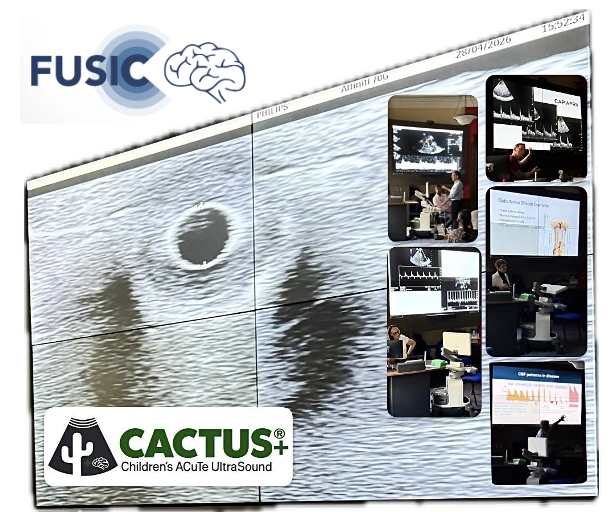
NeuroPOCUS-FUSIC&CACTUS has successfully delivered 2 training cohorts in TCD&ONSD. Co-directed by Dr. Waraich&Dr. Zoica, the courses took place at KCH& provided clinicians with practical, relevant skills to enhance assessment&management of intracranial pathol. in peds&adult pts
bogdana tweet media
English
0
4
11
726
Mátyás Andorka retweetledi
Dr. Chacón-Lozsán F .'.
Dr. Chacón-Lozsán F .'.@franciscojlk·
🫀🤔 Rethinking renal perfusion in critical illness We often default to MAP targets, but this review challenges that simplicity. 🔑 Key insight: Renal perfusion pressure (RPP) = MAP- venous pressure (or CVP/MSFP) → Meaning both hypotension and venous congestion can drive AKI. 📌 What stands out: • The kidney is highly autoregulated… until it isn’t • In critical illness, autoregulatory failure occurs earlier than expected • AKI can develop even with “normal” macrocirculation → microcirculation matters • Fixed MAP targets ignore inter- and intra-patient variability 💡 Clinical implications: • Think beyond MAP → consider mean perfusion pressure (MPP) • Avoid venous congestion (CVP, intra-abdominal pressure, fluid overload) • Move toward individualized perfusion targets • Use multimodal monitoring (Doppler, biomarkers, tissue oxygenation) ⚠️ Bottom line: Renal protection is not just about pressure — it’s about gradients, flow, and congestion. A shift from “one-size MAP” → precision hemodynamics is coming. 📚 Reference Panwar, R., (2025) Annals of Intensive Care, 15, 115. doi.org/10.1186/s13613…
Dr. Chacón-Lozsán F .'. tweet media
English
2
40
115
5.6K
Mátyás Andorka retweetledi
Dr. Chacón-Lozsán F .'.
Dr. Chacón-Lozsán F .'.@franciscojlk·
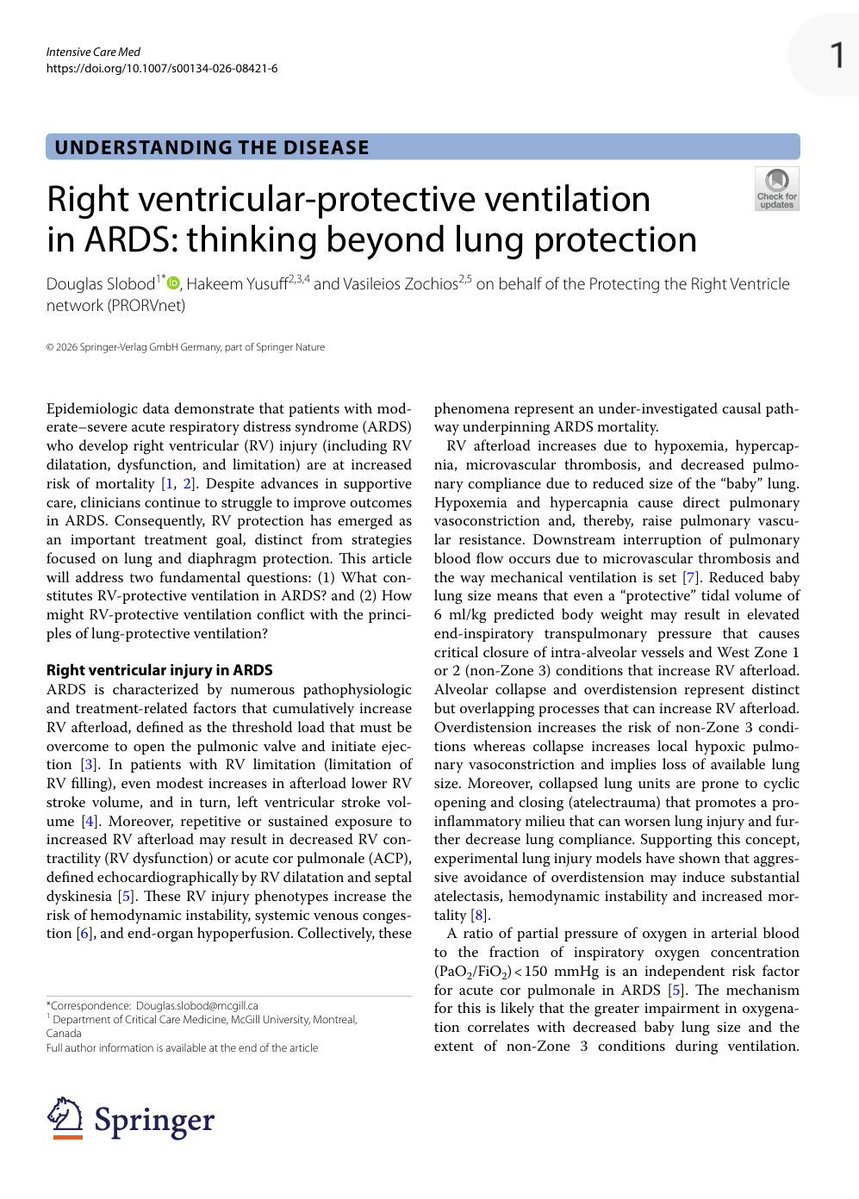
🫀 ARDS is not just a lung disease. It’s a right ventricle disease. ⚠️ And we keep ventilating like it isn’t. 🧠 The blind spot We focus on: ✔️ Tidal volume ✔️ Plateau pressure ✔️ Oxygenation But we ignore: 👉 Right ventricular (RV) afterload 🔥 What really kills in ARDS Not only hypoxemia. 👉 RV failure → hemodynamic collapse → death 💥 Why? ARDS creates a perfect storm: ▪️ Hypoxemia → pulmonary vasoconstriction ▪️ Hypercapnia → ↑ PVR ▪️ Microthrombosis → vascular obstruction ▪️ “Baby lung” → ↓ compliance 👉 Result: 🫀 Massive increase in RV afterload ⚠️ And then we make it worse. 💉 Your ventilator can injure the RV Even “protective” settings: 👉 6 ml/kg PBW can STILL: ❌ Overdistend alveoli ❌ Compress pulmonary vessels ❌ Increase RV afterload 🔥 The paradox Lung-protective ≠ RV-protective Examples: 🔺 High PEEP → better oxygenation BUT → ↑ RV afterload 🔻 Low driving pressure → lung protection BUT → hypercapnia → ↑ pulmonary vasoconstriction ⚠️ You fix the lung… and crash the RV. 🧬 Key concept 👉 RV afterload is dynamic 👉 It increases during inspiration 👉 It depends on HOW you ventilate 💡 What should change Stop ventilating only for: ❌ PaO₂ ❌ PaCO₂ Start ventilating for: ✔️ RV afterload ✔️ Pulmonary vascular resistance ✔️ Cardiopulmonary coupling 🛠️ Practical shift Think: ▪️ Driving pressure (target ↓) ▪️ Recruitability-guided PEEP ▪️ Avoid overdistension AND collapse ▪️ Control hypercapnia (don’t blindly accept it) 🫁 + 🫀 = ONE system 🔥 Game changer 👉 Personalized ventilation based on: ▪️ Lung mechanics ▪️ RV function ▪️ Hemodynamics 🧠 Tools: ✔️ Echo ✔️ EIT ✔️ Esophageal pressure ✔️ Pulmonary pressures 🚨 Final message If you are not monitoring the RV… 👉 You are ventilating half the patient. 🫀 Protect the lung 🫀 Protect the RV 👉 Or you protect neither. 📚 Slobod D. et al. Intensive Care Medicine, 2026 doi.org/10.1007/s00134…
Dr. Chacón-Lozsán F .'. tweet media
English
3
58
196
7.2K
Dr Ihab Suliman
Dr Ihab Suliman@IhabFathiSulima·
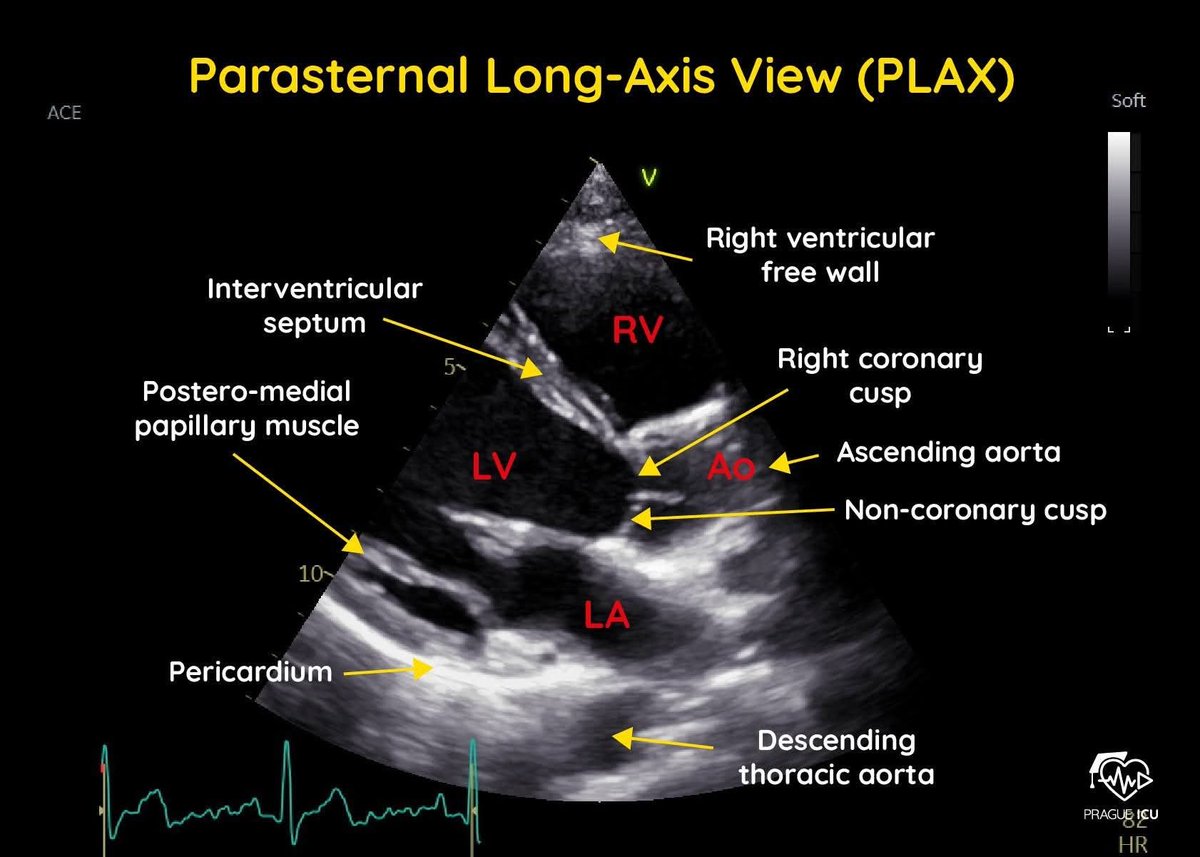
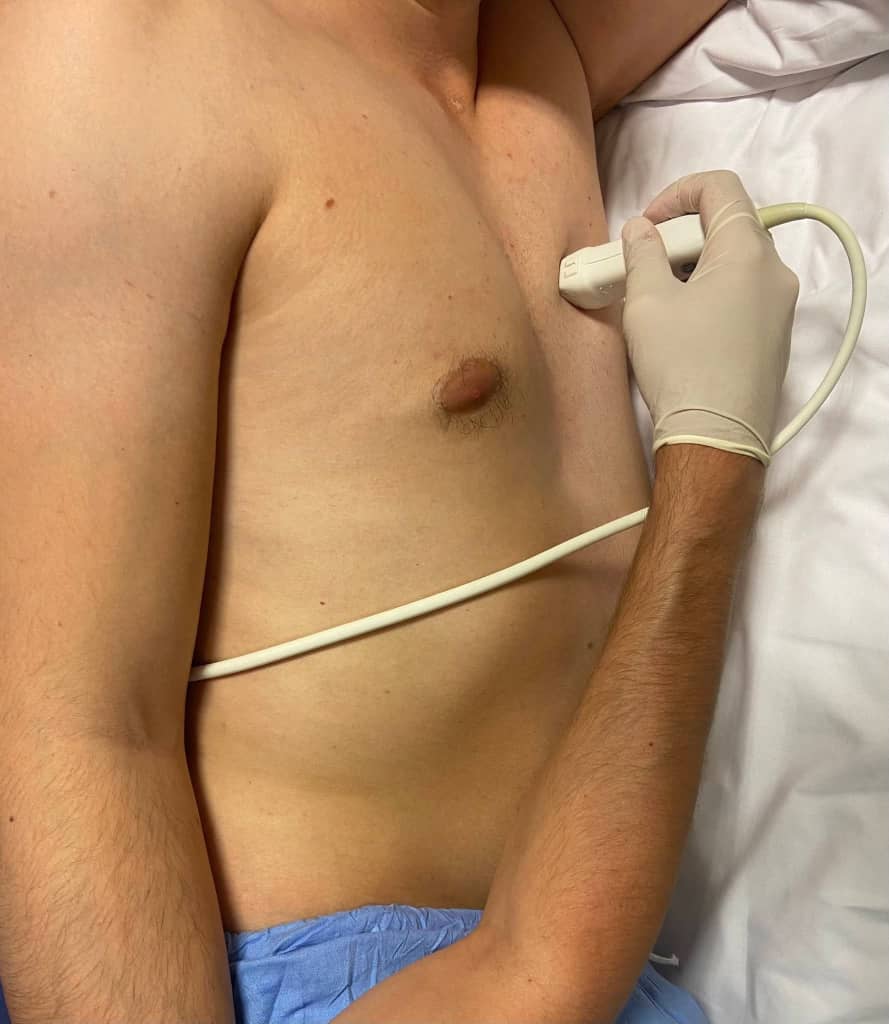
Parasternal Long-Axis Echo View. The most important and initial View of TTE Echo.
Dr Ihab Suliman tweet mediaDr Ihab Suliman tweet media
English
1
24
129
7.2K
Mátyás Andorka retweetledi
Pulmonary-POCUS
Pulmonary-POCUS@HoosierPocus·
Short Clip Week 101 You are performing a suprapubic ultrasound to evaluate decreased urine output in a cirrhotic patient with an indwelling Foley catheter. A nursing bladder scan estimates ~300 mL of urine. What is the white arrow pointing to? Click here to take the challenge pulmonarypocus.com/short-clip-cha… @NephroP
English
1
4
22
6K
Khaled M. Abdullah, MD
Khaled M. Abdullah, MD@Khalemedic·
#POCUS pearl: confirm your wire during CVC placement by checking the IVC. Especially useful for subclavian insertions when you don't get PVCs or you're worried the wire took a detour. #FOAMed #PulmCrit
English
4
9
34
4.4K
Mátyás Andorka
Mátyás Andorka@easypocus·
@FZanouneh @Khalemedic @NephroP @jainPOCUSology @IM_Crit_ (If you can’t ask somebody else to scan) you leave the probe on the patient’s subcostal window. The sterile drape should be large enough to cover, so you can handle the probe through it. When the wire is in, ask an assistant to change the probe on the machine&have a look. #POCUS
English
1
0
1
87
Faris Abu Zaanouneh, MD
Faris Abu Zaanouneh, MD@FZanouneh·
@Khalemedic @NephroP @jainPOCUSology @IM_Crit_ Thanks for the tip! Definitely better than waiting for the CXR to confirm placement. I’ve done plenty of lines but never thought to check the wire in the IVC. Out of curiosity, how do you typically prep the patient to visualize the IVC while keeping things sterile?
English
2
0
1
101