Sabitlenmiş Tweet
Echoes of Eras
398 posts

Echoes of Eras
@echoesoferas1
🕰️ Uncovering history’s most fascinating secrets, forgotten heroes, and remarkable myths.
Katılım Ekim 2025
224 Takip Edilen367 Takipçiler

@Trad_West_Art Your mastery of the English language is nothing short of impressive. I never once before thought I would read this combination of words delivered in a single sentence.
English

You couldn't get two sexually frustrated neckbeard m'lady yeets to fight over this raisin
C3@C_3C_3
The face that emptied 1,000 theatres.
English

#TheOdysseyMovie deserves more consideration than I can possibly put here, immediately post-premiere... But wow. This feels like watershed filmmaking. Simultaneously the most Christopher Nolan movie ever while being completely different to anything he's done before. Simply epic.

London, England 🇬🇧 English

@echoesoferas1 Would you like to be my friend? 🙋🏻♀️🙋🏻♀️🙋🏻♀️
English


@DiscussingFilm Ellen Page is significantly shorter than John Leguizamo.
English

@huynh_tinh1604 x.com/echoesoferas1/…
We’re looking for those who love history.
We’re following back verified accounts.
Echoes of Eras@echoesoferas1
We just hit 300 followers in 72 hours. Thank you to everyone who is passionate about history and has engaged with our content. We are so grateful for your support. Please continue to share and recommend our page. We will continue to build… Ad Astra - To the stars ✨
English

@echoesoferas1 300 followers in 72 hours is solid growth. What’s the content focus?
English


For the first time, scientists have sequenced the entire genome of an ancient Egyptian from the Pyramid Age. The results surprised researchers.
40 years after Nobel laureate Svante Pääbo’s first attempts, researchers have finally sequenced a full genome of a 4,500-year-old Egyptian man (NUE001) found in a ceramic pot. His DNA shatters the myth of isolation, showing 80% North African and 20% Mesopotamian/Fertile Crescent ancestry long before the later famous dynasties.
The 3D facial reconstruction on the right shows the face of an ordinary man who lived between 2855–2570 BCE, during the transition between Egypt's Early Dynastic and Old Kingdom periods.
Why is this a massive scientific breakthrough?
Egypt’s extreme heat, humidity, and the chemical treatments used in mummification are notoriously brutal on ancient DNA, quickly degrading it. While partial sequencing has been done before on more recent remains, mapping an entire genome from the dawn of the Pyramid Age was deemed nearly impossible.
The breakthrough came from an individual excavated in Nuwayrat (south of Cairo). He was buried in a sealed ceramic pot inside a rock-cut tomb. This unique environment perfectly preserved the DNA inside the cementum of his teeth, allowing a team led by Dr. Adeline Morez Jacobs to perform whole-genome "shotgun sequencing."
What the DNA and bones revealed:
The Ancestry Mix: He wasn't completely isolated. While 80% of his DNA traces back to ancient North African populations, a substantial 20% directly links him to the Fertile Crescent and Mesopotamia (modern-day Iraq, Iran, Jordan). This is the first definitive genetic proof of early human migration and deep cultural mixing at the very beginning of Egyptian civilization.
Physical Appearance: Genetic markers indicate he had brown eyes, brown hair, and dark to black skin pigmentation. He stood around 5'2" (157–160 cm) tall.
A Life of Extreme Hard Labor: He lived to a matuzalem age for his time—between 44 and 64 years old. His skeleton shows severe osteoarthritis in almost all joints and vertebrae. Muscle markings on his skull and bones reveal that he spent his entire life leaning forward, looking down, and carrying crushing loads, despite being buried in a high-status ceremonial ceramic vessel.
The full study was published in the journal Nature

English

@StupidManBozo We don’t need impressions. We need real followers who love history. We are building something great.
We’re following verified users.
x.com/echoesoferas1/…
Echoes of Eras@echoesoferas1
We just hit 300 followers in 72 hours. Thank you to everyone who is passionate about history and has engaged with our content. We are so grateful for your support. Please continue to share and recommend our page. We will continue to build… Ad Astra - To the stars ✨

English

@FluxDig1tal It’s interesting to consider. Give us a follow!
English

@echoesoferas1 Whether myth or history, Atlantis has inspired curiosity for over two millennia.
English

It’s Mythological Monday.
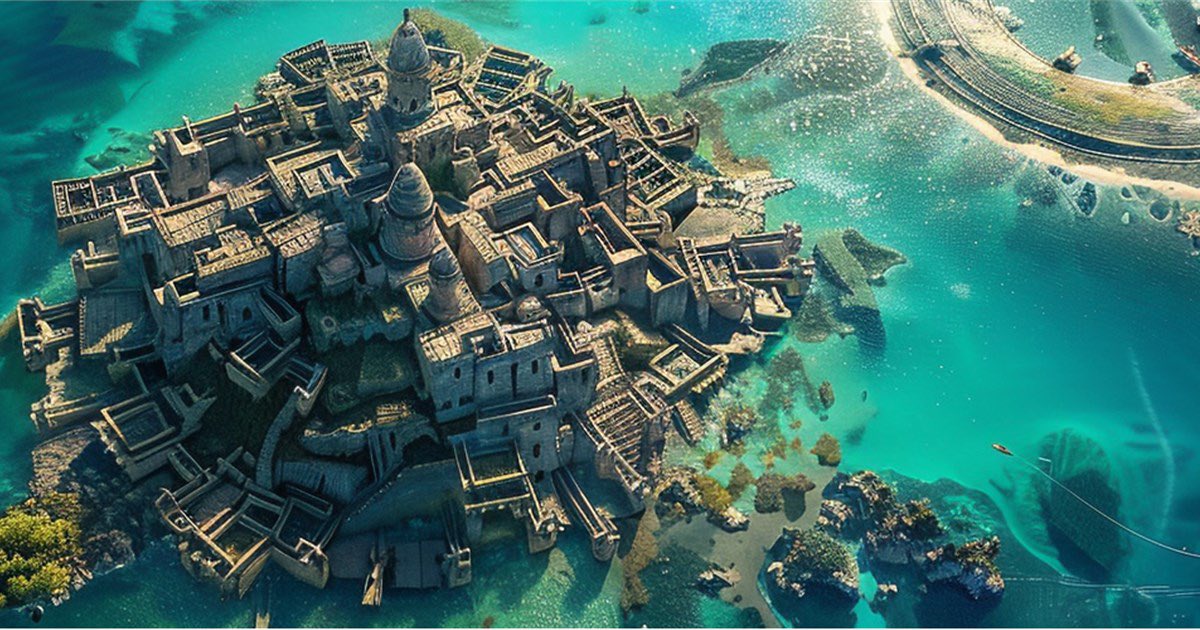
Today we examine the lost civilization of Atlantis.
Plato first described it in his dialogues Timaeus and Critias (c. 360 BC) as a powerful, advanced island civilization located “beyond the Pillars of Hercules” (generally interpreted as the Strait of Gibraltar).
According to the account, Atlantis was a utopian naval empire with concentric rings of land and water, sophisticated engineering, abundant resources, and a society that initially embodied virtue and wisdom. Over time, its people grew corrupt and imperialistic, leading the gods to punish them.
In a single day and night of catastrophe, Atlantis was destroyed, vanishing around 9,000 years before Plato’s time.
Plato used it as a cautionary tale about hubris, the ideal state, and the dangers of excessive power. It wasn’t presented as pure fiction but as a story passed down from Egyptian priests to Solon to Plato’s ancestors—giving it a veneer of ancient authority.
The Azores are one of the more plausible proposed locations for Atlantis among alternative theories, primarily because of their position in the Atlantic, volcanic geology, and dramatic topography. Roughly 1,400 km west of Portugal, clearly “beyond the Pillars of Hercules” in the Atlantic. Plato described a large island/continent in that direction.
While widely regarded as just mythological, it closely aligns with the end of the Younger Dryas period (~11,700–11,600 years ago), a sudden cold snap at the close of the last Ice Age followed by rapid warming, sea-level rise, and significant environmental upheaval.
The story could also draw from the Minoan civilization on Crete and the Thera (Santorini) volcanic eruption in 1600 BC. That event was catastrophic, tsunamis, ash falls, societal disruption and involved a wealthy maritime culture that “disappeared”.
Is it possible Atlantis was a technologically advanced, antediluvian civilization?
Is it a mischaracterization of a much more recent culture?
Or is it myth entirely?
Let us know what you think below 👇
If you liked this post, follow for more history!


English