Jacob Eckel

1.7K posts

Jacob Eckel banner
Jacob Eckel

Jacob Eckel

@eckely

Building software since the last century. From first hire to unicorn - twice. Dropping wisdom one aphorism at a time.

Katılım Nisan 2009
367 Takip Edilen169 Takipçiler
Jacob Eckel
Jacob Eckel@eckely·
@michaelfreedman @martin_casado I’d argue the more important factor is the volume of available training data. That’s why LLMs tend to be far more fluent in JS or Python (and their ecosystems) than in C.
English
0
0
1
23
Mike Freedman
Mike Freedman@michaelfreedman·
My take: I'm guessing at the rise/re-emergence of lower-level languages like C or Go (or something after). Mostly because the key advantage of higher-level languages was to make it easier for humans to write code quickly (and with fewer errors), but that advantage kind of/mostly goes away for agents. And the performance you "gave up" for human programmability as a tradeoff seems less worthwhile if it's not humans writing the code. (The counterargument is that when humans are still doing code review, we'll probably optimize for languages that are still easy to read and understand. But the more we trust the output of agents, the more I think that points toward lower-level languages.) I think you bring up an interesting question about runtime safety, which also might suggest: If you want low-level, why not Rust? My current take is that agents aren't screwing up things like memory safety too much - thats seems like easier thing for them to get right. Plus you can pipe code through good static analysis tools or type checkers ad nauseum, and the robots are tireless at tackling any resulting errors. (And so much less training data with Rust.) But where they screw up is more about semantics. Either they were prompted in an inherently underspecified way (because English is underspecified, or because it's exhausting to be 100% precise), or because they are - at least currently - forgetting to make decisions that align with other decisions/goals in the system. That's probably because they aren't great at managing the full context or prioritizing tradeoffs (again: underspecified). None of these problems seem inherently "easier" in a higher-level language, and something like Rust by itself doesn't solve those either. Long answer. Probably wrong =). It's a wild time.
English
21
9
145
39.8K
Jacob Eckel
Jacob Eckel@eckely·
If ClaudeCode were a person, it would have been fired already. Otherwise, an excellent tool.
English
0
0
0
42
Jacob Eckel
Jacob Eckel@eckely·
@_simonsmith Build vs buy has always been around, and most of the time building is a myopic mistake. AI or not, if the software isn’t core to your business and a solid buy option exists, building it will lose in the long run.
English
0
0
0
43
Simon Smith
Simon Smith@_simonsmith·
I work in a 1,600-person company where we did replace an expensive SaaS product with an internally created piece of software built by a senior engineer using AI. So this is happening. In our case, the software wasn’t just equivalent, but better for our needs. It eliminated features we didn’t need in the original, and added features specific to our use cases that the original didn’t have. We were also able to tightly integrate with our company operating system (think ERP+). Accordingly, I do think the SaaSpocalypse will happen. Jensen’s comments to me are wrong. Would an AI build a hammer if a hammer already existed? Absolutely it would, if the new hammer were more effective and efficient at hammering the specific types of nails the AI was using into the specific types of materials it was using. Most SaaS products aren’t a good fit for companies out of the box but must be configured. But now those companies can just create perfect bespoke software instead of configuring imperfect mass market software. This said, I do still think there will be a need for cloud services to serve all this bespoke software. Things like databases that are a single source of truth will be critical. So parts of the stack aren’t going away. We’ll still need places to safely and securely store and manage data. So it strikes me that a good pivot for software companies is to focus on data and APIs and documentation for AI to build with them. Those are raw materials that AI can use to create bespoke software, like buying wood and iron to build a custom hammer.
English
171
70
792
155.7K
Jacob Eckel
Jacob Eckel@eckely·
I would absolutely pay to read the email Anthropic’s trademark lawyers sent to GitHub the moment they spotted a project called ClawdBot.
English
0
0
0
47
Flapping Airplanes
Flapping Airplanes@flappyairplanes·
Announcing Flapping Airplanes! We’ve raised $180M from GV, Sequoia, and Index to assemble a new guard in AI: one that imagines a world where models can think at human level without ingesting half the internet.
GIF
English
339
255
3.6K
2.1M
dax
dax@thdxr·
i didn't think this would be a big deal or happen so fast but i'm seeing teams nerf their own ability to use their brains because of llm dependence and when they run into a problem the llm can't fix they start doing really weird stuff
English
136
69
1.9K
153.8K
Jacob Eckel
Jacob Eckel@eckely·
@martin_casado Please tell us how you arrived at the 20–30% figure. Measuring software dev productivity with 10% precision is a bigger story than AI.
English
0
0
0
18
martin_casado
martin_casado@martin_casado·
I work with multiple companies where nearly all code is AI generated now. However, the productivity probably has only increased 20-30%. Why? I suspect because writing code is really running code. Changes are the result of a business learnings. Or an operational learnings. For mature companies, the majority of PRs are sub 10 lines codifying these learnings. AI clearly helps here (e.g. debugging, running tests, building tools) but less so. Operations and business learnings are workload and company specific. Until AI can perfectly predict what the market needs, or how a system will be used this bottleneck will exist.
English
116
69
931
276.6K
Jacob Eckel
Jacob Eckel@eckely·
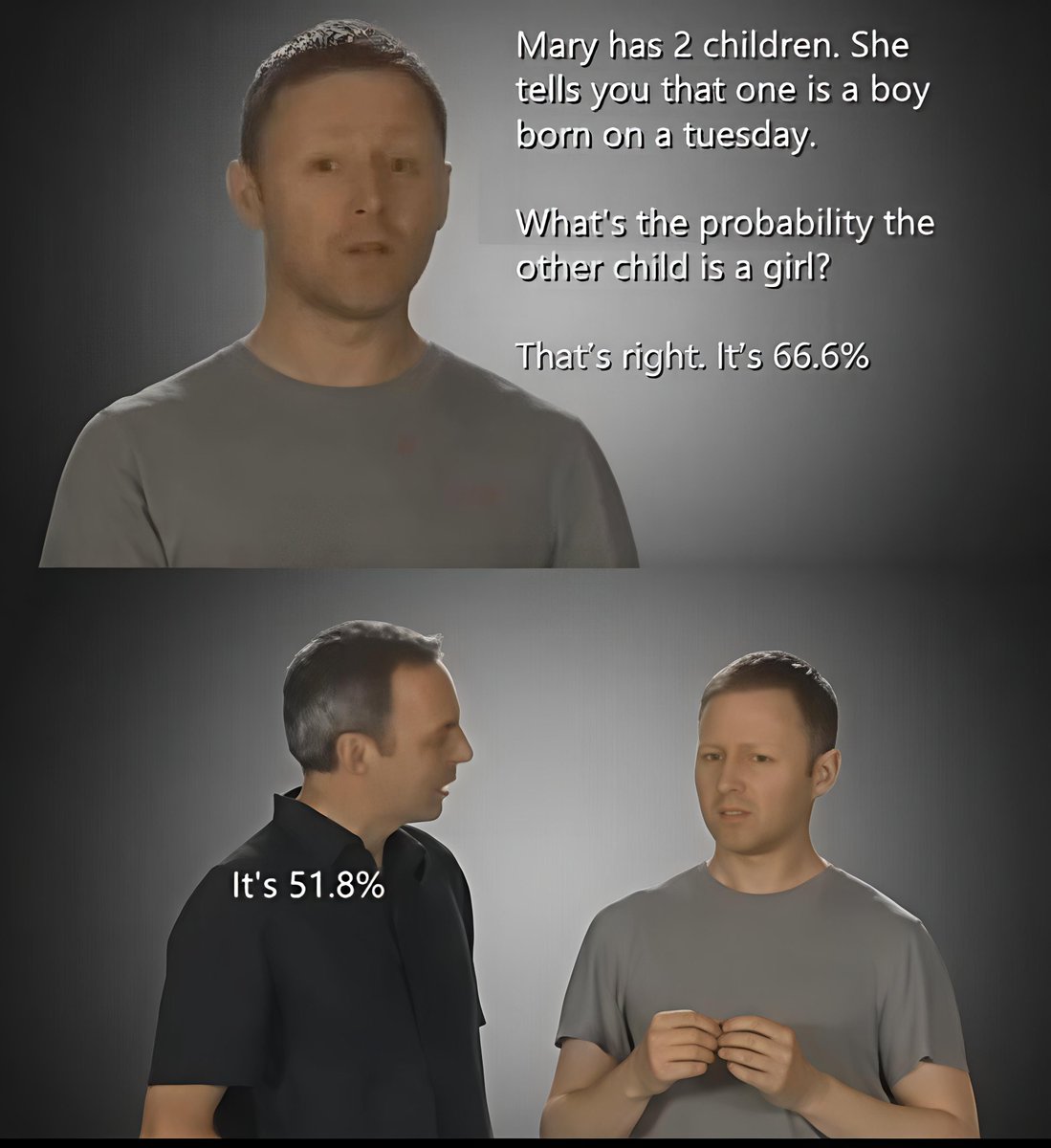
@Math_files Assuming two genders and, at birth, P(boy) = 0.5. There are 4 possible pairs, so: P(same-gender pair) = P(different-gender pair) = 0.5. Given one child is a boy: P(the other child is a girl) = P(different-gender pair) = 0.5. All the rest of the data is irrelevant.
English
0
0
0
7
Jacob Eckel
Jacob Eckel@eckely·
Mosquitoes that eat me in silence, I can understand them. I hate the ones that buzz. The proud ones.
English
0
0
0
29
Jacob Eckel
Jacob Eckel@eckely·
Mary Kay Ash once said, “Everyone has an invisible sign hanging from their neck saying ‘Make me feel important’”. The motto is quite banal except for the word “invisible”. Why is the need for appreciation so often hidden?
English
0
0
0
24
Jacob Eckel
Jacob Eckel@eckely·
Patience is the most Machiavellian trait. Beware, beware of patient people.
English
0
0
0
29
Jacob Eckel
Jacob Eckel@eckely·
Hear me out: Autonomous Teslas should have an Optimus arm for gesture communication with drivers and pedestrians.
Jacob Eckel tweet media
English
0
0
0
35
Jacob Eckel
Jacob Eckel@eckely·
The only thing harder than predicting a black swan is manufacturing a black swan.
English
0
0
0
40
Jacob Eckel
Jacob Eckel@eckely·
@mitsuhiko Not even controversial. Grep, BM25, and whatever else people use for search is the R in RAG.
English
0
0
1
157
Jacob Eckel
Jacob Eckel@eckely·
@paulg To protect free speech, it would be better to proportionally lower the community-note threshold based on how often someone has been noted before. Chronic bullshiters should trigger an instant note.
English
0
0
0
348
Jacob Eckel
Jacob Eckel@eckely·
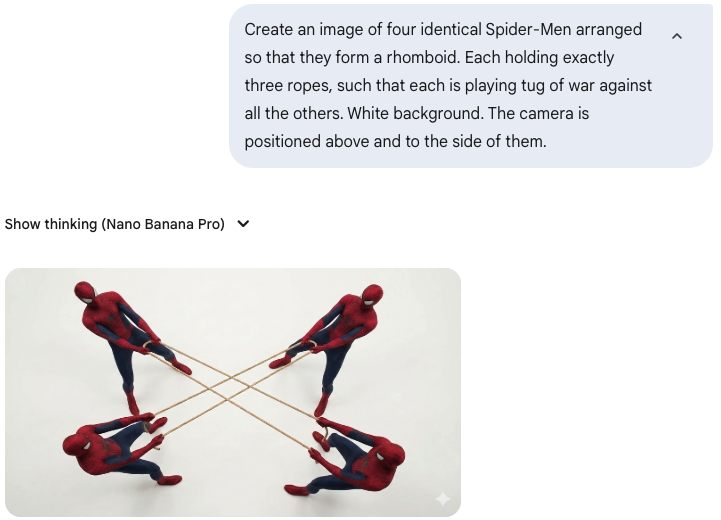
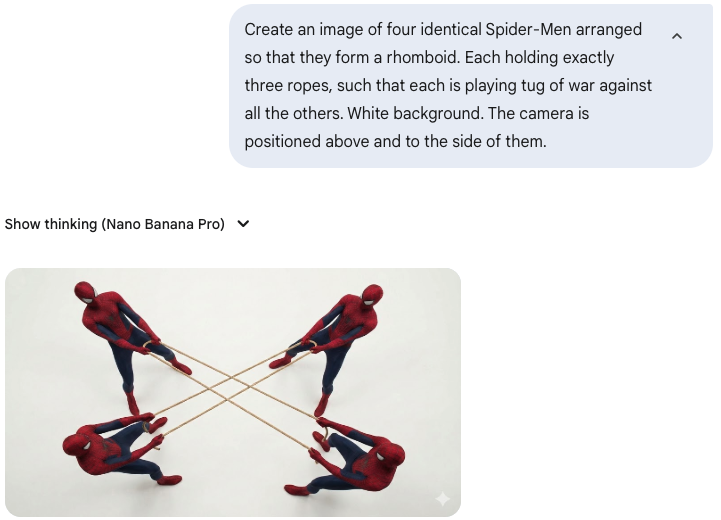
@skirano I would be very cautious with the results, because it cannot count to three yet.
Jacob Eckel tweet media
English
0
0
1
144
Pietro Schirano
Pietro Schirano@skirano·
Nano Banana Pro is wild. Here’s my favorite use case so far: take papers or really long articles and turn them into a detailed whiteboard photo. It’s basically the greatest compression algorithm in human history.
English
146
613
6.8K
1.3M
Google Gemini
Google Gemini@GeminiApp·
Nano Banana Pro is taking off. Here are some standout examples from the community so far 🧵
English
151
346
6.6K
999.1K
Jacob Eckel
Jacob Eckel@eckely·
Most software planning mistakes come from developers semi-deliberately mix up merely annoying with actually time-consuming. We estimate efforts in cognitive dissonance units, not in time units.
English
0
0
1
55
Jacob Eckel
Jacob Eckel@eckely·
If there’s anything I’d bet my life on, it’s that it will happen again. Complexity doesn’t come with safety rails. The theatrical hair-pulling is unnecessary, and the kabuki for the MBA crowd adds nothing. You hit a bug, you fixed it, it took time because systems are messy and intricate. Move on.
Dane Knecht 🦭@dok2001

I won’t mince words: earlier today we failed our customers and the broader Internet when a problem in @Cloudflare network impacted large amounts of traffic that rely on us. The sites, businesses, and organizations that rely on Cloudflare depend on us being available and I apologize for the impact that we caused. Transparency about what happened matters, and we plan to share a breakdown with more details in a few hours. In short, a latent bug in a service underpinning our bot mitigation capability started to crash after a routine configuration change we made. That cascaded into a broad degradation to our network and other services. This was not an attack. That issue, impact it caused, and time to resolution is unacceptable. Work is already underway to make sure it does not happen again, but I know it caused real pain today. The trust our customers place in us is what we value the most and we are going to do what it takes to earn that back.

English
0
0
0
70
Jacob Eckel
Jacob Eckel@eckely·
If there’s anything I’d bet my life on, it’s that it’ll happen again. Complexity doesn’t come with safety rails. The theatrical hair-pulling is unnecessary, and the kabuki for the MBA crowd adds nothing. You hit a bug, you fixed it, it took time because systems are messy and intricate. Move on.
English
0
0
3
2.1K
Dane Knecht 🦭
Dane Knecht 🦭@dok2001·
I won’t mince words: earlier today we failed our customers and the broader Internet when a problem in @Cloudflare network impacted large amounts of traffic that rely on us. The sites, businesses, and organizations that rely on Cloudflare depend on us being available and I apologize for the impact that we caused. Transparency about what happened matters, and we plan to share a breakdown with more details in a few hours. In short, a latent bug in a service underpinning our bot mitigation capability started to crash after a routine configuration change we made. That cascaded into a broad degradation to our network and other services. This was not an attack. That issue, impact it caused, and time to resolution is unacceptable. Work is already underway to make sure it does not happen again, but I know it caused real pain today. The trust our customers place in us is what we value the most and we are going to do what it takes to earn that back.
English
786
1.9K
16.9K
2.6M