Ed
4.2K posts


@MrFlashHQ @Red_wine66 @AndyBurnhamGM Unless you can provide some reasoning for why you are right and the poster is wrong then you are the one who comes across as a loon.
Logic, evidence and reasoning usually help with credibility. Insults? Not so much. You choose your course.
English

@Red_wine66 @AndyBurnhamGM It's not surprising to me that a hard-left loon supports Burnham. The real world is very different to how you think it is. 👍
English


@ricster71 @Deborahw37 @Peston Your memory is very short. It was only last year that Nigel was demanding that Angela Rayner explain the minutiae of her house purchase.
English

@Deborahw37 @Peston I'm aware.
We've still not established the lie you claim he has said or why he has to describe the minutiae of a house purchase when other politicians don't.
Tottenham, London 🇬🇧 English

Reform UK told the BBC that he paid in cash for his £1.4m house in Surrey with his “I’m a Celebrity” fee from ITV and not with the £5m gift from crypto billionaire Christopher Harborne - which Farage says was to provide him with security (physical, not financial). But the ITV “Celeb” fee was £1.5m, which would be £825,000 after tax, for a top-rate taxpayer like Farage. That’s £575,000 less than the price of the house.
And even if the fee was paid into his “Thorn in the side” media company rather than directly to him, it would still be taxable, one way or another
English

@PeterDClack @Satnaai Hyperbole.
The evidence is that the risks are lower than originally thought and certainly much kinder than the effects of equivalent fossil fuels.
euronews.com/2026/04/11/two…
English

By 2050, the estimated total boundary area required for 1.5 million wind turbines is expected to reach 3.1 to 4.6 million square kilometers - the combined size of India and Argentina.
Offshore wind offers no simple escape, either. While these marine turbines are less visible, they are much larger and require even wider wake distances, requiring an estimated 5 to 6 million square kilometers of ocean space to scale up.
The total spanned area for solar is projected to reach 1 to 2 million square kilometers—an area roughly the size of Mexico, accounting for the mandatory spacing between rows to prevent shading.
This massive expansion is driven by a global fleet that is already fast approaching that 1.5 million unit mark, spurred by an installation rate that surged by 40% in 2025 alone. Around 77% of this recent growth occurred in China, which now operates roughly 690,000 turbines. But as this capacity multiplies, the sheer geographic footprint is emerging as a major spatial crisis.
Because turbines require extensive spacing - typically separated by 5 to 10 times their rotor diameter to avoid aerodynamic interference (the 'wake effect') - a wind farm typically spans 30 to 34 hectares per megawatt. Wind acts as a regional net, capturing vast corridors of geography, mountain ridges, and coastlines. This is the zone where migratory paths, scenic vistas, and radar lines are permanently altered.
To be fair, the physical infrastructure itself (turbine bases, power substations, and maintenance roads) takes up a fraction of this space - historically measured at roughly 0.3 to 1.0 hectare per megawatt, or about 1% to 5% of the total spanned area. Yet, even when restricted to this 'direct footprint', the land permanently alienated for equipment drops to about 30,000 to 160,000 square kilometers globally, approaching the size of the British Isles.
While wind farms allow for co-use like farming or grazing between the towers, the broader industrialisation of the landscape remains massive. Access roads cut through pristine mountains, subsoil concrete anchors are poured by the millions, and overhead transmission lines slice through the backcountry.
Where wind spans a region, solar 'farms' completely monopolise the surface. Ground-mounted arrays strip away native vegetation, altering local hydrology and creating localised heat island effects. Solar becomes a structural blanket, entirely displacing ecosystems, sterilising topsoil and locking down hundreds of thousands of square kilometers under silicon and glass.
According to projections by the International Energy Agency, simply tripling global renewable capacity to meet net-zero targets will require allocating an additional 600,000 square kilometers of pristine land to accommodate solar and onshore wind in the near term.
Combined with the $21 trillion grid expansion cost required to connect these far-flung, low-density arrays to distant cities, this planetary-scale geological layer of industrial debris is fast becoming a staggering physical gridlock.

Bega, New South Wales 🇦🇺 English

@PeterDClack You say a wind farm spans 30-34 hectares per acre and then seemingly extrapolate that to all future windfarms. I have pointed out above that the true figure, for current and likely future offshore windfarms, is much lower - 22.
Other posters have pointed out other inaccuracies.
English

@edders51 My post was accurate. Where is it inaccurate?
Bega, New South Wales 🇦🇺 English

It worries me when reports like the one from Adm Cooper don't even mention the c.1000 dhows converted for laying mines
Makes me wonder what to believe...😬
YouTube vid on US weapons burn through to follow later today. I need to get faster, much faster🏃♂️
Navy Lookout@NavyLookout
Latest news article: US Admiral says Iranian navy and its stocks of sea mines have been substantially eliminated navylookout.com/us-admiral-say…
English

@EDDanie86907092 @Wills_42 @FraserNelson @SiSiso077 I'm not sure it's a stretch. He's arguably the biggest politician of the last 20 yrs, everything he does is political.
Does a clever man like Harborne give £5M and expect nothing in return? That is a stretch..
And now story has changed, it's a Brexit reward, so political then!
English

@edders51 @Wills_42 @FraserNelson @SiSiso077 I've read it and can see no reference to Gifts 12 mnths before an election.
publications.parliament.uk/pa/cm5803/cmco…
"Any benefits which relate in any way to their membership of the House or political activities". Farage didn't have any membership of the House. Political Activities? a Stretch...
English

The bigger question: how many more "personal gifts" there have been, to Farage or any other political players?
Does any UK democratic regulator have the power to find out?
Crypto kings now dominate US donations. UK aspect only starting to become clear. comment.press/nf55
Guido Fawkes@GuidoFawkes
Parliament Standards Investigation Opens Into Farage Donation order-order.com/2026/05/13/par…
English

@EDDanie86907092 @Wills_42 @FraserNelson @SiSiso077 Well, that's not what the law says is it?
Firstly, it's not a law but a parliamentary code of conduct.
Secondly, the code says gifts in the 12 months before the election count (with some exceptions).
English

@Wills_42 @FraserNelson @SiSiso077 I defer to your Socratic logic. Never before have I been so rhetorically flummoxed. For you, in simple words:
- Law say "declaration of cash received as MP"
- Farage not MP when cash received.
- Ergo no law broken
- If you no likee you change law
Clear? Or do you need a drawing
English

@ELNVdc @DrDiGiorgio Lots of places in Europe have a very strong food focus. They eat local produce and traditional meals which are often healthy. In the UK our approach is closer to the US and we seem to have obesity rates closer to the US as well.
English

@edders51 @DrDiGiorgio Socioeconomic factors play a part, but poor people in Europe tend not to be as obese as they are here in the US. I think it's the abundance of cheap "food" that isn't food plays a big part.
English

Another midwit healthcare take.
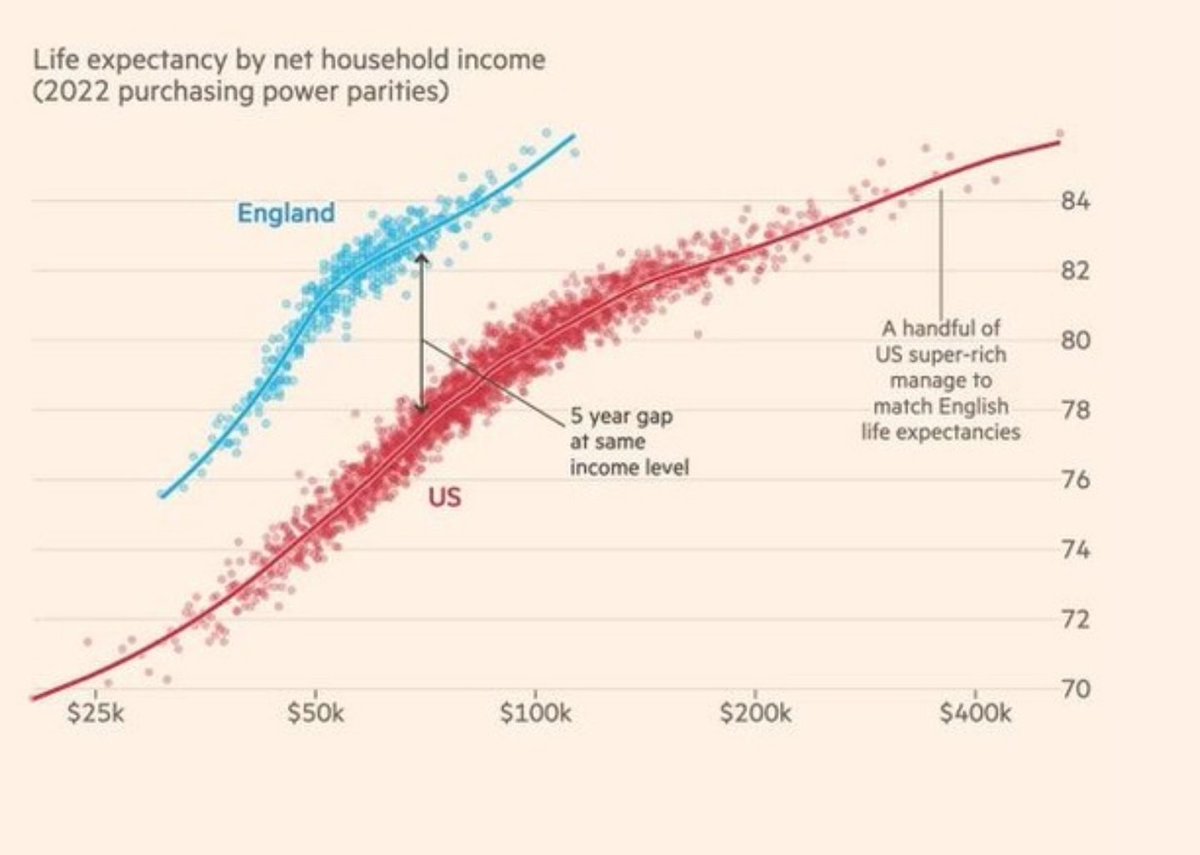
Other countries have better life expectancy than the US. That is not the same as better healthcare outcomes.
Life expectancy is primarily affected by things that kill the young. In the US, that is violent crime, car accients, overdose, and suicide. You can argue that healthcare might be able to influence the last two, but only minimally. Those things are driven by lifestyle choices. Add in our obesity rate, which is also only marginally mitigated by proper healthcare, and you see why our life expectancy is lower than the rest of the OECD.
We are fat, violent, depressed, and like driving on freeways.
Now, if you acutally get sick, there's nowhere else you'd rather be. We have some of the best outcomes in cancer, stroke, heart attack, and trauma. The wealthy from around the globe travel to our hospitals for care. There are entire wings at some prominent hospitals for ultra rich international patients. They aren't going to the NHS for their care.
We excel at coverage for actue care. 98% of Americans are within 90 mintues of a cardiologist who can open up the arteries in your heart in the middle of a heart attack. Meanwhile, in canada, that number is around 80%. They have 10x worse access to acute coronary care than the US.
If you're going to have a heart attack, you want to have it in the US.
If you're going to have any health issue requiring high specialty care, you want to be in the US.
Tony Annett@tonyannett
The rest of the OECD has universal coverage, better health outcomes, and yet spends half what the US spends.
English

@ELNVdc @DrDiGiorgio I think your point about a doctor not stopping them is very on point.
Imo obesity causes medical issues but is not necessarily medically caused. A close look at modern food and the way modern society sets up the food system would help.
English

If people are determined to eat themselves to death there is very little a doctor can do to stop them. At the risk of being called the dreaded r word, race and ethnicity have a lot to do with it. White people are 83% of the UK but only 57% of the US. The US has a variety of subcultures that tend to not concern themselves with obesity and it shows in our health data.
English

@CesarLibranM @clement_molin Also the Italians did not declare war until June 10th, although I'm sure a lot of french troops were tied down defending the border before then.
English

@clement_molin Clement "However, in May 1940, France was the lone country effectively fighting Germans and Italians in Europe : the french army fought but lacked crucial air power, tanks organisation, communication and movement." Again that's not true. The british declared war and sent the BEF.
English

Many people are still often saying "France 🇫🇷 surrender", which is completly ridiculous.
Here is the real version of what happened and why France lost the 6 weeks campaign :
🔹From 1919 to 1939, France was abandonned. It helped central Europe to survive against communists and while Germany was not respecting Versailles Treaty, it was abandonned by the allies (UK, US)
🔹When Hitler entered Rhenania and invaded Austria and Czecoslovakia, no one said anything, France was alone and an intervention was impossible due to internal pacifism.
🔹In 1939, France could have done much better against nazi Germany, especially when it invaded Poland and Norway, that's right
🔹In May 1940, Germany had 2 times more population than France and a way bigger industrial capacity. German military strategy was also younger and better.
🔹However, in May 1940, France was the lone country effectively fighting Germans and Italians in Europe : the french army fought but lacked crucial air power, tanks organisation, communication and movement.
🔹In Dunkirk, the french army fought firmly to allow all the british troops to flee to the UK. Part of the french army was captured to save the british. The UK then refused to send more planes and troops to France. They did help a lot and managed to liberate Western Europe later with other allies
🔹At the same time, the Italian army started attacking the french Alps but got crushed and lost 2 300 men against 37 for France.
🔹What was the Soviet Union doing at the time ? It was an ally of Nazi Germany, it was invading Finland, occupying eastern Poland, Bessarabia and Baltic countries, while supplying Hitler with all the goods he needed.
🔹What were the US doing ? Nothing, they refused to step in the conflict and help their old allies, they waited until 1941-1942 to really step in the conflict.
🔹What were the other european countries doing ? Most were quickly occupied (faster than France), others chose to ally with Hitler and some remained neutral.
There were absolut mistakes in the french decision making and war preparation, while the french soldiers did fight a lot, losing 58 000 soldiers, but repeating "French surrender" is simply ridiculous when you know a bit about history.
The truth is (americans and others) are saying this for France (and not Poland, Denmark, Yugoslavia, Netherlands, Belgium, Luxembourg...) because they hate the fact France decided to be politically independant from the US after the war, not because it is the reality, and that's a shame...

English

@clement_molin @VecKZB I have sympathy with your argument but the British appeasing Hitler is a similar level of trope.
Yes, Hitler was appeased (as France did surrender), but poke beneath the surface and the appeasement was an attempt to give time for belated rearmament.
Everyone messed up.
English

@missD53577909 @Ruby1184659 @RichardGlyn99 @JeffGauch @DrDiGiorgio Yes, but that is not what we are talking about.
He says "socialised healthcare" and the UK NHS is mentioned.
Also we are talking about "dies waiting" and that sort of surgery is rarely done privately in the UK for example. You can't get a private liver transplant eg.
English

@edders51 @Ruby1184659 @RichardGlyn99 @JeffGauch @DrDiGiorgio The dude literally says he waits in line or pays to go private. Openly admitting there is a way to get the care via $$ rather than waiting. That is equivalent to jumping the queue.
English

This is the ultimate midwit healthcare take.
No, 32 countries have not “figured out” universal healthcare.
The UK has “free” healthcare, and roughly 1 in 3 cancer patients in England still fail to start treatment within 62 days of urgent referral.
Canada has “free” healthcare, and the median wait for neurosurgical treatment is around a year.
Australia has “free” healthcare, and over half the country still buys private insurance despite paying for a public universal system with their taxes.
Switzerland has universal coverage, because residents are required to buy private insurance. There is no government system where benevolent bureaucrats tuck you in at night with a warm blanket and an MRI appointment.
The actual lesson from other wealthy countries is not “they figured it out.”
America’s system has huge problems. Our prices are insane, insurance markets are distorted, and hospital systems are cartelized. Our regulations make care more expensive than it needs to be.
Yet we still guarantee access to even the 8% who don’t have coverage. We give easy routes to qualify for medicaid for those with disabilities.
Pretending the rest of the world solved healthcare because they slapped the word “universal” on a rationing scheme is not analysis.
It is bumper sticker policy for people who think access means having a card in your wallet while you wait a year to see the doctor you need.
daz@MetamateDaz
Free Universal Healthcare is so complicated and expensive that only 32 of the 33 wealthiest countries in the world have figured it out.
English

@nikki_goode19 @anon_opin It is illogical to hold the view that the civil service is a blob and also that it will be able to do more with less.
What will inevitably happen is the competent and experienced will leave and the rump will do less with less.
English

Brilliant - out here in the private sector we refer to this as efficiency gains. It’s when a business grows its profitability, by doing more with less.
In respect the civil service, by outsiders looking in, it’s simply referred to as value for money. It’s when the blob does something, as opposed nothing or gets smaller for a change.
English

@ChrisWa16949549 @nxt888 Also my understanding.
Hard to see how plunder grows the global pie, seems like a zero sum game.
English

@nxt888 You've just made all of that up in your head with no evidence whatsoever. The primary power behind the industrial revolution and the increase in GDP was the use of coal.
English

Your argument is: the pie got bigger so India's smaller share isn't evidence of extraction.
My response is:
Who baked the larger pie, and with whose ingredients?
Britain's industrial revolution, the thing that expanded the global GDP denominator you're using to minimize India's declining share, was built with:
Cotton from slave plantations.
Capital from the slave trade and colonial taxation.
Captive markets enforced by colonial military power.
Raw materials extracted at administered prices from colonial territories that were legally prevented from industrializing competitively.
The pie got bigger. Correct.
Britain baked it using ingredients it took from the people now holding the smaller slice.
"The pie got bigger" is not a defense of the baker.
It is a description of what you can accomplish when you have access to other people's kitchens, their ingredients, and the legal authority to stop them from baking for themselves.
OmegaTir@OmegaTir
@nxt888 It didn't go anywhere. The Indian GDP continued to increase during this time. The west started rapid industrialization which grew the global GDP significantly. So, India's slice (though bigger) represented a smaller portion of the world GDP.
English

@Pinkstills2 @DrDiGiorgio Cancer care may be better, that's just one category, I'm talking health outcomes across the board. You could take life expectancy as a proxy for that.

English

@Ruby1184659 @RichardGlyn99 @JeffGauch @missD53577909 @DrDiGiorgio Show your proof.
If you live in a corrupt country it is impossible to believe that other countries are not the same, but that is your own problem.
English

@RichardGlyn99 @JeffGauch @missD53577909 @DrDiGiorgio Why trust you on something you clearly wrong about?
English