
Sabitlenmiş Tweet
Edward Leo
7.9K posts


@marcoetp @Bitwise_Europe @Nasdaq @bitwise Grattis, spännande! Minns när du pratade om Vinter-resan på Fintech Week förra året. Allt det bästa i denna nya roll 👏🇸🇪
Svenska

Jag har anslutit till det fantastiska teamet på @Bitwise_Europe. Och idag noterar vi inte mindre än sju krypto-ETP:er på @Nasdaq Stockholm!
@bitwise är världens största specialiserade kapitalförvaltare inom krypto, med över 15 miljarder dollar under förvaltning från allt ifrån privatsparare till pensionsfonder och suveräna förmögenhetsfonder.
Sverige är ett ovanligt land när det gäller krypto: Vi var först i världen med en börslistad bitcoin-produkt och är idag en av de mest aktiva marknaderna för krypto-ETP per capita. ISK och kapitalförsäkringar på plattformar som @NordnetSE, @avanzabank, @savr och @montrose_io har inte bara gjort oss till erfarna investerare generellt, utan krypto-ETP:er har blivit svenskens favoritsätt att exponera sig mot tillgångsslaget.
Nu rör det sig bland institutionerna globalt: Suveräna fonder i Liechtenstein och Luxemburg allokerar, Harvard och Brown-universiteten är med, pensionsfonder i Michigan och Pennsylvania hoppar på. Och i Norden börjar det röra på sig ordentligt.
Stort tack till @BradleyDukeBTC och resten av teamet på Bitwise.
#finanstwitter
Di Digital@didigital_se
Bitwise, en av världens största förvaltare av kryptotillgångar, lanserar sex kryptofonder på Nasdaq Stockholm. För att locka investerare sänks inledningsvis förvaltningsavgiften på en av bitcoin-fonderna till 0,05 procent. di.se/digital/jatten…
Svenska
Edward Leo retweetledi

I've spent months working on this.
Today, it's live.
If you've ever wanted to understand how encrypted money actually works → this is it.
maxdesalle.com/mastering-zcas…
English
Edward Leo retweetledi

Edward Leo retweetledi

This is well worth watching. HIGHLY recommended as to origins of Bitcoin / Chaum / Hal Finney / Cypherpunks.... Not an endorsement of ZCash.
"I was working on this problem for 12 years, and I saw Bitcoin. I thought it couldn't work. I thought the problem was mathematically unsolvable"
-- Zooko
Zcash Media 🛡️@zcashmedia
Satoshi's Last Wish - The Full Story 00:00 Intro 00:41 Before Bitcoin: The Failure of DigiCash 01:37 The 12-Year Struggle: Cypherpunks vs. The Centralization Problem 03:01 Enter Bitcoin: Satoshi’s Proposed Solution To The Centralization Problem 05:20 Early Days: Bitcoin’s First Blogpost & Satoshi’s Webpage 10:07 Bitcoin’s Major Flaw: The Second Problem Satoshi Wanted to Solve 12:31 Satoshi Proposes A Solution To Bitcoin’s Privacy Problem 14:03 What Did Satoshi Mean By A More Useable Version of Bitcoin? 17:20 Passing The Torch: Solving What Satoshi Couldn’t
English
Tune in (20 mins to go) before our inventor, @hewesterberg, goes live pitching as one of the top 30 teams out of 1500+ worldwide on World Computer Hackathon League 🌱
More to come @MultiCurrencyIO
ICP HUBS NETWORK@ICPHUBS
🔵 Next up : Round 3 of projects pitches starts in 2 hours Live on X OHMS - Kenya, dorahacks.io/buidl/27898 RhinoSpider - Canada, dorahacks.io/buidl/29942 Satsurance - Canada, dorahacks.io/buidl/27197 ChatterPay - Argentina, dorahacks.io/buidl/27599 Prometheus Protocol - Canada, dorahacks.io/buidl/28691 Identify - Canada, dorahacks.io/buidl/28713 Hosty.live - Canada, dorahacks.io/buidl/29189 DAOPad - Canada, dorahacks.io/buidl/29497 PetID - Brazil, dorahacks.io/buidl/29953 Multi - Canada, dorahacks.io/buidl/30050
English
Edward Leo retweetledi

Edward Leo retweetledi

A recent reflection, based on conversations with economists and policy leaders, is that there are two superficially similar but importantly different perspectives one can hold with respect to US manufacturing:
* Affinity for manufacturing and physical production is an anachronistic fetish, embodied by populists with outdated attraction to hard hats and clanging forges. A great deal of manufacturing has departed the US, which is certainly fine and probably even quite good. It's unpleasant labor, and countries ought to each specialize in their respective comparative advantages.
* Manufacturing is the ultimate network effects and economies-of-scale business. As services are substituted by AI, and as datacenter deployment accelerates, the relative importance of manufacturing is likely to grow. To think that one can pick and choose sectors in which one will excel ("let's win in drones but not in dishwashers") is a fallacy. Manufacturing is hence of paramount strategic importance. However, we don't know how to make the US the world's preeminent manufacturing power (given its cost base and given the current center of gravity in China) -- indeed, we don't know whether it's even possible -- and this is a significant strategic problem for the country.
I have zero direct expertise here, but my outside view is closer to #2 than #1: it seems that the ecosystems and supply chains create strong gravity across the board. I also asked @elonmusk, who has clearly done more over the past decade to advance sophisticated US manufacturing than anyone else, and this appears to be his view. Most economists, on the other hand, are much closer to #1, and I don't think that the economics profession considers the absence of good ideas for reviving US manufacturing to be a problem of particular significance. (There are lots of snide epithets about the efficacy of industrial policy.) It seems to me that there's even some amount of backwards reasoning happening, where, because we don't know how to do #2, #1 is subconsciously a much more comfortable position to hold.
Talking about winning particular manufacturing sectors feels to me a bit like talking about winning individual biological research sectors or winning particular software sectors. That is: it seems that the strong default assumption should be that "the place that is best at biology research sector X will also be best at sector Y", and similarly in software, because the skills and inputs needed are so transferable. As such, my guess is that if the US seeks meaningful sovereignty or preeminence in any of drones, robotics, solar, batteries, pharma, etc., we need to bite the bullet, and win at manufacturing across the board.
Overall, I'd love to read more arguments for and against these perspectives, particularly from those with direct expertise.
English
Edward Leo retweetledi

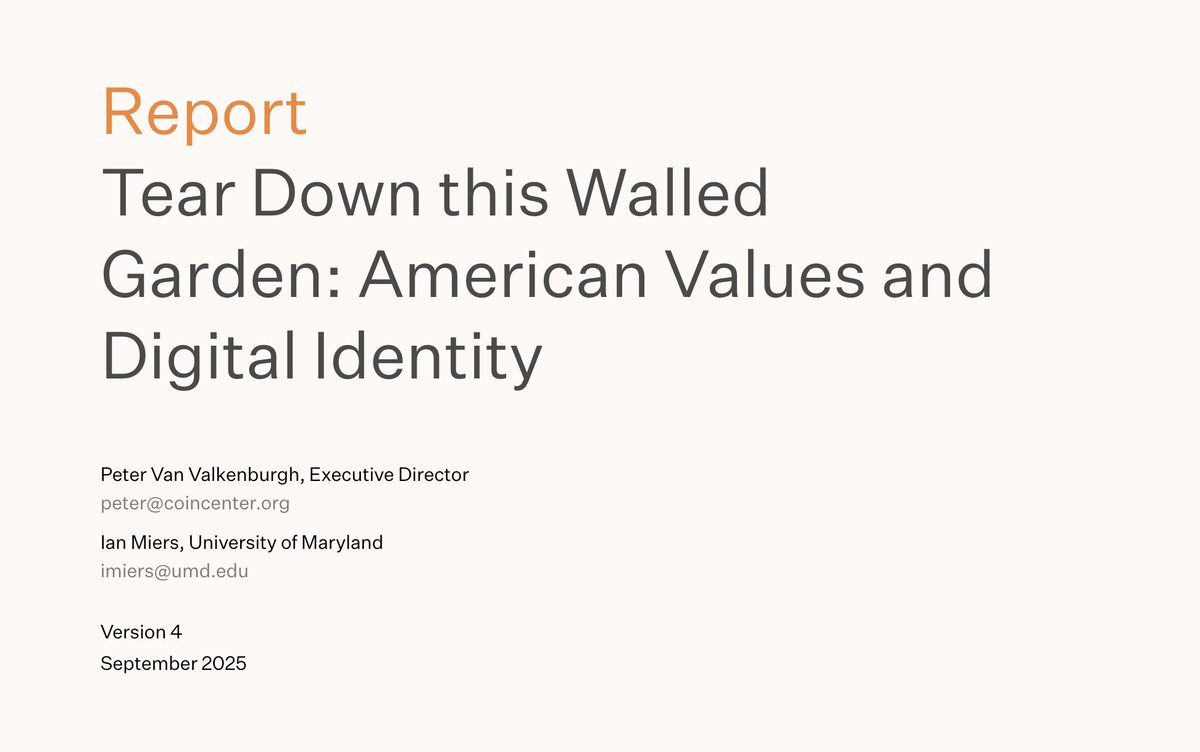
New Coin Center report on digital identity by myself & Ian Miers:
AML/KYC is ineffective, costly, causes breaches/hacks, and jeopardizes our democracy. Tech from crypto can protect American values in ID.
We call for a new initiative, the John Hancock Project, to show the way.
English
@TheiaResearch Interesting convo, very important convo, and even more interesting conclusion
I'd like to also extrapolate this to risk-taking where net edge is becoming increasingly more valuable, whilst what was seen as safe will become less so...
English

A friend (thoughtful, academic type, reads the newspaper) recently asked me why I preferred to talk about topics where I was on the wrong side of expert consensus (like BTC, Internet Finance).
His point (probably true) is that while experts can often be wrong, you are likely to be right >50% of the time by starting with expert views and then adjusting from there.
I told him that markets people make the best returns when they are contrarian and being on the wrong side of expert consensus is usually correlated with low consensus / high payoff opinions.
You want to max Edge i.e max the sum of log2(your probability/market probability). It's pretty hard to max edge by finding 80% probability opinions that you think are 85%. You want to hunt in underpriced markets / low consensus opinion space.
The interesting thing is that most people are not attempting to max Edge at all but min Brier i.e. (your probability - outcome)^2. So if you say there is an 80% that it rains tomorrow and it rains, your Brier Score is (1-0.8)^2 = 0.04 and had you said "No Rain" it would have been (0-0.8)^2 = 0.64. Lower is better.
If your relationship to predictions is basically [saying your opinion to friends / going on TV / writing articles] then you just want to be right pretty often especially when you say you are confident. That directly translates to min Brier.
That makes a ton of sense! Who wants to be the guy who is edge maxxing by betting on 5%s he thinks are 20%s but is basically wrong about 80% of everything he ever says?
The guy who wants to make money, that's who. Min Brier is a disaster for returns. Portfolio growth is directly proportional to edge and orthogonal to brier.
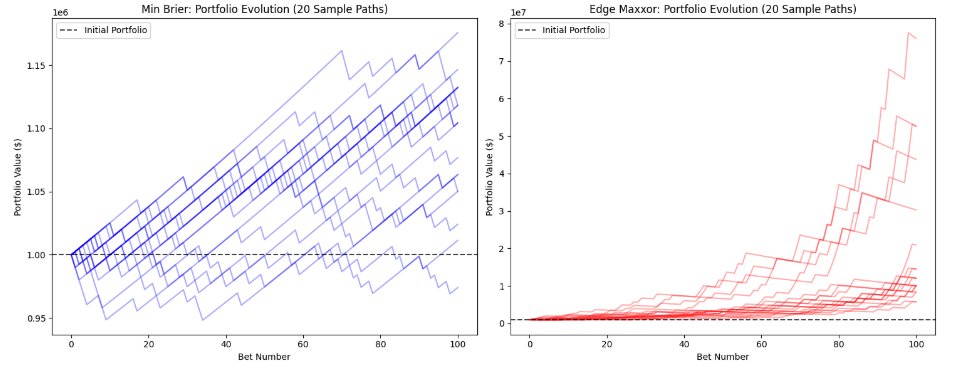
here is a 1000 sim monte carlo comparing a min brier guy who is right 85% of the time (consensus 80%) and an edge maxxor who is right 20% of the time (consensus 5%).
min brier:
mean final portfolio: $1.07m
mean return: +6.6%
win rate: 85%
max drawdown: –3.6%
prob of loss: 10%
edge maxxor:
mean final portfolio: $19.9m
mean return: +1,889%
win rate: 20%
max drawdown: –14.4%
prob of loss: 0%
English
Edward Leo retweetledi

Crypto prediction market crash course #1 (1 hr read) 📚
You're going to want to bookmark this one. From the history of bookies to on-chain order books, trading strategies, oracle risks, and why prediction markets matter far beyond “gambling.” I’m catching up on these 6 pieces, they’re the best written articles I’ve found so far to grasp what's going on right now in this fast-moving space.
Big claps to the writers!
@nikarpit_ @factcheck1ntern @FabianoSolana @splinter0n @Defi_Warhol
English

As an Italian (now American) my most controversial opinion is:
NY Pizza > Italian pizza.
I mean… just look at it.

English
There is research, and then there is research.
knowerofmarkets is onto something here, meriting genuine thought.
knower@knowerofmarkets
I'd like everyone to go read the Valis Research Manifesto We are coming to an internet near you very soon valisresearch.xyz
English
I'd like everyone to go read the Valis Research Manifesto
We are coming to an internet near you very soon
valisresearch.xyz

English
We do a lil reading. Thanks for putting together, Michael! (see link in his comments)
michaellwy@michael_lwy
Comment below if you want access to this Prediction Markets reading list
English
Edward Leo retweetledi

Introducing ETHConf: Ethereum's Conference 📷
@ETHGlobal is thrilled to bring 5,000+ attendees shaping the future of Ethereum to New York City in early June 2026.
Join founders and builders, 200+ speakers, and 100+ exhibitors for 3 days dedicated to exploring what's next for Ethereum.This is where Ethereum's next chapter begins.
Join the waitlist → ethconf.com
English
Edward Leo retweetledi

Echoing something @karpathy recently said, it does frustrate me how a lot of AI development is trying to be as "agentic" as possible, when actually creating *more* paths for human input both creates a better output (now for quite a while going forward) and is better for safety.
English

Tarun Chitra's words from that @SuccinctLabs stream simply won't leave my head. he said something that I think reframes the entire purpose of L2s and ZK tech
this isn't about "faster and cheaper"
what @tarunchitra said...
"...if ETH mainnet has ZK as a first class citizen, you'll be able to do this type of stuff, like using your collateral on mainnet somewhere else without bridging"
he contrasted this with the current state of affairs, where bridging assets creates unnecessary friction and risk:
"why can't I just bridge any spot asset over, why do I need to like have this separate protocol that like does verification and still relies on the multisig effectively"
What This Actually Means:
- we’re used to our assets "living" either on L1 or on a specific L2. to move them, we use a bridge. this is not only risky (bridges are the #1 target for hacks) but also inefficient. your funds get locked into one ecosystem.
Tarun’s idea turns this model on its head
imagine your 10 ETH are sitting in your wallet on the ETH mainnet. they don't move. but you need a loan from a DeFi protocol on an L2. instead of bridging your ETH to that L2, you simply generate a ZK proof that cryptographically confirms: "this address on L1 holds 10 ETH, and they are locked as collateral." the L2 protocol sees this proof and issues you the loan. your assets remain under the security of the most robust blockchain, but they are productively working elsewhere.
Why This Changes Everything
- The Death of Bridge Risk: if assets never leave L1, there's nothing to steal from a bridge. the most vulnerable part of the infrastructure simply becomes obsolete. this improves the security of the entire ecosystem by an order of magnitude.
- Maximum Capital Efficiency: your assets are no longer fragmented. the same 10 ETH sitting on L1 could simultaneously serve as collateral in dozens of L2 applications. its like the money in your bank account working in three different investment funds at the same time without ever having to be moved. your capital becomes universal and hyper-efficient
- True Composability & Interoperability: this is the holy grail everyone talks about. L2s can talk to each other not through clunky workarounds, but through a shared, absolutely reliable source of truth—L1. a protocol on one chain can instantly and trustlessly verify your financial state on another. this enables highly complex DeFi strategies that are simply impossible today.
Simplification for Everyone: for the user, the ethereum ecosystem becomes a unified whole. no more headaches choosing a bridge, paying liquidity fees
For devs, it means they can build their L2 applications counting on access to all of ethereum's liquidity, not just what users have bothered to bridge to their specific chain.
Succinct@SuccinctLabs
Succinct Mainnet Livestream x.com/i/broadcasts/1…
English
Edward Leo retweetledi

Ethereum’s endgame architecture:
> ETH Mainnet: the liquidity layer for high value assets
> ETH L2s: the high-octane execution layers
Institutional grade asset security with zero downtime or counterparty risk; customizable execution across an ecosystem of L2s
Powered by ETH.
jaehaerys 🪽@0xJaehaerys
Tarun Chitra's words from that @SuccinctLabs stream simply won't leave my head. he said something that I think reframes the entire purpose of L2s and ZK tech this isn't about "faster and cheaper" what @tarunchitra said... "...if ETH mainnet has ZK as a first class citizen, you'll be able to do this type of stuff, like using your collateral on mainnet somewhere else without bridging" he contrasted this with the current state of affairs, where bridging assets creates unnecessary friction and risk: "why can't I just bridge any spot asset over, why do I need to like have this separate protocol that like does verification and still relies on the multisig effectively" What This Actually Means: - we’re used to our assets "living" either on L1 or on a specific L2. to move them, we use a bridge. this is not only risky (bridges are the #1 target for hacks) but also inefficient. your funds get locked into one ecosystem. Tarun’s idea turns this model on its head imagine your 10 ETH are sitting in your wallet on the ETH mainnet. they don't move. but you need a loan from a DeFi protocol on an L2. instead of bridging your ETH to that L2, you simply generate a ZK proof that cryptographically confirms: "this address on L1 holds 10 ETH, and they are locked as collateral." the L2 protocol sees this proof and issues you the loan. your assets remain under the security of the most robust blockchain, but they are productively working elsewhere. Why This Changes Everything - The Death of Bridge Risk: if assets never leave L1, there's nothing to steal from a bridge. the most vulnerable part of the infrastructure simply becomes obsolete. this improves the security of the entire ecosystem by an order of magnitude. - Maximum Capital Efficiency: your assets are no longer fragmented. the same 10 ETH sitting on L1 could simultaneously serve as collateral in dozens of L2 applications. its like the money in your bank account working in three different investment funds at the same time without ever having to be moved. your capital becomes universal and hyper-efficient - True Composability & Interoperability: this is the holy grail everyone talks about. L2s can talk to each other not through clunky workarounds, but through a shared, absolutely reliable source of truth—L1. a protocol on one chain can instantly and trustlessly verify your financial state on another. this enables highly complex DeFi strategies that are simply impossible today. Simplification for Everyone: for the user, the ethereum ecosystem becomes a unified whole. no more headaches choosing a bridge, paying liquidity fees For devs, it means they can build their L2 applications counting on access to all of ethereum's liquidity, not just what users have bothered to bridge to their specific chain.
English