Ben Harrell 🌐

16.4K posts

Ben Harrell 🌐 banner
Ben Harrell 🌐

Ben Harrell 🌐

@elben

Asst Prof of Economics @Trinity_U | health insurance, health policy, & health disparities. Abundance bro. Past: @vanderbiltecon @LGBTPolicyLabVU and @aysps

San Antonio, TX Katılım Mayıs 2008
3K Takip Edilen4.9K Takipçiler
Ben Harrell 🌐 retweetledi
Ben Harrell 🌐
Ben Harrell 🌐@elben·
@wwwojtekk We may never step in the same river (or policy regime) twice, but sometimes they're close enough to motivate good inference. History rhymes!
English
0
0
1
83
Ben Harrell 🌐
Ben Harrell 🌐@elben·
@AlexCaswen @tbsama03 I think there’s a strong case to be made for preferential admission of young men into college for this reason. The point of putting your thumb on the scale is to ensure outcomes map onto the population distribution.
English
2
0
2
24
Alex Caswen
Alex Caswen@AlexCaswen·
@tbsama03 @elben I don’t see how anyone thought reducing quotas below demographic percentages was possibly sustainable for society, or even moral university students are now 60% female, and have have been >50% since the 90’s
English
1
0
1
36
Noah Smith 🐇🇺🇸🇺🇦🇹🇼
I've always been against racial discrimination of any kind. But because I got into (and out of) academia before this started, and because I've never really worked a corporate job, I didn't know how widespread it was. No one really talked about it until the 2020s.
T. Greer@Scholars_Stage

This piece is justly being shared around. All I will add is this: if you want to understand the venom behind DOGE, the attacks on academia, and the grants being cut across the government... this is the thing to read, really. This is the main reason that all is happening.

English
329
38
889
626.4K
Ben Harrell 🌐
Ben Harrell 🌐@elben·
@RuxandraTeslo A genuine question: would course correction from several generations of white male dominance over all other groups not empirically look like a decline in the relative power of white men? Was that not the entire point of improving the prospects of women and minorities?
English
0
0
2
110
Ruxandra Teslo 🧬
Ruxandra Teslo 🧬@RuxandraTeslo·
I think discrimination against white men in academia, especially humanities, is a big deal. But, arguably, an even greater source of discrimination is one's political opinions. Anything slightly right of centre is punished imo more than race, gender etc..
English
41
37
841
99.7K
Ben Harrell 🌐
Ben Harrell 🌐@elben·
@tbsama03 @Noahpinion Yeah. I think we should have priced this kind of stuff into our mental model. Not in a “nothing to see here way,” but in a “this was to be expected” way.
English
1
0
0
32
Ben Harrell 🌐 retweetledi
John Cawley
John Cawley@cawley_john·
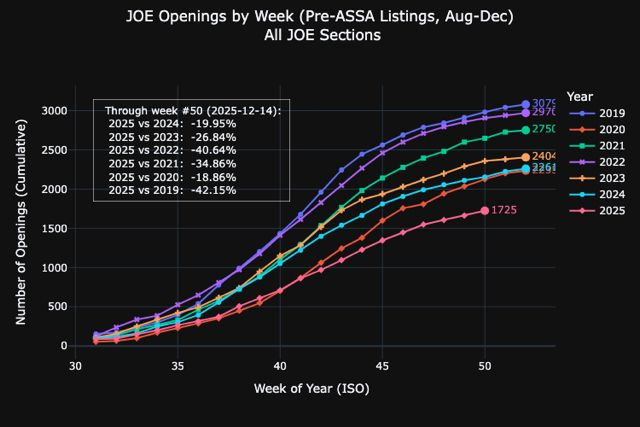
One last (sobering) update on the #EconJobMarket before the winter holidays; data as of 2025-12-14. In terms of # of job listings on JOE, this is the worst job mkt in recent yrs for PhD Economists. # jobs down 20% from last yr, even 18.9% lower than during COVID (2020).
John Cawley tweet media
English
2
12
77
36.8K
John A. List
John A. List@Econ_4_Everyone·
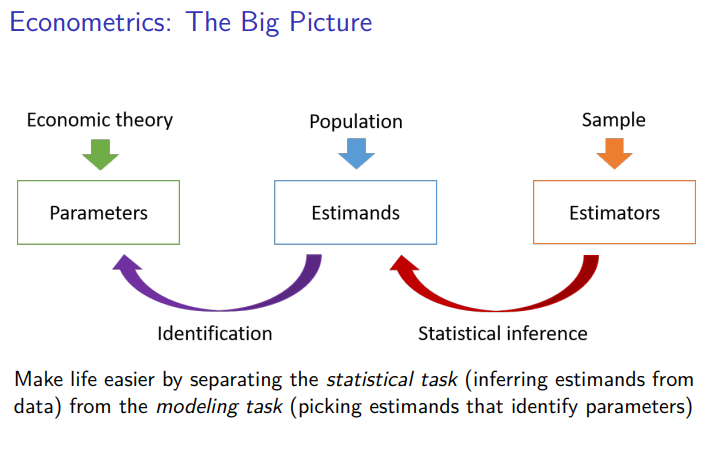
I saw the below picture over on the always astute @instrumenthull. When I used to teach Econometrics, I followed this very approach: econometrics involves three distinct objects and two distinct intellectual tasks. This framework is also beautiful in that it reveals exactly why experiments are so powerful. With observational data, the identification arrow is where all the heavy lifting happens. You want to know a causal effect (your parameter), but you can only observe correlations in the data (potential estimands). The gap between correlation and causation is the identification problem. Random assignment cuts through this problem by construction. When you randomly assign people to treatment or control, you guarantee that the two groups are comparable on average, not just on observables, but on everything, including things you cannot measure.
John A. List tweet media
English
8
59
356
21.4K
alz
alz@alz_zyd_·
tl;dr: causal inference is a kind of prediction because causal inference is just trying to predict the effects of policy interventions
English
5
1
12
4.8K
Ole Peters
Ole Peters@ole_b_peters·
@LughSpear The circularity is this: Joan places a brick. A: moving bricks must have utility for her. B: Why is Joan moving bricks? A: It has utility for her. B: Ah. Evolutionary arguments are an alternative: a house prolongs Joan’s life. Prediction: we may find her moving bricks.
English
5
0
5
178
Ben Harrell 🌐
Ben Harrell 🌐@elben·
@Jeepadaapa @alz_zyd_ Yes, you need continuity, which also ends up being a MOSTLY reasonable assumption as well except in a few circumstances (lexicographic prefs being the usual example).
English
1
0
1
32
Käyttäjänimi
Käyttäjänimi@Jeepadaapa·
@alz_zyd_ Since you explicitly mention MWG, they write in ch. 1: "[...] can any rational preference relation be described by some utility function? It turns out that, in general, the answer is no."
English
1
0
0
129
alz
alz@alz_zyd_·
"People are not rational optimizers!" All consistent rule-based behavior (this can be formalized) looks like it's maximizing an objective function. This is in MWG chapter 1. It's also in a sense the basis of Lagrangian mechanics in physics
alz tweet media
Shahin Ashkiani@shaahin_a

This is from an AEJ paper (2025). To model decision-makers (i.e. people), they assume that: 1.Everyone maximizes their utility 2.Utility = consumption How do they know people actually do that? They don’t and they don’t care about reality. (Other shots are from Romer2016)

English
22
11
161
20.9K
Chasing Ennui
Chasing Ennui@rwlesq·
@alz_zyd_ The disconnect here tends to be that people are rational, but imperfect maximizers, though sometimes only to a local maximum.
English
2
0
0
328
Ben Harrell 🌐
Ben Harrell 🌐@elben·
@jagmavi @alz_zyd_ It ultimately boils down to two conditions: 1.) Preferences are complete. 2.) Preferences are transitive. If you can show that those two conditions hold, in expectation, for most allocations, then agents are roughly rational.
English
0
0
0
39
Jagdeep Mavi
Jagdeep Mavi@jagmavi·
@alz_zyd_ In my behavioural econ course we were taught economic rationality boils down to seeking out more of what brings pleasure, less of what doesn't. Even infants engage in utility maximization.
English
3
0
3
596
Ben Harrell 🌐
Ben Harrell 🌐@elben·
@psycholing @Afinetheorem Econ is for sure the exception. Half my cohort failed our micro theory qualifier and I got a 57 on my first exam (which ended up being a B-). But econ is also unique in that an undergraduate degree in economics is insufficient preparation for a graduate degree in economics.
English
0
0
1
48
psycholing
psycholing@psycholing·
@Afinetheorem How long ago? Things may have changed, or maybe econ is an exception. I've done linguistics & psychology. As a prof, I was pretty much barred from failing someone out.
English
1
0
4
1K
Kevin A. Bryan
Kevin A. Bryan@Afinetheorem·
An unpopular take, but grad school attracts a ton of hard-of-themselves, type-A, neurotic people with very accomplished parents. Half of them, all As their whole life, will be in bottom half of their class. Solution: realize you're paid to LEARN WHATEVER YOU WANT. It's great! 1/3
Arpit Gupta@arpitrage

These results suggest that getting a PhD causally worsens mental health, or at least receiving psychiatric medicines. The reversal post PhD degree is particularly convincing. But the up trend among the control group is intriguing. The highly educated are in distress.

English
13
37
816
88.9K