Ellie Murphy

497 posts

Ellie Murphy banner
Ellie Murphy

Ellie Murphy

@elliemurphy

Founding Student @UAustinorg. Alpha fellow @AlphaSchoolATX. Living the story of someone broken being made whole. https://t.co/rcFSed8dRd

Katılım Aralık 2024
75 Takip Edilen72 Takipçiler
Ellie Murphy
Ellie Murphy@elliemurphy·
@LloydLegalist there is a lot of truth here, but its also important to remember that God is not limited by our selfishness and desire to please the world. He can work through the mega church. People can still come to know Him. If that's not hopeful, I don't know what is.
English
1
0
6
288
Jane Dough
Jane Dough@JaneDough2345·
@ick_real No, they stay because just like anything else their phone starts showing them stuff about suicide lol
English
1
1
7
1.1K
`
`@ick_real·
Do suicidal people stay because of hope?
English
962
387
4.9K
239.7K
Ellie Murphy
Ellie Murphy@elliemurphy·
Lent is a lesson in this. We try to muscle our way through simple fasts, but fail. If we can't even cut out something simple for 40 days, why should we expect ourselves to be able to secure our own salvation?? We can't. It is something we must simply receive. And this applies to much more than just the big "securing salvation".
English
0
0
0
28
Lysa TerKeurst
Lysa TerKeurst@LysaTerKeurst·
We are often so busy trying to achieve what God simply wants us to slow down enough to receive.
English
1
13
124
2.8K
Sonia Katara
Sonia Katara@soniakatara·
Nobody's Watching You.
English
1
1
6
95
Ellie Murphy
Ellie Murphy@elliemurphy·
@JoshuaBarzon We long to be seen, but it's vulnerable. The conflict between this desire and the fear of this desire being satisfied can be in such conflict that it literally feels like a war is raging in your soul.
English
0
0
1
81
Josh Barzon
Josh Barzon@JoshuaBarzon·
One of the most beautiful names of God in Scripture is El Roi. “The God who sees me.” Hagar spoke these words in the wilderness after God met her in her distress. Even in the places where we feel forgotten or unseen, God sees, hears, and cares. Genesis 16:13
Josh Barzon tweet media
English
8
180
971
12.3K
Darshak Rana ⚡️
Darshak Rana ⚡️@thedarshakrana·
Your smartphone may be performing 2.6 million calculations per second while you scroll, but your brain can only hold 7 pieces of information in working memory at once. That mathematical mismatch explains why every creative professional you know complains about having “no time to think” despite consuming more information than any generation in human history. Dr. Sophie Leroy at the University of Washington discovered something she calls “attention residue.” When you switch from consuming content to creating something, fragments of what you just consumed continue processing in the background of your mind. Her team showed this happening. The prefrontal cortex lights up with activity that has nothing to do with the creative task at hand. You think you’re writing an original email after checking Twitter, but your brain is still running calculations on twelve different conversations you scrolled past. You think you’re solving a design problem after watching YouTube, but part of your mental processing power is still trying to complete thoughts that belonged to strangers. The implications of this research demolish the entire way we think about inspiration and creative input. Every writer, designer, and entrepreneur believes they need to “stay informed” to stay creative. They follow industry blogs, consume case studies, track competitor moves, and absorb thought leadership content because they’ve been told that creativity comes from combining existing ideas in new ways. The attention residue findings suggest the opposite is true. The more frequently you interrupt your mental workspace with external input, the less processing power you have available for original combinations. Your brain doesn’t combine ideas. It gets trapped trying to finish processing ideas that were never yours to begin with. Real creativity happens in the cognitive space between problems, when your mind has nothing to react to and starts making connections that don’t exist in any external source. But that space has to be protected like a crime scene. One notification, one article, one podcast episode can contaminate it for hours. Watch what happens to your thinking patterns when you eliminate information input completely for 72 hours. Most people can’t do it. The withdrawal is physical. Your brain has learned to outsource its entertainment to external feeds, and when those feeds disappear, the silence feels unbearable. But around hour 48, something remarkable occurs. Your internal monologue stops being commentary on things you’ve read and becomes a conversation with ideas that have no clear source. You start building mental models instead of consuming them. You start asking questions that don’t have obvious answers instead of seeking answers to questions other people already asked. I read somewhere that Maya Angelou kept a hotel room with nothing in it but a bed and a notepad because she discovered her best writing happened when her mind had nowhere to go but inward. Tesla could design entire machines in his head and run them mentally for weeks to test for flaws because his cognitive workspace wasn’t cluttered with input from other inventors. Consumption and creation compete less for time and more for same neural pathways. Every piece of content you absorb trains your brain to expect external stimulation instead of generating internal signal. Your best work isn’t waiting for better information. It’s waiting for less information to get in its way.
Darshak Rana ⚡️ tweet media
DAN KOE@thedankoe

The more "informed" you feel, the less capable of thinking you become.

English
15
123
433
27.9K
Ellie Murphy
Ellie Murphy@elliemurphy·
@Lovandfear Rewiring the brain is so hard--it's like forcing yourself to destroy and rebuild a main transportation system by which you understand and get around in the world.
English
1
0
0
81
🍂
🍂@Lovandfear·
No one tells you how hard it is to rewire your brain to allow amazing things to happen after experiencing trauma or pain. Blessings exist, good people exist, and a softer life exists. Let it happen.
English
31
409
1.7K
34.7K
Pascal
Pascal@KnowsPascal·
He's just like me.
English
34
310
3.1K
91.8K
Ellie Murphy
Ellie Murphy@elliemurphy·
@uaustinorg Or just go to UATX where you have no escape from this way of education.
English
0
0
1
30
University of Austin (UATX)
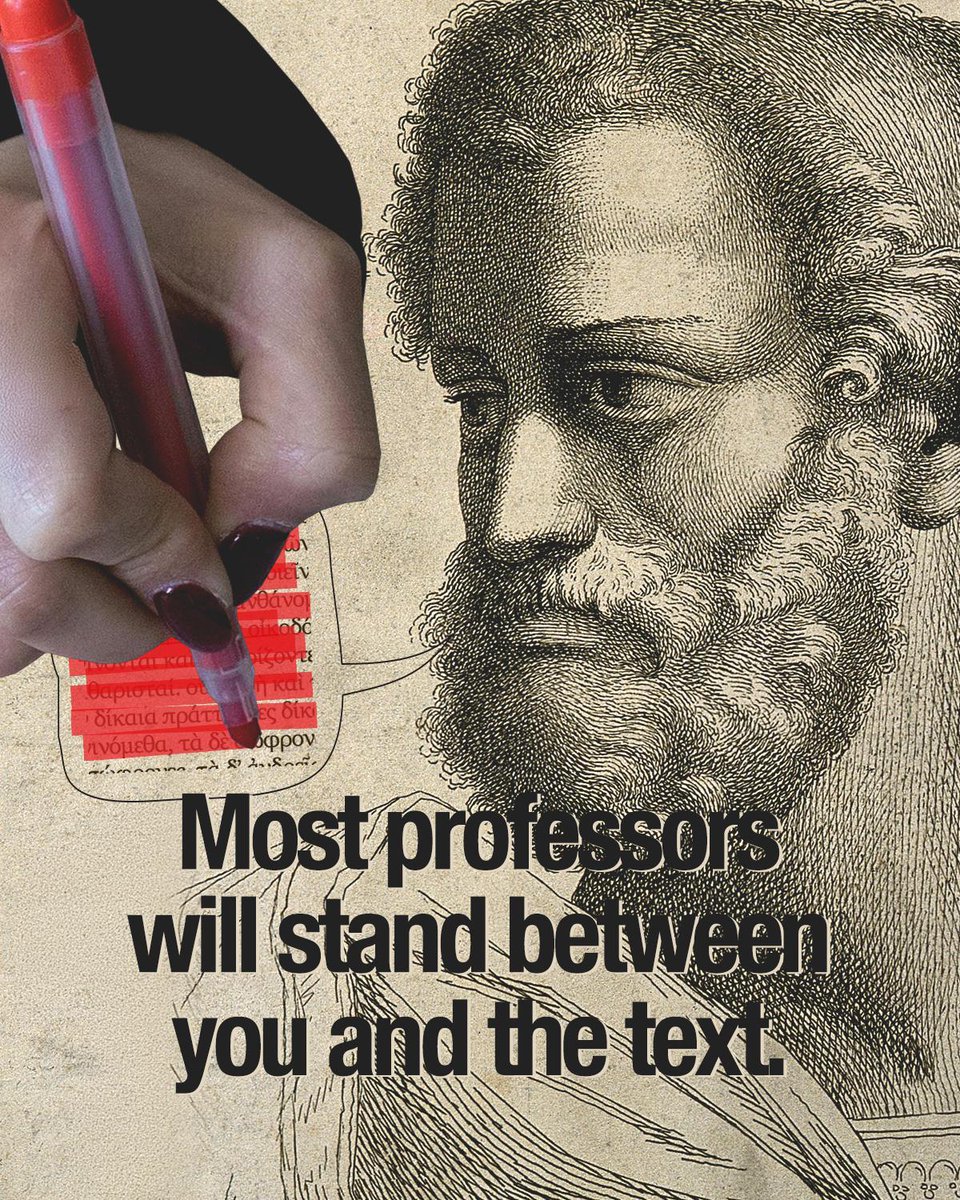
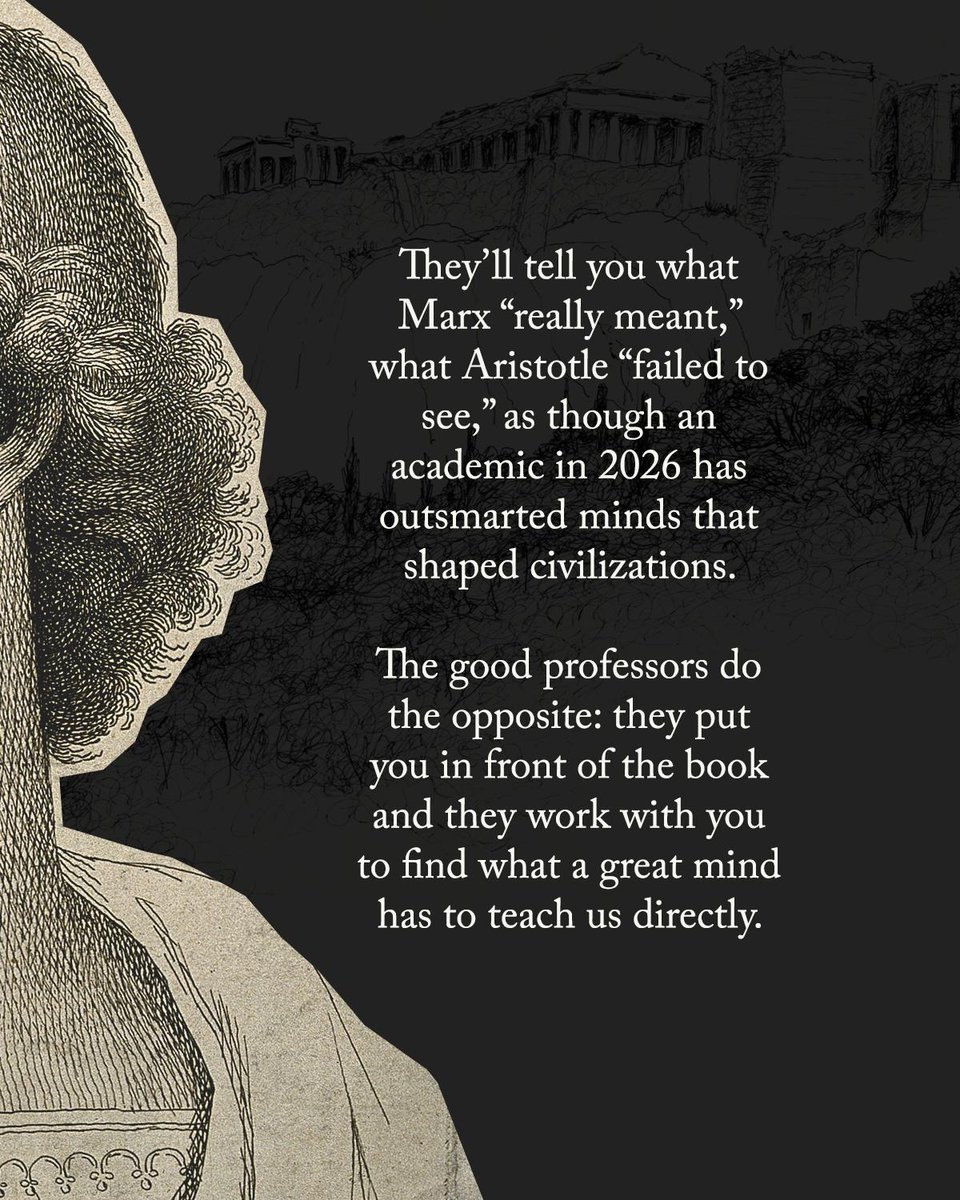
If you’re going to an Ivy League this fall, try to find the good professors, and read everything yourself.
University of Austin (UATX) tweet mediaUniversity of Austin (UATX) tweet media
English
6
2
54
3.6K
Ellie Murphy
Ellie Murphy@elliemurphy·
@Artofpuremind Requires discipline, a virtue greatly lacking in our culture. (I'm very much guilty of lacking it too)
English
0
0
1
48
Ellie Murphy
Ellie Murphy@elliemurphy·
@AustinA_Way This is so cool! History is just a great, long, wild story of people. Yet we've utterly sucked the life out of it. Songs--along with their music videos--bring the delight of narrative (that's always been there) to the forefront. Love that you've done this!
English
0
0
3
61
Austin Way
Austin Way@AustinA_Way·
A week ago our students came to us and said they wanted a way to turn their history lessons into songs. So we built it. After you finish a lesson, you can generate a song about everything you just learned in any style you want. Pop, rap, country, whatever. Now students are doing their history just to get to the song. More of their songs in the reply.
English
9
11
111
7.7K
Ellie Murphy
Ellie Murphy@elliemurphy·
@PathOfMen_ The deepest life lessons do often seem to be packed into the simplest and humblest stories. Oh the power of story to give us fresh perspective on something we all claim to believe (that connection and community matter).
English
0
0
2
1.1K
Path of Men
Path of Men@PathOfMen_·
There was a farmer who grew excellent quality corn. Every year he won the prize for the best corn grown. One year, a reporter interviewed him and discovered something interesting about the way he grew corn. The reporter discovered that the farmer shares his seeds with his neighbors. "Why does he share his best seeds with his neighbors if every year they compete with his own?" the reporter asked him. "Why, sir?" the farmer replied, "didn't you know? The wind picks up the pollen from the ripe corn and swirls it from one field to another. If my neighbors grow inferior corn, cross-pollination will constantly degrade the quality of my corn. If I want to grow good corn, I must help my neighbors grow good corn." The same is true of our lives. Those who want to live good and meaningful lives must help enrich the lives of others, because the value of a life is measured by the lives it touches, and those who choose to be happy must help others find happiness, because the well-being of each is linked to the well-being of all.
Path of Men tweet media
English
69
707
2.9K
88K
Ellie Murphy
Ellie Murphy@elliemurphy·
Do you know what you actually believe about yourself and the world? Is it true? Lies or mistruths often slip in when we're little to explain things we can't understand. They're good for childhood survival. But once we've grown, we must examine our stories, identify those lies which become limiting beliefs, and scrap the false narratives. I'm building Storitiv.com to be a tool in the process--a tool I wish I'd had in my 5+ year journey of rooting out the lies I believed and starting to conform my story to life-giving truth.
English
0
0
1
70
Katelyn James
Katelyn James@KatelynTweeter·
If you are pro-life would you ever be willing to adopt an unwanted baby? Trying to prove a point.
English
5.8K
58
3K
413.6K
Ellie Murphy
Ellie Murphy@elliemurphy·
This principle is also why stories are far more effective than dry technical works. Stories literally change our brains--and it is in large part due to emotion and empathy. So of course, draw your reader into your work and they will extract much from it (and it will influence them beyond just their intellect).
English
0
0
1
61
Charlie Hills
Charlie Hills@charliejhills·
A Harvard professor spent 40 years inside the human brain studying how language works. Wrote 9 books. Taught thousands of students. And he still thinks most people have no idea why their writing fails. Steven Pinker stood in front of a room and asked one question. Why is almost all writing academic, corporate, government, even most things you read online so painfully bad to get through? The room expected him to say laziness. Lack of practice. Poor education. He said none of those things. He called it the Curse of Knowledge. And once he explained it, I couldn't unsee it anywhere. Here's how it works. The moment you understand something deeply, something breaks inside you. You lose access to what it felt like before you knew it. The confusion you once had disappears so completely that you can no longer imagine anyone else feeling it. Your blind spots don't feel like blind spots anymore. They feel like obvious starting points. He told a story about a molecular biologist presenting at a TED event in front of 400 people. Brilliant man. Spent years on his research. Walked on stage and immediately started speaking in technical language without ever once explaining what problem he was trying to solve or why a single person in that room should care about it. People glazed over within two minutes. He finished his talk having no idea what had just happened. He thought he'd done well. That is the curse in its purest form. It doesn't announce itself. It disguises itself as competence. Then Pinker said the thing that stopped me cold. Bad writing is not about intelligence. It is not about effort. It is a failure of empathy. A writer who cannot imagine what it feels like to not know what they know will always lose their reader. Every time. No exceptions. His solution was not a writing technique. It was a person. He gave his drafts to his mother. She was educated, well-read, deeply intelligent. But she was not a cognitive scientist. She had no stake in his field. When she hit a sentence and her eyes slowed down, when she read a paragraph and looked up slightly confused, he didn't think she'd missed something. He went back and fixed the writing. Not her. The writing. That reframe alone is worth more than most writing advice combined. Then he moved to the thing almost every writer gets completely wrong. Words are not the point. Words are just a vehicle. What your reader actually walks away with is not the sentence you wrote. It is the image, the feeling, the physical thing that sentence was supposed to create inside their mind. If no image forms, nothing was communicated. The words passed through and left nothing behind. He asked his audience what a paradigm looks like. What a framework feels like. What color a concept is. Total silence. Because abstractions are invisible. They produce no picture, no texture, no sensation. They are placeholders that feel like meaning but deliver none. The writers who survived two hundred years did it because they had no choice but to be concrete. There was no jargon to retreat into. So instead of writing about aggression they wrote about the spirit of the hawk tearing into flesh. The reader felt it before they understood it. That is the only writing that actually works. The last thing he said was about brevity. And he defined it in a way I had never heard before. Brevity is not a low word count. Brevity is the discipline of cutting every single word that asks something of your reader without giving something back. Every unnecessary word is a small tax. Enough small taxes and the reader stops paying. He has carried three words with him for forty years. Omit needless words. He said that line does something almost no piece of advice manages to do. It demonstrates what it teaches. It is itself an example of the principle it describes. The best writing he ever produced came under an 800-word limit an editor refused to negotiate. The pressure of that constraint cut everything that was hiding inside the extra space. It always worked. Without fail. The Curse of Knowledge will not go away because you are aware of it. Awareness is not enough. The only move that actually works is finding someone outside your world, handing them what you wrote, and watching their face while they read it. Not reading it for them. Watching them. The moment their face shows even a flicker of confusion, you have found exactly where your writing failed. That is the whole masterclass.
Charlie Hills tweet media
English
69
228
745
75.7K
Ellie Murphy
Ellie Murphy@elliemurphy·
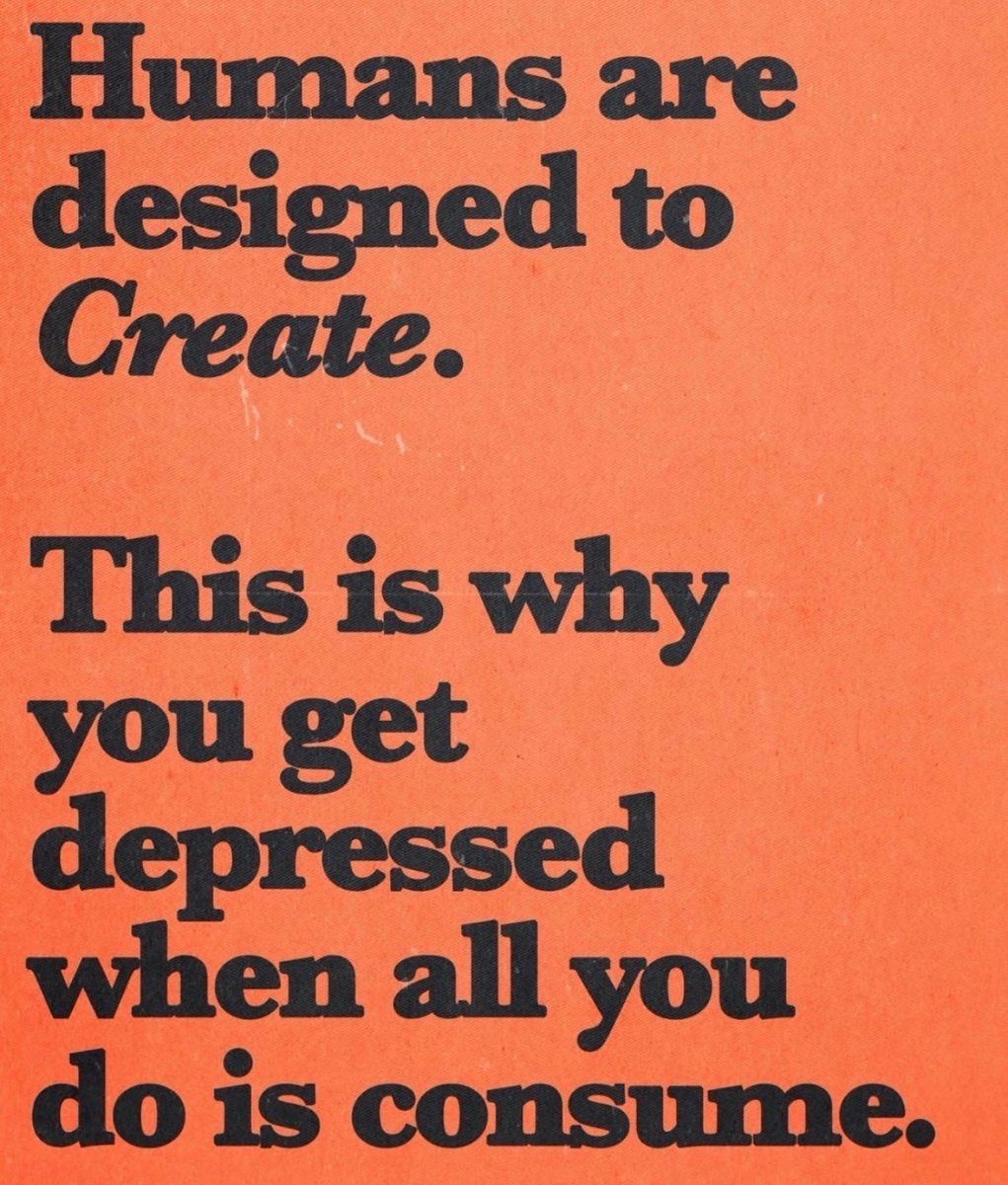
Just like humans are designed to love (which by definition means to put someone else's needs, desires, best, etc. before your own)---wired for love, as some put it---and acting selfishly wears us down.
English
0
0
4
72
Ellie Murphy retweetledi
University of Austin (UATX)
University of Austin (UATX)@uaustinorg·
"Depression, loneliness, anxiety are killing young women and limiting their ability to live free flourishing lives. I’ve experienced it in my life and witnessed it in the lives of so many others I love. And the current solutions we have aren’t working because the problem is not external; it’s with the stories we tell ourselves. And so I am building Storitiv, a narrative based tool designed to help young women uproot limiting beliefs and realign their false narratives with truth. Storitiv would not exist without the open doors provided by UATX or the mentorship, resources, and guidance from @AlphaSchoolATX. For both I am grateful beyond the power of words to express."  — Ellie Murphy, UATX sophomore
University of Austin (UATX) tweet media
University of Austin (UATX)@uaustinorg

"I’m building a credit score for science. The same way a credit score shows you how financially trustworthy someone is, ResearchDoc AI shows you what articles, authors, and journals you can trust in academia: it's a web-extension that scores scientific research article publications. Right now, science has no automated, objective assessment for quality. And with the number of articles getting published skyrocketing, scientists desperately need a quick way to evaluate research quality. The Alpha Fellowship has made my enormous goal of reforming the scientific publication system possible. It has taught me how to leverage AI to its fullest potential (and also how not to use it), how to build from zero to one in a day, and how to go from one to infinity. The Innovation Labs at UATX have given me countless opportunities to grow as a founder. They got me a table at Capital Factory's SXSW Startup Crawl (for free!), where I made connections that transformed my company's future. I'm so grateful to both @AlphaSchoolATX and UATX for their support, without which I would not be where I am today." — Nicole Kargin, UATX sophomore


English
1
5
26
7.1K
Ellie Murphy
Ellie Murphy@elliemurphy·
@Tallowtwins These gifts are already the most meaningful. But they take time and effort to produce and in a culture where efficiency is the highest virtue, thoughtful, hand-made gifts simply take too long.
English
1
0
1
27
Ellie Murphy
Ellie Murphy@elliemurphy·
@Dearme2_ Connection. Have relationships so deep and strong that you can fall apart with these people time and again and they'll still have your back. Care. Take care of your body. Humans are not merely thinking beings. Everything is connected (there's plenty of research about this).
English
0
0
0
408
Dear Self.
Dear Self.@Dearme2_·
Without drugs... what is the greatest weapon against anxiety and depression?
English
15.3K
998
14K
7.8M
Ellie Murphy
Ellie Murphy@elliemurphy·
@DrGailSaltz Great article. At the root of the problem: lack of genuine, deep connection. Heartbreaking.
English
0
0
0
6