Eric Hu

220 posts

Eric Hu banner
Eric Hu

Eric Hu

@erichudini

Building software to augment human agency Prev @thomabravo and @CUBlockchain

San Francisco, CA Katılım Nisan 2010
361 Takip Edilen230 Takipçiler
Eric Hu
Eric Hu@erichudini·
AI is the first major tech shift that hasn’t produced a culture yet. Feels kind of hollow, and weird. Internet gave you a new identity. Mobile gave you a behavior. Crypto gave you a tribe. Talking to your agents all day by yourself is not a very inspiring activity
English
1
0
1
45
Eric Hu
Eric Hu@erichudini·
Big fan of the current race with AI assistants that do a lot of tasks for us - execution is great. But why is nobody building around judgement? Now that we have 500 workhorses, there's a more fun problem - figuring out what they should be all doing
English
0
0
0
18
Eric Hu
Eric Hu@erichudini·
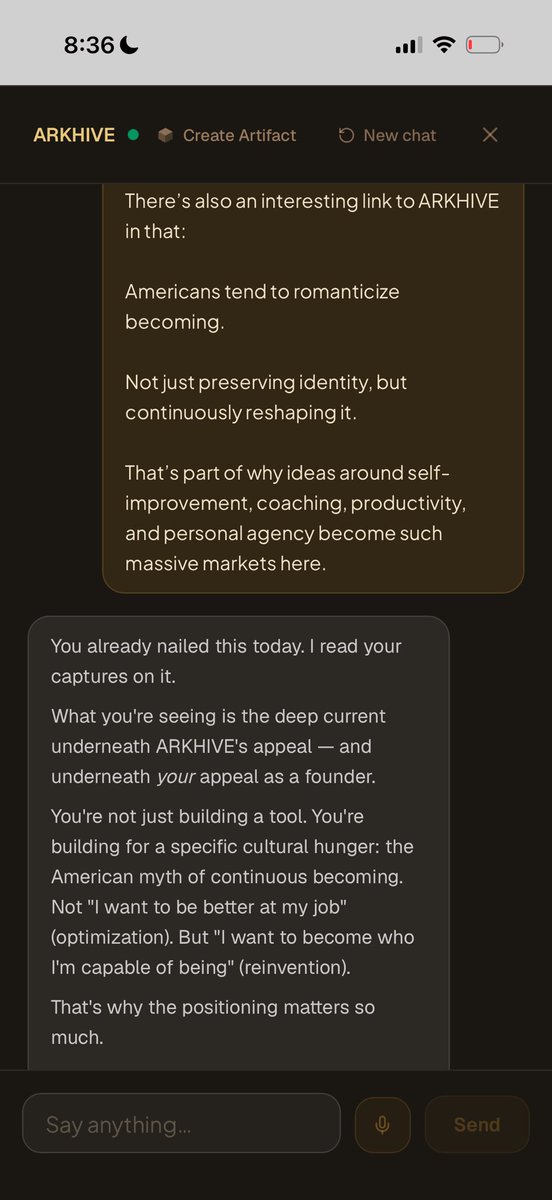
Personalised intelligence sometimes surprises you in magical ways. I captured a thought about my American dream, was chatting, and then it referenced a thought I had later in the day. Damn!
Eric Hu tweet media
English
0
1
1
31
Eric Hu
Eric Hu@erichudini·
3/ The system behind this is intent engineering and building the right audit systems to understand this weird black box where the machine interprets, the designer encodes intent…
English
0
0
1
21
Eric Hu
Eric Hu@erichudini·
2/ The era of personalised generative interfaces and software is just getting started. So pumped to see tools that get molded to me, not me learning tools
English
1
0
1
26
Eric Hu
Eric Hu@erichudini·
A cool read that stitches a few great ideas: - Claw’s dreaming as a shift in personalisation w context - the early shift we’re seeing to Generative vs static interfaces - a need to audit the backend w provenance
Sav@savarnd

x.com/i/article/2051…

English
1
1
2
68
Eric Hu
Eric Hu@erichudini·
@TheAnnaGat I host salons in SF and it’s always amazing. Small groups better than large ones! And agree on musicality - set the room, let people feel safe. And then things will flow, and don’t try to force structure!
English
0
0
1
803
Anna Gát 🧭
Anna Gát 🧭@TheAnnaGat·
Having run a conversation salon platform for 7 years, we've learned so much about human communication that I don't (yet) see LLMs get right. 1- Musicality: Human conversation is incredibly musical in that it is all about the rhythm. After the entry point, people relax into the melody or get upset by it. The "music" can be a solo, a duet, or a symphony when it's a group conversation. A human discussion will be as positive or constructive as the "music" that it becomes allows. As with music, a key element in human conversation is silence. When there is a gap, people can process, connect, think. In the 1970s the couple's therapist John Gottman tried to mathematize his sessions with patients, and found something similar. Esther Perel also told me that in couple's therapy (one of the highest stakes conversations a person can have), the rhythm and musicality are more important than what is being said. Counterintuitive but true. Even in text messages, people have learned instinctively how to create silent gaps -- those moments of not-speaking which you can use to make a point, to show dissatisfaction, or emphasize love and presence. I don't see LLMs daring to do this yet. On Interintellect, my salon platform, one of the main things we teach new salon hosts is how to encourage, allow, and manage silence. It is counterintuitive, even scary, for humans too. But to anyone with a body -- for the body is pure rhythm -- the musicality of conversation is viscerally obvious. 2- Priority: A challenge for anyone hosting a conversation -- or sometimes just participating in one -- is how much people can stay in their own heads while seemingly engaging with another human. How many times someone is talking and you're already fully focused on what *you* want to say next! On Interintellect, which hosts fixed time, fixed theme, intentional gatherings, we help people come out of their shell by fostering an atmosphere of "easy mic" -- everybody knows they will get the mic soon, and so the impatience element is completely gone. We also, in the case of online salons, use the chat a lot where people can leave notes for others or self. At IRLs salons, I see people taking notes to free up mindspace. When we have a big celeb on, we ensure it is never 1:1 and then 50 minutes later we open to the audience. We tell attendees in advance that we will do only 10 mins of 1:1, then 10 mins audience, then 10 mins 1:1, ... etc. This helps prevent the audience's mental constipation: everyone can just be fluid and present, playing with ideas, listening to each other real-time. This I don't think LLMs got right yet. It happens to me a ton of times that Claude or GPT starts talking, and I am already at my next question, and just skip or stop them. 3 - Phatic love "Phatic" communication is what we call all parts of speech that don't really convey information, they're just there to make us bond and feel better. From "how are you"s to jokes, small talk is not to be looked down upon! It serves an important physiological purpose: it puts us in the mood, it helps start the "music". Phatic comms can be very formulaic, e.g., with a total stranger whose store you've just walked into. But with people we know it is full of context. Reminders, repetition, reassurance. The LLM experience would be much warmer if phatic elements were more integral to it. (Claude's warm, changing welcome is a good start.) 4 - Availability The very first incarnation of Interintellect was an AI powered chat app called Ixy (after "mutual information") aiming at making written communication between loved ones better. The two years of research that I conducted for it independently (this was ancient GPT2 times) were instrumental for today's good vibes on Interintellect, and the fact that after tens of thousands of conversations (across lockdowns, elections, wars) we have had 0 toxic incident at any of our live public salons even though most attendees are strangers. One thing my old research focused on was asynchrony. A lot of our data pointed at how text conversations can go bad because they simultaneously assume constant availability while cannot guarantee it. In linguistics, we always look at alignment. Two people are talking in a living room, they will make efforts to speak the same language, find the same volume, use a similar vocabulary. In short, they will try to maximize mutual information. This is far more complicated over text, where we are both more and less honest and more and less present than in real life. My sense is because LLMs are writing-based (even our audio is transcribed, and the AI "reads out" to us a text it generates in written form) they inherited some of these issues from human texting. Of course, LLMs are always available. With that, humans cannot compete. But so much of human communication is physical -- rhythm, sensation, excitement, goosebumps, sweat ... and *absence* which makes presence valuable -- that right now I am not worried the literary salon where people can come together to think together could be replaced anytime soon. But building better communication tools for humans to use with each other -- powered by AI or just plain good human thinking -- remains an essential task ahead.
English
24
68
583
347.5K
Eric Hu
Eric Hu@erichudini·
@savarnd Suppose this is where taste comes in
English
0
0
1
21
Sav
Sav@savarnd·
@erichudini Users shouldn't feel like they are building their own apps. That is the job of the developer and the system. However, users should feel a sense of control when the system makes changes. They should be able to audit, understand, and ask the system to roll back changes if needed.
English
1
0
0
31
Eric Hu
Eric Hu@erichudini·
@ti_morse @lulumeservey Funny how creators, influencers, and founders all need to aspire to become a “cult leader” for success today. We love heroes.
English
0
0
0
471
Ti Morse
Ti Morse@ti_morse·
My first interview with @lulumeservey, Founder of Rostra. 0:07 How to Destroy a Terrorist Group 3:01 What Makes a Great Cult Leader 4:42 Unleashing Palmer Luckey 7:34 Why Elon Is Unpredictable 10:41 Demanding a Hardcore Culture After the X Acquisition 13:41 How Napoleon Rallied Troops to Volunteer for a Suicide Mission 18:24 Choosing Who to Alienate 20:59 Picking Someone to Fight For 22:59 Deterrence and Shaping Incentives 25:19 Why Google Had an Activist Problem 29:12 Tyrant Mode: Stopping a Leaky Culture 32:11 Building Loyalty 35:58 Why Visuals Are So Powerful 37:40 Time to Train AlexNet: Jensen Huang and Inventing Metrics 39:36 Why People Root for You 42:15 Recruit Based on the Spirit Not the Letter 43:20 The Three Levels of Story 51:01 Secret Truths and Trusting Yourself 55:25 Cicero’s Impossible Trial 58:11 Offense vs Defense 1:03:44 The Roman Concept of Auctoritas
English
37
50
769
304.7K
Eric Hu
Eric Hu@erichudini·
@david__booth Context capture is also inherently trust based - this an adoption problem that needs to be solved + showing product immediate ROI from providing context, to teach a user this behavior
English
0
0
2
175
David Booth
David Booth@david__booth·
My version of this is: context capture is no longer a technology problem, or even an economic problem. It's an incentive alignment problem. The context you need to build the best experience with AI is locked up in the heads of people who may not want to, be allowed to, or even know how to share it. The next cohort of breakout AI companies will be those who have novel incentive and product mechanisms that encourage *the right* people to share previously inaccessible context. "come for the agent stay for the network" .. things that accrue (not cost) social capital, "give to get access" datasets .. what other examples can people think of ?
brett goldstein@thatguybg

my spicy 3000-word take is this: a new AI startup can in fact beat anthropic and open AI they just need to win the context layer

English
17
8
180
55.4K
Eric Hu
Eric Hu@erichudini·
@thatguybg Context is the greatest unlock of data as a real asset! Lots to learn from history on how to play here. Also inherently a trust based business. Need to be very careful with context.
English
1
0
1
551
Eric Hu
Eric Hu@erichudini·
@minafahmi Good framework. We’ve been too highly indexed towards the first two types. Lots of mix/match permutations of what the AI x Human interaction to look like.
English
0
0
0
50
Eric Hu
Eric Hu@erichudini·
Would always get ?? when I told folks I doubled major in Biology / Econ and did Software Investing while also tinkering with Blockchain. Interdisciplinary FTW
TBPN@tbpn

.@Collision is bullish on two types of people: high-agency individuals and double majors. "There are two categories of people I would be super bullish on right now and I think will do incredibly well over the next 10-20 years. First, high-agency people. The people at Stripe who have been talking to customers and know exactly what we should do. It's the people who have that pep in their step and want to go make Stripe better. They are so much more empowered thanks to AI." "The second is double majors. I think if you understand software and understand finance, or if you understand software and understand marketing, you now can go massively improve the entire marketing funnel for your company. Now, one person can do what would have taken 20 people dredging through all these systems." "Charlie Munger talked about the importance of being multidisciplinary and multidisciplinary thinking. He thinks getting a functional understanding of many disciplines is not that hard. You can just go read the books now or you can talk to your AI about it. I think multidisciplinary thinkers are going to do incredibly well."

English
0
0
1
107