🛢️⚡🔋 Erick Sánchez S.

140K posts

🛢️⚡🔋 Erick Sánchez S. banner
🛢️⚡🔋 Erick Sánchez S.

🛢️⚡🔋 Erick Sánchez S.

@erickussalas

🛢️🌎⚡ Markets analysis. Finance, energy, economics, public policy. Intelligence. ⚠️Opinions are mine and don't represent anyone else.

A galaxy far, far away. Katılım Ekim 2011
888 Takip Edilen18.3K Takipçiler
Sabitlenmiş Tweet
🛢️⚡🔋 Erick Sánchez S.
«La Edad de Piedra no se acabó por falta de piedras, y la Era del Petróleo, no se acabará por falta de #petróleo». — Ahmed Zaki Yamani, Ministro de Petróleo, de Arabia Saudita entre 1962 y 1986.
Español
20
165
433
0
🛢️⚡🔋 Erick Sánchez S. retweetledi
León Barrena Rodríguez & Partners LLP
Mexico imports approximately 1.1 million barrels per day of refined petroleum products. The United States supplies the overwhelming share of this volume. Domestic refinery throughput reached 1.014 million barrels per day in 2025, the highest annual average since 2015. Yet total petroleum product consumption stands near 1.85 million barrels per day. Imports therefore cover roughly 60 percent of demand, with U.S. Gulf Coast refineries meeting the bulk of gasoline, diesel, and jet fuel needs. Mexico's refining system remains outdated and mismatched to domestic crude quality. Recent upgrades have lifted utilization rates at several facilities, including Tula and Dos Bocas. These gains remain insufficient to close the structural gap. Strategic reserves of finished products are minimal, comparable to low storage buffers seen in natural gas. We are not exaggerating when assessing that shortages would materialize within days of a supply cutoff. A U.S. restriction on petroleum product exports would eliminate Mexico's primary source. Alternative suppliers in Europe, Asia, or the Middle East exist in principle. The resumed closure of Hormuz and the assumed closure of the Bab el-Mandeb Strait renders those routes unavailable or prohibitively slow and expensive. Global tanker logistics cannot pivot quickly. Mexico lacks the port infrastructure and pipeline capacity to absorb large-scale non-U.S. volumes on short notice. Our analysts predict that road transport, which moves over 80 percent of domestic freight, would seize first. Diesel shortages would idle trucks, clog supply chains, and strand goods. Manufacturing, which accounts for roughly 20 percent of GDP and drives nearshoring exports, would contract sharply. Agriculture would lose tractor and harvest capacity. Food distribution would break down. Jet fuel scarcity would curtail aviation and tourism. Fuel prices would spike. Inflation would accelerate across food, transport, and consumer goods. Pemex revenues would fall amid reduced economic activity and lower crude export viability. Government fiscal space would shrink. Unemployment would rise as factories and logistics firms cut staff. This is the scenario the Sheinbaum administration faces if the United States decides to curtail energy exports in the following weeks. Mexico's baseline growth already hovers below 1.5 percent annually. This external shock would drive a deep recession. Prolonged shortages, now measured in months rather than weeks, risk tipping into depression conditions: sustained GDP contraction, widespread business failures, and social strain. No quick domestic workaround exists. Mexico has acknowledged this vulnerability for years. Policy has prioritized refinery modernization and rhetoric of energy sovereignty. Execution has lagged. The country continues to sleepwalk into this exposure, betting on incremental domestic gains while core import dependence remains unaddressed. A U.S. export restriction under closed-strait conditions would expose that bet as untenable. Now, our baseline scenario for the Mexican economy is not merely that it will slow: we expect it to contract severely.
León Barrena Rodríguez & Partners LLP@lbrglobal

The failed diplomatic resolution in the Strait of Hormuz and the subsequent U.S. naval blockade have triggered a terminal exposure in Mexico’s energy balance. Senior officials within Pemex and the federal government now privately concede to our Mexico City desk that the crisis has compromised the country’s energy security far beyond previous public admissions. With Brent sustaining levels above $100.99 and WTI near $98, global markets are pricing in a prolonged disruption of the 17–21 million barrels per day typically transiting the Strait. This systemic shock is already propagating through refined products and shipping insurance, creating a high-bid environment where Mexico is increasingly unable to compete. Mexico’s structural vulnerability is rooted in a dual-dependency on U.S. energy exports that is unmanageable during a war-driven shock. Despite record U.S. production of 13.6 million barrels per day, American domestic consumption remains high, and refining capacity is tightening. Mexico continues to rely on U.S. Gulf Coast refineries for over 1.09 million barrels per day of refined products, while importing nearly 77% of its natural gas from Texas shale basins. In this global supply crunch, U.S. exporters will prioritize domestic stability and premium contracts in Europe and Asia, leaving Mexican importers structurally outbid. The domestic refining system offers no credible hedge against this external pressure. On April 9, 2026, the Dos Bocas refinery suffered its fourth safety incident in less than a month: a fire in the coke storage warehouse. This chronic instability underscores why the facility continues to operate well below its 340,000 bpd nameplate capacity, with utilization fluctuating between 60% and 77%. The failure to stabilize national refining ensures that fuel import requirements remain at strategically dangerous levels precisely as the global supply chain compresses. Mexico’s lack of strategic reserves further accelerates the timeline for a domestic crisis. Current independent analyses estimate the commercial fuel cushion at approximately five days of supply. Historical data from 2022 demonstrates that aggressive fiscal subsidies and price caps, such as the current effort to hold gasoline below 24 pesos per liter, cannot conjure physical supply. Instead, suppressed prices sustain demand while suppliers divert volumes to higher-paying international markets, leading directly to physical shortages. Our sources inside the Mexican government and Pemex confirm that material threats to refined-product imports will manifest in major urban centers within one to three weeks. If price suppression persists and U.S. export availability contracts, either through Pemex being outbid by premium global buyers or the Trump administration aggressively restricting refined product exports, physical shortages and fuel rationing are projected to hit nationwide within four to eight weeks. The Sheinbaum administration is currently careening toward a total supply-shock scenario. Without immediate contingency planning or a secured priority access arrangement with Washington, the result will be total fiscal exhaustion, electricity cost spikes, and uncontrollable inflationary pressure. The margin for error calculated only a month ago has been erased. The crisis is no longer a matter of price volatility but the imminent physical absence of hydrocarbons.

English
1
20
52
5.5K
🛢️⚡🔋 Erick Sánchez S. retweetledi
Bloomberg
Bloomberg@business·
An oil spill in the Gulf of Mexico that soiled beaches, killed wildlife and sparked outrage from environmental groups was caused by a leaky pipeline owned by state oil company Petroleos Mexicanos, the company said bloomberg.com/news/articles/…
English
4
44
85
16.6K
🛢️⚡🔋 Erick Sánchez S. retweetledi
Ariel Moutsatsos
Ariel Moutsatsos@arielmou·
Va Greer a México. El Representante Comercial de EUA Greer, visitará México este lunes 20 para una segunda ronda de conversaciones sobre el TMEC de cara a su revisión. Greer va a reunirse con el Secretario de Economía, Marcelo Ebrard y otros funcionarios y sostendrá un encuentro con la presidenta Claudia Sheinbaum.
Español
0
8
35
2.7K
🛢️⚡🔋 Erick Sánchez S. retweetledi
adn Noticias
adn Noticias@adnnoticiasmx·
🚨#AlertaADN Reportan una explosión en la refinería Miguel Hidalgo en Tula
Español
162
890
1.8K
257.3K
🛢️⚡🔋 Erick Sánchez S. retweetledi
The Kobeissi Letter
The Kobeissi Letter@KobeissiLetter·
BREAKING: Leaders of Gulf and European countries believe that a peace deal between the US and Iran will take six months to be reached, per Bloomberg. Details include: 1. Gulf and European leaders are urging the US and Iran to extend their ceasefire to cover that timeframe 2. Leaders want the Strait of Hormuz opened immediately and are warning in private that a "global food crisis" may develop if that does not happen by next month 3. Gulf states believe Iran is looking to build a nuclear weapon and that has not changed amid the Iran War 4. Thus, they think a peace deal should ban Iran from enriching uranium or having long-range ballistic missiles Gulf leaders are "mostly against" resuming fighting.
English
203
341
2.8K
385K
🛢️⚡🔋 Erick Sánchez S. retweetledi
Department of State
Department of State@StateDept·
The State Department is restricting U.S. visas for individuals from countries in our hemisphere who support our adversaries in undermining America’s interests in our region. Under the newly expanded policy, we have already taken action against 26 individuals in several countries. The Trump Administration continues to work for the American people and to promote our region’s safety and prosperity.
English
726
1.8K
9.5K
1.3M
🛢️⚡🔋 Erick Sánchez S. retweetledi
maria scherer
maria scherer@scherermar·
Al menos 300 multinacionales de EU denunciaron acoso del SAT en México y solicitaron acción urgente al secretario de Hacienda, Édgar Amador, en una carta del Consejo Nacional de Comercio Exterior de EU. Acusan auditorías agresivas, trabas para apelar y medidas fiscales que desincentivan la inversión y el empleo. Vía @Reforma

Español
98
1.6K
3.4K
62.1K
🛢️⚡🔋 Erick Sánchez S. retweetledi
Martin Kelly
Martin Kelly@_MartinKelly_·
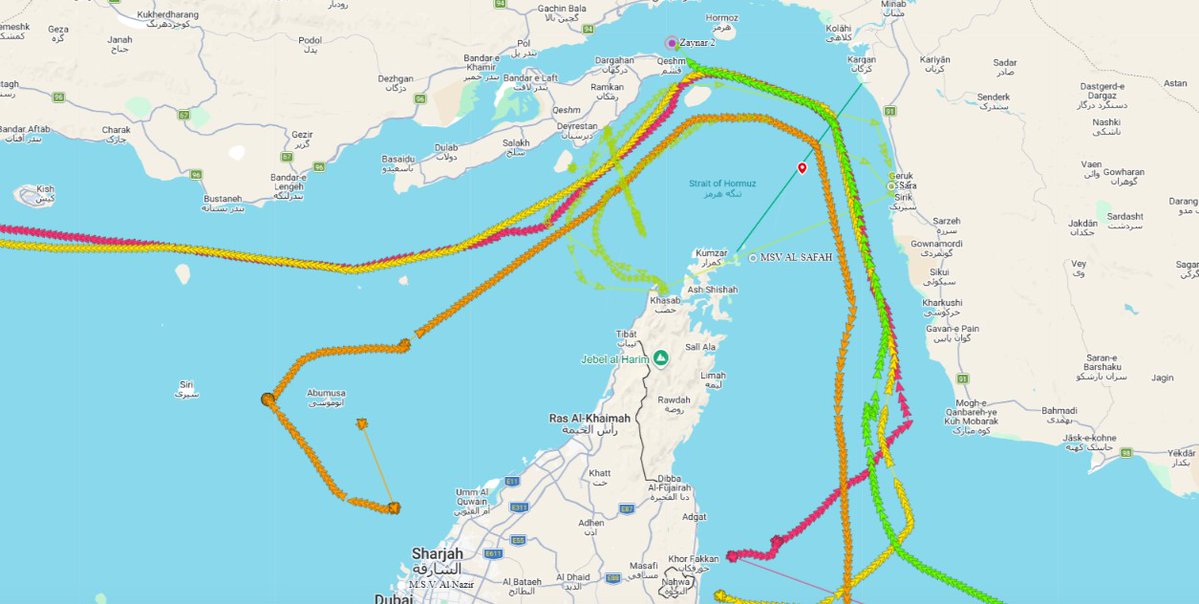
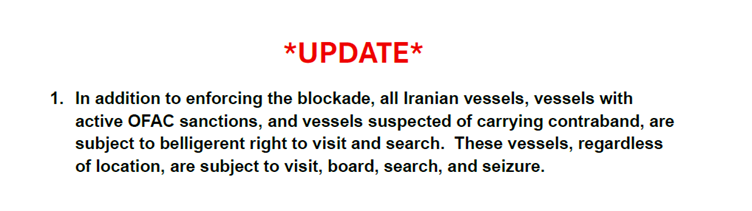
The US just made a significant update to its blockade against Iranian ports 🛑 The update indicates that “all Iranian vessels, vessels with active OFAC sanctions, and vessels suspected of carrying contraband (weapon parts, nuclear components, precursors etc), are subject to belligerent right to visit and search.” The original blockade was against ships calling to/from Iranian ports and terminals only. This means... ALL ships linked to Iran (flagged, owned, operated), carrying Iranian weapons/parts, and ships with OFAC sanctions are liable to boarding. The potential candidates for boarding under this new ruling sees >100 ships between East of SoH & northern Arabian Sea. Now, US opportunity to board vessels has increased, I’d expect to see some sort of physical implementation (boarding) by the US within the next 48hrs. Then, the ball is in Iran’s court in terms of retaliation that could include anything from boarding, ship attack, port attack and even expanding to the Red Sea. On traffic, since yesterday, just 6 ships transited the SoH: 4x inbound: including 3x sanctioned vessels (1x LPG, 1x MT & 1 Containership). Interestingly, NOT-sanctioned Panama-flagged bulk carrier ROSALINA (IMO: 9568562) is signalling “Food for B.I.K” (Bandar Imam Khomeini port, IRAN). 2x outbound: 1x Comoros-flagged cargo (73m) remains in SoH, and 1x Chinese (Lloyd’s shadow fleet) tanker now off Fujairah. The numbers above reflect only those vessels which have transited the SoH with AIS switched on. Multiple tankers have headed to Iranian ports during the past couple of days with AIS off. So What? The blockade is effective in the sense that ships which have departed Iranian ports/terminals are being turned around. However, ships are still heading to Iranian ports.
Martin Kelly tweet mediaMartin Kelly tweet mediaMartin Kelly tweet media
English
23
210
637
155.9K
🛢️⚡🔋 Erick Sánchez S. retweetledi
Anas Alhajji
Anas Alhajji@anasalhajji·
🔥A MUST READ:🔥🔥🔥 This is a fascinating development in the oil markets! Iraq has been unable to export its crude oil through the Strait of Hormuz due to ongoing disruptions. The country's only current crude export route is the pipeline through Turkey, which is running at roughly 200 kb/d. To work around this, Iraq has started exporting fuel oil via hundreds of tanker trucks. The route takes them across the western Iraqi desert, into Syria, and all the way to the Mediterranean port of Banyas (see black arrow in the map below). The tanker Asahi Princess recently delivered a fuel oil cargo to Syria from Saudi Arabia. It is scheduled to load Iraqi fuel oil today and is expected to depart the port on Friday or Saturday. This represents approximately 700,000 barrels of fuel oil. What's particularly noteworthy is that almost all analysts are not yet factoring this volume into their supply-demand balances. It is small, but continues.
Anas Alhajji tweet media
English
33
297
1.6K
330.6K
🛢️⚡🔋 Erick Sánchez S. retweetledi
The Kobeissi Letter
The Kobeissi Letter@KobeissiLetter·
BREAKING: The IEA announces that Europe has just 6 weeks worth of jet fuel remaining as the Iran War shortage worsens. The IEA also says that many flights may soon be cancelled as a result. Jet fuel prices in Europe soared over +100% amid the war.
English
240
720
5.6K
670.9K
🛢️⚡🔋 Erick Sánchez S. retweetledi
Eduardo Prud'homme
Eduardo Prud'homme@eprudhomme·
Pero el capital no se mueve sólo porque exista el recurso. Se mueve cuando hay confianza en que los contratos se respetarán, los permisos avanzarán, la participación privada no será políticamente estigmatizada y las reglas no cambiarán al ritmo de la ideología. El shale no depende sólo de la geología. Depende también de la credibilidad del país.
Español
1
2
9
658
🛢️⚡🔋 Erick Sánchez S. retweetledi
Eduardo Prud'homme
Eduardo Prud'homme@eprudhomme·
Y aquí es donde la discusión mexicana deja de ser meramente técnica. Porque el shale no se destraba con discurso político ni con declaraciones aisladas. Se destraba con inversión privada grande, persistente y dispuesta a asumir riesgo durante años. (en US ya podemos hablar de décadas de inversión sustancial continua) Eso significa: muchos rigs, muchos servicios adyacentes, mucha infraestructura, muchos desplazamientos de personal y equipos y muchísimo capital.
Español
2
5
14
791
🛢️⚡🔋 Erick Sánchez S. retweetledi
Eduardo Prud'homme
Eduardo Prud'homme@eprudhomme·
Aquí aparece el punto clave: el shale necesita muchos rigs. ¿Por qué? Porque los pozos suelen arrancar con tasas iniciales altas, pero también con declinaciones muy pronunciadas. Eso significa que para sostener o expandir la producción no basta con perforar una vez: hay que seguir perforando y completando constantemente. En otras palabras: el shale funciona como una banda de movimiento continuo. Si se frena de manera importante la actividad de perforación y completación, tarde o temprano la producción pierde impulso. La productividad por rig puede mejorar mucho. Pero no elimina la necesidad de un despliegue masivo y sostenido de capital y actividad.
Español
1
2
7
747
🛢️⚡🔋 Erick Sánchez S. retweetledi
Eduardo Prud'homme
Eduardo Prud'homme@eprudhomme·
Por eso el verdadero modelo shale no consiste en perforar “un pozo”. Consiste en desplegar una lógica de manufactura: pads multi-pozo, perforación repetitiva, completaciones estandarizadas, logística intensiva de agua, arena y equipos, y conexión rápida a infraestructura de recolección y transporte. Es una operación industrial continua.
Español
1
4
13
1.1K
🛢️⚡🔋 Erick Sánchez S. retweetledi
Eduardo Prud'homme
Eduardo Prud'homme@eprudhomme·
Pero ni siquiera eso basta si la roca sigue siendo demasiado cerrada. Ahí entra el fracturamiento hidráulico: se inyecta fluido a alta presión para crear fracturas, y el apuntalante mantiene abiertas esas microvías de flujo. En pozos horizontales, este proceso se repite por etapas a lo largo del lateral. Sin eso, el shale no entrega producción comercial.
Español
1
2
9
884
🛢️⚡🔋 Erick Sánchez S. retweetledi
Eduardo Prud'homme
Eduardo Prud'homme@eprudhomme·
La perforación horizontal multiplica el contacto del pozo con la formación productiva. En vez de atravesar la roca en un solo punto, el pozo desciende verticalmente, gira y recorre lateralmente miles de pies dentro del intervalo objetivo. Eso amplía drásticamente el volumen de roca que puede aportar hidrocarburos al pozo.
Español
1
2
9
931
🛢️⚡🔋 Erick Sánchez S. retweetledi
Eduardo Prud'homme
Eduardo Prud'homme@eprudhomme·
El gobierno de México ha reabierto la discusión pública sobre el fracking. Pero antes de que el debate se reduzca a consignas, conviene recordar algo básico: El shale no es simplemente “más gas” o “más petróleo”. Es un modelo de desarrollo completamente distinto. Y ese modelo exige escala industrial, muchos equipos de perforación y muchísimo capital.
Español
10
42
124
18.8K
🛢️⚡🔋 Erick Sánchez S. retweetledi
Gabriela Siller Pagaza
Gabriela Siller Pagaza@GabySillerP·
Why is the Mexican economy underperforming? Are the reasons underlying the slow growth rate structural? “Locked in Low Gear: Mexico’s Struggling Economy” bakerinstitute.org/research/locke…
English
4
105
263
12.4K