IntoWild

1.8K posts

IntoWild

IntoWild

@euvlook

Katılım Şubat 2015
1.4K Takip Edilen100 Takipçiler
IntoWild retweetledi
RehlingLab
RehlingLab@RehlingLab·
How do mitochondrial ribosomes keep pace with membrane insertion? We address this question in our paper “Membrane insertion of mitochondrial-encoded proteins regulates ribosome decoding speed,” now out in Nature Structural & Molecular Biology (Link).
RehlingLab tweet media
English
0
13
41
3.4K
IntoWild retweetledi
Cell
Cell@CellCellPress·
Now online! Galvanin (TMEM154) is an electric-field sensor for directed cell migration dlvr.it/TSVvkt
English
2
21
68
12.2K
Ning Zhao
Ning Zhao@NingInScience·
We have developed a cysteine-free, highly thermostable tagging system, UTag, that enables single-mRNA translation tracking in live cells. You may wonder how different tagging systems affect translation kinetics—we addressed this by performing a systematic comparison.
GIF
English
8
84
387
24.4K
IntoWild
IntoWild@euvlook·
@NingInScience @NikoMcCarty This is very interesting work. Does this indicate that there is real-time translation occurring within the nucleus?"
English
0
0
0
334
IntoWild retweetledi
Agnieszka Chacińska
Agnieszka Chacińska@A_Chacinska·
TOM, translokaza odpowiedzialna za transport białek, to nie tylko droga wejścia do mitochondriów, ale dynamiczny hub regulacyjny. Pełne zaskoczenie! Podziękowania dla wszystkich autorów. Special thanks! Mayra i Vanessa @MassSpecVaniLi #NaukaPL
IMol@IMol_Institute

A new @IMol_Institute study in Science Advances sheds light on mitochondrial protein import. science.org/doi/epdf/10.11… Huge credit to this outstanding team of co-authors!

Polski
1
3
25
2.3K
IntoWild retweetledi
Anders Sejr Hansen
Anders Sejr Hansen@Anders_S_Hansen·
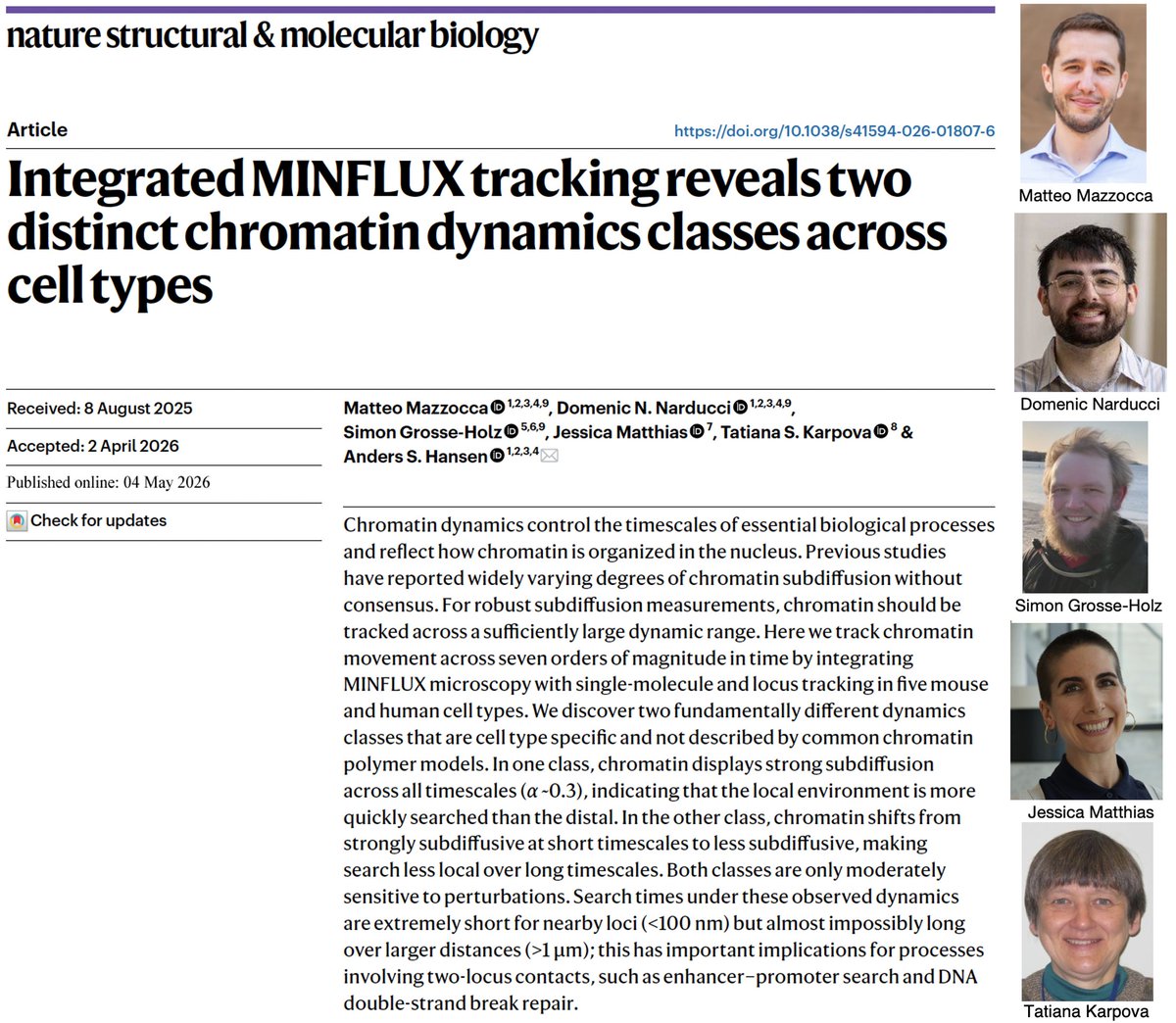
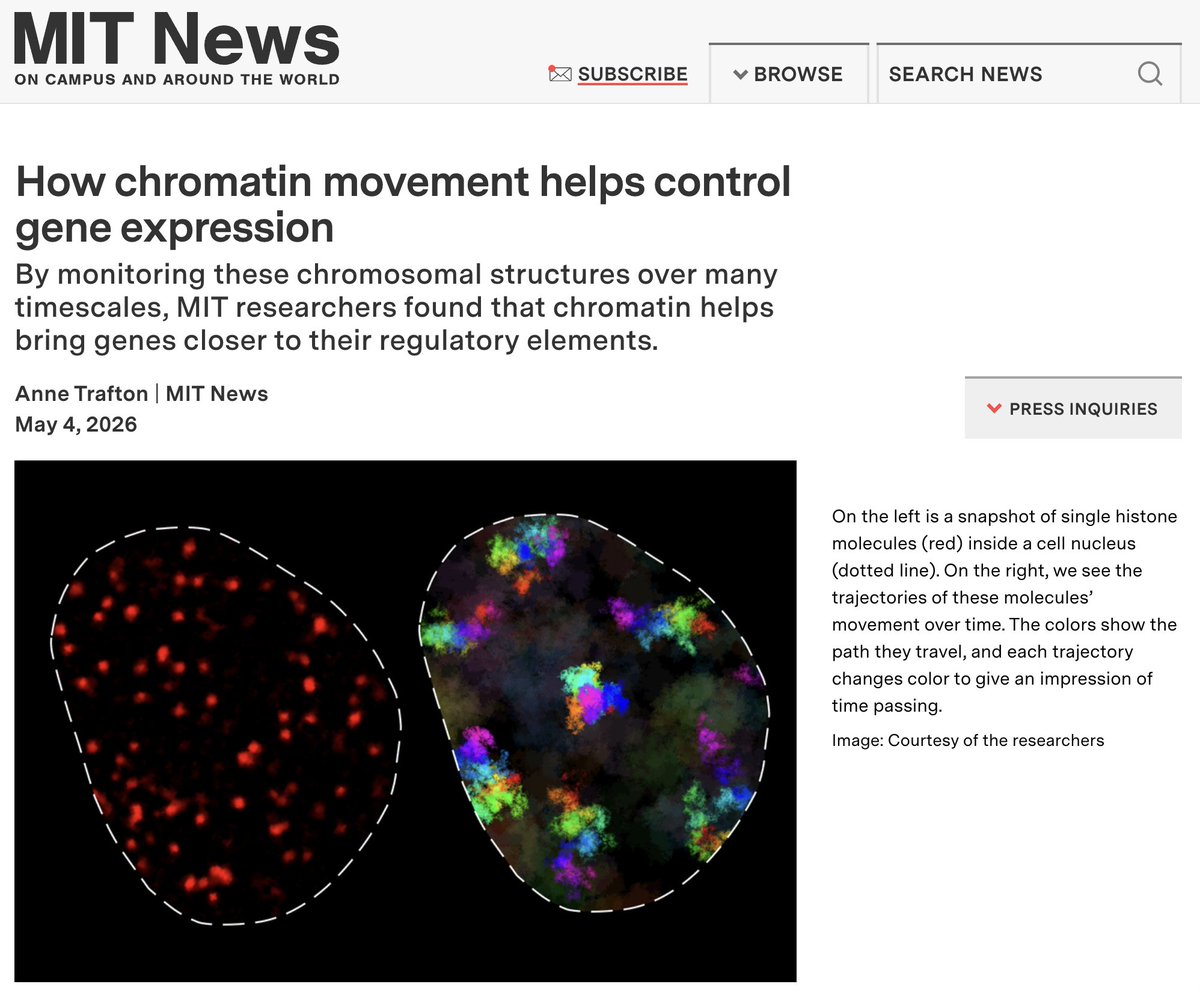
(1/n) Super excited to share that our preprint is out today in @NatureSMB with a new name "Integrated MINFLUX tracking reveals two distinct chromatin dynamics classes across cell types" and more than 2x more data: nature.com/articles/s4159… MIT NEWS: news.mit.edu/2026/how-chrom…
Anders Sejr Hansen tweet mediaAnders Sejr Hansen tweet media
Anders Sejr Hansen@Anders_S_Hansen

(1/13) Thread on @mazzocca_matteo @DomenicNarducci @SGrosseHolz @_jessematthias new preprint Q: how does chromatin move? Using MINFLUX, SPT & SRLCI, we track chromatin dynamics across 7 orders of magnitude in time to provide some answers biorxiv.org/content/10.110…

English
4
37
171
20K
IntoWild retweetledi
luba yudasina
luba yudasina@LubaYudasina·
Grant Sanderson, (@3Blue1Brown) created one of the most beloved math channels on the internet. Grant is a Stanford math grad, Khan Academy alum, and self-taught animator who built his own open-source visualization engine from scratch. From students learning linear algebra for the first time, to researchers, to millions of curious people on the internet, @3blue1brown makes math feel beautiful. Topics we cover - How Grant wrote the "best wedding speech anyone's ever heard" with 24 hours notice - Why he's never felt the burnout other creators describe after 10+ years His take on the algorithm - The real problem with modern education - Being a source vs. being a relay and original thinking - Why he's now building a team and rethinking sponsorships - and much more! Timestamps 00:00 Intro 01:05 How to Write a Wedding Speech 07:04 Use Pauses Like a Pro 11:39 Going Full Time on YouTube 17:27 Why I Left Academia 20:51 Explain It vs. Discover It 27:53 Be a Source, Not a Relay 39:00 The Analytics Dopamine Trap 43:23 Your Algorithm = Your Audience 47:36 Fun Work vs. Strategic Work 52:12 Mental Hygiene for Creators 54:15 Write to Think, Not to Publish 56:49 How My Team Changed Everything 01:01:36 New Ways I'm Making Money 01:06:05 The Loneliness of Solo Creating 01:09:37 How Ego Shapes Your Topics 01:11:31 The Beauty of High Dimensions 01:17:36 Pretty Videos vs. Clear Videos 01:23:14 Will LLMs Kill Motivation to Learn? 01:29:32 Don't Niche Down Too Early 01:34:37 Happiness vs. Fulfillment 01:38:01 Growth vs. Serving Your Audience 01:48:37 Teaching Empathy to Kids 01:51:48 Lightning Round I hope you enjoy this one!! Grant Sanderson (@3Blue1Brown): The High Cost of Being a Second-Hand Thinker is below and on all the major platforms.
English
18
133
1.3K
145.5K
IntoWild retweetledi
Alfonso Martinez Arias
Alfonso Martinez Arias@AMartinezArias·
One of the clear, and significant findings derived from the single cell (sc) analysis of biological systems has been the realization that phenotypically homogeneous populations are heterogeneities at the level of gene expression (GE). cell.com/fulltext/S0092… 🧵
Alfonso Martinez Arias tweet media
English
4
15
59
5.3K
IntoWild retweetledi
Prof. Nikolai Slavov
Prof. Nikolai Slavov@slavov_n·
When science advances: "... at that time, nobody could imagine that the phosphorylation of an enzyme could be involved in its regulation." -- Eddy Fischer Nobel Prize in Physiology or Medicine 1992
Prof. Nikolai Slavov tweet media
English
0
3
15
5.2K
IntoWild retweetledi
the Peijun Zhang Lab
the Peijun Zhang Lab@GroupZhang·
Water is 70–80% of a cell, with our mspSA + SGAG affinity grid, we capture a near atomic (<2 Å) view showing water actively driving gene transcription inside RNA Pol II. Not just background,water is part of the machinery. Now published in Molecular Cell.doi.org/10.1016/j.molc…
English
2
32
153
10.1K
IntoWild
IntoWild@euvlook·
@FulkaLab Nice shot,How far are these DNA damages from going out of control? After all, DNA damage is everywhere. Also, what nightmare did you encounter?
English
1
0
0
104
Fulka Lab
Fulka Lab@FulkaLab·
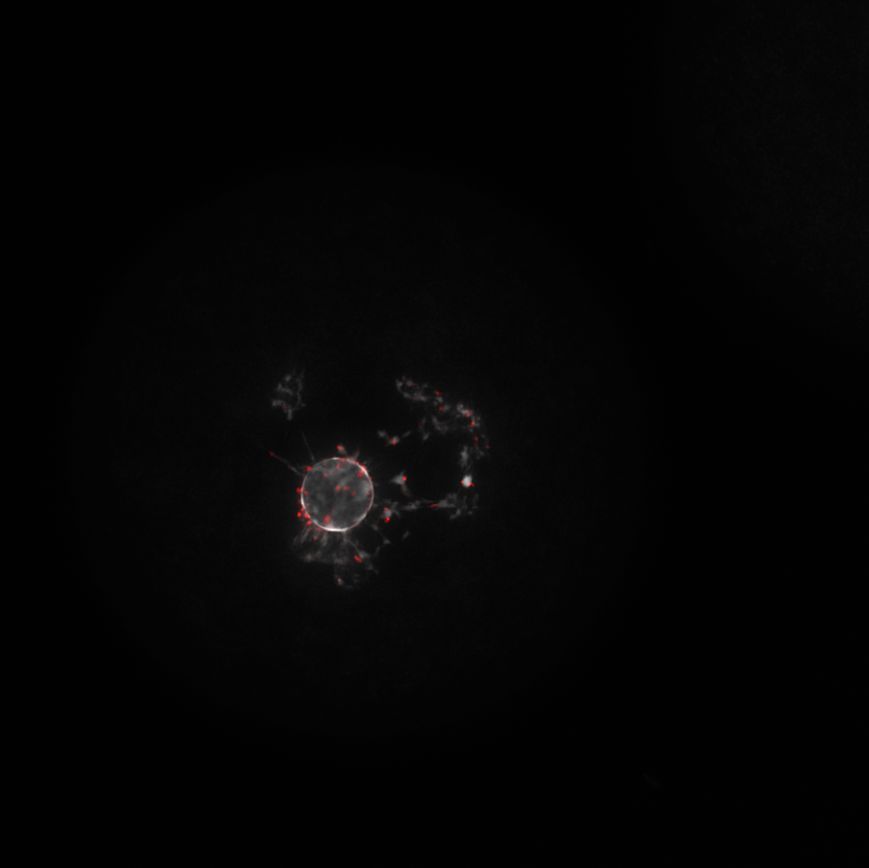
How do oocytes handle DNA damage when transcription is shut down? What I thought would be a small, fun project has ballooned into a nightmare of endless variables. Science really isn’t all sunshine and rainbows. #CellBiology #ReproductiveBiology #futureART
Fulka Lab tweet media
English
1
1
16
1.1K
IntoWild retweetledi
Sam Peng
Sam Peng@CTSPeng·
Excited to share our work on ErbB receptors published today @CellCellPress! Using multicolor, photostable UCNPs, we perform long-term (>15 min) single-particle tracking of EGFR, HER2, and HER3, enabling direct visualization of dimerization in live cells. cell.com/cell/fulltext/…
English
2
51
244
30.1K
IntoWild retweetledi
Takeshi Imai
Takeshi Imai@TakeshiImaiLab·
Interested in live tissue clearing? SeeDB-Live is now commercially available from Nacalai Tesque! @NacalaiTesqueJP @NacalaiTesque Resources and protocols: sites.google.com/site/seedbreso…
Takeshi Imai@TakeshiImaiLab

Our live tissue clearing paper is out in @naturemethods! We achieved optical clearing of mammalian brain tissues without compromising normal neuronal function. Big congrats to @Shigenori774 and our wonderful collaborators! 🎉 nature.com/articles/s4159… (1/10)

English
2
26
84
11.5K
IntoWild retweetledi
Bo Wang
Bo Wang@BoWang87·
This is probably the best paper I have read about causal reasoning for quite some time. Really a great weekend read! "Causal Persuasion" (Burkovskaya & Starkov) models how much evidence you need to establish vs. rule out a causal link. The result is stark: To prove X causes Y: 1-2 well-chosen variables often suffice. To prove X does NOT cause Y: you must account for every possible common cause. Arbitrarily many confounders. Practically unfalsifiable. This inverts the Humean intuition: in causal reasoning, positive claims are cheap to sell and negative ones are almost impossible to rebut. Now think about what this means for Virtual Cell models. Most perturbation datasets cover a thin slice of the combinatorial space — a few hundred gene knockouts, maybe a few contexts. A model trained on that data can confidently "learn" gene X drives phenotype Y. But if the true structure is X←C→Y , and C was never systematically varied — the model will never see its own confounding. It has no mechanism to distinguish causal signal from correlated noise. The paper formalizes exactly why: the model is a sophisticated receiver that accepts whatever causal story is consistent with the data it's seen. And if the data omits the right confounders, even a "sophisticated" model is manipulable. This is the deepest argument for perturbation diversity. Not just more data, but also more axes of variation. Vary the context. Vary the genetic background. Vary the timing. You're not just collecting samples; you're systematically eliminating alternative causal explanations. This is why we need “scale” the training data with more contexts including cell types, spatial, and temporal variations. Paper: aburkovskaya.com/pdf/causality.…
Bo Wang tweet media
English
18
204
968
106.8K
IntoWild retweetledi
Hemanth Govinde
Hemanth Govinde@HemanthGovinde·
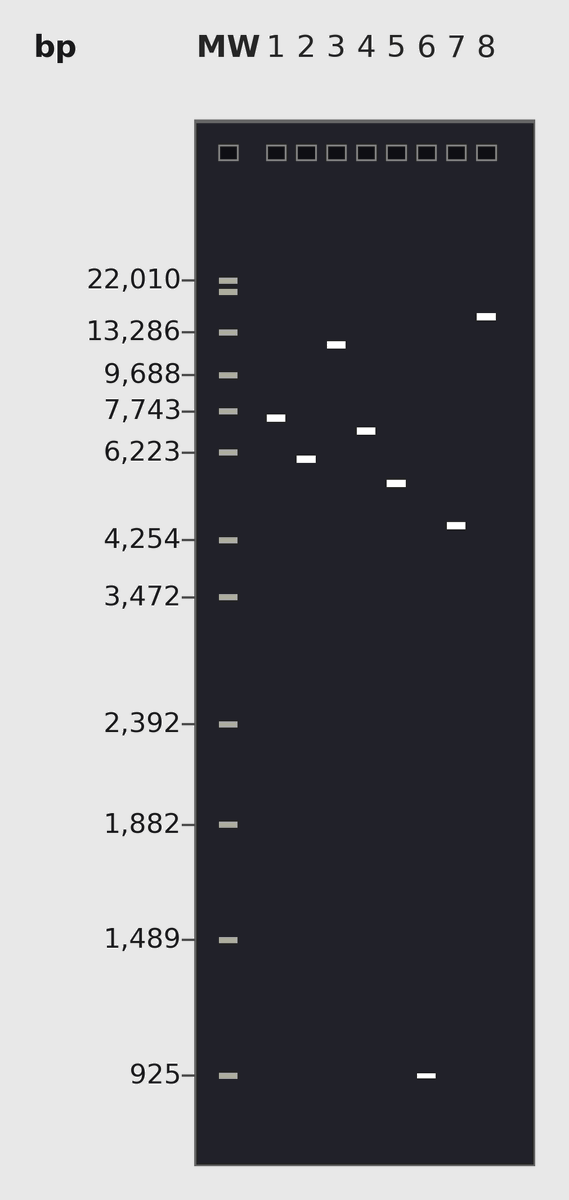
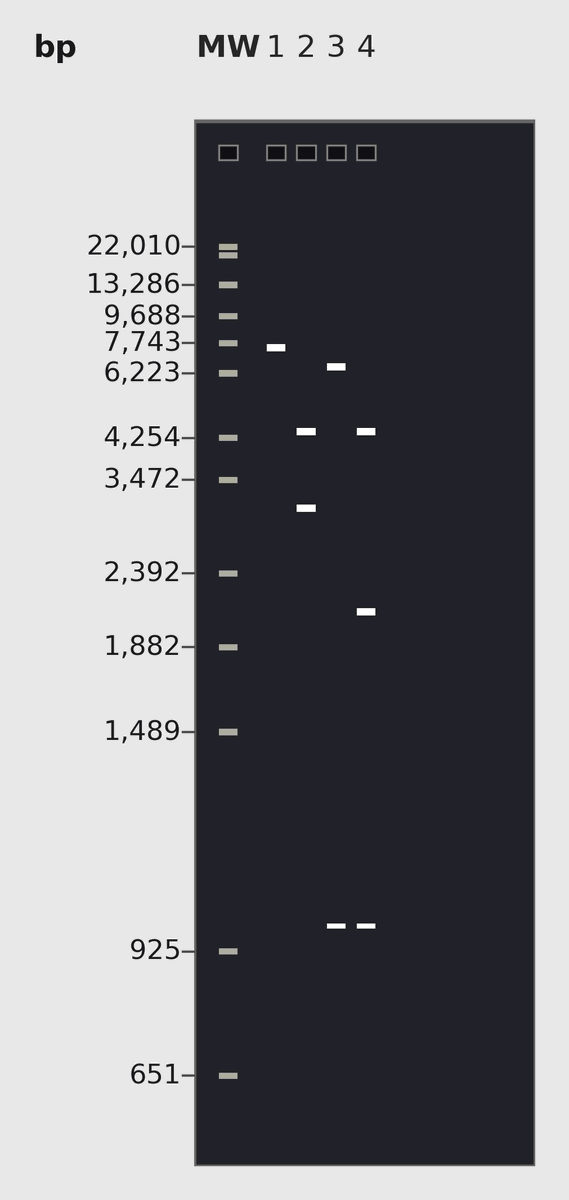
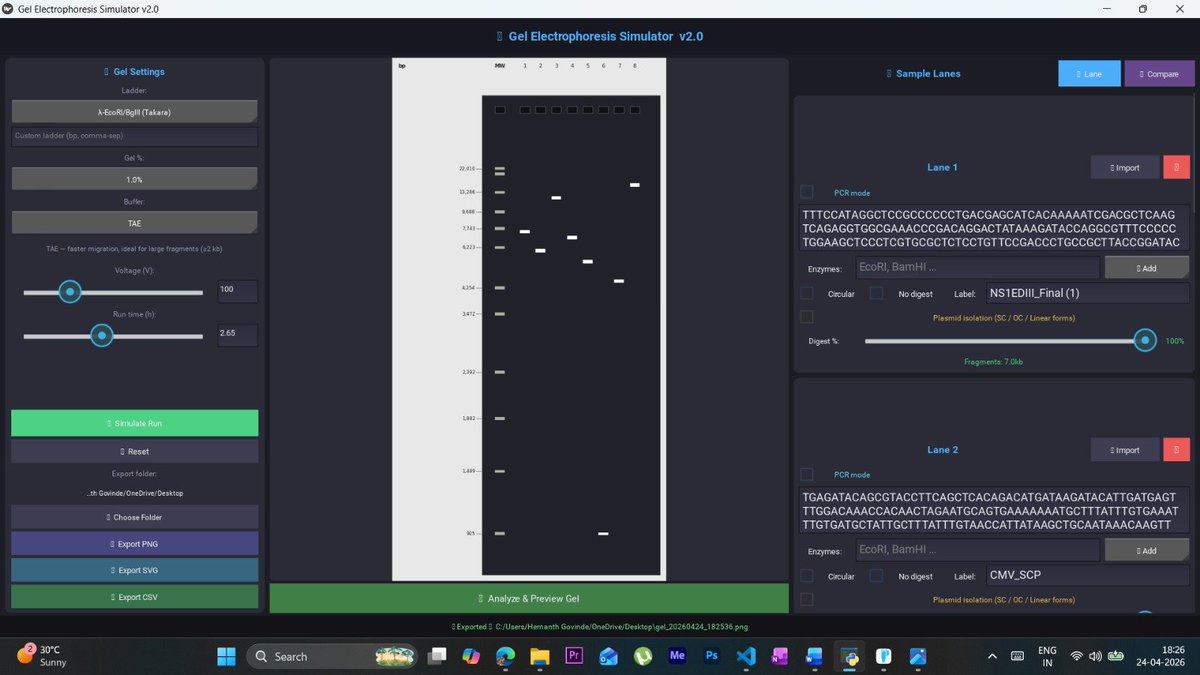
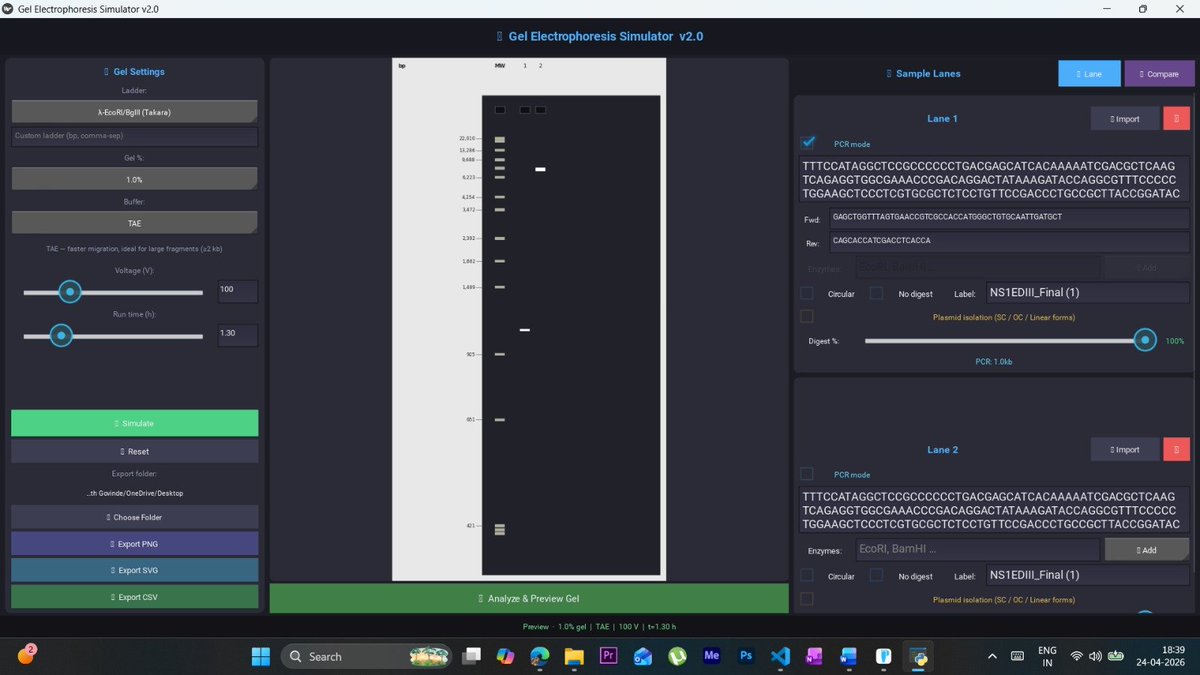
github.com/Govinde18/Gel-… Vibe coded (Claude) an electrophoresis simulator. Run the code and add more features if possible. -Export PNG/SVG -PCR mode - input both primers to simulate amplicon only -Compare with multiple enzyme cuts (Use compare button) (1/n)
Hemanth Govinde tweet mediaHemanth Govinde tweet mediaHemanth Govinde tweet mediaHemanth Govinde tweet media
English
5
15
111
6.9K
IntoWild retweetledi
Weisong Zhao
Weisong Zhao@weisong_zhao·
Please RT🙏 github.com/SR-Wiki Managed to establish a GitHub organization that consolidates resources for biomedical imaging and analysis. A range of tools is available—please use as needed.
Weisong Zhao tweet media
English
0
9
17
907