Varun Satyam

1.3K posts

Varun Satyam banner
Varun Satyam

Varun Satyam

@exportpng

Agent behaviour designer building AI memory infra @HyperbolaNet Ex @bitfinex, @Tether_to, @ankr, @biconomy. I explain agent memory and behaviour

Kamar-Taj Katılım Ekim 2014
2.5K Takip Edilen2.1K Takipçiler
Varun Satyam
Varun Satyam@exportpng·
The beauty lies in the background assets, which are not created by AI. The sections are quite simple and can be created by any AI. However, an average person cannot replicate them with AI because they require design direction and specific assets that are not readily available to everyone.
English
0
0
10
4K
Viktor Oddy
Viktor Oddy@viktoroddy·
Google Stitch vs Claude Prompt 👇
English
169
558
10.1K
902.3K
Pareen
Pareen@pareen·
Physical residencies: Rarest skill in this industry - work with best founders in the industry - jam with top tier VCs - travel to 5 countries a year - get paid to do this tag anyone you know who can do this. tag yourself. no agents only humans. cyborgs okay
Pareen@pareen

do you want to learn how to manage physical founder residencies? i have an opportunity for you. it will be hard, you will have to learn a lot quickly, travel to different places, live with founders, and be on top of your game. but it will be worth it coz only a handful of people in this industry can do this currently. reply if you are interested. QT/RT/tag 🙏

English
51
7
204
20.5K
Garry Tan
Garry Tan@garrytan·
MCP sucks honestly It eats too much context window and you have to toggle it on and off and the auth sucks I got sick of Claude in Chrome via MCP and vibe coded a CLI wrapper for Playwright tonight in 30 minutes only for my team to tell me Vercel already did it lmao But it worked 100x better and was like 100LOC as a CLI
Morgan@morganlinton

The cofounder and CTO of Perplexity, @denisyarats just said internally at Perplexity they’re moving away from MCPs and instead using APIs and CLIs 👀

English
431
213
3.8K
1.3M
Taylor Fox
Taylor Fox@taylorfox__·
request for product: Agent marketplace- Describe the problem you’d like to solve, see all suggested agents, hire agent, scroll the TL for a bit, boom, work complete felix, kellyclaude, polsia are already doing real work and generating crazy revenue. the demand side is proven, what’s missing is the discovery and hiring layer. now make it investable - there’s an interesting intersection of utility/ICM tokens where one could invest in agents and get some kind of upside through utility, rev share or some other mechanism this sits at the intersection of speculation and utility which tends to have exciting results. leverages tokenization to create attention and distribution incentives which will be one of the only ways to have products stand out in a world where anything can be created with AI
English
65
9
202
32.8K
jack
jack@jackbutcher·
I open-sourced my writing voice. 50,000 tweets distilled into one file. Drop it into any AI and it writes like me. github.com/visualizevalue…
English
151
87
1.4K
194.5K
Hayden Bleasel
Hayden Bleasel@haydenbleasel·
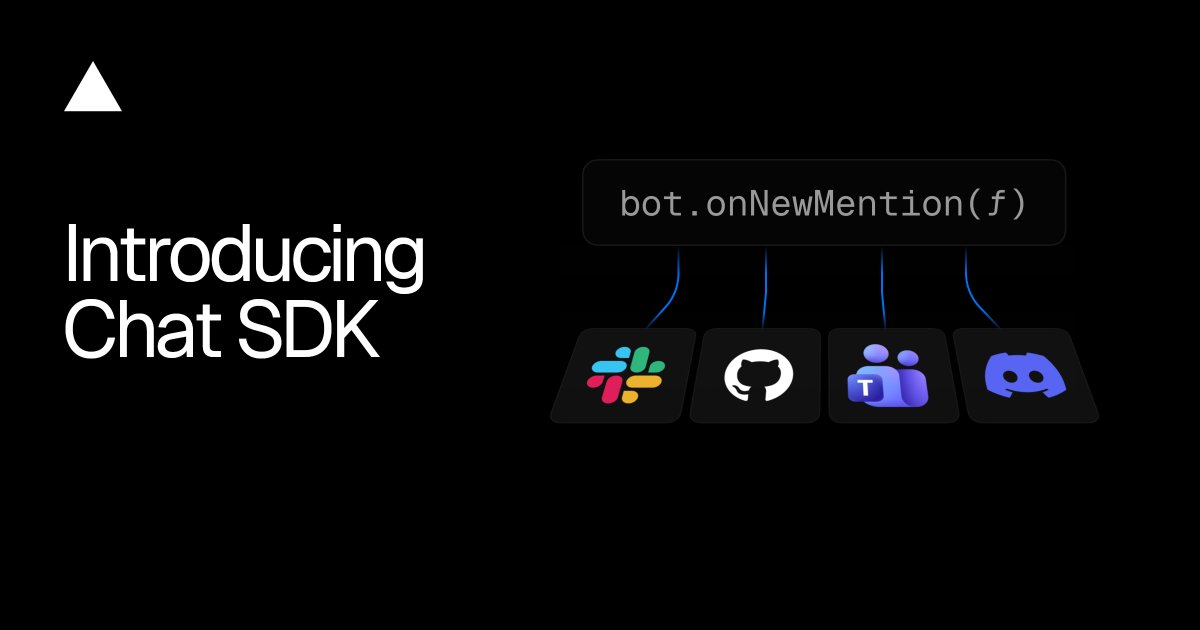
Today we're open sourcing the new Chat SDK, a unified TypeScript SDK for building chat bots across Slack, Microsoft Teams, Google Chat, Discord, and more. Now in public beta. ▲ ~/ 𝚗𝚙𝚖 𝚒 𝚌𝚑𝚊𝚝 Let's see how it works ↓
Hayden Bleasel tweet media
English
157
408
4.1K
825.3K
Varun Satyam
Varun Satyam@exportpng·
@uxkosta Could be storytelling and presentation too. Screens alone give very little to judge someone’s capability. You don’t see the constraints, scope, or context behind the decisions.
English
0
0
0
35
kosta
kosta@uxkosta·
the bar is very low, most of the submissions are equal to the output you would receive with claude. the design job market isn't overcrowded it's underskilled
English
51
25
680
91.6K
Varun Satyam
Varun Satyam@exportpng·
@alexgilev For sure. As a design exercise, it’s such a beautiful concept, and I really loved it from your perspective
English
0
0
1
19
Alex
Alex@alexgilev·
@exportpng It's a design exercise. A beautiful constraint.
English
1
0
1
213
Alex
Alex@alexgilev·
Sound ON🔊 Aristotle is built on the premise that an interface should explain itself quietly, without metaphors, in favor of context over icons, precision over expression. ⚫ The interface carries no icons. Icons require a user to recall what a shape means before they can act on it. Aristotle removes that translation layer entirely. Labels carry intent. ⚫ Sound as the feedback layer. Sound enhances the experience the way texture enhances a surface: not by adding information, but by making the interaction feel present and alive.
English
14
13
383
18.2K
Mike Bespalov
Mike Bespalov@bbssppllvv·
AI agents read markdown better than they read your mind Built an ascii wireframe editor. Draw a page in 30 seconds, copy/paste into Claude Code and get a full working page back
English
139
251
4.1K
515.8K
Aishwary
Aishwary@0xAishwary·
Taking on another responsibility: Being a Dad. 🧑
Aishwary tweet media
English
142
3
511
14K
Dan Robinson
Dan Robinson@danrobinson·
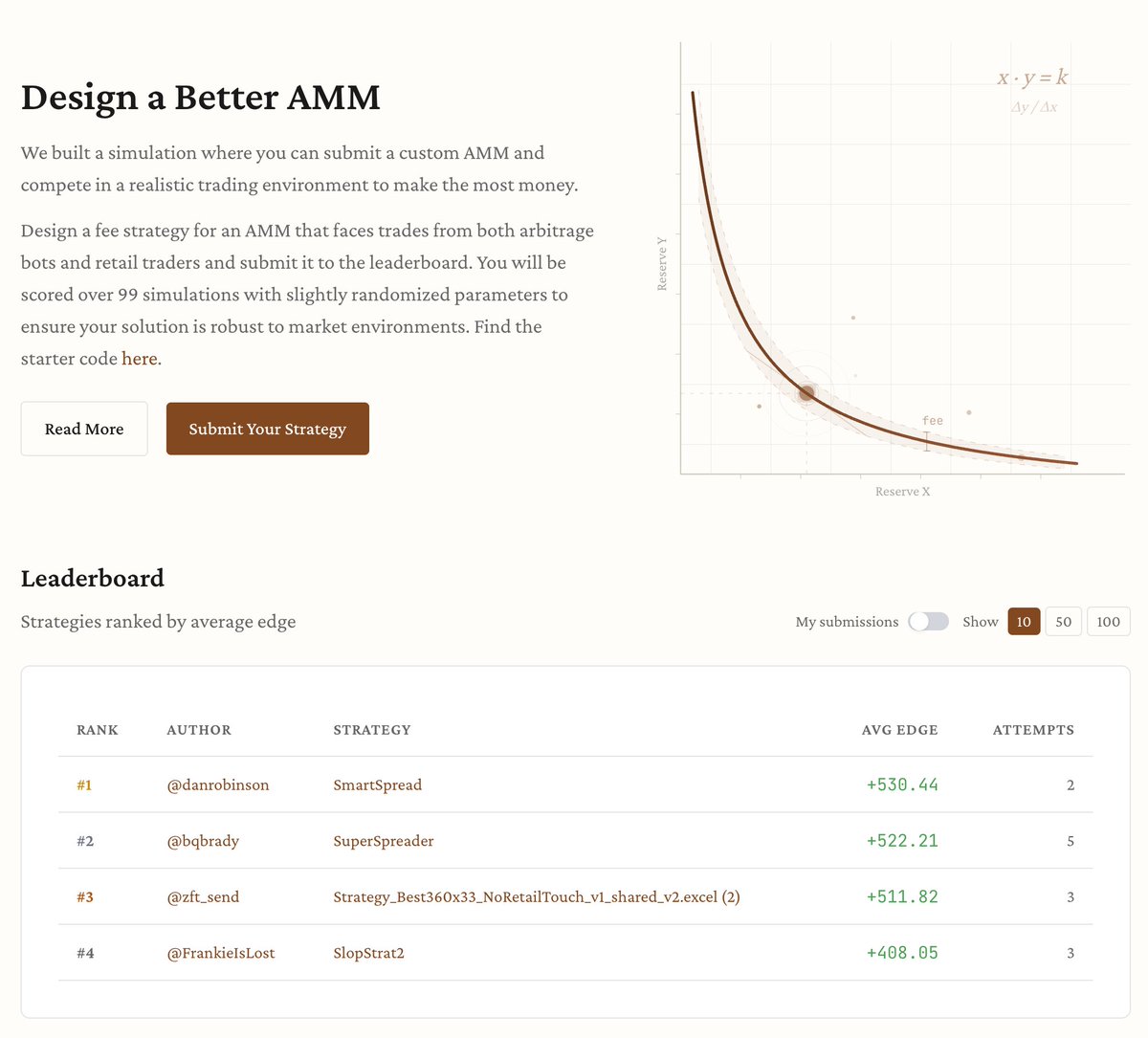
Are you a better AMM designer than me? @bqbrady and I built a challenge that lets you prove it Create your own dynamic-fee AMM and submit it to get onto our leaderboard Link in 🧵👇
Dan Robinson tweet media
English
72
70
800
525K
Varun Satyam
Varun Satyam@exportpng·
@awilkinson One suggestion is to use an AI chatbot to ask questions that are hard to understand or to clarify doubts during the answer. This would be powerful.
English
0
0
0
402
Andrew Wilkinson
Andrew Wilkinson@awilkinson·
For $5,000 worth of Claude Code credits, I vibe coded something that replaces tens of thousands of dollars of psychological evaluations. Let me explain... Last month, my girlfriend and I sat in our den with our jaws on the floor… We were in front of my laptop, taking turns reading a report out loud, line by line. The document read like a CIA dossier—incisively breaking down each of our repeated fights and nailing our relationship dynamics. We had to laugh. We couldn’t believe it. A few days earlier, I’d asked ChatGPT a simple but loaded question: “What information would you need in order to become the ultimate personalized relationship coach?” It replied with a long list of personality tests—the same ones psychologists use to evaluate mental health, personality, and relationship satisfaction. The tests were all available online, but scattered across annoying PDFs and awkward, old-school forms. For someone with ADHD, like me, the idea of doing them one by one was pure torture. I just wanted to pound through them as one big test. So I asked Claude Code to build a simple app that combined them. I listed all the tests I wanted and asked it to build a web app that would. I’d done some vibe coding last year with tools like Replit and Lovable, but nothing prepared me for how good Claude Code has become. Within a few hours, I had a beautiful web app that combined all of these tests into one. When I say beautiful, I mean it looked like I employed a $50,000-a-month payroll of talented designers and engineers who’d spent two months working on it. Except I didn’t have a $50,000-a-month payroll. I’d paid Claude around $500 in AI credits — and what would normally take months had taken hours. Crazier yet, I’d just talked to it like it was a human employee. Once a beta version was ready, we completed our tests and exported our results into ChatGPT—no names, no context—and asked: “Based on this couple’s psychological test results, tell me as much as you can about their relationship.” That’s how we ended up in our kitchen, in shock, as ChatGPT broke down our relationship patterns with eerie precision. How my ADHD makes me want quick resolution, while Zoe needs to talk things through. How her high openness craves novelty, while I’m a stick-in-the-mud who craves routine. How my avoidance causes me to pull away and shut down when I’m stressed. It felt like a report written by a world-class therapist who’d spent dozens of multi-hour sessions carefully dissecting our dynamic and suggesting remedies. It told us where we were most compatible, and where we’d struggle if we didn’t put in the work. It even wrote personal deep dives on each of us, our personalities, and our individual gifts and challenges. And it knew all of this from 45 minutes of multiple-choice questions. I started thinking about friends who’d never been to therapy, or couldn’t afford anything like this, and how much it could help them. That’s when I realized this was a business. Something that would solve a valuable problem for a lot of people. So I got to work. For the last month, I’ve been jolting out of bed at 5:30 a.m., too excited to sleep, obsessively building this product. And today, I’m excited to launch Deep Personality. I think it’s one of the most comprehensive mental-health screening tools on the internet. It’s not a replacement for professional help, but a roadmap to it. Most people stumble blindly into a random therapist or doctor’s office without knowing what type of treatment they are even trained in or its efficacy for their specific problems. Deep Personality will screen you across 30+ mental health conditions and provide you with a detailed roadmap of how to get the help you need. In under an hour, it gives you a high-signal snapshot of your mental health across dozens of dimensions: Big Five Personality The gold standard for understanding why you do what you do. Attachment Styles The hidden patterns behind pushing people away, clinging too tightly, or choosing unavailable partners. Anxiety & Depression Screens for what you might be dismissing as “just stress.” Relationship Satisfaction Measures the real health of your relationship — often surfacing problems you’ve been avoiding. Sensory Processing Why crowded rooms drain you — or why you need things just so to focus. Neurodivergence Flags potential ADHD and autism-spectrum traits that often go undiagnosed into adulthood. Trauma Maps early experiences shaping your triggers and stress responses. Values & Career Fit Shows what actually motivates you, and why some work quietly drains your soul. You can do this individually, or compare yourself to anyone in your life. This is where it gets really interesting… Have your partner, coworker, friend, or family member take the assessment, upload their profile, and wait while the app analyzes your personalities and how they interact with one another. For romantic relationships, it analyzes attachment compatibility, conflict styles, emotional regulation, and values alignment — telling you exactly where you’ll clash and what to do about it. For work relationships, it focuses on communication, motivation, and how you’ll collaborate — or blow up under pressure. For friendships, it looks at shared values, social energy, and the dynamics that help relationships thrive (or quietly fade). For Zoe and me, having our relationship laid out with this kind of clarity — patterns we’d felt but never articulated — was deeply meaningful. Once you complete the assessment, you get a 50+ page deep dive on your personality. It felt like finally getting the owner’s manual for myself. You also get a custom AI prompt pre-loaded with your psychological data. Drop it into ChatGPT, Claude, or any AI assistant — and you have a therapist who already knows your attachment style, anxiety patterns, values, trauma history, and emotional regulation tendencies. No more spending six therapy sessions explaining who you are. The AI already gets it. And if you’re in therapy, or going to start with a new therapist, you can also export a clinical PDF designed for practitioners—raw scores, thresholds, severity flags, discussion points, and citations. Or… it can help you attract your perfect romantic partner. This one’s just fun. Deep Personality can generate dating bios based on your actual personality data — tailored to Hinge, Bumble, or Tinder — in tones like witty, sincere, adventurous, or intellectual. The AI turns what makes you unique into something that attracts compatible people. Once it knows you, it helps you get the help you need. Based on your results, it recommends books, podcasts, and treatment options backed by peer-reviewed research. The full assessment covers 30+ psychological screens and 300+ questions, and it costs a fraction of a single therapy session (free for the basic analysis, $19 for the full report, $29 for a couples comparison). It’s really crazy and I think it's going to help a lot of people. Who is this for? • High achievers who want to understand their edge • People who feel stuck and don’t know why • Curious minds who want real data • Pattern repeaters, same story — different chapter • Anyone who wants better relationships I’d love it if you’d try it and send me your thoughts! 👉 Click here to check it out: deeppersonality.app
English
99
33
735
164.6K
Antti Karjalainen
Antti Karjalainen@aikarjal·
Someone needs to build a company around Customer Context Graph. Collect all the threads – emails, meeting transcripts, slack messages, contracts, deliverables, detail, info, and config – from your customers into context that can be explored and queried by agents. This info is scattered between CRMs, ticketing systems, note takers, product, landing pages – it's inherently cross platform information. You need a new solution. Kind of how Segment did it trad SaaS apps. With this context, you can fire up Claude Cowork or similar for ad-hoc work or build extremely powerful agent automation flows. Expose the context as skills, MCP, and file system. Even better if you build it as open-source with a hosted option so people can take it on-prem as needed. Create a connector ecosystem around it. This will power every single next-gen AI-native full-stack business. Sort of like the context graph (@ashugarg @JayaGup10 ) that has been discussed recently but I'm thinking something very concrete: "Get me all the context about this particular customer." A customer-level, cross-system context substrate that agents can explore and act on
English
142
22
405
116.5K
fabiano.sol
fabiano.sol@FabianoSolana·
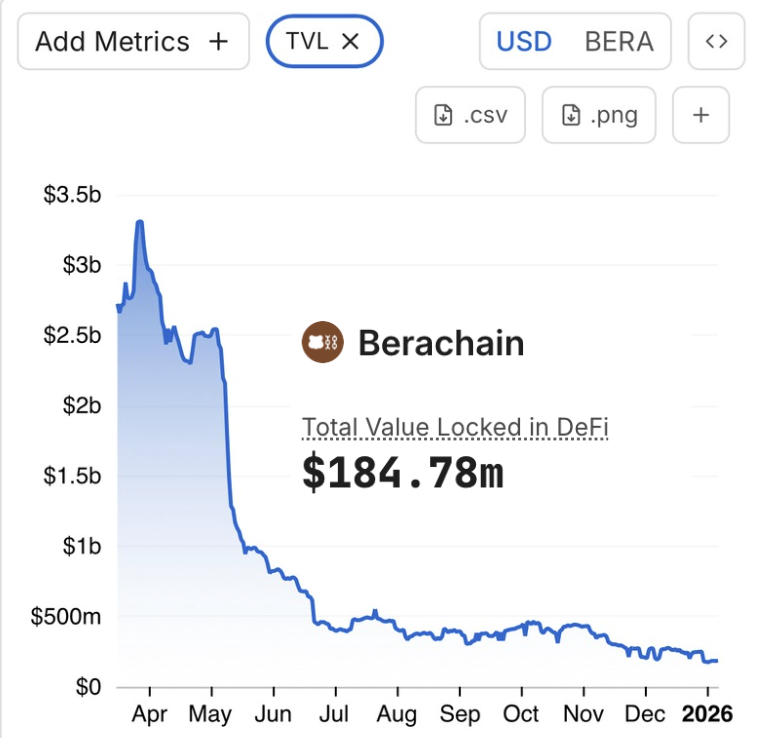
Remember Berachain? In 2024, at Token2049 in Singapore, they hosted the biggest party at Marquee in Marina Bay Sands They had unbelievable hype Today, their TVL is down from $3B to about $184M, and on a good day they generate a few thousand dollars
fabiano.sol tweet media
English
535
142
2.8K
651.8K