

Fairground
68 posts

Fairground
@fairground_work
Fairground is an engineering hiring platform built for technical teams. AI native tool for real world interviews on real world problems. [email protected]
Katılım Mart 2026
31 Takip Edilen7 Takipçiler
Fairground CLI Interviews - available now!
Supports both - human (sync) and take-home (async) modes.
Level up your technical interviews today! Emails us at team@fairground.work to know more.
English
@lennysan @simonw The inflection point created a split. One group got productive while another just got faster at code and needs rewriting next w. 50% of tech roles now require AI skills but most interviews still test recall/checkbox "how" one is using AI tools matter more. fairground.work/blog/engineeri…
English

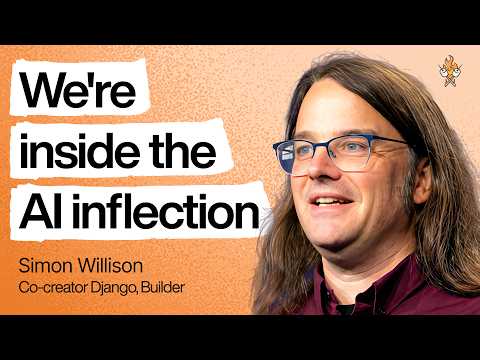
My biggest takeaways from @simonw:
1. November 2025 was an inflection point for AI coding. GPT 5.1 and Claude Opus 4.5 crossed a threshold where coding agents went from “mostly works” to “almost always does what you want it to do.” Software engineers who tinkered over the holidays realized the technology had become genuinely reliable.
2. Mid-career engineers are the most vulnerable—not juniors, not seniors. AI amplifies experienced engineers by letting them leverage decades of pattern recognition. It also dramatically helps new engineers onboard. Cloudflare and Shopify each hired a thousand interns because AI cut ramp-up time from a month to a week. But mid-career engineers who haven’t accumulated deep expertise and have already captured the beginner boost are in the most precarious position.
3. AI exhaustion is real and underestimated. Simon runs four coding agents in parallel and is mentally wiped out by 11 a.m. He’s getting more time back, but his brain is exhausted from the intensity of directing multiple autonomous workers. Some engineers are losing sleep to keep agents running. This may just be a novelty issue, but the underlying dynamic—that managing AI amplifies cognitive load even as it reduces labor—is a real tension. Good companies will manage expectations rather than expecting 5x output indefinitely.
4. Code is cheap now. This simple idea has profound implications. The thing that used to take most of the time—writing code—now takes the least. The bottleneck has shifted to everything else: deciding what to build, proving ideas work, getting user feedback. Since prototyping is nearly free, Simon often builds three versions of every feature when he’s getting started.
5. The “dark factory” is the most radical experiment in AI-assisted development happening right now. A company called StrongDM established a policy: nobody writes code, nobody reads code. Instead, they run a swarm of AI-simulated end users 24/7—thousands of fake employees making requests like “give me access to Jira”—at $10,000 a day in token costs. They even had coding agents build simulated versions of Slack, Jira, and Okta from API documentation so they could test without rate limits.
6. "Red/green TDD" is the single highest-leverage agentic engineering pattern. Having coding agents write tests first, watch them fail, then write the implementation, then watch them pass produces materially better results. The five-word prompt “use red/green TDD” encodes this entire workflow because the agents recognize the jargon.
7. “Hoarding things you know how to do” is one of Simon's other favorite agentic engineering patterns. Simon maintains a GitHub repo of 193 small HTML/JavaScript tools and a separate research repo of coding-agent experiments. Each one captures a technique, a proof of concept, or a library he’s tested. When a new problem arrives, he can point Claude Code at past projects and say “combine these two approaches.”
8. The "lethal trifecta" makes AI agent security fundamentally unsolved. Whenever an AI agent has access to private data, exposure to untrusted content (like incoming emails), and the ability to send data externally (like replying to email), you have a lethal trifecta. Prompt injection—where malicious instructions in untrusted text override the agent’s intended behavior—cannot be reliably prevented. Simon has predicted a “Challenger disaster” for AI security every six months for three years. It hasn’t happened yet, but he’s pretty sure it will.
9. Start every project from a thin template, not a long instructions file. Coding agents are phenomenally good at matching existing patterns. A single test file with your preferred indentation and style is more effective than paragraphs of written instructions. Simon starts every project with a template containing one test (literally testing that 1 + 1 = 2) laid out in his preferred style. The agent picks it up and follows the convention across the entire codebase. This is cheaper and more reliable than maintaining elaborate prompt files.
10. The pelican-on-a-bicycle benchmark accidentally became a real AI benchmark. Simon created it as a joke to mock numeric benchmarks—get each LLM to generate an SVG of a pelican riding a bicycle, and compare the drawings. Unexpectedly, there’s a strong correlation between how good the drawing is and how good the model is at everything else. Nobody can explain why. It’s become a meme: Gemini 3.1’s launch video featured a pelican riding a bicycle. The AI labs are aware of it and quietly competing on it.
Don't miss our full conversation: youtube.com/watch?v=wc8FBh…
YouTube
Lenny Rachitsky@lennysan
"Using coding agents well is taking every inch of my 25 years of experience as a software engineer." Simon Willison (@simonw) is one of the most prolific independent software engineers and most trusted voices on how AI is changing the craft of building software. He co-created Django, coined the term "prompt injection," and popularized the terms "agentic engineering" and "AI slop." In our in-depth conversation, we discuss: 🔸 Why November 2025 was an inflection point 🔸 The "dark factory" pattern 🔸 Why mid-career engineers (not juniors) are the most at risk right now 🔸 Three agentic engineering patterns he uses daily: red/green TDD, thin templates, hoarding 🔸 Why he writes 95% of his code from his phone while walking the dog 🔸 Why he thinks we're headed for an AI Challenger disaster 🔸 How a pelican riding a bicycle became the unofficial benchmark for AI model quality Listen now 👇 youtu.be/wc8FBhQtdsA
English
@angeljimenez The best engineers already do this. Use AI selectively, validate everything, close the tool when the problem is too context-dependent. That restraint is what predicts quality.
We try to solve for this in tech interviewing - fairground.work/blog/tokenmaxx…
English

Al tokenmaxxing le quedan dos telediarios. Ahora los empleados que se rifarán las tecnológicas harán tokenminimaxxing.
The Information@theinformation
About 11% of Uber’s backend code updates are being written by AI agents built primarily with Claude Code, driving up costs faster than expected. Full story: thein.fo/41DvG3y
Español
@SpirosMargaris This is what we also keep coming back to. Esp when hiring or upskilling your engineering teams - need to check "how" people are using AI rather than just that are they using or not. Classic middle manager and TA team mistake.
We dug into the data here: fairground.work/blog/tokenmaxx…
English

Uber is already feeling the cost of rapid AI adoption.
Heavy use of tools like coding agents has pushed spending beyond expectations, exhausting its AI budget early in the year.
It highlights a growing reality. AI can boost productivity, but the costs can scale just as quickly.
aimagazine.com/news/why-uber-… @AIMagazine_BC
English
@GavinSherry This is what we keep coming back to. You need to check "how" people are using AI rather than just that are they using or not. Classic middle manager and TA team mistake.
We dug into the data here: fairground.work/blog/tokenmaxx…
English

Tokenmaxxing: the classic mistake of conflating a measure with a target: en.wikipedia.org/wiki/Goodhart%…
English
Fairground retweetledi

AI-native software engineering teams operate very differently than traditional teams. The obvious difference is that AI-native teams use coding agents to build products much faster, but this leads to many other changes in how we operate. For example, some great engineers now play broader roles than just writing code. They are partly product managers, designers, sometimes marketers. Further, small teams who work in the same office, where they can communicate face-to-face, can move incredibly quickly.
Because we can now build fast, a greater fraction of time must be spent deciding what to build. To deal with this project-management bottleneck, some teams are pushing engineer:product manager (PM) some teams are pushing engineer:product manager (PM) ratios downward from, say, 8:1 to as low as 1:1. But we can do even better: If we have one PM who decides what to build and one engineer who builds it, the communication between them becomes a bottleneck. This is why the fastest-moving teams I see tend to have engineers who know how to do some product work (and, optionally, some PMs who know how to do some engineering work). When an engineer understands users and can make decisions on what to build and build it directly, they can execute incredibly quickly.
I’ve seen engineers successfully expand their roles to including making product decisions, and PMs expand their roles to building software. The tech industry has more engineers than PMs, but both are promising paths. If you are an engineer, you’ll find it useful to learn some product management skills, and if you’re a PM, please learn to build!
Looking beyond the product-management bottleneck, I also see bottlenecks in design, marketing, legal compliance, and much more. When we speed up coding 10x or 100x, everything else becomes slow in comparison. For example, some of my teams have built great features so quickly that the marketing organization was left scrambling to figure out how to communicate them to users — a marketing bottleneck. Or when a team can build software in a day that the legal department needs a week to review, that’s a legal compliance bottleneck. In this way, agentic coding isn’t just changing the workflow of software engineering, it’s also changing all the teams around it.
When smaller, AI-enabled teams can get more done, generalists excel. Traditional companies need to pull together people from many specialties — engineering, product management, design, marketing, legal, etc. — to execute projects and create value. This has resulted in large teams of specialists who work together. But if a team of 2 persons is to get work done that require 5 different specialities, then some of those individuals must play roles outside a single speciality. In some small teams, individuals do have deep specializations. For example, one might be a great engineer and another a great PM. But they also understand the other key functions needed to move a project forward, and can jump into thinking through other kinds of problems as needed. Of course, proficiency with AI tools is a big help, since it helps us to think through problems that involve different roles.
Even in a two-person team, to move fast, communication bottlenecks also must be minimized. This is why I value teams that work in the same location. Remote teams can perform well too, but the highest speed is achieved by having everyone in the room, able to communicate instantaneously to solve problems.
This post focuses on AI-native teams with around 2-10 persons, but not everything can be done by a small team. I'll address the coordination of larger teams in the future.
I realize these shifts to job roles are tough to navigate for many people. At the same time, I am encouraged that individuals and small teams who are willing to learn the relevant skills are now able to get far more done than was possible before. This is the golden age of learning and building!
[Original text: deeplearning.ai/the-batch/issu… ]

English
This is exactly what we are building for @btaylor. We believe even phone screens can be AI-assisted and still remain high signal. Need to ask better questions like debugging, code review, optimizations etc upfront (as you are experimenting)
fairground.work/take-home-earl…
Bret Taylor@btaylor
As coding agents have become the standard for developing software, we've transformed Sierra's engineering interview process to be AI-native. We've documented our lessons here, and very curious how others in the industry are navigating sierra.ai/blog/the-ai-na…
English
Fairground enables this for all companies - so that you can evaluate fairly and consistently.
fairground.work/blog/take-home…
English
What seems "impossible" is now possible, coz you get to use AI agents and CLI agents like Claude Code, Codex etc.
We believe this is the new interview every company and software engineer needs to get used to.
English
Frontier labs are giving "impossible" questions in their interviews now. Make a full end-to-end working app in 25-35 mins with logging, tests and automation. Might seem excessive but this is what the new bar is.
English
Fairground retweetledi

Google is now asking PM candidates to open Cursor and build a working prototype in 45 minutes.
Not engineers. Product managers.
Figma does it. Perplexity does it. v0 does it. It's been confirmed on Blind and I've had candidates come back from these rounds stunned because nothing in their prep covered it.
The round doesn't test whether you can code. It tests whether you can think through a product problem and make it real while someone watches. Scoping, trade-offs, what to build first, what to skip, how you handle the moment something breaks. All the product judgment that used to happen in a whiteboard case now happens in a live IDE.
No framework saves you here. CIRCLES doesn't help. A product sense structure doesn't help. You either have reps in these tools or you freeze for 45 minutes while the interviewer writes their notes.
Google removed the standalone technical interview for PMs entirely. They replaced it with this. The bar moved from "can you talk about technology" to "can you build with it while we watch."
The candidates practicing behavioral answers and product cases are preparing for 4 out of 5 rounds. This is the round they don't know exists yet. And it's the one with a zero percent recovery rate. A mediocre behavioral answer still passes. A blank screen doesn't.
Aakash Gupta@aakashgupta
OpenAI pays $860K. Google runs 10 rounds. And most PM candidates are still prepping with frameworks from 2023. I've coached 200+ PM candidates. 30+ landed AI PM offers in the last 12 months. Five things shifted in the interview. First, they test whether you've built AI. "I understand transformers" used to pass. Now they ask you to walk through a production model that degraded and what you did. One candidate at Google: "They asked me what the F1 score was. I said I'd have to check. Interview was over in their minds." Second, vibe coding is a real round. Google, Figma, Perplexity. 45 minutes to build a working prototype in Cursor or Bolt. If you've never opened these tools, no framework saves you. Third, AI product sense replaced traditional product sense. Google removed the standalone technical interview for PMs. They want model-layer vs app-layer separation, safety without prompting, and prioritization with real math. Not "high/medium/low." Fourth, behavioral questions got specific. "Tell me about a failure" became "Walk me through an AI product decision you made that seemed right but you'd approach differently now." Generic STAR doesn't survive. Fifth, safety is tested everywhere. Anthropic has a dedicated round. OpenAI embeds it throughout. If you hit minute 40 without mentioning it, you've told them you don't understand the job. I recorded a full unedited mock with Dr. Bart Jaworski (12,000+ PMs helped, ex-Microsoft AI PM) showing how to handle all five: youtu.be/vPQCsAxWJ70
English
We talked to many recruiters and talent teams hiring PMs and most are thinking of testing PM candidates on their coding / vibe coding skills - this is a tectonic shift.
We are helping companies do these take-home tests on real world problems in real world scenarios.
claire vo 🖤@clairevo
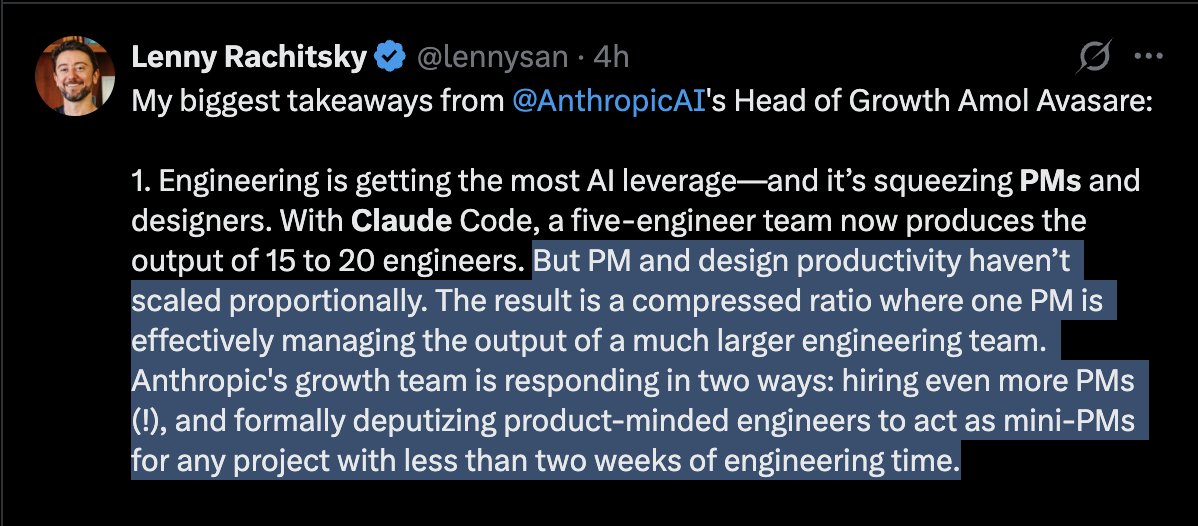
I tried to kill PM, but @AnthropicAI is hiring more of them. Why? Because engineering is getting massive AI leverage and the PM capacity cannot catch up. Even with standard ratios (1 PM: ~5 engineers) it feels more like 1 PM to 20 engineers. Interesting that the response is both a) hire more PMs (which says that PMs are at max capacity/leverage) and my more favorite tool -> b) turning engineers into PMs This is my fave use case of @chatprd - I see so many teams deciding "anyone can cook" and using the app to make non PMs a little more product-minded...without the meetings. What I really want to see though is what we can build to get those PMs the same 4-5x leverage that the engineers are getting. So far PMs are still - managing stakeholders - getting everyone to agree - spending time with customers - playing with the right solution via prototypes Are these things that AI can eventually replace? My bet is yes, but until then... apply for those anthropic jobs 😎
English
Fairground retweetledi

I tried to kill PM, but @AnthropicAI is hiring more of them.
Why?
Because engineering is getting massive AI leverage and the PM capacity cannot catch up. Even with standard ratios (1 PM: ~5 engineers) it feels more like 1 PM to 20 engineers.
Interesting that the response is both a) hire more PMs (which says that PMs are at max capacity/leverage) and my more favorite tool -> b) turning engineers into PMs
This is my fave use case of @chatprd - I see so many teams deciding "anyone can cook" and using the app to make non PMs a little more product-minded...without the meetings.
What I really want to see though is what we can build to get those PMs the same 4-5x leverage that the engineers are getting. So far PMs are still
- managing stakeholders
- getting everyone to agree
- spending time with customers
- playing with the right solution via prototypes
Are these things that AI can eventually replace?
My bet is yes, but until then... apply for those anthropic jobs 😎
English
@andrewchen Trials are great. But you cannot do it for everyone, you still need to filter your (bloated) pipeline (and keyword matching doesn't work for sure).
Thats why we believe in doing a real-world async interview / take-home test in a controlled environment on @fairground_work
English

noticing a trend of startups replacing standard resumes/interviews with week-long (or at least 3-day weekend) in-office trials. Makes sense in a world of AI-generated resumes and interview responses
Turns out the best signal for whether someone can do a job is watching them actually do the job. took us 100 years of HR to rediscover apprenticeships!!! 😂
English
We are helping CTOs re-org for future. Test AI-readiness of incoming (and existing) talent is critical and will be table-stakes in future.
Thats why we let candidates use claude code, codex and agents during their interviews.
Join the waitlist now.
Aakrit Vaish@aakrit
We surveyed 77 of India's top CTOs on how they are using AI. What's working, what's not, model choices, org design, and everything in between. Median company size of 500-2,000 employees across new economy companies such as Meesho, upGrad, Dream11, Groww, Pine Labs, CRED, etc.
English
Fairground retweetledi

We surveyed 77 of India's top CTOs on how they are using AI.
What's working, what's not, model choices, org design, and everything in between.
Median company size of 500-2,000 employees across new economy companies such as Meesho, upGrad, Dream11, Groww, Pine Labs, CRED, etc.
English
@pratyush_r8 @ThineAI We are happy to help with custom take home rounds - where you let them build something meaningful but also get the whole interview audit log, evaluated, proctored.
We are building this to find builders - fairground.work/take-home-earl…
English

Want to know if someone's a great hire? Look at their proof of work and talk to their references.
Not GPA. Not school. Not how polished your application looks.
Recently, for a growth intern role, we built our entire hiring process @ThineAI around this. No JD. No resume. No form.
Here's what we did and why it's found us better people than any traditional filter ever could:
1. We give you one ask: show us how you think. Build something, break something, write something. There's no brief. No structure. On purpose. The people who need a prompt to get started are not the people we're looking for.
2. We care less about what you shipped in past and more about what you chose to care about. What did you notice without being told? What did you ignore? Judgment lives in those quiet decisions.
3. We value people who put themselves out there. No guarantees, no perfect setup, just taking a shot anyway. That willingness to risk rejection and still show up is legitimate proof of work. You can't fake it. You can't credential your way into it.
4. Knowing when to move fast and when to slow down. That instinct separates someone useful from someone essential.
This process has helped us find people who are genuinely curious, growth-minded, and willing to do the work to get things right. We've hired 4 interns this way - every one of them came through from a pool of 500+.
We are still looking. Not for the most structured application. But for the one that makes us stop scrolling.
English
@omooretweets We belive in giving them claude code and codex in interviews itself to solve problems.
fairground.work/take-home-earl…
English

A startup is asking job candidates to have ChatGPT assess them for the role, and submit their chat log 👇
It sounds crazy, but I think we will see more of this
AI knows us better than any other software (and most humans) ever will


English
@IgorSteblii @lennysan We believe we should be taking tech interviews directly on CLI coding agents, if they are expected to do that in their day-to-day.
We are solving for this with AI-readiness scorecards -
fairground.work/take-home-earl…
Would love for you to try.
English

Who’s hiring engineers right now?
Reply with the role, location, and how to apply.
English