fcollman

292 posts

fcollman banner
fcollman

fcollman

@fcollman

Neuroscientist @AllenInstitute studying synaptic and artificial networks

Katılım Haziran 2008
208 Takip Edilen444 Takipçiler
fcollman
fcollman@fcollman·
@stardazed0 @nc_znc I didn't really understand why they normalized by devices used... one big difference in technologies is how easy it is the parallelize across scopes.
English
0
0
0
88
niccolò zanichelli
niccolò zanichelli@nc_znc·
Is there any experience curve data on connectomics progress? Something like this (from arxiv.org/abs/2103.14662) but tracking e.g. number of segmented synapses in published connectomics research over time
niccolò zanichelli tweet media
English
1
0
2
532
fcollman
fcollman@fcollman·
Excited to get started working on this! Will also aim to do 10 mm^3 at synaptic resolution across the basal ganglia, including NaC, VP, MD thalamus and VTA and the connections between, with segmentation from @zettaconnectome.
Allen Institute@AllenInstitute

Our scientists and collaborators will enhance transmission #electronmicroscopy techniques with goal of imaging an entire hemisphere of mouse brain at 120nm resolution. @Princeton @argonne @calstateeastbay @mtholyoke @appstate @CollmanForrest @nih | #studyBRAIN


English
0
1
21
3.2K
fcollman
fcollman@fcollman·
@paulbohm @sdorkenw Huge variations from cell to cell, tens of thousands of different types. Different neurotransmitters abound. The complexity makes a LLM look simple in comparison.
English
1
0
30
2.2K
Paul Bohm
Paul Bohm@paulbohm·
@sdorkenw That's incredible! Are all the neurons and synapses functioning interchangeably, or is there considerable variation between them?
English
1
0
7
17.8K
fcollman
fcollman@fcollman·
@BevilConway @eLife Journal editors for PNAS, Frontiers and SFN's eNeuro are all working scientists as well... to name a few.
English
1
0
0
59
Bevil Conway
Bevil Conway@BevilConway·
@fcollman @eLife Others have high rejections BUT their editors are not publishing scientists so incentives differ. Sep powers! Eg: The FDA is not run by pharma executives with business before the agency. Is rejection rate the same for papers by eLife editors? Appearance of COI = bias against URMs
English
1
0
0
84
Bevil Conway
Bevil Conway@BevilConway·
Science happens through theory, data, and publication. An important scientist-run journal, @eLife, recently made a major shift in how they handle publication. It’s caused major controversy. Here’s my attempt to explain why. #Science #research a 🧵 1/12
English
3
14
59
57.3K
fcollman
fcollman@fcollman·
@BevilConway @eLife All other journals also have desk rejection, your argument introduces it as if it’s a unique feature of elife, plus your argument doesn’t make a clear case for an alternative that doesn’t already exist.
English
1
0
0
169
Bevil Conway
Bevil Conway@BevilConway·
I tweet reluctantly. @eLife is run by scientists whose approval I desire (I can’t imagine my tweet pleases them). But my hesitation is itself evidence of the central challenge: science depends on the capriciousness of human decisions. Separation of powers is vital. 12/12
English
6
0
12
2.9K
fcollman
fcollman@fcollman·
@AndrewHires Oh and if we can just add in some recordings from our phones and gps data we can save another 2 trillion and 200 years we spend on trying to record from neurons because brain machine interfaces will be unnesserary as we will predict all motor behaviors.
English
0
0
1
84
Andrew Hires
Andrew Hires@AndrewHires·
All the effort spent on brain preservation and a synaptic connectome, when the relevant embeddings are much more easily accessible. Just feed a generative model your gmail history and a few IG reels. Boom your brain is uploaded. Saved you $10B and 30 years of R & D.
California, USA 🇺🇸 English
5
0
14
3.3K
fcollman retweetledi
Allen Institute
Allen Institute@AllenInstitute·
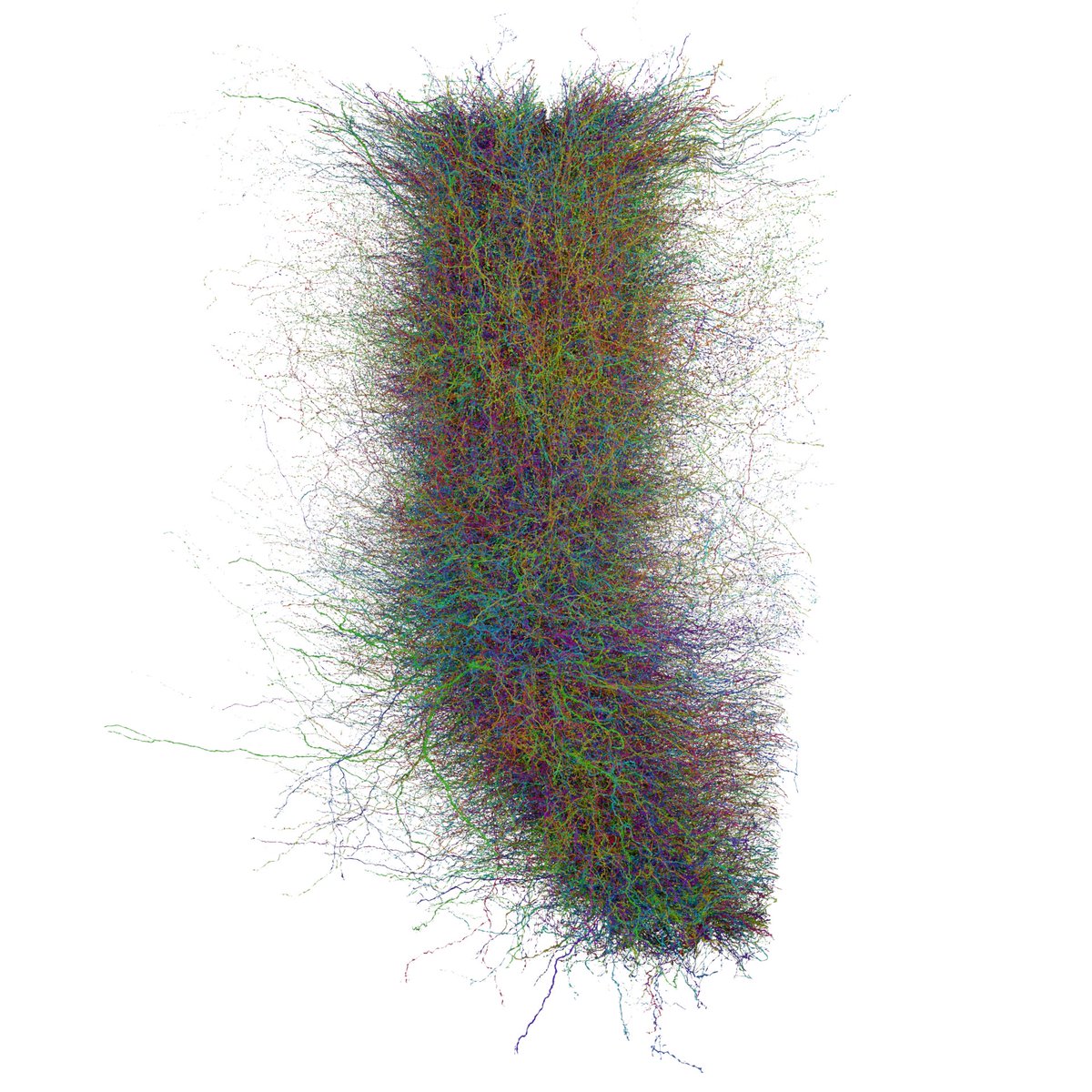
Our scientists are using millimeter-scale #volumeEM to map the brain w/ single-synapse resolution. In a recent preprint, using data spanning millions of synapses across more than 1300 neurons, they reveal new organizing principles for cortical inhibition. biorxiv.org/content/10.110…
Allen Institute tweet mediaAllen Institute tweet media
English
2
22
60
12.5K
fcollman
fcollman@fcollman·
@cksalmo @HaniehFalahati We seem to find that the degree of this varies a lot by presynaptic cell type, a lot of thalamic axon synapses for example are almost fully surrounded by astrocyte, but others are less so. Perhaps firing rate and/or release probability related.
English
1
1
2
221
Chris Salmon
Chris Salmon@cksalmo·
@HaniehFalahati These are great images bc they illustrate something confusing about PAPs - they very very rarely surround synapses with a fully connected ring structure. It looks like they do in these images, but you can see the breaks in the rings! Thanks for sharing :)
English
2
1
1
410
Hanieh Falahati هانيه فلاحتى
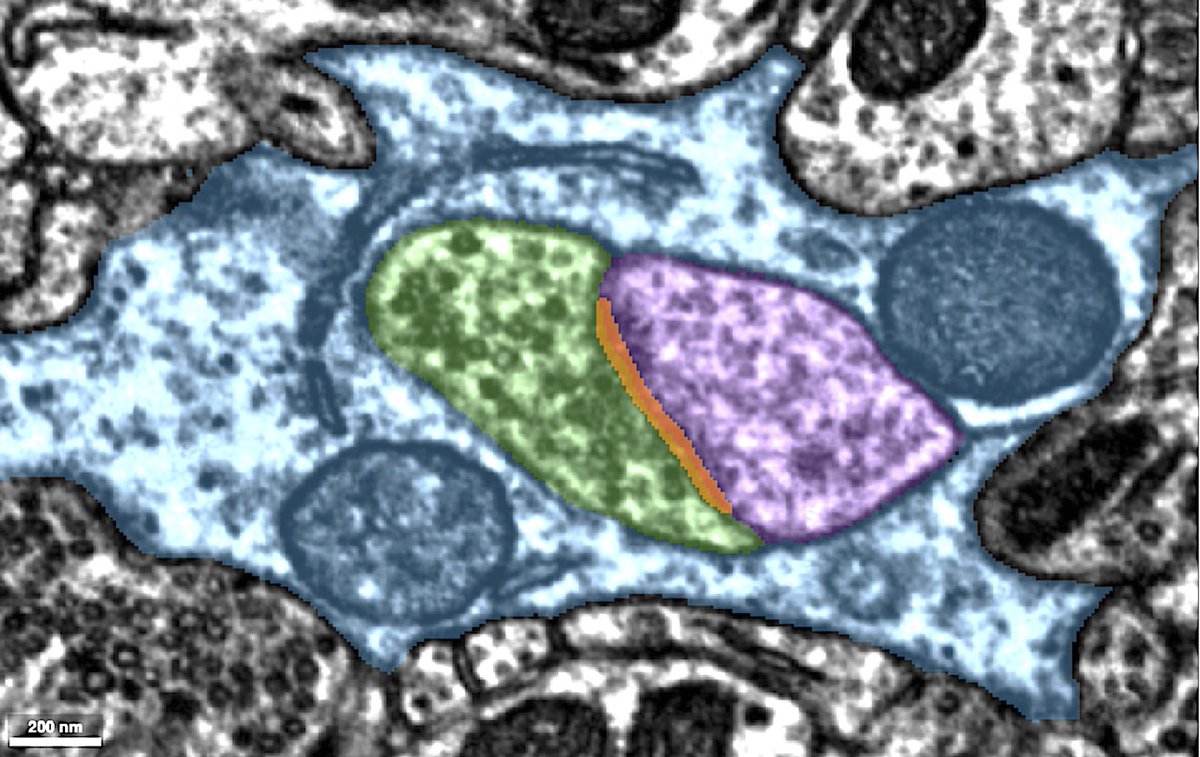
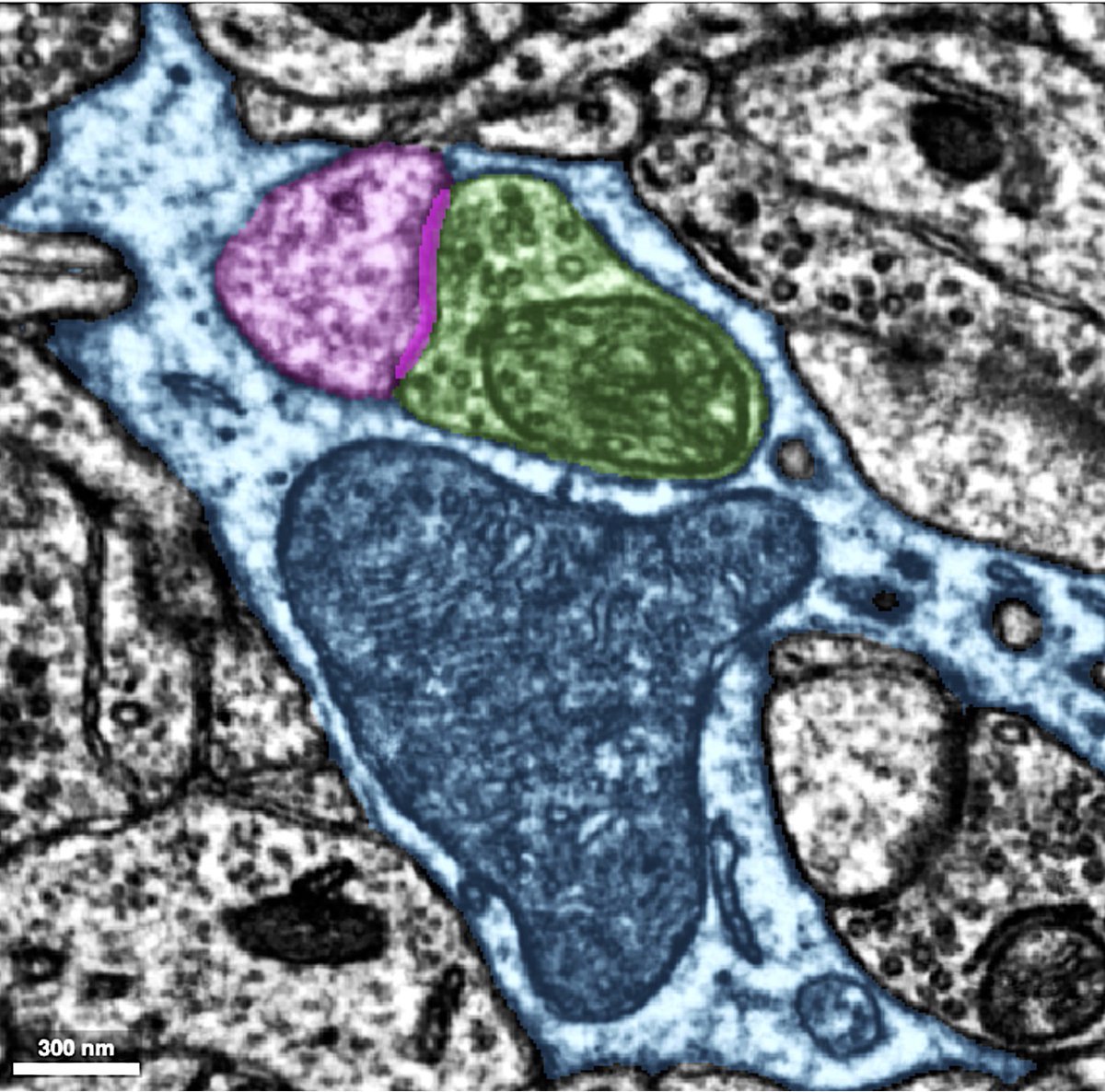
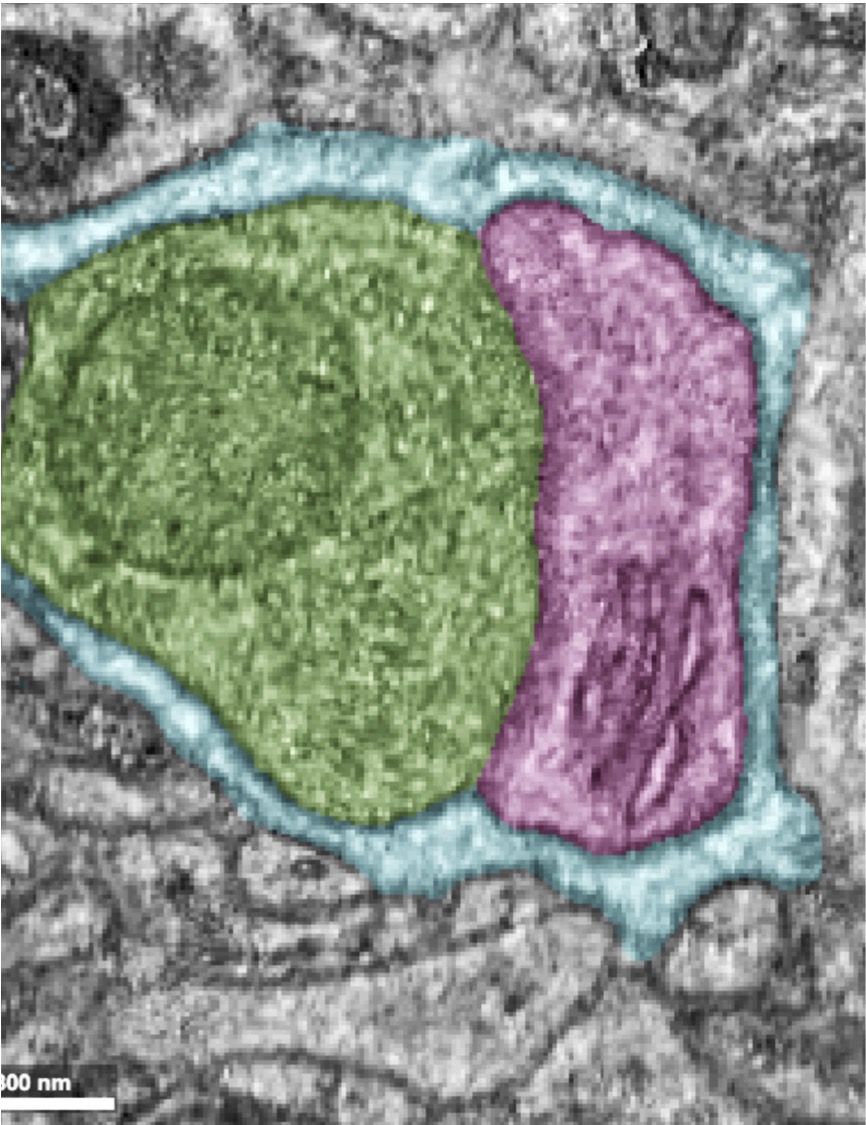
This #EM_Monday I will share some astrocyte hug. In these images, astrocytes (blue) surround the presynaptic boutons (green) and the dendritic spines( pink) that form a synapse.
Hanieh Falahati هانيه فلاحتى tweet mediaHanieh Falahati هانيه فلاحتى tweet mediaHanieh Falahati هانيه فلاحتى tweet media
English
3
8
88
12.3K
Aella
Aella@Aella_Girl·
my data was too big for google sheets, so i installed and learned python. but now it's too big for my computer, python won't run it. off to buy a new computer i guess?
English
220
7
635
202.1K
fcollman
fcollman@fcollman·
@timjarsky @TonyZador Bonus trick... zoom out a bit and drag the corner of the drawing to make it very large and then insert it and resize it in the google doc, will come out even higher resolution. If you put the caption in the drawing you'll need to use large font.
English
0
0
0
46
timjarsky
timjarsky@timjarsky·
@TonyZador Make a google drawing that contains the image and caption. Then link to the drawing from the google doc.
English
1
0
4
336
Tony Zador
Tony Zador@TonyZador·
what is the best way to insert an image & caption in a google doc? The way i am doing it renders the both kind of blurry. thx for any pointers
English
2
1
5
5.1K
fcollman retweetledi
Tyler Sloan
Tyler Sloan@quorumetrix·
Happy to share my latest #neuro animation, a remix of previous #MICrONS videos, while I took some #SciArt license and had some fun, it remains quantitative. Possibly inspired by me having recently ridden Smuggler’s Run. A video🧵 1/4 #neuroscience #b3d
English
1
1
10
3.1K
Hanieh Falahati هانيه فلاحتى
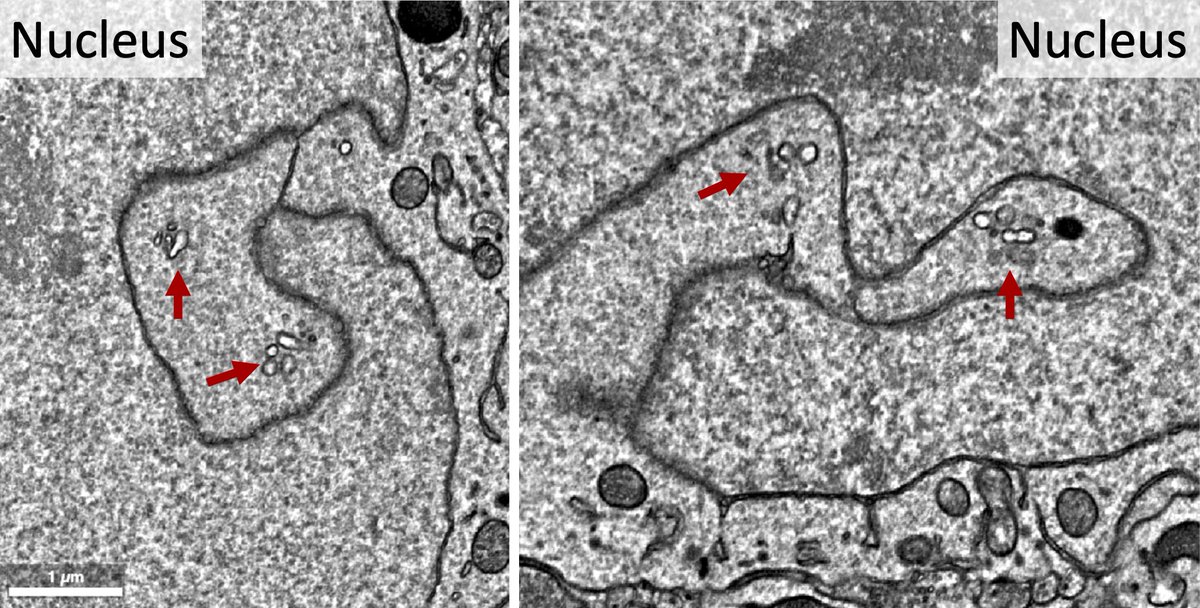
As a follow-up to last week's #EM_Monday, I wanted to know if there is anything inside nuclear membrane invaginations of neurons? It seems like the most common thing is clusters of vesicle like structures that are heterogenous in size. They are present in /1
Hanieh Falahati هانيه فلاحتى tweet media
English
2
5
28
6.6K
fcollman
fcollman@fcollman·
@KennethHayworth But you ask so often and I respect you as scientist and colleague so I thought you deserved a response.
English
0
0
3
62
fcollman
fcollman@fcollman·
@KennethHayworth Given that I have these ethical issues with the idea and that its not why i'm doing what I do research in this area, elevating the profile of this idea is not really in my interest. Probably responding to this isn't either.
English
1
0
2
66
Kenneth Hayworth
Kenneth Hayworth@KennethHayworth·
I’m sorry, but it is still really bugging me that we could ALL likely get to the future together (via quality brain preservation and far future mind uploading) if only the neuroscience community would start taking its own findings seriously and consider the implications. 1/6
English
53
99
1K
563.6K