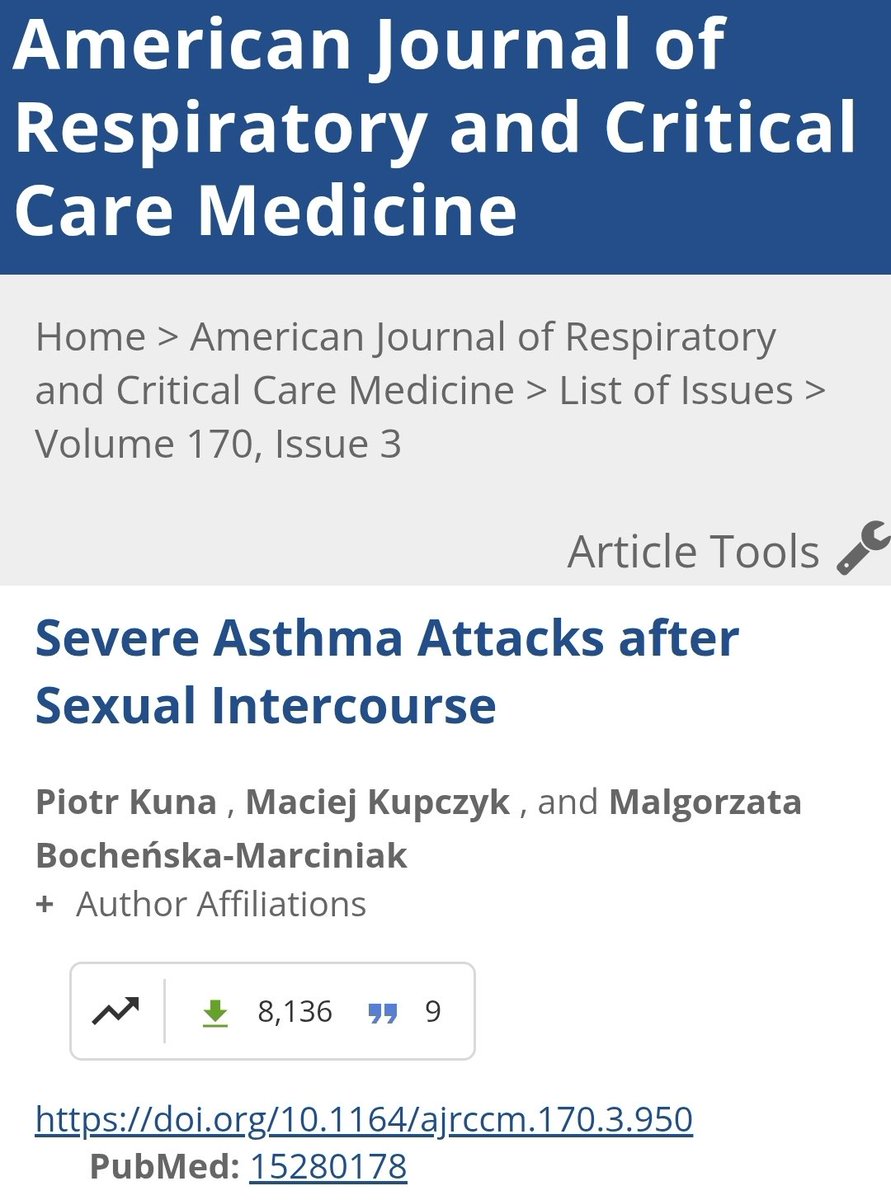
After sexual intercourse, this 48-year-old white man presented to the emergency department with severe asthma attacks. On examination, he was found to have nasal polyposis. He denied taking aspirin or other NSAIDs.
Further history showed that the patient’s wife was using aspirin for headache relief, and his postcoital asthma attacks consistently coincided with periods when she was taking aspirin. Notably, these exacerbations did not occur when condoms were used.
A bronchial provocation test with lysine–aspirin produced a marked reduction in FEV₁, confirming Samter’s triad and establishing a diagnosis of aspirin-exacerbated respiratory disease (AERD). The wife was subsequently advised to replace aspirin with paracetamol, after which sexual intercourse no longer precipitated asthma symptoms in the patient.
Get ready for this. These Chinese investigators report a cohort of 121 malignant MCA infarction patients age >60, 47 of whom underwent drill-assisted sterotactic aspiration of the infarcted tissue from 24-72 hrs after onset. Check out the CT images and the 70 mL of nectrotic brain tissue in the image below to give you an idera of what they were doing.
Retrospective, not randomized -- but the results were great.
Herniation: 47% vs 9%
Death: 65% vs 9%
Favorable mRS (0-3): 3% vs 26%
Not only #curingcoma –– cheating death.
pmc.ncbi.nlm.nih.gov/articles/PMC12…
🚨 #ISC26 delivered BIG for stroke care. Multiple practice-important and promising trials across thrombosis, reperfusion, EVT, ICH, and neuroprotection 🏥🧠👇
🔹 OCEANIC-STROKE – Positive phase III: FXIa inhibition with asundexian reduced ischemic stroke in patients with non-cardioembolic stroke or high-risk TIA on antiplatelet therapy without increased major bleeding
🔹 OPTION – In patients with salvageable tissue, tenecteplase (4.5–24h) significantly improved 90-day excellent outcomes with higher sICH (2.8% vs 0%)
🔹 CHOICE-2 – Largest phase III trial of IA alteplase after successful EVT: higher excellent outcomes (mRS 0–1), no increase in sICH, NNT ≈ 7
🔹 FASTEST – rFVIIa for spontaneous ICH: promising early results in spot sign–positive patients treated <90 min
🔹 LAIS – Loberamisal (dual-target neuroprotection) within 48h for AIS (NIHSS 7–20): 13% absolute increase in excellent functional outcomes at 90 days
🔹 DISTALS – Tigertriever for distal occlusions: higher successful reperfusion at 24h without increased sICH
🔹 ORIENTA-MeVO – EVT for MeVO improved 90-day functional outcomes without excess sICH in a Chinese population
The stroke playbook is evolving in real time. 🔥
#Stroke#ISC26#VascularNeurology#EVT#Tenecteplase#ICH#ClinicalTrials#AHAScience#StrokeResearch@StrokeAHA_ASA@AHAScience 🧠
This is it. GA wins. Better outcomes and more successful reperfusion.
Sedation vs General Anesthesia in Acute Ischemic Stroke
jamanetwork.com/journals/jaman…
In patients with salvageable brain tissue identified by perfusion imaging who did not initially receive thrombectomy, alteplase given 4.5 to 24 hours after acute ischemic #stroke onset may improve functional outcomes.
ja.ma/4mrcsX3
📢 Me complace anunciaros un nuevo número de Kranion | @RKranion
- Salud cerebral
- Tabaco y neurología
- Trastornos neurológicos funcionales
- Relación paciente-IA-médico
- De Cajal a la AGI-ASI
- Neuroestética de la arquitectura
Muchas gracias por compartir 🔁❤️
Do night and shift work increase or decrease your risk for later dementia? Spoiler alert: new research just dropped in Brain Communications by King-Robson and colleagues and it flips the script on what we thought we knew about night and shift work relative to later dementia risk. For decades, we’ve warned that disrupted sleep and circadian rhythms may raise Alzheimer’s risk. However, this new study from the UK 1946 Birth Cohort offers us a brain teasing surprise.
Key Points:
- The authors showed they had smaller brains, but lower Alzheimer’s Pathology.
- Night and shift workers had lower brain volume by age 70. They also had lower levels of amyloid and tau. These are of course two important hallmarks of Alzheimer’s.
- The authors showed they also had a lower dementia risk. By age 78, night and shift workers had about one third the risk of nonvascular dementia compared to non-shift workers (HR 0.33).
- Lifestyle habits matter, however that isn't the complete story.
- Worse lifestyle factors including more smoking and alcohol, and also the presence of the APOE ε4 allele explained only 28% of brain volume differences.
- Alzheimer’s markers were lower in shift workers.
My take: I found this study so interesting as it challenges much of the logic we preach in the clinic. Here are 5 points that resonated w/ me. 1- Don't panic if you work the night shift. Surprisingly, this long term study actually found lower Alzheimer’s pathology in people who worked night shifts earlier in life. 2- The Brain is complex and adaptive. Despite having smaller brain volumes and more health risk factors, night shift workers did not end up with more dementia. 3- It's not all about sleep loss. It turns out that circadian disruption may impact brain health a bit differently than short-term sleep deprivation. Could chronic sleep wake patterns could trigger unexpected protective adaptations. 4-Lifestyle still matters. More alcohol and smoking were linked to reduced brain volume. 5- Folks, this data is not a free pass. We are not ready to declare shift work safe or protective for brain health. Neuroscience is however full of surprises. I would say that this new article is worth staying up late to read.
academic.oup.com/braincomms/adv…@ParkinsonDotOrg@alzassociation@FixelInstitute#Parkinson#Alzheimer
50-year-old woman
2-day hx of diarrhea, vomiting, progressive numbness around her mouth and generalized body cramps.
She reported taking citalopram, rabeprazole for GERD, calcium carbonate, levothyroxine and vitamin B12.
Sign?
Diagnosis?
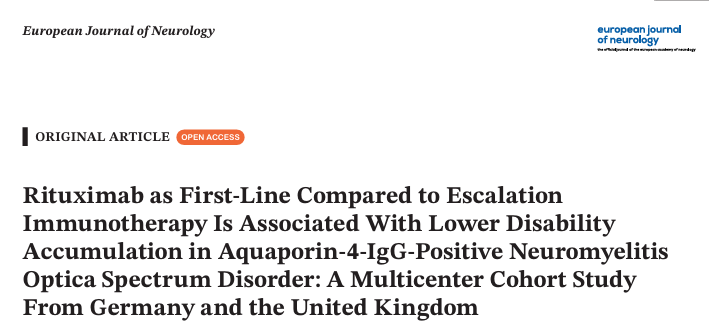
First-line rituximab 🧬 in AQP4-IgG+ NMOSD 🧠 leads to LESS disability accumulation 🦽 vs escalation therapy.
🇩🇪 🇬🇧 Multicenter data show early B-cell depletion = better outcomes!
👉 Time to rethink treatment strategies? #Neurology#NMOSD#Rituximab#Neuroimmunology#MSResearch
Diagnosing/localizing CSF leak is harder than treating. But transdural repair for ventral bone spur is beautiful, technical surgery
March 2025 @StrokeBern series showed no diff bw suture and patch, though I like both
@NeurosurgeryCNS PMID 39132996 @WouterSchievink@tdobrocky
@Brandon_Beaber@DrFelipeSuarez The same as with the acetylcholine receptor antibodies in myasthenia gravis, positive is positive, generally just qualitative information.
🧠 Intravenous Thrombolysis (IVT) in Atypical Stroke Patients: Guidelines and Beyond
🔍 In stroke care, we frequently encounter challenging scenarios that don't neatly fit traditional guidelines.
Are there clear recommendations to follow in these cases?
Let’s explore evidence-based guidance to optimize patient outcomes: