fin_constructor

196 posts

fin_constructor banner
fin_constructor

fin_constructor

@fin_constructor

quantitative finance developer / lifelong learner

Katılım Eylül 2023
414 Takip Edilen76 Takipçiler
fin_constructor
fin_constructor@fin_constructor·
@mean_field_zane A general explanation of why equities had a realized premium over bonds for example, is that it had more risk. That is true, but there also a lot of other risky assets that had a lot of vol and were very risky but had even negative returns. It needs to have a baseline quality.
English
1
0
0
85
𝔐𝔽𝓩
𝔐𝔽𝓩@mean_field_zane·
What are y’alls favorite solutions to the equity premium puzzle? I feel like incomplete markets plus standard risky equities might do the trick. Effectively, it’s not why equities are so high-return, but why bonds are so low-return.
English
12
0
62
35.6K
pedma
pedma@pedma7·
I havent put the trade on just yet, it should be live trading by end of this week. but its not as simple as go long/short the top/bottom deciles of funding. there's added complexities like hedging for factors that influence your l/s basket returns, that are not pure funding. if you want the purity of the funding, you have to pay the extra cost to hedge out the factors driving that side of the PnL. but its been a fun experimentation so far and its close to being done and added to the book as a solid return stream.
David@ObabakoRandom

@pedma7 Hey @pedma7 ! I really liked your article about dirty carry. I usually do delta neutral carry trades but I think if done well dirty could be more capital efficient. Any thoughts or experiences about this?

English
3
0
14
2.4K
Rob
Rob@BostonRobTrades·
Market Open Trend Strategy - Long Only Nasdaq As promised ... here is my best strategy, It's the most simple yet effective strategy I run and is a framework traders can build off of! It's based on the stat that over time the markets trend upwards. We capture those trends by getting in at the open then outperform by using adaptive position sizing and filtering out bad environments. We get in early then before the markets trend then let our winners ride. Momentum + Vwap + Sizing = Edge 1. Time: 9:30 Market Open Markets trend over time so we want to get in as early as possible to give our positions as much time as possible to be able to participate in any trends. I personally even wait for the end of the opening range to get in once the chaos has settled. Both work 2. Entry: Time & Filter Enter at market open IF - Price is above yesterdays open (Simple momentum filter) - Price is above vwap (Anchor at 18:00 session open) 3. Position Size: VWAP At entry measure how close price is to vwap measured in % then scale accordingly. Ex: 1% = min size 0.5% = med size 0.25% = max size 4. Exit: Time or Price Only close 1 of 2 ways. - Market close at 4 - 5m close below vwap 5. Bonus: % scaling IF you are using your own account and not trading via prop firms then I have yet another way you can look into boosting your performance... % sizing instead of Contract sizing. Instead of a base of 1 contract and max of 3, try using a base of 33% and a max of 100% of your account. I showed the crazy difference due to compounding gains down below. same strat, same rules, just using % instead of fixed amount. Below is the 15 year NQ backtest with cost/slippage included. I am so comfortable with dropping my strategies because these seem to be the lowest hanging fruit and most robust concepts out there. Plus I struggled for years to find profitable strategies and always wished that someone would help me out and just explain a simple one to help. Going forward I will continue to create posts like these, how I verify strats, and will also be getting into other parts of the process / biz. Thank you for all the engagement in my last few posts, I have really enjoyed connecting with the community! Question for the community: - Is it overfitting to a dataset by only trading a strategy long instead of L/S? even when both L & S are profitable? - Is it overfitting to wait for the market open to play out then automatically enter say 15m into market open instead of at the exact open to avoid volatility? my testing says its ok but would love to hear from someone who has more experience than me. #NQ #Algotrading
Rob tweet mediaRob tweet media
English
19
13
191
13.9K
HangukQuant
HangukQuant@HangukQuant·
@_TraderPanda 1. The Elements of Statistical Learning 2. Systematic Trading: A Unique New Method 3. High Peformance Python
English
2
0
26
9.8K
HangukQuant
HangukQuant@HangukQuant·
Btw it’s 8 years in markets, including 2 in crypto. Started with rando YT/Udemy videos that led me no where. I got my first stripes and feet pointed in the right direction by grabbing books and papers off my PM’s desk at my first stint. Fun times 🎉
HangukQuant@HangukQuant

x.com/i/article/2042…

English
5
4
88
12.7K
fin_constructor
fin_constructor@fin_constructor·
@ScottPh77711570 Scott, question out of curiosity. You are a really good trader and seems to be very serious about it. But at the same time I've watchex some of your yt videos and they reallly look like grifters course selling types. Why?
English
1
0
3
556
small_caps_automated
small_caps_automated@SmallCapSmarts·
@fin_constructor Mostly simple regime-based momentum models, with discretion layered on top for universe selection and execution parameters.
English
1
0
1
331
small_caps_automated
small_caps_automated@SmallCapSmarts·
A lot of small-cap traders who say there’s no edge in large caps are either looking at the wrong things or just dealing with a skill issue. Large-cap edge usually won’t show up in a spreadsheet. It’s more contextual, less mechanical, and the cadence of setups is nowhere near what you get in small caps. But you get real liquidity, tighter spreads, much rarer fat tails, and therefore real capacity. You can size much bigger and still make similar returns on a far larger portfolio. It also opens the door to managing other people’s money, effectively giving you access to free leverage without the same level of personal downside. Of course, if you’re trading a $30k–$50k account, small caps probably still make more sense, mostly because of lower volatility of large caps.
English
11
5
77
6.3K
fin_constructor retweetledi
BeatzXBT
BeatzXBT@BeatzXBT·
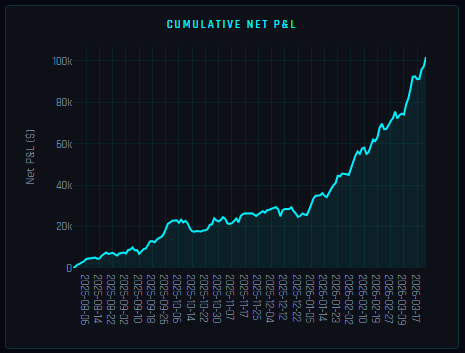
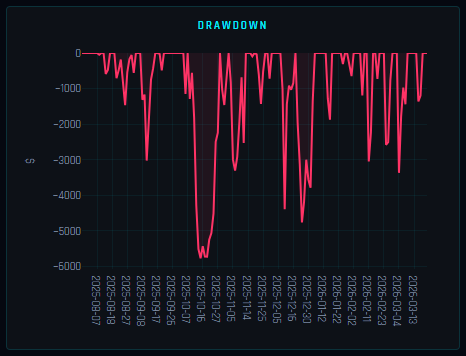
so, been a while... back to making bad markets slightly less bad, and man i've missed it. this time its less stinky on the coins, more stinky on the exchange choice. the system is new, been working on it since ~mid feb and got it stable right before the start of this month.
BeatzXBT tweet media
English
25
18
253
32.2K
Fearless Trades
Fearless Trades@Fearless_Trades·
System account just hit 100k 🚀🍻 ($1,700 > $100k in 8 months, fully systematic. Or maybe more like 95% systematic). Now running 13 strategies (12 short, 1 long), all vibe coded using Cursor and Massive. I know folks have been complaining about small caps lately, and things have been slow. What I will say is that scalps have been the way to go in this market. All day holds have been rough. A lot of my system profit has come from trades < 1h so far this year.
Fearless Trades tweet mediaFearless Trades tweet media
English
27
6
185
24.3K
Coastal Quant
Coastal Quant@coastal_quant·
For the quant finance crowd: let's say you have a signal with high IC forecasting 1-day returns and high in-sample Sharpe ignoring costs. However bid/ask spreads are large so simulating a strategy including fees leads to very negative performance. How do you decide whether to: - Switch to maker instead of taker orders - Subset your signal to only tail positions - Slow down your signal / slow down your trading - Find longer term signals and use this faster one as an excution overlay - ... something else?
English
13
6
129
22.8K
Coastal Quant
Coastal Quant@coastal_quant·
There’s some conflation between “statistical significance” and “implementability” here, but yes in typically systematic equity a correlation of 0.2% is quite strong. I do find the point about E[r] << StdDev(r) interesting. Let’s say you ensembled a bunch of non-implementable signals together to build some stronger forecast, but half of your cross-section still has an ER less than the bid/ask spread. Is it fair to just toss out those assets from your investment universe, since they can’t cross the spread even if you have 100% hit rate on forecasting their directional move?
English
3
1
4
1.2K
fin_constructor
fin_constructor@fin_constructor·
@0xaporia @CryptoMichNL Im curious on how do you approach trading with this signal after you've tested it like this. First, do you test for a range of future returns window size? In this case would you use it as a discrete or continuous signal?
English
0
0
0
62
Aporia
Aporia@0xaporia·
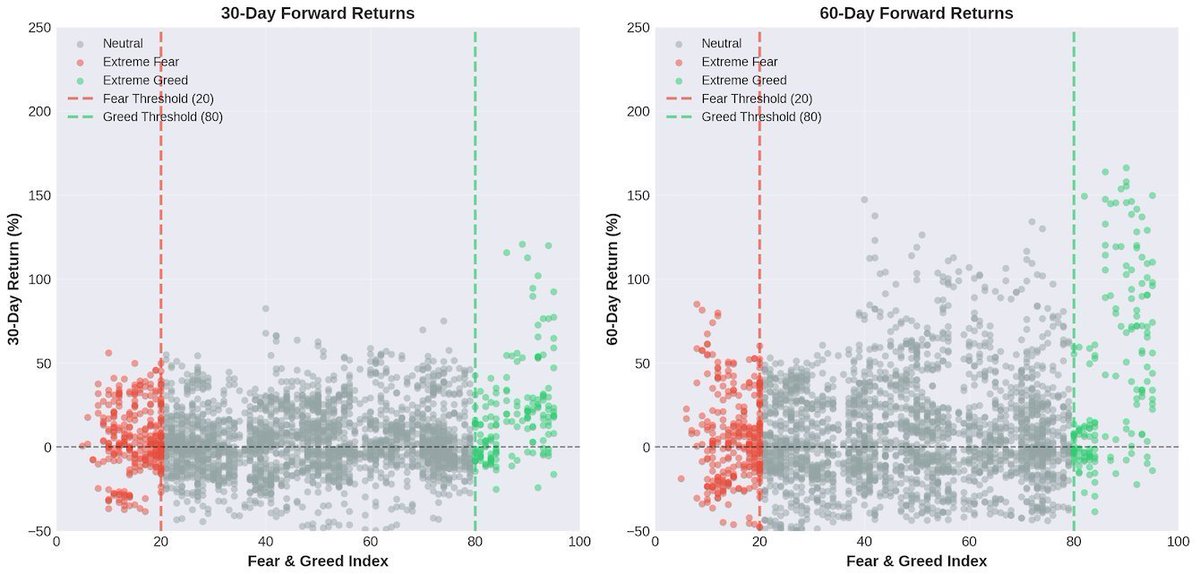
You're doing this backwards. You've identified historical bottoms first, then noted what the Fear & Greed Index read at those moments. The actual useful question is: when the index showed these low readings, what happened next? Your approach guarantees a 100% success rate because you're starting from the outcomes and working backward. Why not look at all the times 'Extreme Fear' was hit?
Aporia tweet media
English
12
1
162
5K
Michaël van de Poppe
Michaël van de Poppe@CryptoMichNL·
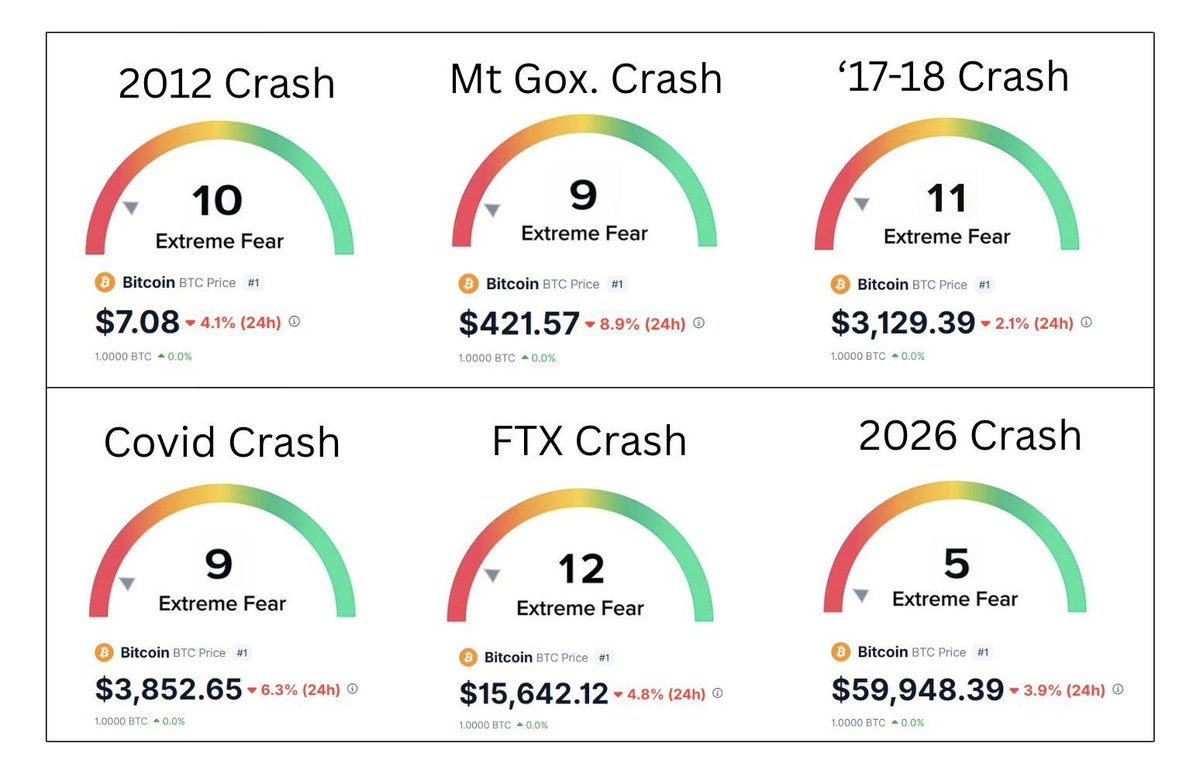
This is a phenomenal overview of the recent periods of 'Extreme Fear' in the markets. What did happen eventually? Well, just check the numbers beneath any number. Price goes up astronomically after every crash. This time won't be different for #Bitcoin.
Michaël van de Poppe tweet media
English
85
126
776
144.7K
fin_constructor
fin_constructor@fin_constructor·
@choffstein I had to test it by myself 😂. One large assumption to the day to day of financial markets is that all assets tend to have somewhat of a similar drift.Then you could have the "usual" correlation intuition. But yes, this really makes you think
English
0
0
0
118
Corey Hoffstein 🏴‍☠️
Corey Hoffstein 🏴‍☠️@choffstein·
Why Bonds Still Belong: Rethinking Fixed Income in Modern Portfolios There’s also a common misconception around correlation itself. Two assets can be perfectly correlated and still move in different directions. Correlation captures relative movement, not absolute return. So, while it’s possible that bonds no longer hedge the short-term volatility of stocks, they may still drift differently over time. Combining stocks and bonds, then, may do less to dampen volatility but can still significantly dampen dispersion in expected terminal wealth.
Vik Pansare@pansareV

Great article that hits on some subtle but important points by @choffstein returnstacked.com/why-bonds-stil…

English
9
10
100
42K
fin_constructor
fin_constructor@fin_constructor·
@Merridew__ Basically you think the imp vol between june and november is too cheap?
English
1
0
0
151
fin_constructor
fin_constructor@fin_constructor·
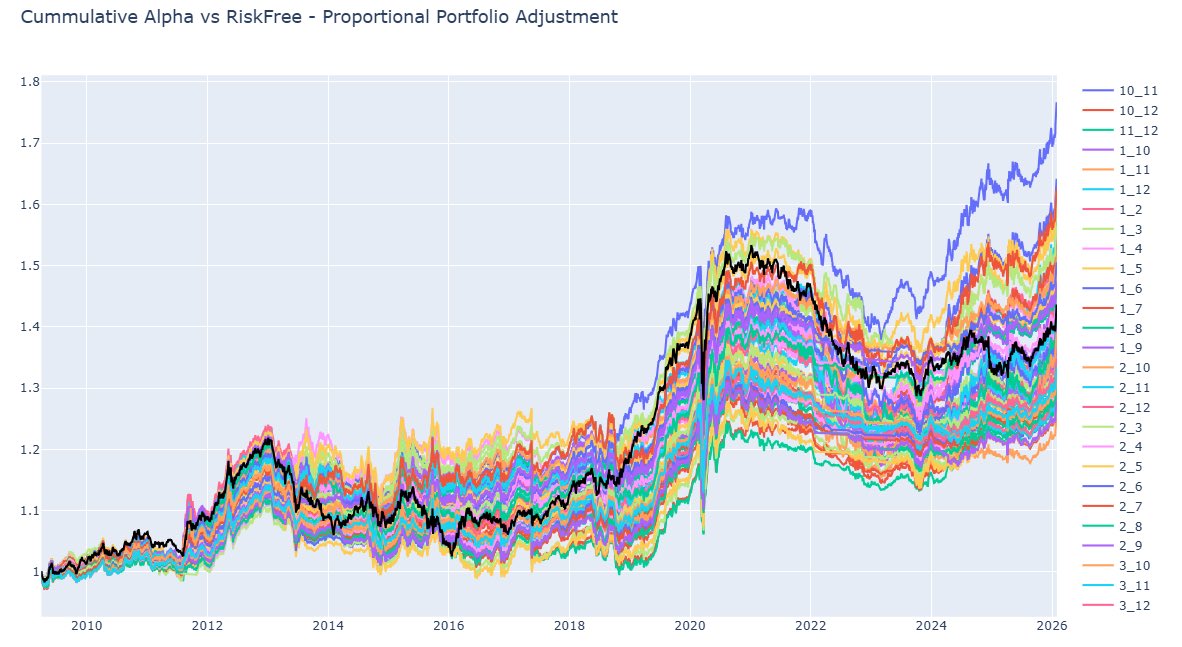
@AahanPrometheus @prometheusmacro The black line is the alpha without the trend tilts. To compensate the added complexity, I was hoping for a more robust and parameter stable improvements.... but lets see, I will test some more
English
1
0
0
181
fin_constructor
fin_constructor@fin_constructor·
@AahanPrometheus @prometheusmacro Got some mixed results. My main worry is the parameter selection... I've tested both replacing with cash and doing the proportional adjustment. I got this acc alphas vs risk free (I'm Brazil based, so here is vs CDI)
fin_constructor tweet mediafin_constructor tweet media
English
1
0
0
174
@aahan_prometheus
@aahan_prometheus@AahanPrometheus·
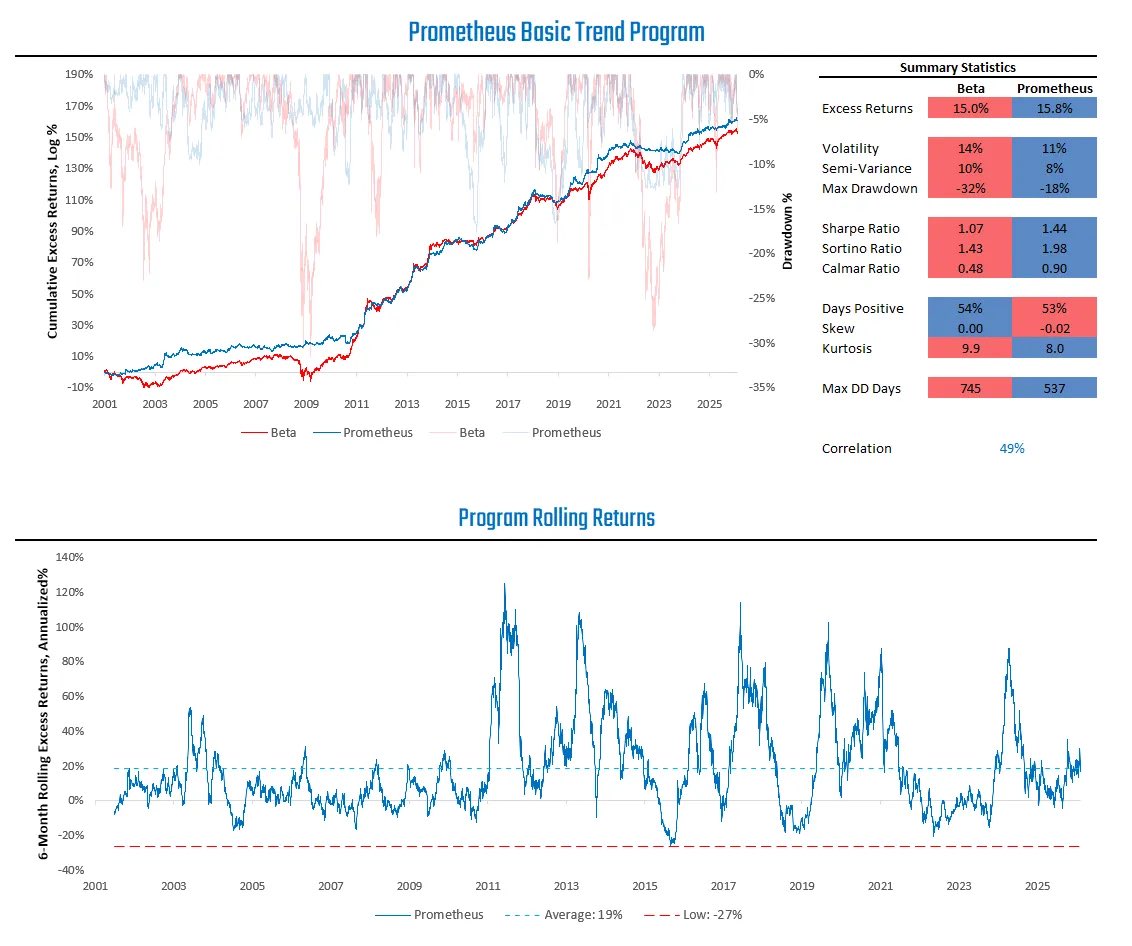
Basic Trend Following: Primer We’re going to have a more substantive note from @prometheusmacro on how we construct our basic trend program with the empirics. 1/ This thread will focus on the concepts and exact steps to constructing our Basic Trend Program
@aahan_prometheus tweet media
English
12
54
491
148.1K