Sabitlenmiş Tweet
Finley Robinson
2.6K posts

Finley Robinson
@finrobinson
I help moms & dads of 3 to 13 year-olds amplify their power-decade of parenting. | Father of 3 and pastor of 20 years turned digital writer.
Fayetteville, AR Katılım Ağustos 2009
451 Takip Edilen804 Takipçiler
Finley Robinson retweetledi

My advice to 25 year olds:
Get married young and have more kids than you can afford.
I've never met anyone who wishes they'd had fewer kids.
But I've met a lot of people who regret waiting so long or having so few.
Every 60+ year old that I know cares about one thing above all else:
Their kids and grandkids.
English
Finley Robinson retweetledi

@denk_tweets @BUnlimited would do an incredible job for you. send me a DM if you'd like me to help connect you with their top notch team.
English
Finley Robinson retweetledi

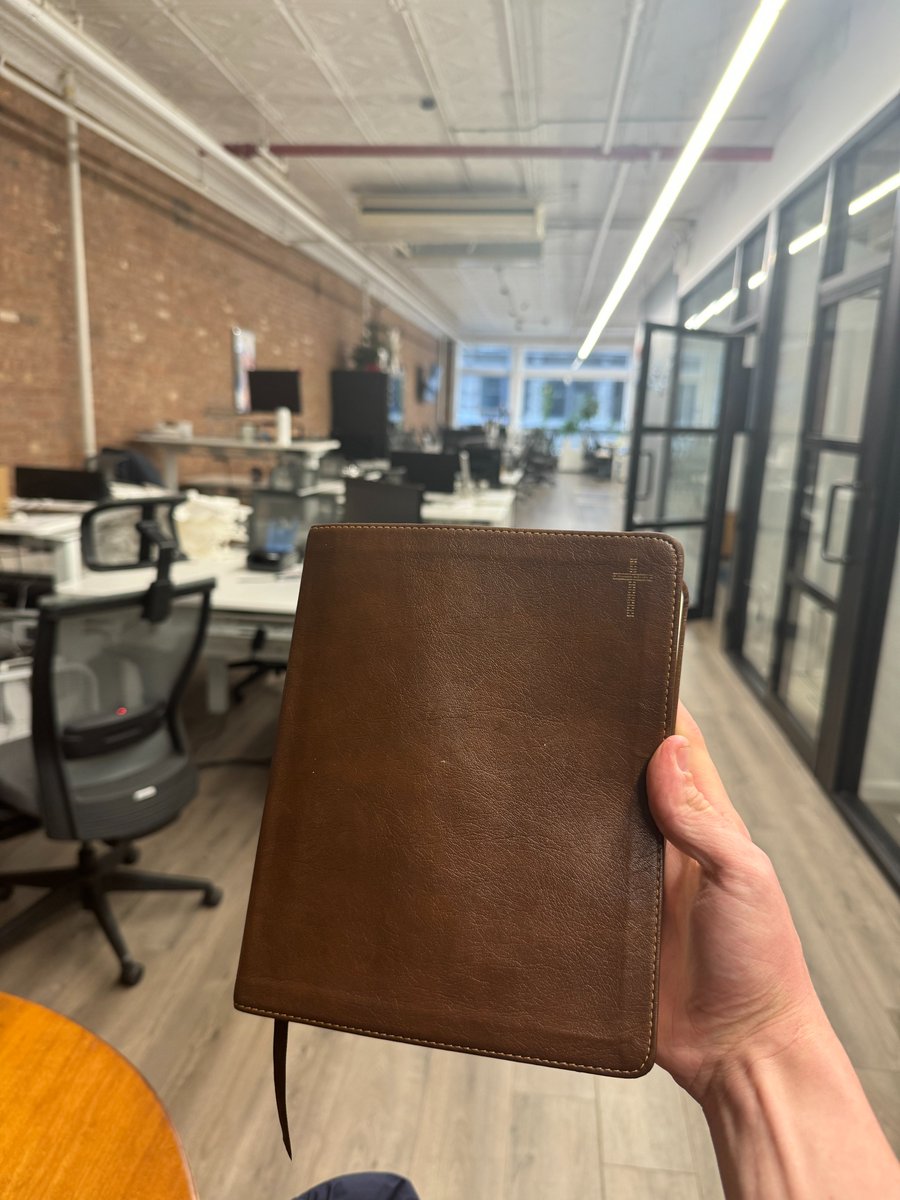
I went from thinking the Bible was the most boring book ever to seeing the magic in it.
Years ago, I realized that the Bible is the foundational book of Western civilization. If I was going to be an educated person, I needed to know what it said. Though I was motivated to learn about it, I didn't have the patience to read it or the knowledge to understand it.
Generally, I try to follow my 4th-grade English teacher's advice to read things first-hand. But the Bible seemed too hard, too boring, and too confusing to read on my own. It was a snooze fest. The stories felt outdated in a world of smartphones and fast Internet. Living in the modern world, shouldn’t I be rooting my life in modern books, modern studies, and modern authors?
At the time, I was living in New York when a friend introduced me to the work of Tim Keller. I reluctantly found time to put down the self-help and picked up two of his books instead: The Reason for God and Making Sense of God. It was around that time when I discovered Keller's Questioning Christianity lecture series.
Instead of focusing on the Bible directly, Keller focused on Christianity's relationship with culture and the modern world. He spoke to career-driven Gordon Gekkos who were driven by the glories of the material world, but sensed the emptiness at the heart of such a single-minded pursuit. Instead of referencing scripture directly, he spoke about big-picture themes like identity and purpose, morality and meaning.
This was back when I thought all Christians had the intelligence of sidewalk pigeons. I would scoff at church-goers because I didn’t understand why anyone would worship a sky fairy or follow rules from thousands of years ago. Keller was the guide I needed.
For the first few years, I looked at faith through a cultural lens instead of reading the Bible directly. I literally knew nothing about Jesus or Christianity — and I came to realize how little I knew about my own atheism too. In school, while studying the Declaration of Independence, I’d learned that it’s “self-evident” that “all men are created equal.” Turns out, this defining American ideal is only self-evident if you assume that every person has inherent worth because they’re made in the image of God. I was stumped. Where did my moral compass come from? Do people have inherent value? And if so, is it because every human is a child of God?
In addition to advocating for the life of Jesus and the truth of his message, Keller revealed the many assumptions underlying my own atheistic worldview. He taught me that every worldview requires a leap of faith. Sure, Christianity couldn’t perfectly explain everything in the universe, but then again, neither can any worldview. Astrophysicists say that much of the universe is made up of “dark matter,” which is a scientific-sounding way to talk about a leap of faith
Though I did some Bible studies, I never enjoyed them. They felt more like reading tedious academic papers than drinking directly from the fountain of God’s wisdom. Instead of reading Scripture directly, I joined a small Christian reading group where I was the only non-believer. By showing me coherent ways to interpret reality besides my science-based materialism, books like The Story of Reality and I Don't Have Enough Faith to Be an Atheist loosened the screws on my atheism.
My palate was beginning to change. Like a fine wine, the same flavors that were once repulsive to me started to appeal to my intellectual taste buds. I surrounded myself with wise Christians who were orthodox about scripture and eager to answer my hardest questions about faith. I asked them to dinner and invited myself to Church with them.
This marked a new era. Once again, I found some guides: books, Internet sources, and an in-person leader to show me the way. On the Internet, I'd turn to The Bible Project to answer my big-picture thematic questions. I picked up the ESV Study Bible, which I still read every day on the white boucle couch in my living room (if you like reading on the computer, I recommend The Bible Study App by Olive Tree).
For years, I’d stiff-armed the Bible. Now, I was skipping to a 7am Bible Study led by a devout believer who'd been reading God's word every day for almost a quarter-century, and wasn’t afraid to rebuke my theology.
What surprised me most was how carefully we read. I admired the integrity of our study. We live in a culture of binge-reading where people boast about how many books they can complete in a given year. We did the opposite. We never read more than ~20 verses in a single session and dissected every word, every verse, and every story. (I once spent two hours studying John 1:1-4 — just four verses at a strip mall Schlotzsky's in the Texas Hill Country.)
Never in my life had I read so deliberately. I spent months in the books of Ephesians, Romans, John, and 2 Corinthians, and there's no way I would've known how to read the Bible so diligently on my own. I learned to look beyond English translations, and I use the BibleHub to look up the original Greek and Hebrew whenever possible.
For a translation, I recommend the English Standard Version (ESV) (no, you don’t need to read the King James Version). And If you're going to pick two books, I recommend the Gospel of John and the Book of Romans. Either find a guide to read them carefully with you or follow along with The Bible Project and The ESV Study Bible. Whatever you do, read slowly.
I used to be a serial consumer who’d brag about how many books I read every year. I’d pick up anything and everything. The more, the merry. But the more I study the Bible, the more careful I’ve become about who I read and listen to. Gone are my days as a serial consumer. Frauds, charlatans, and false teachers abound, so be skeptical and vet your sources. In all this time, I’ve had no more than ten serious teachers. Fortunately, that’s all you need.
I became a believer on March 20th of this year, four years after attending my first Tim Keller lecture, and the Bible is alive for me now like no book I've ever read.
These days, I read the Bible and basically nothing else.
Opening it up is the best part of my daily routine. The words twinkle. The stories are supernatural. It's a living, breathing document, and I wholeheartedly believe it's the Word of God, which makes every other book feel dim by comparison.

English

@Erichealthcoach Option 1 (non-negotiable): Play hard with your kids. Chase, jump & ride.
Option 2 (semi-negotiable): The early years of parenting prioritize not losing ground physically.
Option 3 (negotiable): Choose a big physical goal and go for it. *I trained for my 1st marathon at age 30.
English
Finley Robinson retweetledi

I was in 4 grade schools in 5 years growing up.
I still get a pit in my stomach when I think of the 1st day in a new classroom because being a new kid sucks
These are 5 things I tell my son & daughter to do when they see a new student having it rough:
1/ Pay Attention to the Edges
As a new kid, recess is terrifying.
Seems like everyone is playing. Having fun. Except you.
I tell my kids to scope the edges of the field/playground.
Who's wandering solo? Who's alone?
Introduce yourself. Ask them to play. It's HUGE.
2/ No Lonely Lunches
Second to recess, lunch is a tough time.
Feels like everyone has someone so sit/eat/talk with and you don't. So you sit alone.
I ask my kids to sit next to the kid eating alone. Or ask the new kid to join their table.
The gesture itself goes a long way.
3/ Avoid "Choose a Partner" Purgatory
When you're a new kid and the teacher says, "partner up" for a project...
Man, you get chills. You KNOW nobody is asking you.
I ask my kids to be on the lookout for this.
And if possible, pick the kid you know doesn't know anybody.
Tiny act. Big effect.
4/ A Basic "How Are You?"
New kids feel super isolated. It stinks.
I remember days where it felt like no other kid even notices you.
A simple, "Hey! What's up?" could mean the world.
Shows someone sees you.
And that you're not invisible...
5/ Smile
The simplest of all gestures.
When you're a new kid in a new school you'd kill for a friendly face to acknowledge you.
Too often, it feels like you're drowning in a sea of strangers...
But often all it takes is one smile to pull you out of a funk. Just an big, full smile when you walk by someone let's you know that there are nice people around.
And you smile back... And now you feel better.
Easy.
It's been several decades since my last 1st day of school as a new kid.
I can still feel it.
And that's why I hammer home these points to my kids at the end of every summer.
Thanks for reading and please share with other parents.
Hopefully this'll help one new kid adjust sooner.
And follow me @Jon_Finkel for more dad columns like this.

English

@AaronAmeen 5 year olds should start in kindergarten with a second language.
It should carry all the way through junior high at least.
Most every other country in the world does this with English and I've long believed that American kids would benefit from second language exposure early.
English

@AhnaleeB Your concern as a Tween parent is super valid!
We set 13yrs old as the mark for our children and we were in the last 25% of families to hand over a phone.
I believe our best decision was to delay social media until they proved responsible for the phone and had build trust.
English

@dbustac Well, it's been a while since I wrote it but here you go.
It was long before I learned some @ship30for30 writing strategies but it was my first attempt as a lead gen for a business that never took off!
finrobinson.notion.site/3-Challenges-c…
English

@finrobinson Haha that's a great signal then!
Have you written about some of your lessons from working together?
Paola & I would love to learn from you guys :-)
English

Earlier this year, I had a crazy idea.
I was on a walk with my wife when I asked her:
“What if we start a business together?”
To my surprise…
She immediately said, “Yes, I’d love to!”
After 6 months building together, we’ve come a long way.
So I wanted to share some of the biggest lessons we’ve learned so far:
Lesson #1: Set boundaries.
I’m obsessed with my work.
I spend most of my waking hours working or thinking about work.
And yes, I know there’s more to life than work.
But this is how I’ve chosen to spend this season of my life.
The caveat here is that my wife is *not* obsessed about work.
And I’m actually glad she isn’t.
Because if she were, we’d spend all our time together talking about the business.
And we don’t want our romantic relationship to be overtaken by our business relationship.
So, we had to set boundaries.
For example:
We only talk about work during our designated “work hours.”
Not before, not after.
And if for some reason one of us tries to talk about work off our “designated hours,” the other has to “enforce” our policy.
Lesson #2: Protect your “me” time.
These days, we spend more time together than ever.
We both work from home.
And we get to work on our business together.
It’s a dream come true.
But this also means we’re spending less time alone with ourselves.
And as much as we enjoy each other’s company, we also value our “me” time.
So in the same way we’ve been intentional about protecting our romantic relationship…
We’ve also had to intentionally create space for “me” time.
Lesson #3: Seek the uncomfortable conversations.
My wife and I have been together for 10+ years.
Ever since we started dating in high school.
Often, people ask us how we’ve been able to build such a healthy, long-lasting relationship.
And I used to say the key was communication.
Now I understand it’s more than just “good communication.”
It’s about seeking and embracing the difficult conversations.
Over the years, we’ve had our ups and downs like every couple.
But instead of pretending everything was perfect, we've always confronted the situation.
And we talked it through.
So far, it’s been the same with the business.
And it's worked pretty well.
Lesson #4: Play to your strengths.
Last year, my wife started her own business.
And she completely burned out.
That’s why I was surprised when she took me up on this idea.
But more recently she shared she felt confident because “I knew what I was doing.”
When she started her business, she was a beginner in every single way.
And it was extremely overwhelming.
This time, we’re building something in a space I’m familiar with.
Where I have relationships.
And the business relies on skills I’ve already built.
Obviously, there’s a bunch of new things we need to learn.
But the learning curve is not near as steep as it was for her the first time.
If we were trying to build something in a space where we’re both absolutely beginners, things would be much harder.
Lesson #5: Think it twice.
Most businesses fail.
So do most relationships.
Starting a business with your spouse or significant other can be incredibly fun and rewarding.
But at times, it can also be painful, stressful, and exhausting.
And if you have any sort of relationship issues, your business relationship will magnify them.
(Or at least expose them.)
So definitely think it twice before taking the leap.
Because it's not for everyone.

English

@dannyreeves1 Welcome back Danny and nice to be introduced at the same time! LFG is right.
English

Coming full circle with #ship30for30
Back in the game and it feels so good.
LFG @Nicolascole77 and @dickiebush

English

@dylan_bridger I recognize I'm an outlier here, but I favor C and here's why...
1. "Exactly" delivers some precision
2. "Some" conveys honesty & authenticity
3. No "finger lifting" is intriguing and makes me curious
English

@GinStLawrence It’s safe to say they are “received” when they come from your @ConvertKit account.
I’ve found the biggest fight is to consistently land in the Primary folder instead of Promotions.
Asking new subs to move your email to Primary helps open rates and helps them take action early.
English