Flareforward

1.9K posts

Flareforward banner
Flareforward

Flareforward

@flareforward

Flare Forward: DeFi updates & interviews for DeFi University & Tracker Pro. Insights & news. https://t.co/6TnGApjNWW

Mexico Katılım Mart 2025
32 Takip Edilen2.4K Takipçiler
Flareforward
Flareforward@flareforward·
Dropping my first AI workflow video. What do you think? How do you do it? Not theory. Live system. I show the full cycle I run every week to improve my own AI: → /grok pulls what's relevant on X → /web searches and filters it → /codex fleet builds the improvements with parallel agents All from one chat. Working toward doing it from my phone. If you're still just prompting ChatGPT and hoping — this is a different level.
English
0
2
6
190
Flareforward
Flareforward@flareforward·
@xrpen15 I don't get that as much now. I have it when it looks at certain things it is required to have code proof.
English
0
0
1
14
Flareforward
Flareforward@flareforward·
I don't know about anyone else, but when working with AI sucks, the one thing I have to fall back on is "oh well." There’s no other way but to push the AI until it works. I have no other options. That in itself is an option and honestly, it’s been working. We went from barely getting a form to work to building complex systems
English
1
0
2
210
Johnny Mag Sax
Johnny Mag Sax@johnnymagsax·
WilliamLolli.DigitalAssetEvangel@WLolli3342

x.com/XRPWatcherJanu… Janus is basically pushing the Flare community and builders to step up and create a home-grown solution instead of relying on external platforms like Rysk. Why this matters to you (as a big XRP/FLR/sFLR holder): This is about maximizing yield on your bags without leaving Flare. Janus is the loud voice saying “We have the tech — let’s use it properly instead of bridging out.” It’s classic ecosystem advocacy: praising what exists while pointing out the missing native opportunity. In short: Rysk is delivering real yield today (but with friction for Flare users). Janus is using their success as proof that a better, fully Flare-native version would be even stronger. What Janus is saying in that tweet:He’s giving Rysk credit for a smart new feature they just announced (ROSF — a fee-funded liquidity backstop). Basically, Rysk is using some of their own protocol fees to guarantee better pricing and liquidity when demand for these yield products grows. But Janus says: “This proves my bigger point.”Demand for this kind of “volatility yield” (earning money from selling options) is real and growing. However, Rysk’s solution still forces Flare users to leave the Flare ecosystem (bridge to Hyperliquid). It doesn’t use Flare’s unique strengths: FTSO oracles (fast, decentralized price data), FAssets, native XRP/FLR collateral, etc. Janus believes Flare should build its own native version of this kind of options/yield product. That way: No bridging Better integration with sFLR, SparkDEX, etc. Captures all the value and fees inside Flare


English
1
0
0
233
Flareforward
Flareforward@flareforward·
16 projects. 2 hackathons. 45 days. Here's what we're building and why each one exists. Project 1 — Apex on XRPL XRPL's new smart contract chain launched with no financial infrastructure. We're porting our live Flare mainnet protocol there first. Project 2 — MCP Payment Rail AI agents doing real work need a safe way to pay each other. No standard exists yet. We're building it. Project 3 — Agent Reputation Registry Apps need to verify identity without handing data to a middleman. On-chain identity, no third party. Project 4 — X402 FDC Bridge When an AI agent pays for a service, how does it know delivery actually happened? This adds blockchain-verified proof before payment releases. Project 5 — XRPFi V3 Flare already gives XRP holders access to DeFi. XRPFi is the tool you use once you're there — navigate options, track every decision on-chain, meet institutional compliance requirements. Project 6 — Audit Receipt Marketplace Audit proofs today are PDFs that can disappear. This puts them on-chain permanently as tradeable tokens. Project 7 — RLUSD Yield Vault Institutions have almost no compliant DeFi yield options. KYC-gated vault, XRPL permissioned exchange, performance fee routing. Project 8 — Cross-Border Invoice Settlement International B2B payments are slow and expensive. Tokenized invoice, RLUSD escrow, releases on confirmed delivery. Project 9 — FDC Oracle Pack No developer toolkit existed to wire Flare's attestation system into the XRPL ecosystem. We built one. Already at quality gate. Project 10 — DID Compliance Layer Every regulated DeFi protocol rebuilds sanctions screening from scratch. This is a drop-in contract that handles it for any XRPL EVM app. Project 11 — Keeper Network DeFi protocols need outside parties to run time-sensitive tasks. Open registry, RLUSD bounties. Our Apex protocol is the first tenant. Project 12 — Apex Keeper-AVS Keepers have no accountability today. This wraps the model with EigenLayer staking — fail your task, lose your stake. Project 13 — FDC-AVS Ethereum apps can't use Flare's data proofs without trusting a single relayer. This pays staked operators to relay them with real slashing consequences. Project 14 — Drosera Trap Pack Most exploits follow known patterns. This ships 5 on-chain detection contracts from our audit toolkit, each with a test showing how it stops a real past hack. Project 15 — Audit-AVS Auditors say your code is safe with nothing on the line. This makes them stake real money behind it. Bad audit within 90 days — stake gets slashed. Projects 6 and 15 together are the foundation of what we're building toward — an on-chain auditing company. Follow along. Videos dropping as we build.
English
1
6
10
256
Janus the Watcher
Janus the Watcher@XRPWatcherJanus·
Exactly the costing the RFP needed. Thank you for running it. Your sub-$100k audit holds on the fork path. Fork a proven codebase like Lyra and you audit only the Flare-specific surface — the FTSO and FAsset integration — not the whole options engine. That delta is also where the real risk sits, so scope cheap, review hard. ~$400k against a 20B FLR incentive pool isn't a capital problem. It's a question of will.
English
1
0
0
16
Flareforward
Flareforward@flareforward·
@XRPWatcherJanus @WLolli3342 Yeah, it could be built. The issue is the capital to start running it day 1. North of 250k. That's just the capital to start the engine.Even built on a shoestring budget, it would run close to 400k, I think. You might get the audit under 100k.
English
2
0
1
18
Janus the Watcher
Janus the Watcher@XRPWatcherJanus·
@WLolli3342 I'll take the power-washer. But the job isn't blasting devs. It's blasting the marketing off the mechanism — the grime was already there, I just rinse around it so you can read it. ROSF is a real fix. It still never touches Flare's native rails. That's the gap.
English
1
0
1
42
WilliamLolli.DigitalAssetEvangel
x.com/XRPWatcherJanu… Janus is basically pushing the Flare community and builders to step up and create a home-grown solution instead of relying on external platforms like Rysk. Why this matters to you (as a big XRP/FLR/sFLR holder): This is about maximizing yield on your bags without leaving Flare. Janus is the loud voice saying “We have the tech — let’s use it properly instead of bridging out.” It’s classic ecosystem advocacy: praising what exists while pointing out the missing native opportunity. In short: Rysk is delivering real yield today (but with friction for Flare users). Janus is using their success as proof that a better, fully Flare-native version would be even stronger. What Janus is saying in that tweet:He’s giving Rysk credit for a smart new feature they just announced (ROSF — a fee-funded liquidity backstop). Basically, Rysk is using some of their own protocol fees to guarantee better pricing and liquidity when demand for these yield products grows. But Janus says: “This proves my bigger point.”Demand for this kind of “volatility yield” (earning money from selling options) is real and growing. However, Rysk’s solution still forces Flare users to leave the Flare ecosystem (bridge to Hyperliquid). It doesn’t use Flare’s unique strengths: FTSO oracles (fast, decentralized price data), FAssets, native XRP/FLR collateral, etc. Janus believes Flare should build its own native version of this kind of options/yield product. That way: No bridging Better integration with sFLR, SparkDEX, etc. Captures all the value and fees inside Flare
Janus the Watcher@XRPWatcherJanus

Rysk just confirmed the thesis. On-chain volatility-income demand is growing, and external market-maker liquidity alone can't keep up. Their answer: a fee-funded backstop (ROSF) that supplies RFQ liquidity from protocol fees. Smart mechanism. It also names the gap it doesn't close. ROSF still hedges on Hyperliquid and prices with closed risk models. FXRP holders still bridge in and price against an external chain. None of Flare's native rails get touched. A token-free, fee-reinforced backstop is exactly what a Flare-native venue should borrow, minus the cross-chain dependency. The opportunity isn't smaller today. It's validated by the incumbent's own move. janusthewatcher.substack.com/p/the-unbuilt-…

English
1
0
3
375
Flareforward
Flareforward@flareforward·
Who doesn't love DeFI?
Flareforward tweet media
English
0
2
23
830
Flareforward
Flareforward@flareforward·
Projects 14 and 15 of 16 — and these two matter a lot to us. Project 14 — Drosera Trap Pack Most DeFi exploits follow patterns that have been seen before. Project 14 ships 5 on-chain detection contracts from our audit toolkit — each one catches a real attack pattern, with a test proving it would have stopped a past hack. Project 15 — Audit-AVS Auditors say your code is safe with nothing on the line. Project 15 makes them stake real money behind that opinion. If a critical vulnerability is found within 90 days that they missed, their stake gets slashed. Together with Project 6, these are the foundation of FlareForward becoming an on-chain auditing company. That's where this is all heading. 16 projects, 2 weeks of context. Now we build. Watch for the first build video this week.
English
0
0
1
200
Flareforward
Flareforward@flareforward·
Projects 12 and 13 of 16 — the EigenLayer pair. Project 12 — Apex Keeper-AVS Keepers have no accountability. Miss a task, nothing happens. Project 12 wraps the keeper model with EigenLayer staking. Fail your task, lose your stake. Project 13 — FDC-AVS Flare produces verified data proofs but Ethereum apps can't consume them without trusting a single relayer. Project 13 pays staked operators to relay those proofs with real slashing if they go wrong. Both bring economic accountability to systems that currently run on trust.
English
0
0
0
192
Flareforward
Flareforward@flareforward·
Project 10 of 16 — DID Compliance Layer Every DeFi protocol operating in regulated markets has to screen for sanctioned addresses. Right now every team builds their own version from scratch. Months of work, legal expertise most devs don't have. Project 10 is a drop-in compliance contract. One import. Any XRPL EVM app gets sanctions screening powered by Flare's attestation system. Open source. Verifiable. No rebuilding from zero.
English
0
0
1
168
Flareforward
Flareforward@flareforward·
We're taking on 16 blockchain projects in 45 days. All built with AI. Not demos. Not prototypes. Real code, real @FlareNetworks @XRPLF
English
0
11
36
565
Flareforward
Flareforward@flareforward·
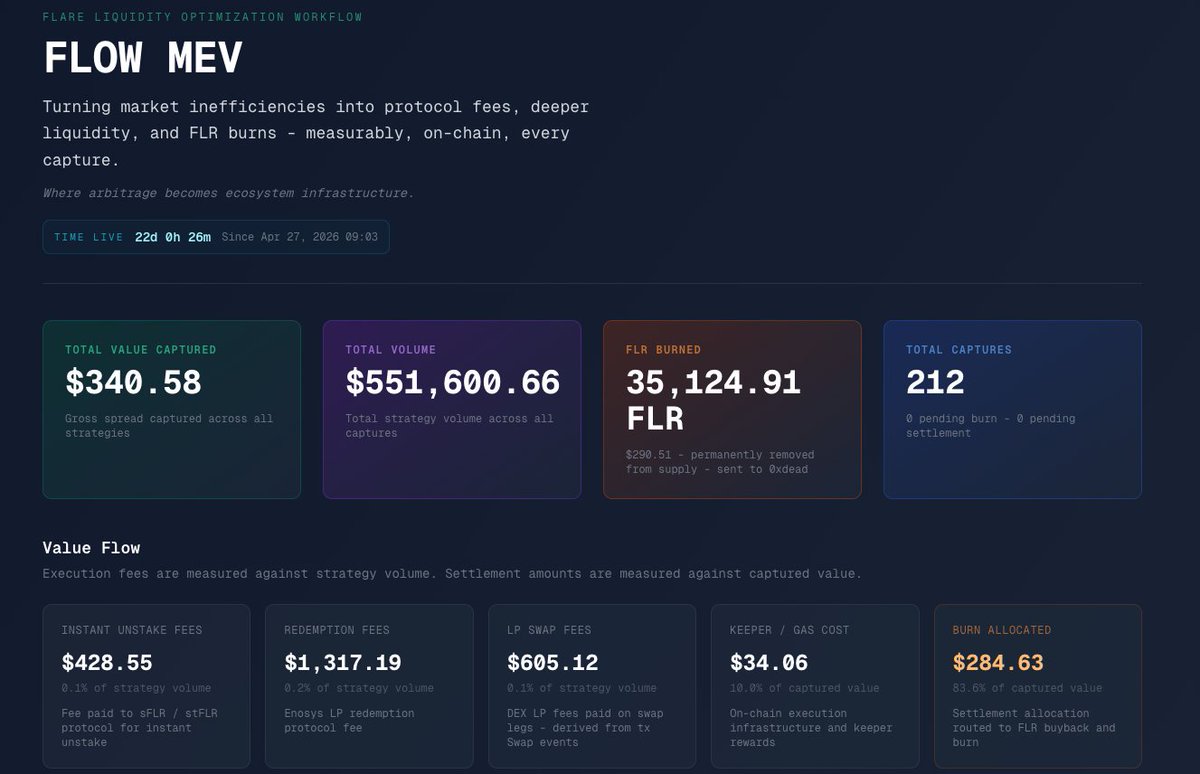
MEV used to be a tax on users. On @FlareNetworks , it's becoming yield. So far: • 35,000 $FLR burned 🔥 • 431 unstaked fees → LPs • 1,317 redemption fees → LPs Oh, and traffic is at its slowest right now. What happens when it isn't? defitrackerpro.com/flow-mev
GIF
Flareforward tweet media
English
3
17
59
1.7K