

Bogusz Jagoda
1.1K posts
Bogusz Jagoda
@frakimo
Intensivist with a little twist of engineering. I’m pretty good reinventing wheels in my garage.
PL Katılım Eylül 2012
213 Takip Edilen21 Takipçiler

PCB MILLER IS WORKING!
You can now generate the gcode to mill a PCB in UNDER ONE MINUTE. No installation, no dependencies, just ONE HTML FILE!!!
I still have a lot of improvements to make but I would call this a complete victory.
You can just make your own software.
English

🚨Someone just open sourced a computer that works when the entire internet goes down.
It's called Project N.O.M.A.D.
A self-contained offline survival server with AI, Wikipedia, maps, medical references, and full education courses.
No internet. No cloud. No subscription. It just works.
Here's what's packed inside:
→ A local AI assistant powered by Ollama (works fully offline)
→ All of Wikipedia, downloadable and searchable
→ Offline maps of any region you choose
→ Medical references and survival guides
→ Full Khan Academy courses with progress tracking
→ Encryption and data analysis tools via CyberChef
→ Document upload with semantic search (local RAG)
Here's the wildest part:
A solar panel, a battery, a mini PC, and a WiFi access point. That's it. That's your entire off-grid knowledge station. 15 to 65 watts of power. Works from a cabin, an RV, a sailboat, or a bunker.
Companies sell "prepper drives" with static PDFs for $185. This gives you a full AI brain, an entire encyclopedia, and real courses for free.
One command to install.
100% Open Source. Apache 2.0 License.
English

Logitech. Best hardware (MX Master) but the worst software. I have no idea why this is so bad. For Macs it's so bad in terms of CPU and overall system performance.
Tried fresh installs - always getting to this point that updater is doing this crazy stuff (in the background). App won't run.
I know - there is open source alternative like github.com/TomBadash/Mous… 👏
But come on. Please, fix your software @Logitech

English

@QVHenkel @yacineMTB Yet a very sophisticated and enjoyable part of design… why would we give it away…. We’re using LLMs as a tool, but wrong way
English

If people would stop trying to throw transformer-based 'AI' models at everything, including PCB design, and actually treat it for what it is — a large-scale EM problem — we might be a little further ahead with this issue already.
While every small step in the right direction is progress, I'm not sure why everyone is so hyped about automating PCB design first. It's one of the more difficult problems to automate, and in most proper product design cycles it constitutes a surprisingly small proportion of the total project duration
English

@Dinosn Well, most copy protection logic of that time could be defeated by changing je=>jne or similar cond branch opcode (single byte patch) in a proper exe file offset… there is always ultimate comparison (ok/not ok)…
English

Defeating a 40-year-old copy protection dongle dmitrybrant.com/2026/02/01/def…
English



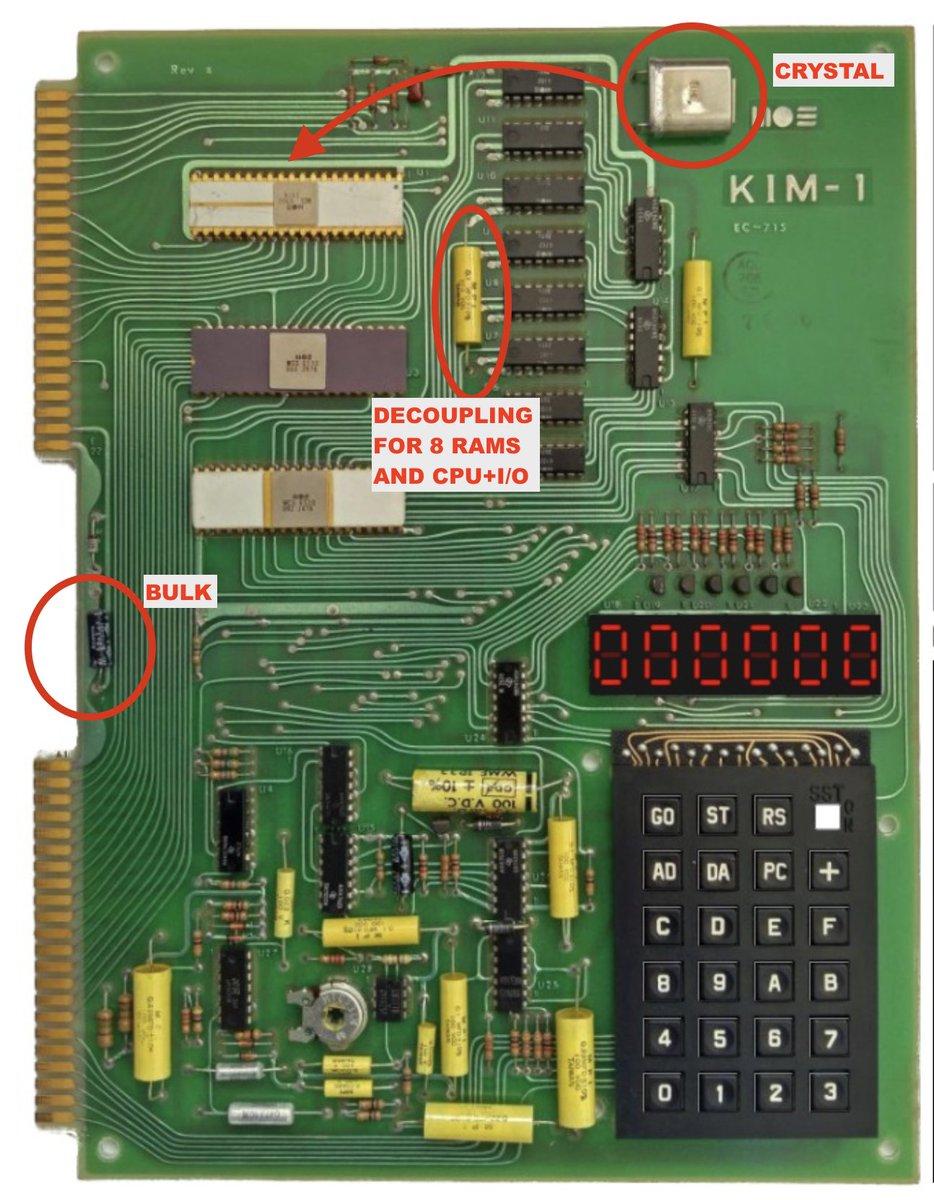
This reminds me of how much "bad engineering" and "ignoring of best practices" a design can tolerate and still work just fine. Like the KIM-1 - a single decoupling capacitor for 8 RAMs, CPU and I/O ICs. And the crystal super far from the oscillator in the CPU.
Big Man J@JacquesBerman
@matseng I see those now thanks. Still wouldn't think that's enough
English
@Youssef_Afella @SebastianLague Some scale according to IOR factor and should be good ;)
English

I probably, probably, made a physically accurate glass shader without any ray tracing or ray marching.
It based on some (relatively wrong) assumptions but it could give you realestic back face reflection/refraction.
I tested the prism from @SebastianLague video
English
It is getting hard to be a conspiracy theory freak when all those teories become true these days…
English
@blind_via Yeah, is it considered "retro" now? Many boards from 2000s looked like that, and yes: '000' -> cheap smd jumpers
English

Respect to this single sided PCB. It has a dual footprint for smt or through hole. There is a handful of zero ohm resistors on the board, that might be used for jumpers. In this case to literally jump over other traces instead of using a via jump to another layer. The chip is hidden with some kind of epoxy so we can't see the chip itself, this is really common. It provides obscurity, but also probably provide structural stability to the chip and the solder joins for long term use.

English
@rezoundous hobby coder here - claude $20 - I hit limits all the time, need to wait for reset; codex $20 - haven't hit limit yet (same work intensity...) I'm not coding for $$
English

@InfZakladowy Styczeń 2027 - przestałem być Informatykiem Zakładowym... jestem tylko informatykiem...
Polski

Styczeń 2026 - to właśnie wtedy zacząłem zmieniać zdanie na temat programowania z asystą LLM-ów. Nie mam tego jeszcze w pełni przemyślanego, ale zawód programisty zmieni się bardziej, niż sądziłem rok temu. Przestałem kpić i śmieszkować z tych zmian. Dziś wyglądają ekscytująco.
Polski
@WesRoth Yup, exactly my own exp, too. Hanging with claude code since Sonnet3, but codex-5.2 is another league. Opus is burning tokens like crazy and results are mediocre on large codebase, lying about fixing errors and always want to keep you happy... it is weird...
English

Clawdbot creator, Peter Steinberger says Opus is the best model overall, but Codex is his go-to for coding.
He trusts Codex to handle big codebases with almost no mistakes.
It’s more reliable and needs less handholding, which makes him faster.
Claude Code can work too, but it requires more effort and tricks.
For serious tasks, Codex feels like a dependable coworker.
English
@blind_via It just works. I have those boards. Pity, espressif haven't released sockets for all modules they selling, yet...
English


@vkrajacic Pascal strings for the win… just make length >=16bit var
English

I've been saying this for some time now. But most people in the C world don't even consider it. Maybe because of the legacy code they have to deal with, maybe because of the standard library, who knows. But length based strings are far superior in every respect.
x.com/vkrajacic/stat…
Dmitriy Kovalenko@neogoose_btw
One of the biggest problems of C are strings. Better to say no out of the box strings. *const u8 is absolutely the worst way to represent strings because every time you need to compare the strings you have to loop over the bytes instead of starting with length comparison
English