i'm joining @a16zcrypto to shape their social strategy.
crypto is the most interesting technology being built today, but most of the world still just doesn't get it. telling that story well requires long-term thinking from long-term believers, and a16z is the place to do it.
couldn't be more ready for this one.
We need more DAOs - but different and better DAOs.
The original drive to build Ethereum was heavily inspired by decentralized autonomous organizations: systems of code and rules that lived on decentralized networks that could manage resources and direct activity, more efficiently and more robustly than traditional governments and corporations could.
Since then, the concept of DAOs has migrated to essentially referring to a treasury controlled by token holder voting - a design which "works", hence why it got copied so much, but a design which is inefficient, vulnerable to capture, and fails utterly at the goal of mitigating the weaknesses of human politics. As a result, many have become cynical about DAOs.
But we need DAOs.
* We need DAOs to create better oracles. Today, decentralized stablecoins, prediction markets, and other basic building blocks of defi are built on oracle designs that we are not satisfied with. If the oracle is token based, whales can manipulate the answer on a subjective issue and it becomes difficult to counteract them. Fundamentally, a token-based oracle cannot have a cost of attack higher than its market cap, which in turn means it cannot secure assets without extracting rent higher than the discount rate. And if the oracle uses human curation, then it's not very decentralized. The problem here is not greed. The problem is that we have bad oracle designs, we need better ones, and bootstrapping them is not just a technical problem but also a social problem.
* We need DAOs for onchain dispute resolution, a necessary component of many types of more advanced smart contract use cases (eg. insurance). This is the same type of problem as price oracles, but even more subjective, and so even harder to get right.
* We need DAOs to maintain lists. This includes: lists of applications known to be secure or not scams, lists of canonical interfaces, lists of token contract addresses, and much more.
* We need DAOs to get projects off the ground quickly. If you have a group of people, who all want something done and are willing to contribute some funds (perhaps in exchange for benefits), then how do you manage this, especially if the task is too short-duration for legal entities to be worth it?
* We need DAOs to do long-term project maintenance. If the original team of a project disappears, how can a community keep going, and how can new people coming in get the funding they need?
One framework that I use to analyze this is "convex vs concave" from vitalik.eth.limo/general/2020/1… . If the DAO is solving a concave problem, then it is in an environment where, if faced with two possible courses of action, a compromise is better than a coin flip. Hence, you want systems that maximize robustness by averaging (or rather, medianing) in input from many sources, and protect against capture and financial attacks. If the DAO is solving a convex problem, then you want the ability to make decisive choices and follow through on them. In this case, leaders can be good, and the job of the decentralized process should be to keep the leaders in check.
For all of this to work, we need to solve two problems: privacy, and decision fatigue. Without privacy, governance becomes a social game (see vitalik.eth.limo/general/2025/0… ). And if people have to make decisions every week, for the first month you see excited participation, but over time willingness to participate, and even to stay informed, declines.
I see modern technology as opening the door to a renaissance here. Specifically:
* ZK (and in some cases MPC/FHE, though these should be used only when ZK along cannot solve the problem) for privacy
* AI to solve decision fatigue
* Consensus-finding communication tools (like pol.is, but going further)
AI must be used carefully: we must *not* put full-size deepseek (or worse, GPT 5.2) in charge of a DAO and call it a day. Rather, AI must be put in thoughtfully, as something that scales and enhances human intention and judgement, rather than replacing it. This could be done at DAO level (eg. see how deepfunding.org works), or at individual level (user-controlled local LLMs that vote on their behalf).
It is important to think about the "DAO stack" as also including the communication layer, hence the need for forums and platforms specially designed for the purpose. A multisig plus well-designed consensus-finding tools can easily beat idealized collusion-resistant quadratic funding plus crypto twitter.
But in all cases, we need new designs. Projects that need new oracles and want to build their own should see that as 50% of their job, not 10%.
Projects working on new governance designs should build with ZK and AI in mind, and they should treat the communication layer as 50% of their job, not 10%.
This is how we can ensure the decentralization and robustness of the Ethereum base layer also applies to the world that gets built on top.
thought this was an interesting chart from @a16zcrypto's annual report - NFT activity is overwhelmingly on @base today
while there is a lot of momentum around coining / fungible tokens on base, cool to see how much experimentation there still is with non fungibles (especially in gaming, ticketing, identity, social, etc)
There still aren’t enough seasoned marketers/strategists in Web3, and when they try to enter, they often hit the same gatekeeping and favor-trading that slowed things down last cycle.
In this cycle, real growth has mostly come when larger partners and brands stepped in, through traditional press, partnerships, and co-marketing that brought their audiences into the space. This mirrors skate culture gaining mainstream appeal through high fashion or SoundCloud artists scaling only once major labels added structure, the opposite of what many hoped but inevitable when both markets couldn’t get out of their own way.
Some are working to bridge the gap, but too much energy goes into protecting spots instead of collaborating. If we move past that, adoption will accelerate.
So many people who are supposedly good marketers in Web3 are really just good at marketing themselves.
Most of what passes for “marketing” is lifestyle marketing, using company funds to build personal networks, with the barometer being whether people know a project because that person is there.
That doesn’t include actually explaining what the project is, why it’s valuable, or how to expand that understanding to others.
At best, it’s a high school popularity contest inside a small circle on this app. And too often, that’s leveraged into the next job.
I have empathy for how difficult marketing is in this industry. There are many legitimate gripes. But let’s not pretend there aren’t people very much at fault here too.
For @nounsdao we’re leaning into IRL + Web2 brand partnerships and creative collabs - retail, fashion, arts, cultural events that bring bigger audiences onchain through tools + payments, instead of brands launching tokens that hurt the market last cycle.
By building charity tools, educational programs, and community - driven activations, we give traditional brands a safe way to participate. Partnering with household names builds trust, credibility, and adoption. Meeting people where they already are is the fastest path to scale.
I’m joining @a16z !
After five years at Shopify, I’m moving onto my next adventure in life, and heading to Andreessen Horowitz. Shopify is an incredible place, and Tobi is one of the great founders of our era. I’ll remember those years as one of the golden chapters of my life. Now, onwards!
I’m joining a16z as Editor at Large, and I’ll be responsible for the written output of the firm. A16z has always prioritized great thinking and writing as a deliberate instrument of the firm’s purpose and power. It starts with Ben and Marc: both generationally talented high-agency thinkers, writers, and company builders. And there’s a burning new energy in the firm today, brought by @eriktorenberg - who I’ll work with closely as he takes a16z’s narrative presence to a new level of ambition.
Writing is power transfer technology
I’ve had a few different vocations over the years - I’ve been a founder, touring musician, venture associate, worked at Shopify - but most people on the internet know me from my writing online. I’ve been blogging since my early twenties, and in that time I’ve seen different online content metas come and go - the golden years of VC blogs like AVC and Haystack, the Medium years, now Substack; the rise of “Go direct” and the crisis of traditional media.
What hasn’t changed is how valuable great writing can be. Something special happens when you give someone words to express an idea they always knew, but couldn’t articulate: you give them power. And it didn’t cost you anything.
“Power transfer technology” is what the business of VC is. Why does a VC firm care about content? It can’t just be to advertise the firm; or promote their partners and their theses. Those are both consequences of success, but they can’t be the actual goal.
The primary objective of a VC firm’s content, particularly their written output, should be to give founders power. The goal is to give them writing that transforms them into someone with more legitimacy, which is what power really is about.
Traditional media sometimes helps you accomplish this. A well-written op ed, thoughtfully crafted, can serve this purpose. But I think bloggers are naturally better at this craft, because bloggers have to grow their franchises under the constraint of not having built-in distribution. If you’ve mastered the craft of writing online, you know something important about how to reach and influence people, and what exactly it is you offer to an audience that gives them power.
Blogging is a trade
Winning, for bloggers, means writing the reference take on a good topic. My favourite example of this is how Byrne Hobart broke out with his piece on the 30-year mortgage. It’s kind of surprising that this kind of post had such influence - it’s wonky, it’s not written for a general audience whatsoever. But it turns out that people think and talk about their mortgages a lot, and like to feel competent when they do. Reading that piece equips them with a kind of legitimacy to speak on the topic.
One lesson hiding in plain sight here is that most of the audience of any successful post does not actually read it. They are told it by someone who did read it. There’s a primary audience who carefully reads the piece and does the cognitive work of “restructuring their consciousness” (Walter Ong coded) around good writing. And then there’s a secondary audience, who are re-told the content, either verbally (including group chats, podcasts, Youtube) or in other oral formats like Twitter.
(This is broadly true both inside and outside of organizations; e.g. a lot of work goes into writing an annual plan, which only a small number of people actually read, but a lot of people are “re-told” in some way.)
The primary audience gets something out of this sequence of events: they get power. This is the great secret of writing in public: the writer and primary audience both put in effort (to pack and unpack the idea); and they jointly reap the rewards, which is the legitimacy earned when the idea gets subsequently retold verbally to the wider secondary audience.
This is why, paradoxically, to reach the widest audience, you write to the narrow audience. Your objective as a writer is to give your primary audience material they’ll want to re-tell. They do the work of translating it to wider audiences in specific contexts; you do the general articulation in rich detail.
The secret of magic is to transform the magician
Today, there’s an amazing idea-sharing format that’s swallowed a lot of the “smart people discourse” on the internet, which is podcasting. The rise of podcasts has been astounding to watch, in the six years since I wrote The Audio Revolution. And a16z has both a great past and a great future in this media format, especially with Erik at the helm and seeing the caliber of talent he’s bringing on board his New Media team.
But podcasts are not enough on their own. Great writing, which has gone through the crucible of thinking and editing, transfers something into the reader, and transforms something within the reader, that talking does not.
I know a lot of smart people who correctly intuit that blogging is powerful, but can’t justify it on a return-on-effort basis compared to other ways of getting their message out. This is a mistake. Writing matters.
It takes more effort to read something than to listen to it. (And much more to write something than to talk about it.) The cognitive work of writing and reading is a real cost, but the benefit is that you get “restructured consciousness” from factoring and negotiating with the idea in written form. When you read an important idea and put in the work to understand it, you gain the subconscious competence and legitimacy to talk about it: you are transformed into someone with more power. Whereas, when you hear an idea, you can usually repeat the idea but not with the same authority. The deep competency is not transferred to the same degree.
This is an important idea to understand in a world where most of our information diet is shifting towards oral communication in various forms - “the internet village.” Now, people have been complaining that “nobody reads anymore” for decades - the point here is, the benefits of reading have never been more disproportionate, nor less obvious.
The farther we move towards being a default-verbal information culture, the more powerful the trade between writer and primary reader, but the less obvious it is to do. (Why write things if people would rather watch or listen?) If your goal is “I want to maximize the number of people who receive my message” then oral formats like podcasts, Youtube, and Twitter will appear like the obvious choice. But if you articulate the goal as “I want to give people power” then clearly you’ve got to write something down.
Founders are customers for legitimacy
I remember some days when I was a founder and no one would take me seriously, except for when I could produce a blog post from someone like Paul Graham or Semil Shah and speak to that idea. Something incredible would happen in those moments - people would actually listen to me, as if I’d suddenly become magic. Magic works because it is communication. The founder equipped with the VC’s writing should communicate something higher-signal than the founder alone. Ask, “what must be true of the content for this statement to become real?” and you’ve got a good guide for what kinds of things to write.
This relationship between VC and founder scales all the way up to real power-politics: the job of the VC firm is to be the “legitimacy bank” where founders (and other high-agency people) can go to take out legitimacy on credit, or make a legitimacy deposit. I find this to be a wonderful way to frame the founder-VC relationship because it does NOT imply the VCs are the “grownups” in some patronizing sense: it celebrates legitimacy as a thing that VCs and founders incept together, just like how blogging is thing that the writers and their primary readers incept together.
This is why VC blogs were such a good product in their heyday. As the “free tier” of the VC, it naturally frames the relationship as one where legitimacy is jointly incepted (by the writer and primary reader), not as one that’s benevolently bestowed.
The meta is different now, but the purpose is the same, and I think a16z is probably the best spot in the world to pursue that craft and that thesis. I’m incredibly fortunate to get to join this group of talented investors and company builders, towards a mission that’s never been more important: giving the world’s founders the power they need to build a bright future.
Let’s go!
Introducing Nounified ENS identities
↳ (yourname).⌐◨-◨.eth
Free to mint. Yours forever.
The fastest way to make your wallet instantly recognizable in the ⌐◨-◨ universe.
Mint now — link below & in bio ↴
ethereum has been online ten years straight with zero pauses and zero maintenance windows.
in that time:
- facebook went down for 14 hours
- aws kinesis froze for 17
- cloudflare dropped 19 datacenters
- alt L1s…well, you know.
every centralised giant blinks, they rely on on-call humans and scheduled downtime.
but ethereum never stops, not through forks, crashes, bubbles, lawsuits, hacks, wars, and every kind of drama the internet can throw at it.
and it’s not thanks to a CEO or a hotline.
it’s not because someone saved it.
it’s because we all did.
devs, stakers, researchers, users,
millions of us, scattered across the world, choosing to show up, block after block, year after year.
while banks fail, clouds go dark and servers get patched, ethereum keeps going.
we keep going.
ten years online.
forever to go.
The Noggle Table — a modular coffee table inspired by the iconic ⌐◨-◨'s
Each segment can be bent, separated, or reconfigured.
Built for shared spaces, conversation, and cultural connection.
By @Franke
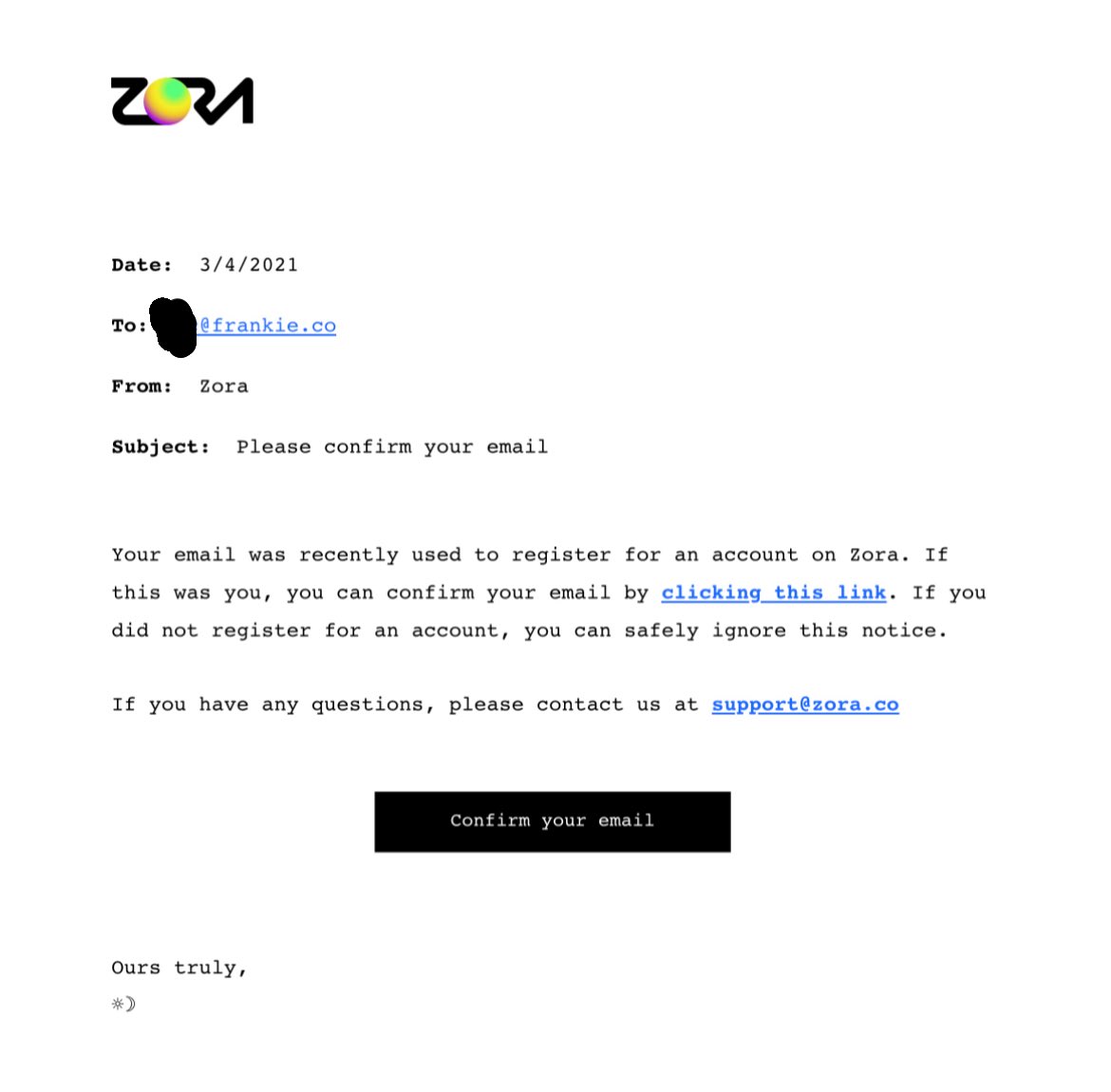
someone asked me if I plan to be active on @zora since I activated my creator coin there.
Sir this is a Wendy’s and I’ve been active on Zora since 2021.