Mr Game of Chains

579 posts

Mr Game of Chains banner
Mr Game of Chains

Mr Game of Chains

@gameofchains

🌎 Geospatial Intelligent 👨‍🏫 Life Learner 🔎 Mind Explorer

🌌 The Milky Way Katılım Ağustos 2021
236 Takip Edilen24 Takipçiler
Sabitlenmiş Tweet
Mr Game of Chains
Mr Game of Chains@gameofchains·
Everyday ask yourself..."What's your goal for today?"
English
0
0
3
142
Mr Game of Chains
Mr Game of Chains@gameofchains·
Reason is the fundamental survival algorithm. Existence requires directed, computational effort to convert raw environmental state into structural value.
English
0
0
0
2
Mr Game of Chains
Mr Game of Chains@gameofchains·
"It was the greatest sensation of existence: not to trust but to know"- Ayn Rand, Atlas Shrugged
English
0
0
0
4
Mr Game of Chains
Mr Game of Chains@gameofchains·
The Loop: The tool that helps build the operating system that runs the tool.
English
0
0
0
0
Dan Go
Dan Go@CoachDanGo·
You've been lied to. They said burgers are junk food but the truth is they're one of the healthiest meals on the planet when you build it right. All it takes is 5 ingredients: 1. Sourdough bun: fermentation lowers glycemic load, unlocks minerals 2. Grass-fed beef: omega-3s, CLA, iron, B vitamins 3. Raw gouda: K2, B12, probiotics, calcium 4. Romaine lettuce: vitamins A, K, C, folate, fiber 5. Heirloom tomatos: antioxidants, non-GMO, real nutrients Burgers can be one of the healthiest things you put into your body if you build it right. See you at the BBQ.
Formula🌵@1realFormula

What’s this logic 😭?

English
212
267
3.4K
874.1K
Mr Game of Chains
Mr Game of Chains@gameofchains·
@brivael Great thread. Makers .vs. Takers How could we educate the public on this?
English
0
0
1
9
Brivael Le Pogam
Brivael Le Pogam@brivael·
Elon Musk avait dit un truc qui m'avait marqué sur l'allocation de ressources. En substance : passé un certain niveau de richesse, l'argent n'est plus de la consommation, c'est de l'allocation de capital. Cette phrase change tout. L'économie, dans le fond, c'est juste un problème d'allocation. Tu as des ressources finies et des usages infinis. Qui décide où va quoi ? Imagine une cour de récré. 100 enfants, des paquets de cartes Pokémon distribués au hasard. Tu laisses faire. Très vite, un ordre émerge. Les bons joueurs accumulent les cartes rares, les collectionneurs trient, les négociateurs trouvent des deals. Personne n'a planifié. Et pourtant chaque carte finit dans les mains de celui qui en tire le plus de valeur. Le système maximise le bonheur total de la cour. C'est ça, la main invisible. Maintenant fais entrer la maîtresse. Elle trouve ça injuste. Léo a 50 cartes, Tom en a 3. Elle confisque, redistribue, impose l'égalité. Trois effets immédiats. Les bons joueurs arrêtent de jouer, à quoi bon. Les mauvais n'ont plus de raison de progresser, ils auront leur part. Les échanges s'effondrent. La cour est égale, et morte. Elle a maximisé l'égalité, elle a détruit le bonheur. Le problème de la maîtresse, c'est qu'elle ne peut pas avoir l'information que la cour avait collectivement. C'est le problème du calcul économique de Mises, formulé en 1920. L'URSS a essayé de le résoudre pendant 70 ans avec le Gosplan. Résultat : pénuries, queues, effondrement. Pas parce que les Soviétiques étaient bêtes, parce que le problème est mathématiquement insoluble en mode centralisé. Quand Musk a 200 milliards, il ne les consomme pas, il les alloue. SpaceX, Starlink, Neuralink, xAI. Chaque dollar est un pari sur le futur. Et lui a un track record. PayPal, Tesla, SpaceX. Il a démontré qu'il sait identifier des problèmes immenses et y allouer des ressources avec un rendement spectaculaire. L'État aussi a un track record. Hôpitaux qui s'effondrent, éducation qui décline, dette qui explose, services publics qui se dégradent malgré des budgets en hausse constante. Le marché identifie les bons allocateurs, la politique identifie les bons communicants. Le profit n'est pas une finalité, c'est un signal. Il dit : tu as alloué des ressources rares vers un usage que les gens valorisent suffisamment pour payer. Plus le profit est gros, plus la création de valeur est grande. Quand Starlink est rentable, ça veut dire que des millions de gens dans des zones rurales ont enfin internet. Quand un ministère est en déficit, ça veut dire qu'il consomme plus qu'il ne produit. L'un crée, l'autre détruit, et on appelle ça redistribution. Dans nos sociétés il y a deux catégories d'acteurs. Les entrepreneurs et les bureaucrates. L'entrepreneur prend un risque personnel pour identifier un problème, mobiliser des ressources, créer une solution. S'il se trompe il perd. S'il a raison, ses clients gagnent, ses employés gagnent, ses fournisseurs gagnent, l'État collecte des impôts. Il est la cellule de base du progrès humain. Le bureaucrate ne prend aucun risque personnel. Son salaire est garanti. Au mieux il maintient une rente existante. Au pire il la détruit par excès de réglementation, mauvaise allocation forcée, incitations perverses qui découragent ceux qui produisent. Mais dans aucun cas il ne crée. Regarde les 50 dernières années. iPhone, internet civil, SpaceX, Tesla, Google, Amazon, Stripe, mRNA, ChatGPT. Toutes des inventions privées, portées par des entrepreneurs, financées par du capital risque. Pas un seul ministère n'a inventé quoi que ce soit qui ait changé ta vie au quotidien. La France est devenue le laboratoire mondial de la dérive bureaucratique. 57% du PIB en dépenses publiques, record absolu. Une administration tentaculaire, une fiscalité qui pénalise la création de richesse. Résultat : décrochage face aux États-Unis, à l'Allemagne, à la Suisse. Fuite des cerveaux. Désindustrialisation. Dette qui explose. Et le pire c'est que la mauvaise allocation s'auto-renforce. Plus l'État prélève, moins les entrepreneurs créent. Moins ils créent, moins il y a de base fiscale. Plus l'État s'endette et taxe. Boucle de rétroaction négative parfaite. La maîtresse pense qu'elle aide, et chaque année la cour produit moins. Dans nos sociétés, ce sont les entrepreneurs, toujours, qui font avancer la civilisation. Les bureaucrates au mieux maintiennent une rente, au pire la détruisent. Aucune société n'a jamais progressé en taxant ses créateurs pour subventionner ses gestionnaires. La question n'est jamais qui a combien. C'est qui alloue le mieux la prochaine unité de ressource pour maximiser le futur de l'humanité. La réponse depuis 200 ans n'a jamais changé. Ce ne sont pas les fonctionnaires.
Français
3.3K
16.5K
61.8K
81.5M
David Sinclair
David Sinclair@davidasinclair·
I applaud the direction and wish Laurent the best of luck. But trying to solve complex biology with AI and physics is like trying to understand how Michelangelo painted The Last Judgment by studying the chemistry of paint
Science girl@sciencegirl

A teenage prodigy in quantum physics is aiming to tackle one of science’s biggest challenges: human aging. Laurent Simons earned his PhD in quantum physics from the University of Antwerp at just 15. Rather than slowing down, he has already begun a second doctorate, this time focusing on medical science and artificial intelligence. His long-term ambition is to better understand aging and disease, with the hope of helping extend healthy human lifespan. He has described death as a complex “puzzle,” made up of many interconnected pieces across biology, physics, and engineering. His strategy is to study these layers together, using AI to analyze biological systems and identify patterns that would be difficult to detect otherwise. Simons’ academic journey has been unusually fast. He completed high school by age 8, finished a bachelor’s degree at 12, and went on to earn both a master’s and PhD in quantum physics years ahead of typical timelines. His doctoral work explored advanced topics like Bose–Einstein condensates, where atoms behave as a single quantum system at extremely low temperatures. Although highly theoretical, this research underpins technologies such as quantum computing and precision measurement. Now, his focus is shifting toward biology and medicine. In AI-driven healthcare, researchers are already using machine learning to improve early disease detection, model protein structures, and accelerate drug development. In the field of aging, scientists are investigating ways to reduce cellular damage, eliminate dysfunctional cells, and better understand how the body changes over time. However, experts stress that “solving aging” is extraordinarily complex. While lifespan extension has been achieved in simple organisms, applying those findings to humans remains a major scientific hurdle. Simons himself acknowledges that meaningful progress could take decades. Even so, his path reflects a broader trend in science—where breakthroughs are increasingly happening at the intersection of disciplines, and younger researchers are setting ambitious, long-term goals. Learn more: "15-year-old genius sets his sights on solving human immortality." Brighter Side.

English
187
99
1.7K
234.6K
Dan Go
Dan Go@CoachDanGo·
Question for people under 15% body fat: What's one meal you eat on most days?
English
1K
59
1.5K
5.2M
Natalie Wolchover
Natalie Wolchover@nattyover·
Bacteria move around using a molecular machine called the flagellar motor that rotates faster than the flywheel of a race car engine and switches directions in an instant. After 50 yrs, scientists have finally figured out how it works. “My lifelong quest is now fulfilled.” Link⤵️
English
530
4.4K
32.9K
6.1M
Yann LeCun
Yann LeCun@ylecun·
Dario is wrong. He knows absolutely nothing about the effects of technological revolutions on the labor market. Don't listen to him, Sam, Yoshua, Geoff, or me on this topic. Listen to economists who have spent their career studying this, like @Ph_Aghion , @erikbryn , @DAcemogluMIT , @amcafee , @davidautor
TFTC@TFTC21

Anthropic CEO Dario Amodei: “50% of all tech jobs, entry-level lawyers, consultants, and finance professionals will be completely wiped out within 1–5 years.”

English
1.2K
2.8K
21.4K
4.1M
won kim
won kim@waleuga·
@muellerberndt You should do more animation to let people understand this.
English
2
0
1
2.2K
Dr Singularity
Dr Singularity@Dr_Singularity·
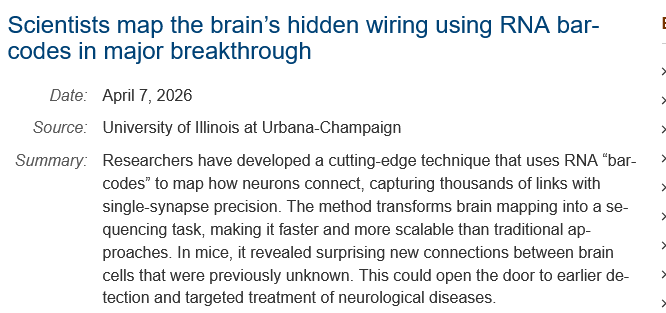
insane tech achievement Scientists just found a way to map the brain like it’s code. Instead of slowly scanning neurons with microscopes (which takes forever), they gave brain cells tiny "barcodes" made of RNA, so when two neurons connect, that connection gets recorded like data. Then they just sequence it like DNA and boom: a map of how the brain is wired. In plain terms, they turned one of the hardest problems in biology into something computers are insanely good at. Now we can map way more connections, way faster It can reveal hidden brain circuits we didn’t even know existed and help detect diseases like Alzheimer’s before symptoms even show up.
Dr Singularity tweet media
English
23
121
617
25.4K
Mathelirium
Mathelirium@mathelirium·
Russian Genius Found Structure in The Mess of Turbulence In 1941, Andrey Kolmogorov proposed a simple but powerful picture of turbulence: Energy does not disappear where it is injected but moves. Large eddies pass energy to smaller ones, those smaller ones feed even finer motion, and viscosity finally removes it at the tiniest scales. That cascade picture became one of the foundations of modern turbulence theory. The point is not just that turbulence looks messy. The point is that the mess has structure, and Kolmogorov’s great insight was to treat that structure statistically.
English
19
118
841
58.8K
Mr Game of Chains
Mr Game of Chains@gameofchains·
A partnership pilot .is. the most elegant version of a due diligence money can't buy.
English
0
0
1
14
Mr Game of Chains
Mr Game of Chains@gameofchains·
Engineer the Constraints that Force the Desired Outcome
English
0
0
0
11
Mr Game of Chains
Mr Game of Chains@gameofchains·
Design the incentives system that eases the path to your goals.
English
1
0
1
18
Jacob Edward
Jacob Edward@JacobEdwardInc·
Neither of these men are married or have kids. Both are simply obsessed with their own personal perfection and optimization. There is nothing impressive about a single man with no kids sleeping well and being fit. Show me a man with young children, a full time job, disrupted sleep, who works out regularly, eats healthy, trains Jui Jitsu, with a muscular body… THIS is impressive. THIS requires extreme discipline.
Camus@newstart_2024

Chris Williamson just shared his "nuclear" sleep stack that's quietly changing his life—and Andrew Huberman breaks down exactly why it works: If you're lying in bed at 2 a.m. scrolling or staring at the ceiling, this 4-minute protocol combo might be the fastest way to shut your brain off without pills. The two killer techniques Williamson swears by: 1. The Mind Walk (visualization on steroids) - Imagine walking a route you know perfectly (your house → front door → street) - Do it with insane detail: feel the shoehorn, hear the key turn, feel the door handle, pressure of the pavement - It's like reading fiction for your nervous system—engages the brain just enough to stop problem-solving loops, but not enough to keep you awake 2. Resonance breathing with the Ohm stone lamp - Bedside lamp with induction-charging stone that has a built-in FDA-cleared HRV sensor - Hold the stone → 3/6/9/12-minute guided sessions with silent tactile vibration (no sound, no light, partner-safe) - Guides you into true resonance frequency (max vagal tone) → the stone knows when you hit it - Williamson calls it “the sickest” sleep tool he’s ever used—currently in stealth (ohmhealth, not widely available yet) Huberman adds the neuroscience: Looking down + eyelids lowering activates parasympathetic circuits and deactivates wakefulness-promoting brainstem nuclei. It’s literally pedaling the sleep pedal while shutting off the alertness arm. Williamson: “Some days you need the adventure story (mind walk), some days you need the physiological hammer (resonance breathing). Stack them and I’m cross-eyed into sleep.” Already trying one of these? Or is your nighttime routine still a war zone?
English
1.2K
917
20K
2M
Mr Game of Chains
Mr Game of Chains@gameofchains·
Any thing that exists or existed .is. a Complex System Any Complex System .is. a Database
English
0
0
0
9