@SuperBitcoinBro @JoeCarlasare he RTed you so he likely agrees. was just confusing in the context of this prev comment.
English
ɢᴅʀ252
2K posts

@gdr252
dilettante, generally optimistic. 🟢🟢🔴🟢🟢🟢🟢

@PeterLBrandt BTC vs GOLD is a buy here

The 2029 $MSTR Convert Buyback Is Not What It Looks Like It's been a while since I posted on MSTR because there's generally a lot of coverage - and I'd rather only post when I have something to add to the discourse. Like many of you probably, @saylor orange pilled me (MSTR class of 2022) and I haven't looked back since. There's been some important developments lately, and I'd like to weigh in. Saylor is an incredibly intelligent financial engineer (I'm sure even @JoshMandell6 would agree). And I think that reading friday's $1.5B convertible buyback as deleveraging actually misses the trade. While it may look like they're just retiring less favorable debt for a 'healthier' balance sheet, the actual action is a clean short on MSTR's implied vol. Here's how the numbers work out. Strategy is buying back $1.5B of its $3B 0% convertible senior notes due Dec 2, 2029. Settlement around May 19. Conversion price: $672.40 per share. $MSTR price: ~$175. For these notes to convert into common stock at maturity, the stock has to achieve a 284% gain in 3.5 years (46% CAGR). A year ago, $MSTR was $400+. Those same 2029 converts traded above par because the embedded call option had real conversion value. Today, with the stock at $175, that call is deeply out of the money. The bond traded at roughly 92 cents on the dollar. Enter Saylor. The headline trade. $1.5B face retired for $1.38B cash. An 8% discount to par. Roughly a 2.3% annualized IRR on the debt itself. By bond-math standards, that's nothing remarkable. But that's not the trade. The actual trade. The actual trade is the dilution being retired. $1.5B face divided by a $672.40 conversion price equals approximately 2.23 million potential shares. If MSTR rerates above $672.40 by maturity, those shares would have been issued. Every dollar above $672.40 is equity dilution to existing holders. So consider the asymmetry. If MSTR sees $1,000 by Dec 2029, those 2.23 million shares represent $2.23B of dilution Saylor just retired — an ~$850M saving vs. doing nothing. At $1,500, the dilution retired is $3.34B — nearly $2B in savings. And if MSTR stays below $672.40, the converts wouldn't have converted anyway, and Saylor still banks the $120M discount and clears the 0% debt early. Who's on the other side. Convertible arbs. When MSTR fell from $400+ to $175, their hedge worked. The embedded call decayed. Their position printed and now they want their capital back. They sold optionality they had stopped pricing. This is the equivalent of a cash-secured-put run in reverse. When implied vol on a name you have conviction in compresses, you buy back the convexity you originally sold. Saylor isn't selling vol here. He's buying it back. Where this is wrong. If MSTR stays below $672.40 through Dec 2029, the converts never convert. The buyback economics / return shrink to a small one. Not a disaster, but not the trade of the year. The asymmetry really pays if MSTR rerates. That's the bet Saylor is making. Make of it what you will. Issuing the converts was Saylor selling MSTR's upside (even if he said otherwise at the time); buying them back is Saylor purchasing it. He's not telling you he's bullish — he's paying paying $1.38B to buy it back. #Bitcoin


There is a limited universe of listed preferred shares in Japan today. Upon listing, our preferred would be only the seventh in the market, and the first perpetual preferred. We view this as a meaningful contribution to the development of Japan's capital markets, but it is also why the path to listing is necessarily deliberate. In the Japanese market, dividends on preferred shares are expected to be supported by sustainable cash flows generated from underlying operations. The listing review accordingly assesses dividend-paying capacity based on projected financial performance over a multi-year period, including scenarios across different market environments. Metaplanet already has a six-quarter track record in its Bitcoin Income Generation Business, and we believe it is important to continue demonstrating that the business can generate stable, recurring cash flows across both strong and weak Bitcoin market conditions. We are also continuing to articulate the scalability and long-term viability of our related operating businesses that support this cash flow profile. A second consideration is dividend operations. Listed companies in Japan have historically paid dividends once or twice per year. The structure we are designing contemplates more frequent distributions, including monthly dividends. Implementing this requires careful work on record-date procedures, shareholder identification, dividend calculation, and recurring shareholder notice operations. We are working closely with our partners to build and modernize this infrastructure in a manner consistent with Japanese regulatory and market practice. The process has taken longer than we initially anticipated, and we appreciate that this has created uncertainty. We are deliberate about this work because Japan today is one of the most yield-starved major capital markets in the world, and we believe a preferred equity product supported by credible operating cash flows, robust operational infrastructure, and a long-term growth strategy can meaningfully address that need. We are deeply committed to bringing this product to market, and to doing so in a form that earns the long-term trust of investors and market participants.


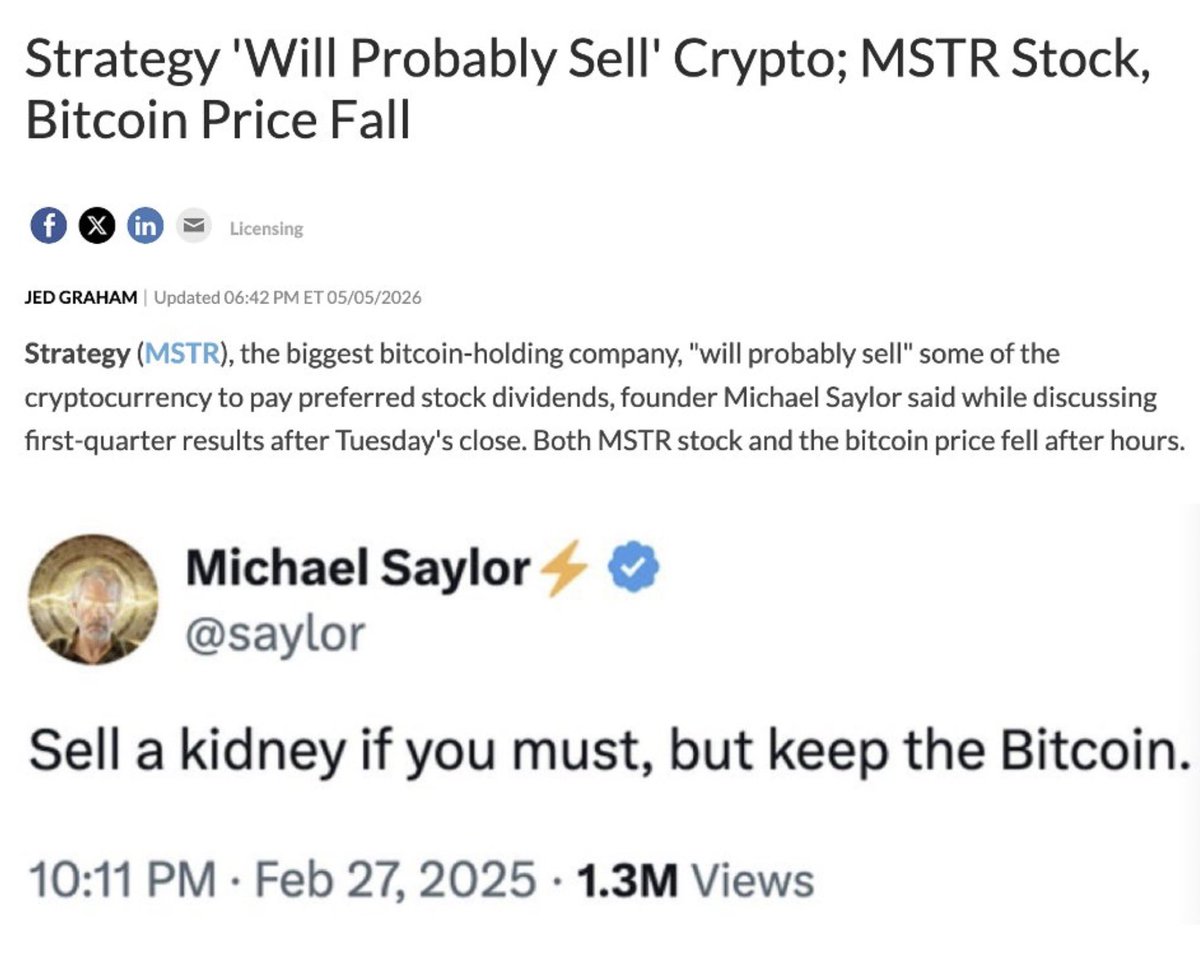

$BTC capital gains fund $STRC credit dividends.
The earnings call for @strategy explicitly stated a shift in Strategy and it could be awesome. TL;DR -> Sell High Cost Bitcoin, Book Taxable Loss, Use $4B to buy back $MSTR and Converts, boost share price and mNAV, crush shorts. GAAP volatility ≠ taxable event Realized BTC sales = taxable event Previously, Strategy could show huge GAAP gains/losses from fair-value accounting without necessarily triggering CAMT because unrealized appreciation alone does not create taxable income in the same way as realized gains from selling BTC. Now, if they sell high-cost-basis BTC first (FIFO/HIFO strategy matters), they can intentionally realize losses. Sell 50,000 BTC at ~$80K = ~$4B proceeds If average basis was ~$100K+, they realize roughly ~$1B+ actual capital loss That realized loss becomes economically valuable because it can: Offset realized gains elsewhere Reduce future CAMT exposure Create tax assets / shield future taxable income Free up billions in liquidity without increasing leverage Then the important second step: They can redeploy the cash into higher BPS-accretive actions. Buy back undervalued MSTR (if mNAV low) Retire low-conversion-price converts Fund dividends / USD reserves Reduce float and future dilution So the realized loss itself is not “good” because EPS changes. EPS alone doesn’t mechanically help the stock. The value comes from: converting high-cost BTC into liquidity + tax assets + denominator reduction. That is the shift. $MSTR $STRC BTC is no longer treated as untouchable inventory. It’s becoming an actively managed capital allocation asset optimized around Bitcoin per share, float control, taxes, and capital structure.


No buys this week. Back to work next week. $BTC


This is my portfolio: 40% $MTPLF 20% $ASST 15% $BMNR 15% $PURR 10% $TSWCF Ready for the rocket ship 🚀