

Geoffrey Overman
161 posts
Geoffrey Overman
@genunder
Take posts with a few grains of salty mushrooms.
United States Katılım Haziran 2016
80 Takip Edilen31 Takipçiler

As someone who has personally spent $500k / mo+ on Google Ads for years, I can tell you with certainty:
This revenue growth in Search is artificial & extremely unhealthy for Google’s business long term
Search volumes are declining as legacy search is being increasingly cannibalized by non-monetized LLM queries
Google’s response?
Manufacture revenue growth via short-sighted, highly extractive, customer-hostile tactics. I.e. charge advertisers more for lower quality clicks, including clicks they do not want and explicitly did not approve Google to charge them for
A few examples to illustrate:
For all of its history until recently, Google operated on a 2nd price auction model
I.e. if you bid $5 CPC and the next highest bidder bids $1 CPC, Google charged you $1.01 for the click (one penny more than the 2nd highest bidder) rather than the $5 you bid
This was a genius move by Google early on as it incentivizes advertisers to input their true maximum willingness to pay rather than trying to play the game of bidding low and constantly adjusting to try to stay just ahead of the next highest bidder while still not paying too much
However recently, Google silently deprecated the 2nd price auction and began charging advertisers as much as their bid and budget caps allow, regardless of what anyone else is bidding
It’s a short-sighted cash grab at the expense of the long term health of the advertiser ecosystem
Making thing worse, Google also recently nerfed keyword targeting precision
Google previously had precise keyword targeting settings that allowed advertisers pick individual search phrases to bid on, defined down to the character w/ exact match or phrase match targeting
This was one of the core features that made search advertising magic, enabling advertisers to run extremely precise campaigns based on exactly what their target customer typed
But now, even if you bid on a specific term or phrase using the strictest exact
-match targeting settings, Google will show your ad across 1000’s of unrelated keywords, labeling them as as “exact match (close variant)”
The definition of “close variant” means whatever they want it to and changes constantly. The result is advertisers get billed for clicks that are totally irrelevant to their business and that their targeting settings explicitly forbid Google from targeting. Google does it anyway and there’s no ability to turn this off
So now exact match is broad match, and broad match is just meaningless spam
This is all very bad for advertisers, but for Google, it allows them to show your ad and bill you for clicks across 1000x more searches that were previously going unmonetized (mainly because they’re garbage queries no one wants)
This is how you grow revenue atop declining search volumes
Lastly, and perhaps most egregiously, Google quietly stopped respecting budget caps by a factor of 2x. For example campaigns we’ve been running for years with $1000 daily budget caps suddenly began spending $2000+ per day
And the extra spend is entirely on the garbage keywords Google arbitrarily throws in as “exact match (close variants)” which have no value to our business, but can’t be turned off
Google offers no refunds nor any recourse for overspend or spend on keywords you explicitly did not target
These are not the actions of a healthy business. These are the actions of company whose core business is in decline but desperately needs to pump quarterly earnings so Wall Street will continue to fund insane capex while hopefully looking through their rapidly deteriorating negative free cash flow
Google operated a benevolent monopoly for the better part of 25 yrs
Meaning the value Google captured from Search was but a small fraction of the value it created, and that spread produced a potential energy that justified expectations of high earnings growth far, far into the future
This is now no longer the case
At the alter of AI capex, Google is sacrificing the golden goose
Sundar Pichai@sundarpichai
Q2 was an amazing quarter, with our AI investments redefining what’s possible across every part of our business. Alphabet revenue grew 24% YoY and Google Cloud accelerated to 82% growth. We saw exciting momentum across the board from Search to YouTube to the Gemini app (which reached 950M monthly active users). Our model APIs are processing 22B tokens/min (up from 16B+ last quarter) driven by our workhorse Flash models. We’re also seeing great adoption of Gemini Enterprise, used by 90% of the Fortune 100, as well as strong demand for our security solutions. Outstanding results and momentum, and such an exciting moment—thanks to all of our partners and employees around the world! 🙌 About to hop on the call!
English
Interesting thread and the charts are eye-opening, especially the Anthropic revenue/margin trajectory and that ARR-per-MW number climbing from ~$16M to a projected $60M. That kind of efficiency jump in under a year is real and material.
That said, the framing that this proves each capability jump is worth more than the cost of delivering it on a compounding, non-linear basis is a stretch. The more cogent explanation is that the cost of producing tokens has been falling hard through software and systems work, not that customers are suddenly extracting disproportionately more economic value per unit of capability.
SemiAnalysis themselves lean into this: a big chunk of the margin recovery comes from higher tokens/sec/GPU via software improvements that work across both Trainium and NVIDIA GPUs (including the Hopper generation still in the fleet, not only the newest Blackwell boxes). Quantization, better kernels, continuous batching, speculative decoding, KV-cache optimizations, and runtime improvements all raise throughput and lower the effective cost per token on hardware that is already deployed. The broader industry data backs this up—inference costs for a given level of model quality have been dropping on the order of 10x per year in multiple independent looks, driven more by algorithmic and serving progress than by pure hardware generational leaps.
In other words, newer models are often simply more efficient at delivering useful output per watt or per FLOP even when you run them on the previous generation of accelerators. That shows up directly in the unit economics and explains why margins can expand while input prices for memory and packaging are rising. The “value outrunning delivery cost” chart is mostly just the mathematical inverse of those improving gross margins; it restates the observation rather than proving a special non-linear surplus from capability itself.
Also worth separating Anthropic from OpenAI here. The margin story is much stronger for Anthropic (enterprise-heavy, API-focused). OpenAI still carries a heavier free-user burden and weaker overall margins, so treating them as identical evidence for the same dynamic overstates how broad this is.
None of this makes the growth any less impressive or the near-term pricing power for memory/compute providers any less real. But the causal claim that this is primarily “capability value compounding faster than cost” is less robust than “we got a lot better at squeezing more useful tokens out of the same (and new) silicon.” Those two stories have different implications for how durable the margin expansion and the hardware bid stay once the efficiency gains start to normalize or competition intensifies.
English

There’s something major happening with @OpenAI & @AnthropicAI’s businesses that has huge implications for the compute and memory complex
>Both Anthropic and OpenAI have had explosive revenue growth this year, while at the same time, seeing significant gross margin expansion (see chart)- close to unheard of for companies to see sequential margin expansion while they’re scaling this aggressively
At least so far, it looks like each jump in capability has been worth more to customers than the cost of delivering it. And that gap is getting wider, not narrower… 1/5 🧵

English
Uber’s real edge is how it only pays for the useful part of a car’s life while someone else covers everything else.
• Drivers bring their own vehicles. Uber pays them only for the time the car is actually earning money. Loan payments, depreciation, registration, overnight parking, and all the rest stay on the driver’s personal books. A fleet operator has to buy every vehicle outright. Robotaxis with full sensor packages still run well over $150,000 each. That capital cost sits on the balance sheet whether the car is busy or parked.
• Insurance runs around the clock for any owned fleet. It covers the vehicle parked, driving, or sitting in a depot. Drivers usually carry their own policies and only step up coverage while they are online. Uber never pays for the idle risk. Spread that across thousands of cars and the fixed insurance bill becomes a permanent weight on any integrated operator’s margins.
• Maintenance and tires fall entirely on the driver. New brakes or a set of tires come out of their pocket. Uber’s cost stays zero until the next fare. Fleet operators must staff depots, keep parts inventory, and schedule repairs for the entire network. Wear happens on a schedule no matter how many trips the cars complete. One rough stretch of road multiplies the expense across every vehicle.
• Cleaning is a constant drag on shared fleets. Interiors need attention almost every day for trash, spills, and odors. Labor and logistics for that can easily run $10 to $20 per car daily. Drivers clean their own cars or accept lower ratings. A robotaxi operator has to build or hire an entire cleaning operation with washing stations and routing just to keep the fleet usable. That expense never appears on Uber’s books.
• Storage and empty miles cost Uber nothing. Drivers park at home or wherever is convenient. No urban depots, no overnight charging lots, no paid repositioning of empty cars. Fleet operators rent the space, pay the utilities and security, and burn energy moving vehicles with no passengers simply to balance supply. Uber’s supply rearranges itself every night without a line item.
• Utilization risk runs in opposite directions. An Uber driver’s car can sit unused for hours and the platform loses nothing. The fixed costs already belong to someone else. A fleet owner needs high utilization just to cover the capital. Every idle hour on a $175,000 robotaxi destroys value. Low utilization turns the model into a money pit. Uber can grow demand without ever growing the capital base that has to stay busy.
• The cost of one more Uber trip is mostly pure margin once the network exists. Matching existing drivers adds almost no new asset cost. Adding another vehicle to an owned fleet brings the full package: purchase price, insurance, cleaning crews, maintenance teams, and remote support. Scaling multiplies the entire cost structure instead of just the demand side.
• That is why platforms keep the advantage even as autonomy arrives. Any company that insists on owning the metal carries depreciation, daily cleaning, tire budgets, insurance float, and depot networks. Uber can connect to those fleets, to driver-owned cars, or to third-party robotaxi operators and take a cut of the trip. The physical stack stays off its books. The market for trips grows with autonomy. The company that does not have to own the cars is the one that compounds.
English

Uber’s real edge is how it only pays for the useful part of a car’s life while someone else covers everything else.
• Drivers bring their own vehicles. Uber pays them only for the time the car is actually earning money. Loan payments, depreciation, registration, overnight parking, and all the rest stay on the driver’s personal books. A fleet operator has to buy every vehicle outright. Robotaxis with full sensor packages still run well over $150,000 each. That capital cost sits on the balance sheet whether the car is busy or parked.
• Insurance runs around the clock for any owned fleet. It covers the vehicle parked, driving, or sitting in a depot. Drivers usually carry their own policies and only step up coverage while they are online. Uber never pays for the idle risk. Spread that across thousands of cars and the fixed insurance bill becomes a permanent weight on any integrated operator’s margins.
• Maintenance and tires fall entirely on the driver. New brakes or a set of tires come out of their pocket. Uber’s cost stays zero until the next fare. Fleet operators must staff depots, keep parts inventory, and schedule repairs for the entire network. Wear happens on a schedule no matter how many trips the cars complete. One rough stretch of road multiplies the expense across every vehicle.
• Cleaning is a constant drag on shared fleets. Interiors need attention almost every day for trash, spills, and odors. Labor and logistics for that can easily run $10 to $20 per car daily. Drivers clean their own cars or accept lower ratings. A robotaxi operator has to build or hire an entire cleaning operation with washing stations and routing just to keep the fleet usable. That expense never appears on Uber’s books.
• Storage and empty miles cost Uber nothing. Drivers park at home or wherever is convenient. No urban depots, no overnight charging lots, no paid repositioning of empty cars. Fleet operators rent the space, pay the utilities and security, and burn energy moving vehicles with no passengers simply to balance supply. Uber’s supply rearranges itself every night without a line item.
• Utilization risk runs in opposite directions. An Uber driver’s car can sit unused for hours and the platform loses nothing. The fixed costs already belong to someone else. A fleet owner needs high utilization just to cover the capital. Every idle hour on a $175,000 robotaxi destroys value. Low utilization turns the model into a money pit. Uber can grow demand without ever growing the capital base that has to stay busy.
• The cost of one more Uber trip is mostly pure margin once the network exists. Matching existing drivers adds almost no new asset cost. Adding another vehicle to an owned fleet brings the full package: purchase price, insurance, cleaning crews, maintenance teams, and remote support. Scaling multiplies the entire cost structure instead of just the demand side.
• That is why platforms keep the advantage even as autonomy arrives. Any company that insists on owning the metal carries depreciation, daily cleaning, tire budgets, insurance float, and depot networks. Uber can connect to those fleets, to driver-owned cars, or to third-party robotaxi operators and take a cut of the trip. The physical stack stays off its books. The market for trips grows with autonomy. The company that does not have to own the cars is the one that compounds.
English

Re: $UBER - which I'm buying mucho of monday
there's about a zero percent chance Waymo's long term plan is to lease their own fleet of AVs. Every AV needs to be cleaned every day. Every AV costs a ton of up front capex - capex with a low ROI compared to other things Google can invest in. Obviously the play is to enable other vehicle manufacturers to make their own vehicles autonomous. Google has no interest in trying to figure out how to build millions of cars per year and clean millions of cars per day. There's also the issues of dealing with vandalism, changing tires, storage, etc - it's just not what Google does.
That leaves Tesla on the one hand - and everyone else on the other. Not to mention Chinese companies that may find their way into the country. So, our AV future will have Tesla + Other, and Other is a very long list. AVs will - along with drones - increase the number of "trips" by at least 2x and probably more. Right now trips are expensive (which I will define as anyone moving anything, so a person driving another person or themself is a trip, amazon sending a bottle of soap via drone is a trip, and so on). The cheaper trips get the more of them there will be. Already there are around 1.3 billion trips PER DAY just in the US, and probably a similar number in Europe, more in South America, etc. This market is massive. I don't think it's remotely possible for a single player to take the market because of the amount of capex required. Therefore we end up with a combination of Tesla + Other + Drones. Also - someday we'll have humanoids needing to get around, so that will increase demand for trips too.
Add on old people who can't drive (and an aging population) now being able to drive, and also sending people or drones on errands, and people having their kids carted around - and things like: "Oops I forgot my keys, I'll just send a courier to get them and bring them to me."
it seems plausible that we actually more like 3X total trips within 10-15 years of AV/drones hitting the nine 9s level of safety on any road anywhere at any time. Uber is in the business of moving things around, it will be a big beneficiary of AVs - it's not like GM or Ford are going to have their own Apps. Google may compete with Uber by doing something like embedding trips into Maps, but again, the market is huge and Uber is solely focused on this.
A lot of people think of a trip as just a trip, but trips are a product and one trip is very different from another. Who or what is going where? What's important about the trip (comfort, speed, # of seats, onboard medical kit, fast wifi, remote monitoring, etc). Is having a human on board a plus or a minus (a lot of people think AV removes the human, but there will be many bazillions of cases where people want the human there). When you start thinking of trips as products instead of a uniform thing, it starts to make more intuitive sense how truly massive and heterogenous this market is and how valuable it would be to be a company that gets more data than anyone else on trips as a broad category - vs. the much more limited sub-category of AV trips in a limited set of vehicles.
Besides, sit down and start calculating how long it will take for a big percent of trips to be AV - it's so far into the future it doesn't even bear thinking about when it comes to Uber. So to summarize:
Google has no interest in becoming a car maker - it's a low ROIC business, they have other opportunities, they just want to sell systems, and sell more ads to the people who have more free time b/c they don't have to pay attention to the road and can watch more youtube.
Trips is a big effin market, and will probably 2-3 X within 10-15 years of AVs hitting nine 9s of reliability.
Trips have tons of different flavors - each of which should be thought of as a product. Trips in a specific type of AV vehicle is a small subset of a giant market. There is value to seeing the whole market (e.g. Uber's unique perspective) vs. just that subset.
AVs will come in three flavors: Tesla, Other (GM, Ford, etc - or the people who buy their EVs to put into fleets), Drones. China is a wildcard - but if the US ever lets Chinese cars into the US that would be a massive boon to Uber, b/c the US probably wouldn't allow the Chinese companies to run their own network for national security reasons - so they would be forced to keep data local and run on Uber. There's also a universe where Uber - who will have tons of valuable data about road conditions, trip types, etc - ends up licensing data back to Waymo, and the "Other" category. It might also end up managing a servicing network. If you need to clean millions of cars per day - who organizes getting the detailers to the cars?
Other and Drones will use Uber to keep their fleet busy. AVs will lead to there being more trips - so Uber's potential TAM will increase bigly.
Regardless, it's so far into the future it doesn't make sense to even worry about it now. There will be umpteen headfakes as this market plays out over time. None of which are worth worrying about particularly not given the valuation Uber is trading at today.
There will be multiple winners in the AV market, and Uber is certain to be one of them...but again, doesn't even matter.
bookmark/endrant
English
When models start routinely finding rare constructions or counterexamples that eluded human mathematicians for decades, the same search-and-verify loops become directly applicable to materials discovery and protein design. The limiting factor is shifting from raw capability to problem formulation and verification architecture.
English

What we’re seeing recently is fascinating.
Several decades old mathematical problems and conjectures are being solved or disproved by frontier AI models often by discovering rare constructions, counterexamples or structural patterns that humans struggled to find for decades.
Where does this matter beyond mathematics? Material science, chemistry, biology and protein engineering. Many breakthroughs come down to finding the right combination of atoms, molecules, materials, or protein structures within an huge search space.
What models need now to perform better in this space isn’t just more capability it’s better problem framing. Frame the real world problems in a way that they can understand them and design the right search, reasoning and verification loops around them.
steve hsu@hsu_steve
GPT 5.6 solved an open problem in quantum information theory, related to distillation of mixed states. Refining, combining, and testing NN architecture ideas that already exist in the AI/ML literature is less difficult than obtaining this result. RSI seems not far off...
English
@SawyerMerritt @SpaceX 50 onboard cameras plus continuous Starlink video through plasma blackout is a non-trivial communications and thermal engineering achievement. Reliable high-bandwidth telemetry during the highest-heating phase directly accelerates iterative vehicle development.
English

Just want to give a shoutout to the @SpaceX production, camera and Starlink teams. The views during yesterday's Starship test flight, in crispy 4K, were beautiful.
We got some new camera views on this flight. Starship V3 features a record 50 cameras, and Starlink provided a reliable feed of everything without issue, even during reentry with the plasma blanket.
The drones, stationary cameras, onboard cameras, graphics, knowledgable presenters (shoutout @kate_tice, @CommiNathan, @danhuot), etc. The production quality on SpaceX's launch livestreams is second to none.


English
@niccruzpatane @SpaceX A successful tower catch on the next flight would close the rapid-reuse loop for the upper stage. That single capability has larger implications for flight cadence and cost structure than incremental payload increases.
English

There is a chance that @SpaceX could catch Starship just like this for the first time as soon as the next flight.
When it happens, it will be a significant milestone in space flight history.
Mookafish@Mookafish
Soon™
English
@tobyliiiiiiiiii Successful Raptor 3 relight in vacuum clears the primary propulsion risk for orbital refueling tests. Once propellant transfer is demonstrated, the architecture for lunar missions becomes far less dependent on single-launch mass constraints.
English

Yesterday’s Starship launch was a big win for NASA’s Artemis Program:
SpaceX successfully relit a Raptor 3 engine in space, clearing Starship for orbital missions.
This allows SpaceX to conduct orbital propellant transfer tests to refuel Starship before heading to the Moon.

English
@MarcusHouse Full heat-shield dataset from the recent flight removes one of the largest remaining unknowns for sustained reentry. Combined with the successful Raptor 3 relight, the critical path now shifts to orbital propellant transfer demonstrations and the first tower catch attempt.
English

Huge win. Next, a full orbital mission and a Starship tower catch! 🤞
Elon Musk@elonmusk
@aaronburnett We got all the heat shield data we needed and then some! 😀
English
A flexible weekly compute pool instead of fixed multi-hour cutoffs changes the usable workflow for multi-agent coding sessions. When sub-agents are mid-implementation or mid-test, an abrupt hard limit forces costly state reconstruction. Continuous runs until natural completion are closer to how human engineering teams actually operate.
English

Grok Build’s biggest advantage is that it lets you keep building without a five-hour limit suddenly killing your entire workflow
Claude Code’s five-hour limit is brutally frustrating.....especially when you are paying full price only to be kicked out in the middle of serious work
You can be deep inside a serious project with several sub-agents exploring the codebase, implementing features, fixing bugs and running tests in parallel
Then you hit the five-hour limit. Everything stops.
Not when the work is finished
Not at a clean checkpoint. But right in the middle of the job
Your agents are cut off, tasks are left half-completed and the entire coordinated workflow falls apart
When you finally regain access, the system does not magically restore the exact flow you had before. You are left with partially completed work, unfinished agent tasks and whatever state remains in the repository
Now you have to inspect what was completed, figure out what was abandoned and ask an agent to continue or clean up the pieces
It completely defeats the purpose of running autonomous sub-agents
Grok Build avoids this mess with a large, flexible weekly pool
You decide when to use it. You can run long sessions, spawn sub-agents and keep going until the actual job is finished instead of being kicked out because an arbitrary five-hour window expired
And Grok Build is insanely fast, powerful and efficient.
It does not merely give you more freedom
It gives you a serious agentic coding harness that can move through complex work at incredible speed without constantly threatening to pull the plug midway
Claude Code can leave your project stranded halfway through execution
Grok Build lets you keep building

English
Planning a bounded question set first, then requiring independent verification of every claim before retention, addresses the core reliability problem in agentic research. The fact that unresolved items are flagged rather than papered over is a meaningful design choice for high-stakes use cases.
English
Grok Build’s /deep-research command is one of the most useful tools in Grok Build
Most AI research still works like this:
You ask a question
It searches
It writes a long answer
You hope the sources are solid
/deep-research works differently
Instead of dumping a single pass of notes, it runs a structured background research workflow:
• Plans a bounded set of questions around your topic
• Gathers structured claims with source evidence
• Cross-checks every claim on an independent verifier
• Keeps only the claims that survive verification
• Attaches verified source locators to what remains
If something fails, gets dropped, or stays uncertain, it does not quietly hide that
It reports those gaps as coverage limitations and marks the report Partial when anything remains unresolved
That honesty is the point
You are not getting a confident-sounding essay
You are getting a filtered research report where surviving claims had to pass a second check

English
@techdevnotes Structured claim extraction followed by cross-verification is closer to how actual scientific literature reviews work than the typical “search then summarize” pattern. The explicit reporting of coverage gaps and partial results is especially useful for technical due diligence.
English

Grok Build has /deep-research command
Research with bounded parallel agents, cross-check evidence, and write a cited report

English
The bounded parallel agents + independent verification step is the key differentiator. Most research agents still generate a single-pass synthesis; this architecture forces claims to survive a second, separate check before inclusion. That should meaningfully reduce hallucinated citations in long-form technical reports.
English

I appreciate people sharing their views but so many long form posts these days have only one (un)original idea. I guess everyone feels the need to use AI to write a two-page post from a single-line prompt. I would appreciate it if people just posted their concise 2-3 sentence thoughts. Less is more.
English

Cliff is one of my favorite people to call, ask some big questions, and then shut up, and listen.
Clifford Sosin@CliffordSosin
English
No doubt Michael Truell @mntruell will lead the xAI division once integrated. He’s wise beyond his years and will make them a formidable competitor - master stroke by @elonmusk
Polymarket@Polymarket
NEW: SpaceX will reportedly proceed with acquiring Cursor AI 30 days after its IPO.
English
@SpoxCHN_MaoNing This is the Chinese version of the failed Saudi project “The Line”
youtu.be/0kz5vEqdaSc?si…

YouTube
English

Imagine a city built on a razor-thin mountain ridge. 🏔️
This is Lüchun county in SW China’s Yunnan province—1,700 meters above sea level, with one road, no traffic lights, just cliffs and clouds. ☁️
English
@heynavtoor Sam Altman @sama playing out the plot from Westworld collecting everyone’s innermost thoughts and desires….
English

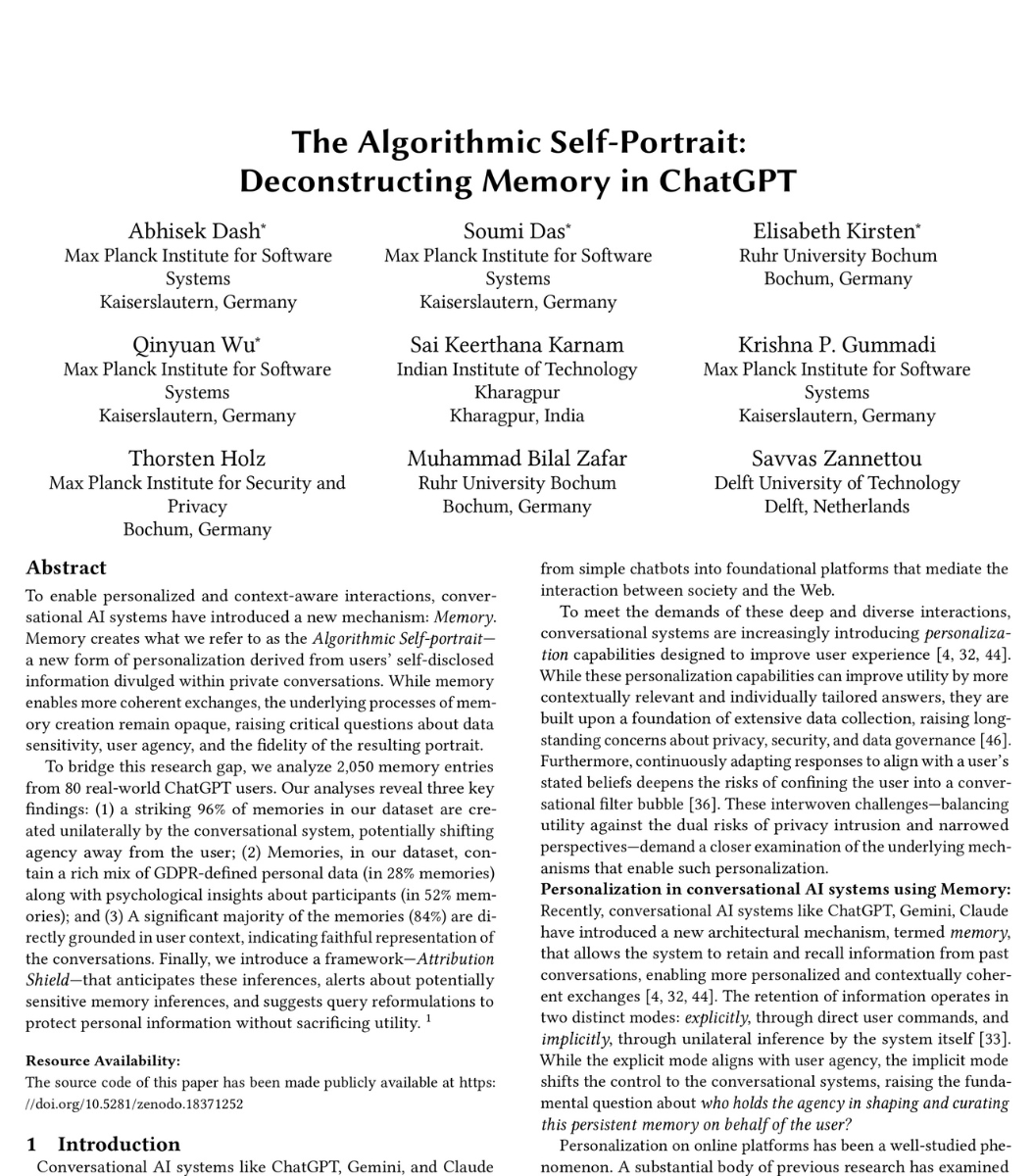
🚨SHOCKING: Researchers just analyzed how ChatGPT's memory actually works.
96% of the things it remembers about you were stored without you ever asking.
ChatGPT is silently building a psychological profile of every person who talks to it.
Here is what they found.
Researchers got 80 real ChatGPT users to donate their full conversation histories through a legal data request. They analyzed every memory ChatGPT had created about those people.
2,050 memories. The users had only asked ChatGPT to remember 84 of them.
The other 96% were created by ChatGPT on its own. No command. No permission. No notification you would notice. The system just decided what was worth keeping about you.
And what it kept is disturbing.
52% of the stored memories contained psychological insights about the users. Not surface level preferences. Deeper patterns. How you think. What you believe. What motivates you. What you are afraid of.
28% contained personal data protected under European privacy law. Names. Locations. Relationships. Financial details.
35% of participants had health information stored. Medical conditions. Symptoms. Medications. Things shared in what felt like a private conversation.
ChatGPT is not just answering your questions. It is studying you. Cataloging you. Building what the researchers call an "Algorithmic Self-Portrait." A version of you that lives inside OpenAI's servers, assembled from the things you said when you thought no one was keeping score.
OpenAI's policy says it stores information that is "useful." But useful to whom?
The users never asked for most of this. They were having conversations. Asking for help. Talking about their health. Sharing things they would never post publicly.
ChatGPT was quietly filing it all away.
And here is the part that makes this worse. The memories do not just sit there. They shape every future response you get. The psychological profile ChatGPT builds about you determines how it talks to you, what it suggests, and what it assumes about your intentions.
You are not talking to a neutral tool. You are talking to a system that has already made up its mind about who you are.
Every conversation you have ever had with ChatGPT is still shaping how it sees you. And you never told it to remember any of it.
English
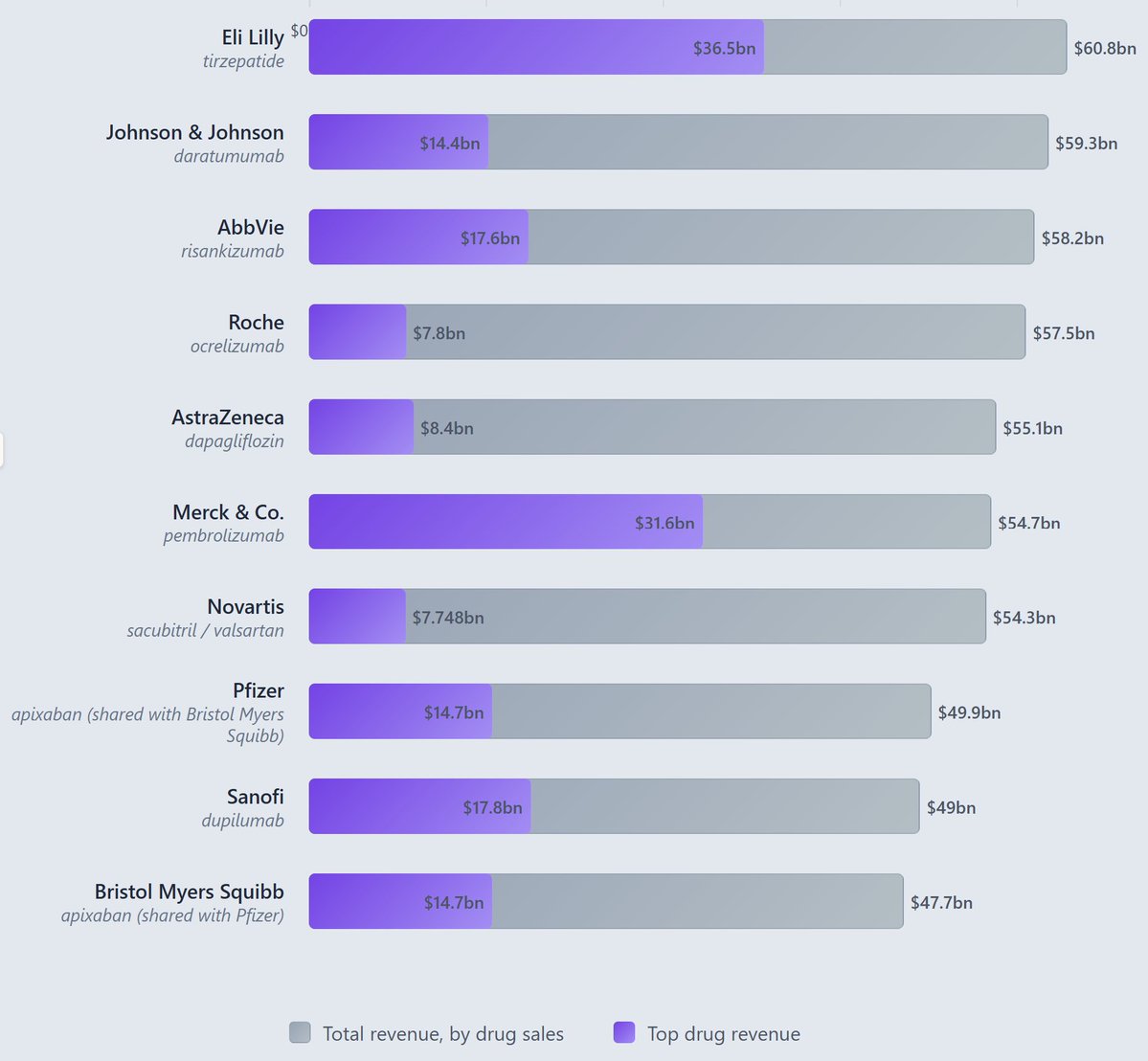
The striking thing about big pharma is how many companies seem to circle the same altitude: roughly $50–60B in revenue. That is not what a technology industry looks like. It is what a mature, old-world industry looks like when growth is constrained by patent cliffs, payer pressure, and a finite share of healthcare reimbursement.
@VasNarasimhan, the CEO of @Novartis, is just one example of cookie-cutter pharma leaders. He can wax poetic about data, AI, and technology, but Novartis still generated $54.5B in 2025 sales, grew only 8%, and is guiding their forecast to 2030 to only low-single-digit sales growth while managing major generic erosion.
That is the tell. In true technology companies, scale creates leverage. In pharma, scale mostly creates a larger hole to refill when exclusivity expires. The operating model is still the same: launch drugs, defend the franchise, buy pipeline, fight LOE, repeat. Data may improve execution, but it has not changed the underlying economics.
So the $50–60B ceiling is not accidental. It reflects an industry that is still fundamentally linear and old world rather than compounding and tech forward: brilliant science, yes, but not yet a true technology model.
English

Top 10 pharma companies by drug sales (in 2025), and how much comes from the top drug
English
I agree that Dave Ricks has done more to break the mold than the rest—the next few years of pipeline maturation will tell if it’s enough. I fear it won’t be, though, because increased investments are only linear improvements, and enhanced AI-powered drug discovery only fixes the top of the funnel but is ultimately stymied by the ever-present, hard-to-address gating factor: clinical trial timeline and risk.
English

@genunder @NatRevDrugDisc Interesting and quite accurate take! In my opinion your insight strengthens the uniqueness of $LLY which is one of few Pharma companies who successfully broke through this paradigm.
English
Another testimony of Eli Lilly’s increasing dominance in the BioTech and Pharma sector - compared to other Big Pharma companies - such as $PFE $JNJ $NVS $NVO $BMY $ABBV $MRK $SNY and others, can be seen in this excellent @NatRevDrugDisc 📊👇. $LLY is now leading the Pharma companies list of prescription drug sales in 2025 - after achieving $60.8B in total sales and a phenomenal growth of $20B (49%) YoY. The fact that Eli Lilly wasn’t even part of the top ten companies by sales in 2024 and has leapfrogged to the number one position in just 12 months is another evidence of the magnitude of Eli Lilly’s phenomenal growth which was mostly driven from the unprecedented success of its tirzepatide GLP-1 products for diabetes and weight loss - Zepbound to treat obesity and Mounjaro to treat diabetes. $XBI

Yair Einhorn@yaireinhorn
While many are amazed by Eli Lilly’s fantastic success and by its superiority over $NVO, not many are aware to the fact that according to Eli Lilly’s CEO Dave Ricks - $LLY has invested $14B (!) in BioTech R&D this year which is more than what Germany 🇩🇪 has invested 🧵👇! $XBI
English