
Nicholas Nezis

3.5K posts

Nicholas Nezis banner
Nicholas Nezis

Nicholas Nezis

@grkg8tr

Apache Heron Podling Project Management Committee member

Baltimore, MD Katılım Aralık 2008
1.8K Takip Edilen387 Takipçiler
Nicholas Nezis retweetledi

Andrej Karpathy
Andrej Karpathy@karpathy·
LLM Knowledge Bases Something I'm finding very useful recently: using LLMs to build personal knowledge bases for various topics of research interest. In this way, a large fraction of my recent token throughput is going less into manipulating code, and more into manipulating knowledge (stored as markdown and images). The latest LLMs are quite good at it. So: Data ingest: I index source documents (articles, papers, repos, datasets, images, etc.) into a raw/ directory, then I use an LLM to incrementally "compile" a wiki, which is just a collection of .md files in a directory structure. The wiki includes summaries of all the data in raw/, backlinks, and then it categorizes data into concepts, writes articles for them, and links them all. To convert web articles into .md files I like to use the Obsidian Web Clipper extension, and then I also use a hotkey to download all the related images to local so that my LLM can easily reference them. IDE: I use Obsidian as the IDE "frontend" where I can view the raw data, the the compiled wiki, and the derived visualizations. Important to note that the LLM writes and maintains all of the data of the wiki, I rarely touch it directly. I've played with a few Obsidian plugins to render and view data in other ways (e.g. Marp for slides). Q&A: Where things get interesting is that once your wiki is big enough (e.g. mine on some recent research is ~100 articles and ~400K words), you can ask your LLM agent all kinds of complex questions against the wiki, and it will go off, research the answers, etc. I thought I had to reach for fancy RAG, but the LLM has been pretty good about auto-maintaining index files and brief summaries of all the documents and it reads all the important related data fairly easily at this ~small scale. Output: Instead of getting answers in text/terminal, I like to have it render markdown files for me, or slide shows (Marp format), or matplotlib images, all of which I then view again in Obsidian. You can imagine many other visual output formats depending on the query. Often, I end up "filing" the outputs back into the wiki to enhance it for further queries. So my own explorations and queries always "add up" in the knowledge base. Linting: I've run some LLM "health checks" over the wiki to e.g. find inconsistent data, impute missing data (with web searchers), find interesting connections for new article candidates, etc., to incrementally clean up the wiki and enhance its overall data integrity. The LLMs are quite good at suggesting further questions to ask and look into. Extra tools: I find myself developing additional tools to process the data, e.g. I vibe coded a small and naive search engine over the wiki, which I both use directly (in a web ui), but more often I want to hand it off to an LLM via CLI as a tool for larger queries. Further explorations: As the repo grows, the natural desire is to also think about synthetic data generation + finetuning to have your LLM "know" the data in its weights instead of just context windows. TLDR: raw data from a given number of sources is collected, then compiled by an LLM into a .md wiki, then operated on by various CLIs by the LLM to do Q&A and to incrementally enhance the wiki, and all of it viewable in Obsidian. You rarely ever write or edit the wiki manually, it's the domain of the LLM. I think there is room here for an incredible new product instead of a hacky collection of scripts.
English
2.7K
6.5K
54.8K
19.2M
Nicholas Nezis retweetledi
Muhammad Ayan
Muhammad Ayan@socialwithaayan·
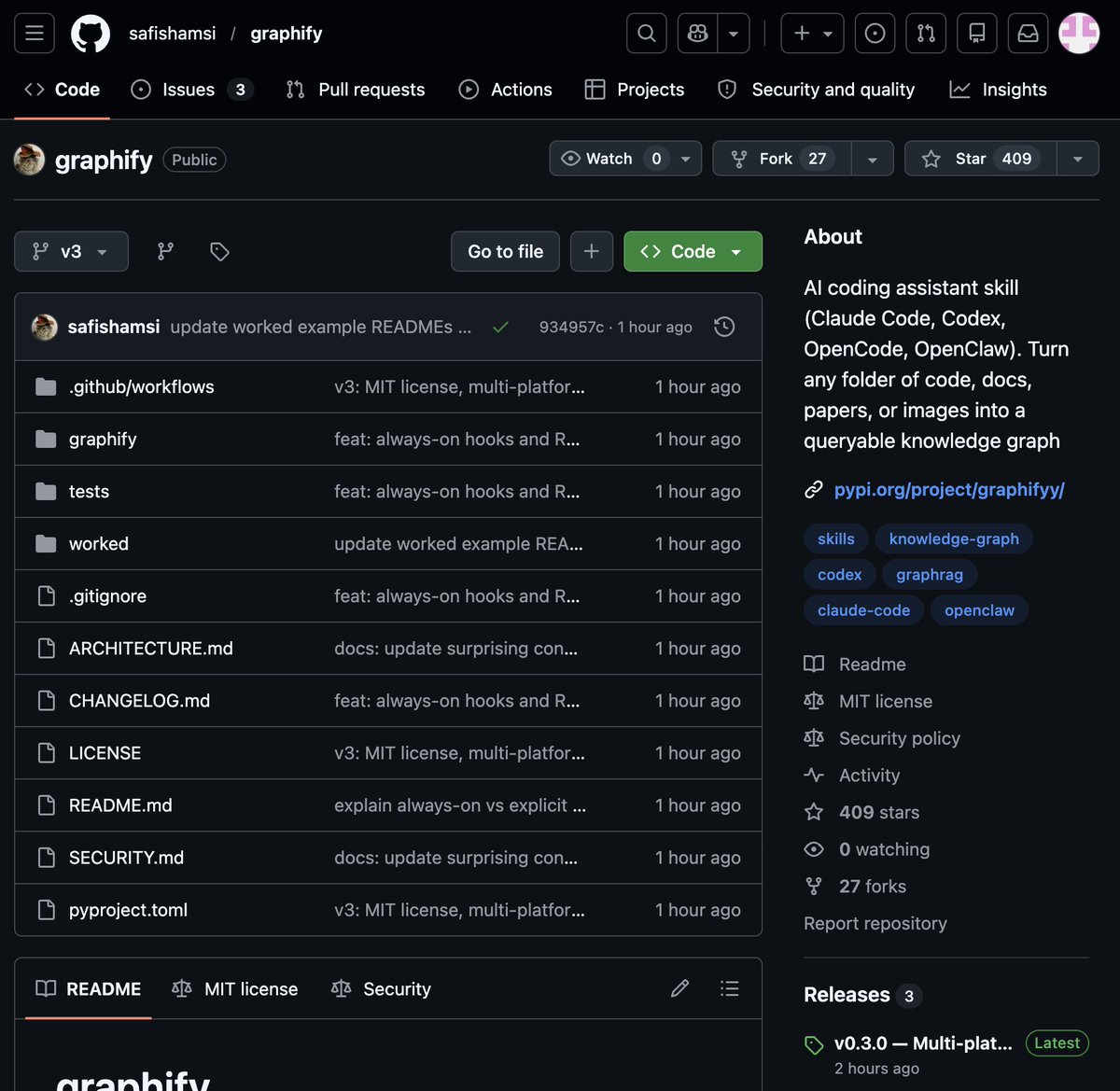
🚨 BREAKING: Someone just built the exact tool Andrej Karpathy said someone should build. 48 hours after Karpathy posted his LLM Knowledge Bases workflow, this showed up on GitHub. It's called Graphify. One command. Any folder. Full knowledge graph. Point it at any folder. Run /graphify inside Claude Code. Walk away. Here is what comes out the other side: -> A navigable knowledge graph of everything in that folder -> An Obsidian vault with backlinked articles -> A wiki that starts at index. md and maps every concept cluster -> Plain English Q&A over your entire codebase or research folder You can ask it things like: "What calls this function?" "What connects these two concepts?" "What are the most important nodes in this project?" No vector database. No setup. No config files. The token efficiency number is what got me: 71.5x fewer tokens per query compared to reading raw files. That is not a small improvement. That is a completely different paradigm for how AI agents reason over large codebases. What it supports: -> Code in 13 programming languages -> PDFs -> Images via Claude Vision -> Markdown files Install in one line: pip install graphify && graphify install Then type /graphify in Claude Code and point it at anything. Karpathy asked. Someone delivered in 48 hours. That is the pace of 2026. Open Source. Free.
Muhammad Ayan tweet media
English
265
1.4K
12.6K
908.2K
Nicholas Nezis retweetledi
Josh Kale
Josh Kale@JoshKale·
This is big... Anthropic just announced a model so powerful they won't release it to the public out of fear over the damage it will cause 😨 Claude Mythos Preview found thousands of zero-day exploits in every major operating system and web browser... The numbers are hard to believe: > $50 to find a 27-year-old bug in OpenBSD, one of the most security-hardened operating systems ever built > Under $1,000 to find AND build a fully working remote code execution exploit on FreeBSD that grants unauthenticated root access from anywhere on the internet > Under $2,000 to chain together multiple Linux kernel vulnerabilities into a complete privilege escalation exploit For context: these are the kinds of findings that previously required elite security researchers working for weeks. Anthropic engineers with no formal security training asked Mythos to find exploits overnight. They woke up to working code the next morning. The results were so impressive Anthropic assembled Apple, Google, Microsoft, Amazon, NVIDIA, and seven other organizations into Project Glasswing: A $100M defensive coalition. They're not releasing this model publicly. Instead, they're racing to patch the world's infrastructure before models like this proliferate.
Anthropic@AnthropicAI

Introducing Project Glasswing: an urgent initiative to help secure the world’s most critical software. It’s powered by our newest frontier model, Claude Mythos Preview, which can find software vulnerabilities better than all but the most skilled humans. anthropic.com/glasswing

English
691
2.4K
17.9K
3.9M
Nicholas Nezis retweetledi
Kyle Saunders
Kyle Saunders@profgoose·
Well, I did a thing. I hope it's useful. I mapped every four-year college in the U.S. higher education along two dimensions — institutional resilience & post-college market position — using eight indicators from federal data along with a new measure of institutional AI exposure.
English
45
120
1.3K
529.7K
Nicholas Nezis retweetledi
Dean W. Ball
Dean W. Ball@deanwball·
It is so cool that you can have an ambitious research idea in ~any field and basically build yourself a suite of custom software tools exclusively for conducting that research within a few hours. No broader point to make. It’s just an amazing and exhilarating fact about reality.
English
17
50
667
31.6K
Nicholas Nezis retweetledi
Being Libertarian
Being Libertarian@beinlibertarian·
How libertarians see election cycles
English
482
3.1K
25.6K
778.8K
Nicholas Nezis retweetledi
Bo Wang
Bo Wang@BoWang87·
Prof. Donald Knuth opened his new paper with "Shock! Shock!" Claude Opus 4.6 had just solved an open problem he'd been working on for weeks — a graph decomposition conjecture from The Art of Computer Programming. He named the paper "Claude's Cycles." 31 explorations. ~1 hour. Knuth read the output, wrote the formal proof, and closed with: "It seems I'll have to revise my opinions about generative AI one of these days." The man who wrote the bible of computer science just said that. In a paper named after an AI. Paper: cs.stanford.edu/~knuth/papers/…
Bo Wang tweet media
English
155
1.9K
9.1K
1.4M
matebenyovszky
matebenyovszky@matebenyovszky·
@ns123abc @sama Love Anthropic and pretty agree with them however "analysis of bulk data" seems pretty important anyways in the data and AI age, this should have been defined more precisely imho
English
1
0
1
1.1K
NIK
NIK@ns123abc·
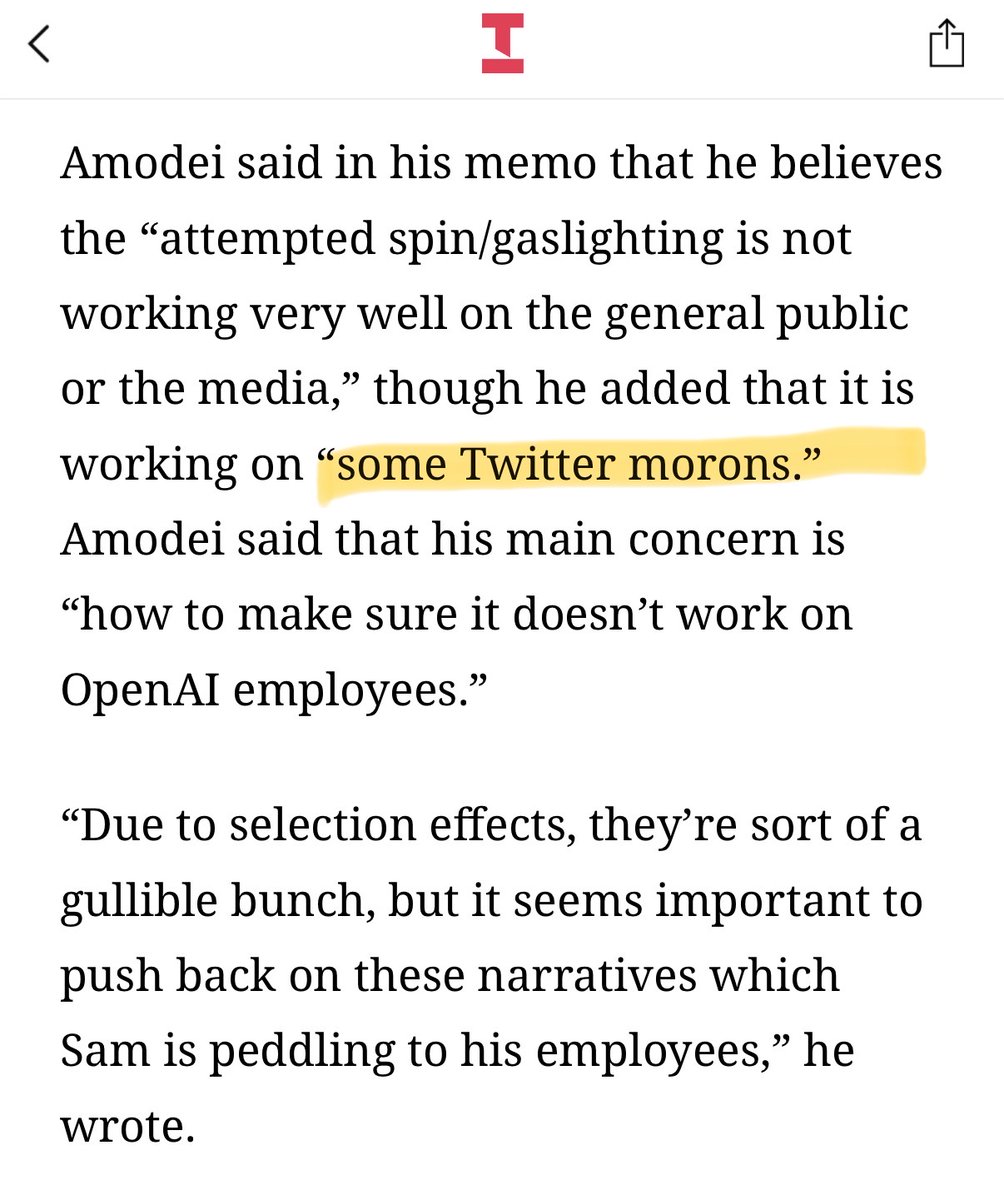
🚨BREAKING: ANTHROPIC CEO JUST ENDED OPENAI @sama After getting blacklisted by Pentagon, Dario sits down and writes the most unhinged CEO memo in silicon valley history: >calls openai's pentagon deal "safety theater" >says trump admin hates them because they haven't "given dictator-style praise to Trump (while Sam has)" >names greg brockman's $25M trump super PAC donation by name says they supported AI regulation >"which is against their agenda" >says they "told the truth about AI policy issues like job displacement" THE PALANTIR EXPOSÉ: >reveals palantir's actual pitch to anthropic during negotiations >"you have some unhappy employees, you need to offer them something that placates them or makes what is happening invisible to them, and that's the service we provide" >palantir's pitch wasn't safety. it was CONCEALMENT >palantir offered a "classifier" to detect red line violations >dario: models get jailbroken, monitoring only works in a few cases "maybe 20% real and 80% safety theater" >says palantir offered openai the same package >openai accepted it >says Altman is "peddling narratives" to his own employees >calls openai employees "sort of a gullible bunch" due to "selection effects" >says the "attempted spin/gaslighting" isn't working on >the public or media but IS working on "some Twitter morons" rofl >says his main concern is making sure it doesn't work on openai employees too BTW near the end of negotiations the pentagon offered to accept ALL of anthropic's terms if they deleted ONE phrase: >"analysis of bulk acquired data" >anthropic refused >same surveillance clause pentagon said they didn't even want to do >meanwhile Altman told his employees: "you don't get to weigh in on that" 💀 ITS OVER. ANTHROPIC WON, DEAL WITH IT
NIK tweet mediaNIK tweet media
English
382
1.1K
10.3K
1.1M
Nicholas Nezis retweetledi
ₕₐₘₚₜₒₙ
ₕₐₘₚₜₒₙ@hamptonism·
no one is talking about this…
ₕₐₘₚₜₒₙ tweet media
English
398
475
6.3K
1M
Nicholas Nezis retweetledi
Charlotte Lee
Charlotte Lee@cljack·
I'm trying to train Claude to read the weekly emails from my kids school and reliably summarize them and print a list of action items. It is losing its damn mind and rapidly spiraling into madness. I feel vindicated
English
140
287
8K
402.1K
Nicholas Nezis retweetledi
Chris
Chris@chatgpt21·
Anthropic had 16 AI agents build a C compiler from scratch. 100k lines, compiles the Linux kernel, $20k, 2 weeks. To put that in perspective GCC took thousands of engineers over 37 years to build. (Granted from 1987 - however) One researcher and 16 AI agents just built a compiler that passes 99% of GCC's own torture test suite, compiles FFmpeg, Redis, PostgreSQL, QEMU and runs Doom. They say they "(mostly) walked away." But that "mostly" is doing heavy lifting. No human wrote code but the researcher constantly redesigned tests, built CI pipelines when agents broke each other's work, and created workarounds when all 16 agents got stuck on the same bug. The human role didn't disappear. It shifted from writing code to engineering the environment that lets AI write code. I don’t know how you could make the point AI is hitting a wall.
English
735
829
7.4K
1.7M
Nicholas Nezis
Nicholas Nezis@grkg8tr·
@taylorjlyons Thank you! Any way to see a digital version of the print edition online like the Baltimore Sun provides? I might have to run out to find a copy. Eager to see if my daughter won it this week. 😆
English
0
0
0
55
Taylor Lyons
Taylor Lyons@taylorjlyons·
@grkg8tr Voting results were published in the print edition of The Aegis today, and it'll be online in the next player of the week story (likely 2/9 with no games this week)
English
1
0
1
18
Nicholas Nezis
Nicholas Nezis@grkg8tr·
@taylorjlyons When and where do the results of the Harford athlete of the week get posted? The original article mentioned Friday, but I couldn't find any other details.
English
1
0
0
60
Nicholas Nezis
Nicholas Nezis@grkg8tr·
@fb_engineering Instagram question: Why does HLG HDR recorded on my Pixel 9 Pro looks good when uploaded, but HLG made on my mac and uploaded on my Pixel doesn't? I've edited metadata tags to spoof it, but the preview colors are still off. Same file uploaded from iPhone is fine.
English
0
0
0
34
Nicholas Nezis
Nicholas Nezis@grkg8tr·
@instagrameng Could someone help me understand why HLG HDR recorded on my Pixel 9 Pro looks good when uploaded, but HLG from my mac (Davinci Resolve) doesn't? I've edited metadata tags to spoof it, but the preview colors are still off. Same file uploaded from iPhone is fine.
English
0
0
0
37
Nicholas Nezis retweetledi
Luis Yáñez
Luis Yáñez@is_lu_is·
@emollick The 90% prediction sounds scary until you realize what it actually means: less typing, same thinking. The hard part of coding was never the syntax. It was knowing what to build and why. That part is still 100% human.
English
2
2
69
3.5K
Nicholas Nezis
Nicholas Nezis@grkg8tr·
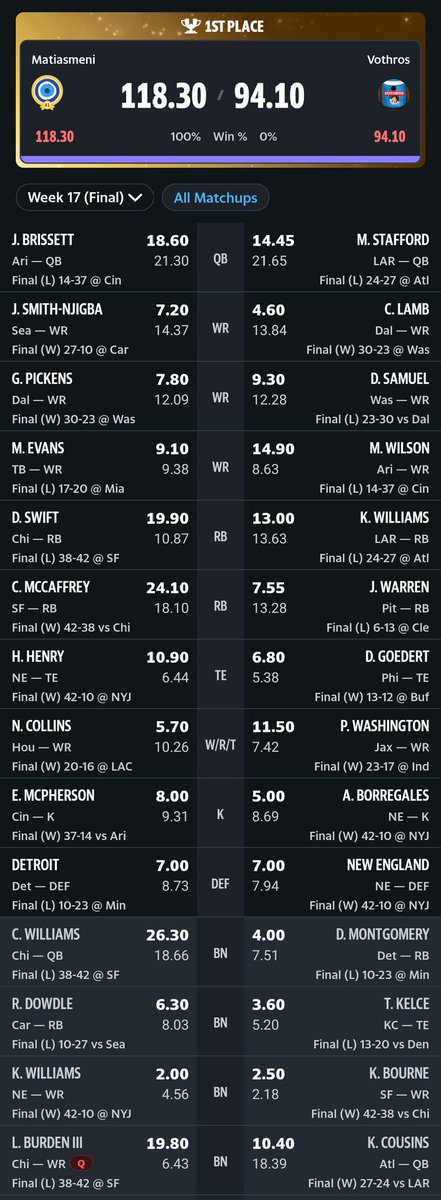
@mikeMaher I'm right there with you. But I keep 2nd guessing myself with starting Caleb Williams over him.
English
0
0
1
102
Mike Maher
Mike Maher@mikeMaher·
Welp, here we are. Starting Jacoby Brissett in the championship for a team that went 14-1 this season. Trust the process.
Mike Maher tweet media
English
2
0
9
3.1K