Santafhessiano
3.1K posts

Santafhessiano
@gxonon
Prof. de matemática UNL - FHUC. Docente UNL - Fac. de Ciencias Económicas.
Katılım Kasım 2011
209 Takip Edilen133 Takipçiler


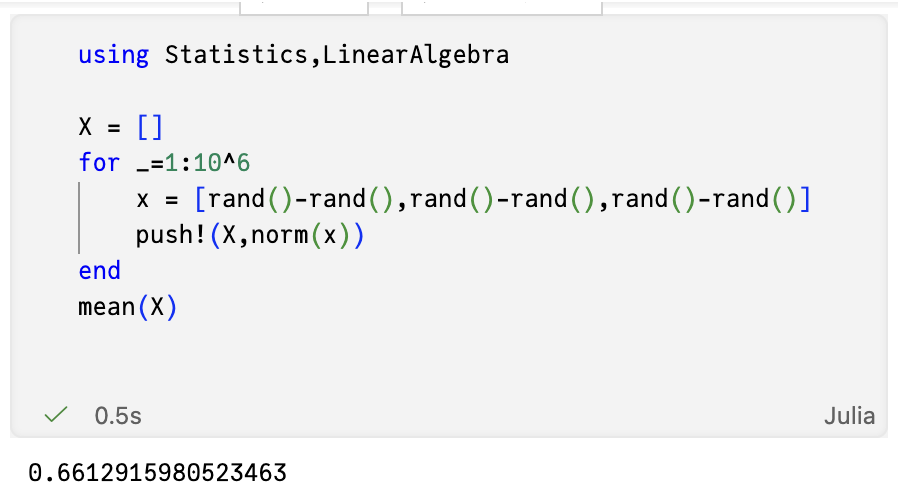
とりあえず,100万回作って平均を求めてみました。
いい感じです。
#JuliaLang
using Statistics,LinearAlgebra
X = []
for _=1:10^6
x = [rand()-rand(),rand()-rand(),rand()-rand()]
push!(X,norm(x))
end
mean(X)
うどん@udon_math_yade
単位立方体の内部からランダムに2点を選んだときの距離の期待値、こんな複雑になるのか...
日本語

@annttoo__ Lo que odio overleaf desde que bajaron el tiempo de compilación gratis, ahora todo en vscode
Español

el overleaf cuando se te olvida poner un }
alba🏹@albaisnotcool
1 mes para entregar el tfg y mi ordenador gastándome pequeñas bromitas😁
Español

Sobre el autor del video:
Teo López Puccio es un matemático, pianista, actor y docente argentino de 27 años, reconocido por divulgar matemáticas en redes sociales (Instagram/TikTok) con un enfoque artístico y creativo. Hijo de Carlos López Puccio de Les Luthiers, combina la docencia en universidades como UdeSA/Di Tella con la producción teatral y musical.
Español
🧮 CALCULADORA
Nunca vi a nadie explicar mejor algo referido a números, es impresionante cómo te atrapa el flaco
Español
@kohantoys En los comentarios están confundiendo:
• ceil(x): menor entero mayor igual que x, con
• ceiling(x, y): menor numero (no necesariamente entero) mayor o igual que x, múltiplo de y.
ceil(x) = ceiling(x, 1)
ceil(-2.3) = -2
ceiling(2, 1.5) = 3
Español

Hoy aprendí la función CEILING del excel, que es medio difícil de explicar pero fácil de entender:
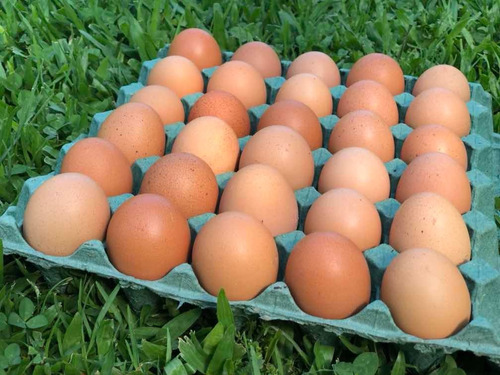
Digamos que necesito 14 huevos, pero las cajas vienen de a 12. CEILING te calcula cuantos huevos (o cajas) deberías comprar para lo que necesitas.
Síganme para mas tips de idiotas que usan excel por primera vez.
Español

🚨 BREAKING NEWS 🚨
Trump signs executive order to FORCE all biologists to STOP USING R STUDIO effective IMMEDIATELY.


English


@agarra_pala Supongo que como es un servicio esencial los sueldos van a ser acorde a su importancia... verdad?
Español

EDUCACIÓN ESENCIAL POR LEY EN LA ARGENTINA!
NO CIERRAN ESCUELAS NUNCA MÁS!

Español
@JitePastafrola Me llama mas la atención que use un símbolo del esperanto, cuando el creador de este también era oftalmólogo (polaco).

Español
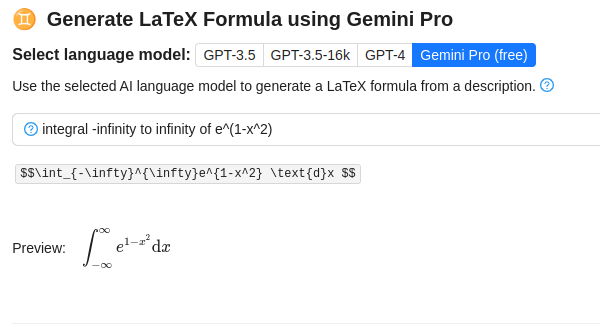
@cocalc_com Proper LaTeX?
1) $$...$$ is STRONGLY DISCOURAGED in LaTeX because it does not handle preceding and following spacing correctly. Instead, use \[ ... \] or, even better, the equation environment.
2) \text{d}x? I want to die.
English

AI-powered formula assistant
Have you ever struggled typesetting a LaTeX formula in a tex file or markdown document? We can help you!
Describe the formula however you like and an LLM of your choice will attempt to turn this into proper LaTeX 🙂
cocalc.com/news/ai-powere…
English
@chiefcebo_ @Francismatt04 @Coinvo OpenOffice está obsoleto y sin actualizaciones importanes desde hace más de una década. LibreOffice es una alternativa superior.
Español





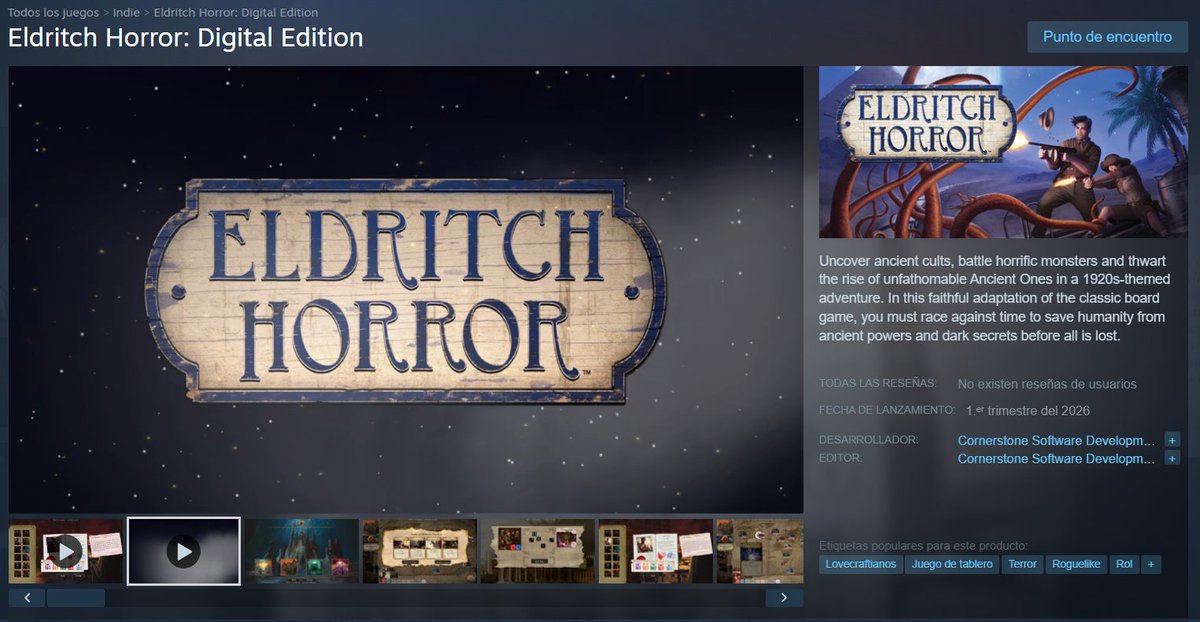
@tristanoberon Habrá que ver qué ofrece por sobre la versión de Tabletop Simulator :P
Español

¿Sabíais que Eldritch Horror estará en Steam a principios del año que viene? #EldritchHorror
Español


@wsosaescudero Hola Walter! Aprovecho el día lluvioso y te hago una consulta(?).
Se habla del lenguaje Julia entre colegas economistas o estadísticos? Alguna opinión?
Español

Dia lluvioso, de ocuparse de la noble tarea de enviar cartas de recomendacion para los alumnos (5 millones, en mi caso)
Español
@justinskycak 1/n > 0 for all n in N, but lim_{n to infty} 1/n = 0.
English

The whole "how is 0.999999... equal to 1, it's obviously less" thing comes up from time to time on here.
The crux of the confusion is usually that they're thinking "every item of the sequence {0.9, 0.99, 0.999, ...} is less than 1, so the limit of the sequence must also be less than 1."
Which happens to be false -- just because every term in a sequence has property X, does NOT imply the limit has property X. Here, the limit is not a term of the sequence, so it does not automatically inherit properties of the terms of the sequence.
This may feel a bit counterintuitive but it's true and it's an idea that comes up over and over in higher math.
If you go far enough down the rabbit hole on this you get to some really weird results, e.g., if you add together a series of continuous functions (nothing crazy, just sines & cosines), and take the limit, the limit can end up being a DIScontinuous function.
That came as a shock to many mathematicians about 200 years ago, but it's true, and it helped spur a movement in the 19th-century mathematical community to reformulate previous findings in more rigorous fashion, which is taught today as Real Analysis.
To quote the book "How We Got From There to Here: A Story of Real Analysis" by Eugene Boman and Robert Rogers:
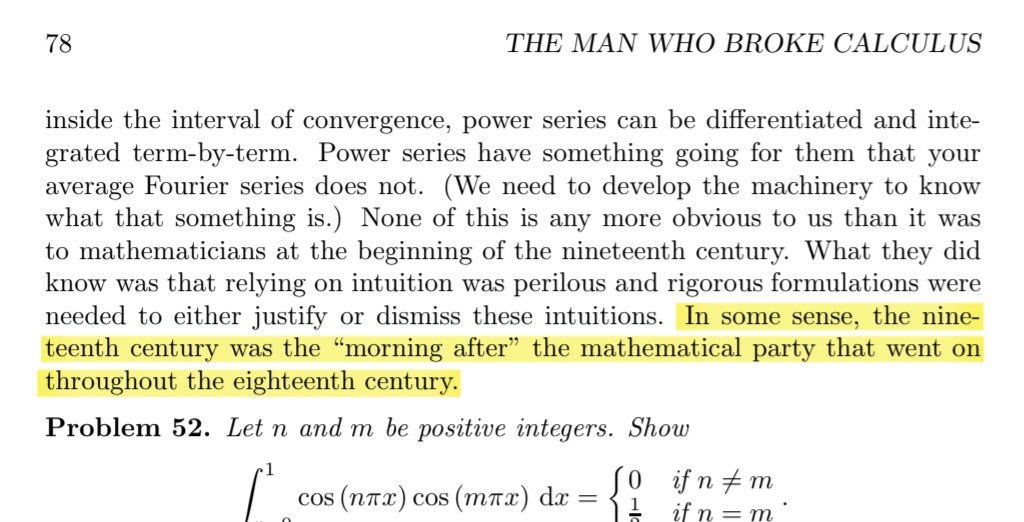
"In some sense, the nineteenth century was the 'morning after' the mathematical party that went on throughout the eighteenth century."
Anthony Bonato@Anthony_Bonato
A student said that 0.999999999999999... is obviously less than 1 since he can only write out finitely many 9's in his lifetime, and I'm dead
English
@wsosaescudero Usar Rcpp? No sé si correrá online. Se podría probar.
Español
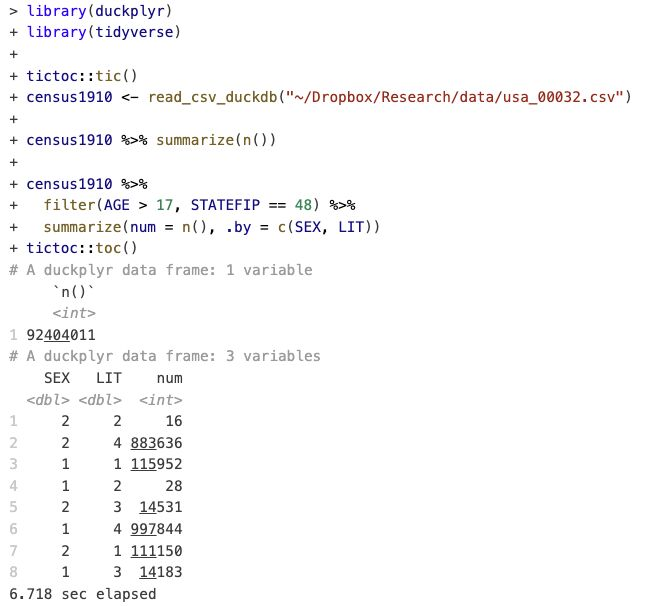
Nerds de este antro: me cuentan cual es una alternativa razonable (barata) de correr una bestia de experimento de montecarlo en R ONLINE (si o si)? Gracias por la magia.
Español
Cuando se enteren que las hamburguesas están hechas con carne picada...
lavanya anasera@lavanyaanasra
I will never see mayonnaise the same
Español