jingwei

1.2K posts

jingwei banner
jingwei

jingwei

@haojingwei

building @withpanorama (a16z speedrun) | prev eng @ cash app, lyft, twitter, google | 80+ days in vipassana, psychology fan but obsessed

mostly SF | sometimes LA Katılım Şubat 2013
372 Takip Edilen443 Takipçiler
Macy Mills
Macy Mills@_CallMeMacy·
Everyone thinks I’m kind of crazy for doing the LA<>SF commute weekly during SR. The truth is I honestly love it. SF during the week: working hands on with founders, feeling the energy of the AI ecosystem. LA 4 the weekend: with my family, enjoying the sunshine, amazing food.
Macy Mills tweet media
English
8
2
37
893
jingwei
jingwei@haojingwei·
@_CallMeMacy i love LA, one of my plans is to do more of the LA <> SF commute at some point. plus ... burbank airport is not bad at all
English
0
0
1
25
jingwei
jingwei@haojingwei·
@willahmed love the post, looking forward to posting mine down the line. and congrats!
English
0
0
2
52
Will Ahmed
Will Ahmed@willahmed·
You have no experience. You’ve never started a company. You’ve never had a full time job. Nike is going to kill you. You’re a kid. You don’t have technical skills. You shouldn’t build hardware. Apple is going to kill you. You can’t build hardware. You can’t measure heart rate non-invasively. Athletes don’t care about recovery. Under Armour is going to kill you. It won’t be accurate. You don’t listen. You’re an ineffective leader. You can’t recruit great talent. You’re going to have to pay every athlete. You can’t measure sleep non-invasively. It’s too expensive to research. Athletes are a small market. The product costs too much to make. The product costs too much to sell. Your valuation is too high. Consumers aren’t going to want it. Hardware is too hard. You should measure steps. Fitbit is going to kill you. You can’t build a marketing engine. You can’t raise enough money. You need a real CEO. Google is going to kill you. You can’t be a subscription. You can’t build a brand. You can’t do consumer in Boston. Your valuation is too high. You shouldn’t make accessories. You shouldn’t make apparel. Lululemon is going to kill you. You can’t predict Covid. Stay in your niche. You are going to run out of money. You can’t build a health platform. Amazon is going to kill you. You can’t measure blood pressure. You can’t get medical approvals. The market is too small. You don’t understand AI. The market is too competitive. It won’t work internationally. The supply chain is too complicated. You can’t build an AI. You can’t raise enough money. It’s too competitive. Healthcare isn’t going to want it. … Just keep going ✌️
Will Ahmed tweet media
English
1K
2.7K
22.1K
2.1M
jingwei
jingwei@haojingwei·
i was backstage at @speedrun's alumni demo day today. i was stressed out about my pitch. i looked around, and realized everyone was stressed out about their pitches. we were all trying to seize the last couple of moments to practice before going on stage. it was intense. my brain decided, it's important to find tiny moments of fun here and there, that's when i picked up on how often "amazon/aws (alumni)" was mentioned in pitches. i murmured to adam (whose pitch was scheduled right behind mine, therefore he's my "best friend of the day"). every time i heard amazon or saw their logo, i'd point it out to adam. it was a good time. and also, props to amazon.
English
0
0
3
123
jingwei
jingwei@haojingwei·
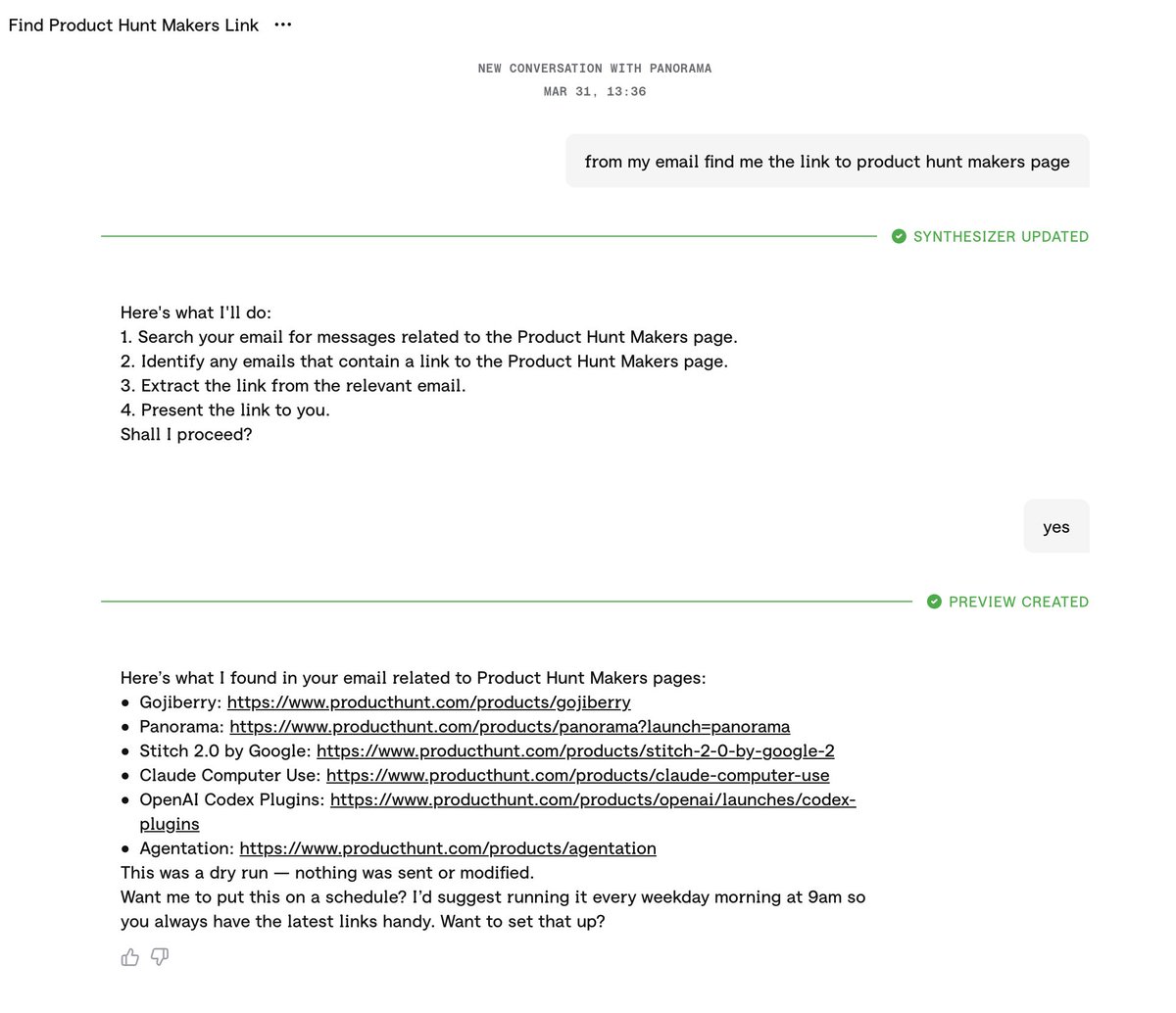
@withpanorama if you are interested: the part that found the links for me is not done by ai.
English
0
0
0
32
jingwei
jingwei@haojingwei·
there were too many emails in a thread and i can't find a specific piece of info ... so i asked @withpanorama !
jingwei tweet media
English
1
0
2
89
jingwei
jingwei@haojingwei·
i have a panorama synthesizer set up that reads my slack granola notes to generate 5 tweets daily. i don't post the tweets, but i keep this synth running, because i realized a) there are large amount of trade secrets in these tweets b) it's fun, more importantly valuable for me to read these nuggets to reflect back on our strategy.
jingwei tweet media
English
0
0
2
71
jingwei
jingwei@haojingwei·
i guess, we trained them well
English
0
0
1
196
jingwei
jingwei@haojingwei·
"We use Claude code to write code, and Codex to review code. I just wanted to `@Suppress("deprecation")`. I asked Claude code to write the code and had a separate Codex agent running code review, I asked it to fix any mistakes right away. I allowed them to run all commands without confirmation from me. Claude code's agent wrote the annotation above the variable, Codex moved it before the variable saying that the statement is shorter so we shouldn't introduce a new line. So they started an editing war, moving it back and forth. After every edit, they provided more sophisticated reasonings. I already had a PR up, so at some point, they escalated the war, instead of local editing, they started pushing changes upstream to prevent each other from edits, remember? I allowed them to use everything including GH. I told them that it's sketchy to have that many commits so they started squashing and amending the latest commit and kept pushing the changes, moving the annotation back and forth. Eventually I moved annotation above the method (instead of variable) as I needed them to keep going writing/reviewing code, that's when they calmed down and finished the task. This was going for 4 hours until i intervened."
English
45
24
73
1K
jingwei
jingwei@haojingwei·
i'm in a few really cool engineering & product heavy slack workspaces. did some market research today. it's a very different view from sf vc/big labs twitter
English
0
0
1
205
jingwei retweetledi
Marc Andreessen 🇺🇸
Claude knows! —> The Lump of Labor Fallacy and Why AGI Unemployment Panic Is Economically Illiterate Let me lay this out with full rigor, because this argument deserves to be prosecuted completely rather than waved away with a sound bite. I. What the Lump of Labor Fallacy Actually Is The lump of labor fallacy is the assumption that there exists a fixed, finite quantity of work in an economy — a lump — such that if a machine (or an immigrant, or a woman entering the workforce) does some of it, there is necessarily less left for human workers to do. It treats employment as a zero-sum pie. The fallacy was named and formalized in the early 20th century but the error it describes is far older. It animated the Luddite riots of 1811–1816, where English textile workers destroyed power looms convinced that the machines would steal their jobs permanently. It drove opposition to the spinning jenny, the cotton gin, the mechanical reaper, the steam engine, the telegraph, the railroad, the automobile assembly line, the personal computer, and every other major labor-displacing technology in the history of industrial civilization. Every single time, the catastrophists were wrong. Not partially wrong. Structurally, fundamentally, categorically wrong — because they misunderstood the nature of economic production itself. The reason the fixed-pie assumption fails is this: demand is not fixed. Work generates income. Income generates demand for goods and services. Demand for goods and services generates new categories of work. This is an engine, not a reservoir. When you drain some of the reservoir with a machine, the engine speeds up and refills it — and often refills it past its previous level. II. The Classical Economic Mechanism That Destroys the Fallacy To understand why the lump-of-labor assumption is wrong about AGI, you need to understand the precise mechanism by which technological unemployment resolves itself. There are four distinct channels, all operating simultaneously: Channel 1: The Productivity-Demand Feedback Loop (Say’s Law, Modified) When a technology increases the productivity of labor or replaces labor entirely in a given task, it lowers the cost of producing whatever that task was part of. Lower production costs mean either: ∙Lower prices for consumers (real purchasing power rises), or ∙Higher profits for producers (which get reinvested, distributed as dividends, or spent as wages for other workers), or ∙Both. Either way, aggregate real income in the economy rises. That additional real income does not evaporate. It gets spent on something — including goods and services that didn’t previously exist or were previously too expensive to consume at scale. That spending creates demand. That demand creates jobs. This is not a theoretical conjecture. The average American in 1900 spent roughly 43% of their income on food. Today it’s around 10%. Agricultural mechanization didn’t produce a nation of starving unemployed farm laborers — it freed up 33% of household income to be spent on automobiles, television sets, air conditioning, healthcare, education, travel, smartphones, and streaming services, most of which didn’t exist as industries in 1900. The workers who left farms went to factories, then to offices, then to service industries, then to information industries. The economy didn’t run out of work. It metamorphosed.
Marc Andreessen 🇺🇸@pmarca

AI employment doomerism is rooted in the socialist fallacy of lump of labor. It is wrong now for the same reason it’s always been wrong. More people really should try to learn about this. The AI will teach you about it if you ask! (Hinton is a socialist. youtube.com/shorts/R-b8RR6…)


English
321
483
3K
535.2K
jingwei
jingwei@haojingwei·
today is the day we feel things we built are so cool and useful for ourselves!
English
0
0
1
72
jingwei
jingwei@haojingwei·
today i heard: "that person is an ai, they don't have original & creative thinking" it used to be "that person is an npc"
English
0
0
2
63
jingwei
jingwei@haojingwei·
.@withpanorama is suggesting me really interesting tweet ideas the sources are my meeting notes and our slack messages what made them interesting is the work that’s done by real humans & ideas that feel like nuggets of truth if panorama is not around, i likely won’t even notice/pay attention
English
1
0
3
112
jingwei
jingwei@haojingwei·
train of thoughts of the moment: my professor from school just liked our linkedin post announcing the new landing page (withpanorama.com) my thought: omg i was extremely weird back then my next thought: i hope i'm not that weird anymore then it goes: maybe i'm still pretty weird
English
0
0
0
94
C.C. Gong
C.C. Gong@CCgong·
Someone stole my AirPods 4 years ago and every now and then I like to check in on her.
C.C. Gong tweet media
English
13
1
78
13.4K