

Jeremiah
1.2K posts


once you have agents write reports with screenshots of what they did you can never go back

English


Introducing Aval - a new open source format for interactive video on the web. It has a built-in state machine, frame accurate transitions, and packed alpha transparency.
This is probably the craziest thing I’ve ever built with Codex.
I’d been dreaming about this technology for years. Before AI, building it would have taken months of work. I could never justify that investment for a noncommercial open source project. Then, a little over a year ago, Airbnb created Lava for almost exactly the same purpose. That gave me hope. But Lava was never released as open source.
So I decided to build my own, with AI.
Aval comes with a compiler and a web renderer. Together, they give you:
• a deterministic state graph - named states, authored triggers, and routing where the latest trigger wins.
• frame accurate routes with transitions that begin on authored content frames using portals, finishes, cuts, and reversals.
• small file size and low CPU overhead, perfect for small icons designed and animated in Blender.
• seekless loops so the decoder timeline keeps moving forward across loop seams instead of seeking.
• packed alpha transparency. transparent prerendered motion composited with WebGL2.
• a web native runtime: decoding with WebCodecs and rendering with WebGL2.
• progressive fallback: Host-owned fallback markup remains available for unsupported and reduced motion contexts.
Now it exists, it’s open source, and it’s available today as a technical preview.
I’ll be polishing it further over the next few days.
English
@andymac4182 @MaximeRivest Had the screen shatter on me all of a sudden. Apparently it's a known issue with Boox. If you get one, handle with EXTREME caution. It broke with the tablet held near the corner with my thumb.
English

@MaximeRivest Curious have you tried out the Boox version? It has a screen with a higher contrast I believe.
English

Wow, I really did not think a remarkable eink screen had so much potential. Colors, decent navigation speed, definitely tolerable to just 'transit' to your next deep read / focus.
In this demo I mirror my computer screen on it with Wi-Fi and custom software. This is nice-ish... It's pretty clear it would be better if the whole content was less animated and more pagination friendly.
English
Jeremiah retweetledi
my personal flow chart of what model to pick for a task has never been more complicated

English
@ericlu The same concept of temporal dithering and motion is exploited here: cloakscreen.tech
Meant to keep bots out, but with some clever frame blending, it's solvable. Nothing is foolproof
English

Jeremiah retweetledi

introducing prose - a calmer way to speak to codex
i've struggled to get comfortable with chatgpt for coding because the way it speaks is jittery, unstructured, forcing you to "search" for an answer in its weird mumblings.
claude is much better at this, but can definitely be far too verbose with its blocky 'chat-walls'
i've distilled the best parts of claude's writing style, and some extra additions into a 22-line markdown file, to make our agents speak more clearly.

English
@haipingfu Very comprehensive! Love it. Have you benefited any use out of it yet? I'm super curious to see how this pans out over long-form work across different sessions.
English

Introducing Trail!
AI coding agents create more than a final diff. They generate prompts, attempts, tool calls, partial patches, checkpoints, test runs, approvals, review notes, and handoffs. But when the work becomes a Git commit, most of that operational context disappears.
That’s the problem Trail is built to solve.
Trail is a local-first operation database for code and text worktrees. It gives coding agents branch-like memory, transcripts, checkpoints, and rewind—without polluting your active Git branch.
Trail does not replace Git. Git remains the publication and synchronization layer: commits, branches, remotes, and PRs. Trail handles the high-frequency local work between commits, preserving what happened, why it happened, and whether it is safe to accept.
This makes questions that are difficult to answer with Git alone directly queryable:
• Which operation introduced this line?
• What did an agent change before the final commit?
• What happened during the task?
• Is the work blocked by conflicts, pending approvals, a dirty workdir, or missing tests?
• Can we rewind to a known-good checkpoint?
The core abstraction is a lane: isolated, branch-backed code state plus the context needed to safely complete one task. A lane can record sessions, turns, messages, traces, patches, approvals, test/eval gates, checkpoints, handoffs, and merge readiness. It can stay virtual until a tool actually needs files, or use a materialized or sparse workdir.
Under the hood, Trail is written in Rust. A content-addressed graph of operations and worktree roots is the durable source of truth. SQLite powers indexes, lane state, and queues. Prolly maps store paths, files, text, and line order. Stable ChangeId, FileId, and LineId values support provenance and line-aware patching.
The same core powers the CLI, a loopback HTTP/OpenAPI interface, an MCP stdio server, and the Rust API. Workspace state remains local under .trail/, with ignore policies, guardrails, approvals, and readiness checks protecting mutations.
A basic workflow looks like this:
trail init --working-tree
trail lane spawn fix-login --from main --materialize=true
trail lane record fix-login -m "Fix login validation"
trail lane readiness fix-login
trail merge-lane fix-login --into main --dry-run
Then query the operational history:
trail why src/auth.rs:42
trail history src/auth.rs
trail transcript fix-login
The impact is simple: agent work becomes isolated, explainable, reviewable, recoverable, and safer to merge. Developers can run more agents in parallel without losing control of how the code was produced.
Git keeps the accepted history. Trail preserves the operational story behind it.
Explore Trail: github.com/crabbuild/trail
English


@thekitze Maybe try @MulticaAI ? It's better than Paperclip imo
English

i'm trying to get a "software factory" from temu going with my agents
i'm fine with paying $1k/mo and i'll go to $2k/mo if it's actually successful
my current experiment is:
- dedicated hetzner server for vibe coding ($60/mo)
- 4 x $200/mo codex accounts, load balanced with codex-lb
- self hosted paperclip
- paperclip workspaces feature: each task gets done in an isolated environment, because there's like 30 of them being worked on in parallel and my own method of doing everything on one branch just breaks and burns tokens
- one codex high level manager running a /goal with gpt 5.5 xhigh: drives everything through paperclip, reviews, merges, makes new releases, writes changelog etc.
it's going surprisingly good but what i'm missing is that this feels like a scraped together solution and reading the codex chat causes me pain
someone should create a proper software factory that's already properly wired and has enough instructions and automations under the hood
so you just connect your github, top up some money to burn, and have some initial chat about your goals and what needs to be done.
then everything automatically gets picked up from there. new tasks, bug reports, crashes get auto patched, checks for health, user requests get triaged and the important ones get auto fixed, when there is idle time more tests get added, accessibility gets improved etc etc.
the pitch of "you just throw money and things get automatically better for you" is super appealing for many people
you just chat with ONE AGENT that's on top, and stuff trickles down
FMFL CAN SOMEONE THROW ME A COUPLE OF MILLYS SO I CAN WORK ON THIS PLS
dms closed
English

I've been frustrated with the linear chat experience for learning, so I used Fable to help rethink it.
Introducing Rabbithole 🐇, an infinite canvas where you can select anything, ask anything, and your questions branch instead of stack.
This lets you pull on a thread until your curiosity is satisfied, then easily step right back to where you started.
Completely changed the way I learn with AI.
English
@MarcosHernanz github.com/ymichael/bb your best bet and my daily driver.
English

- Codex: No Fable 5
- Cursor: No caching with BYOK
- Conductor: No done notifications
- T3 Code: No forks
- OpenCode: No worktrees
What coding app do I even use? 😭
English



T3 Code Mobile app is getting way too good way faster than I expected. It’s screwing with my sleep. I just prompted for hours without touching my laptop.

English
Fable turned my remarkable into Tom Riddle's diary from Harry Potter.
My prompts fade, a LLM respond.
Magical!
English
@kunchenguid @orca_build @ssbrouhard I would absolutely love to see firstmate support BB as a backend. Very similar to the Codex app with spawning threads: getbb.app
English

firstmate now natively support @orca_build as its session management backend, alongside tmux, zellij and herdr - big thanks to @ssbrouhard for pushing it through!
start letting firstmate juggle your orca sessions so you can focus on steering the ship github.com/kunchenguid/fi…

English
another big release today - firstmate now supports both tmux and @herdrdev as the session manager
i'm blown away by how big of an upgrade herdr is compared to tmux, and how cleanly it maps to firstmate's working model
when firstmate is run within a herdr session, it will:
- map secondmates to spaces
- group crewmates under the corresponding secondmate's space
- leverage herdr's event driven architecture to watch for crewmate updates
i have completed replaced tmux with herdr by now and it's been working very smoothly so far
along with this update, i've also completed an abstraction layer in firstmate to support different session managers. zellij and orca are coming next!

English

@sawyerhood @wesbos Is this your own work? Looks promising for sure!
English
@wesbos I’ve been using this one recently and quite like it github.com/ymichael/bb. The agents have the ability to control it themselves which is something I haven’t seen in a lot of other orchestrators.
English


f-ck me. looks like in 24 hours I’ve created a tool that’s made all coding agents obsolete for me.
still iterating, but at this point I’m more than excited about the results I’m getting.
this tool is based purely on my understanding of how LLMs and agents work, so it’s full of deterministic hooks and checks, but also dynamic triggers that can be picked by either me or the agent.
for example: things like “skills” implemented in, let’s say, Claude Code are deeply flawed because they expect the LLM to follow additional instructions in a thread where there’s already a ton of other context. the same goes for system prompts and other “rules” we want an agent to follow.
and the funny thing is that I don’t expect the typical user to be able to work with such a tool effectively, since it requires deep knowledge of what’s going on under the hood. it’s obvious to me why big labs or IDEs don’t follow this path YET, but I believe this is the direction we’re all heading as general awareness of language models and agents improves over time.

English
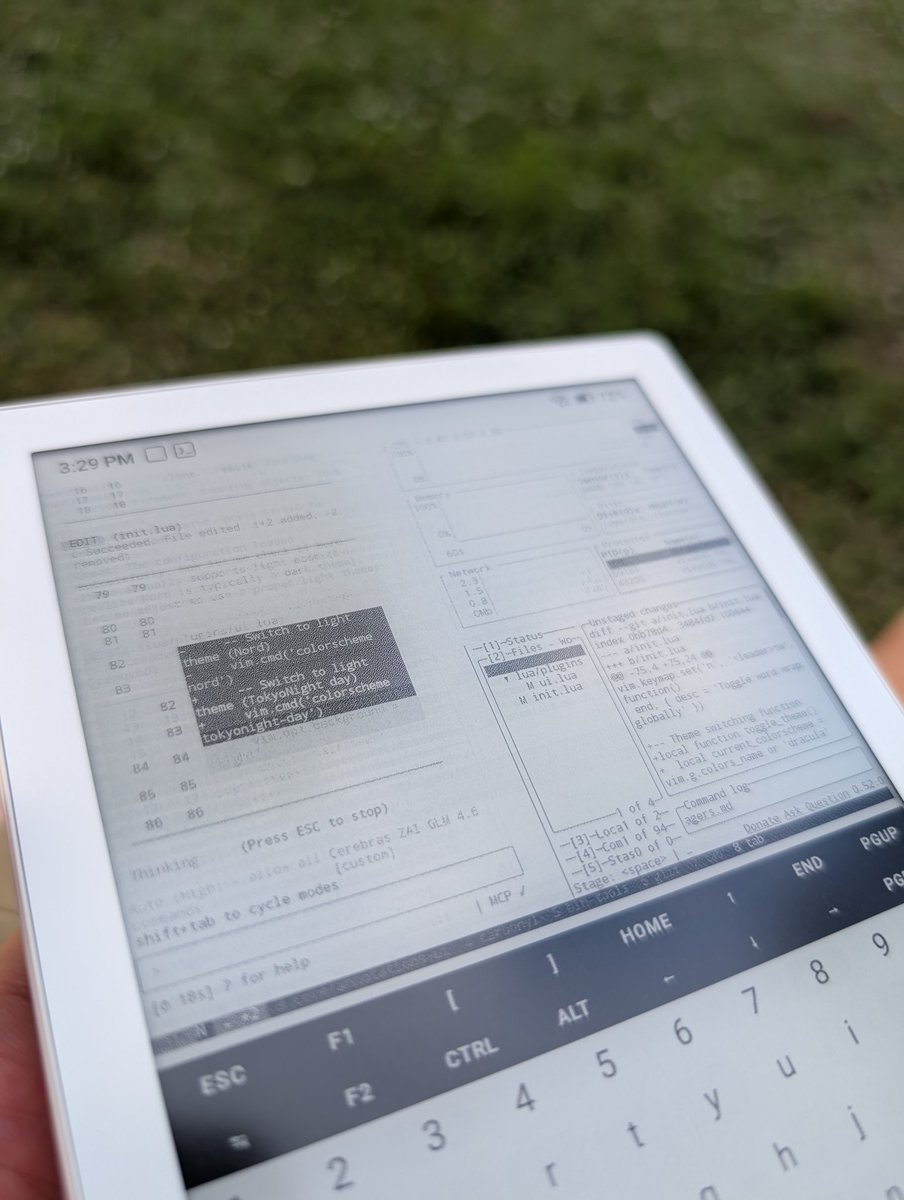

Someone ran Claude Code on an e-ink notebook and the slowest screen in the world suddenly turned out to be the best home for an AI that already thinks one word at a time.
This is the reMarkable Paper Pro, a paper tablet for notes with no browser and no social media and not a single app. He went into it over SSH and brought up Claude Code on Opus 4.8 on Claude Max and typed right into the terminal on the paper screen: "hello reddit, this is ssh terminal on rmpp".
For years this screen got slammed for one thing. E-ink is too slow and it draws with a delay and it ghosts and it is no good for real work. But Claude itself puts out a thought one word at a time.
And here is what came out of it: the very thing that killed the paper screen for normal software lined up perfectly with the pace of the AI. There is no more lag because there is nothing left to lag.
And then come the things no monitor can give you.
Your eyes do not get tired. You can watch Opus think on max effort for an hour and it feels like reading a book and not staring into a backlight.
Nothing distracts you. Not a single notification and not a single tab and just a cursor and an agent that writes code while you simply watch the page.
The charge lasts for days. E-ink barely touches the battery so Claude can grind on a task all night long and the tablet is still alive by morning.
And it weighs as much as a notebook. The whole work setup now fits into a bag like a notepad with a stylus on top.
Everything on the screen is for real: Claude Code v2.1.162 and bypass permissions on and Opus going off to think on max effort right on the e-ink.
In my opinion this is the most unexpected home for an AI this year.
Not a farm of graphics cards and not a wall of monitors but a quiet sheet of paper on a coffee table where the most powerful Claude writes code one word at a time like a pen.
English