Vaibhav Aggarwal

541 posts

Vaibhav Aggarwal banner
Vaibhav Aggarwal

Vaibhav Aggarwal

@hellovaibhava

Co-founder @FabHotels @TravelPlusHQ | Previously FabFurnish, Groupon, Bain & Co | Wharton, IIT

Katılım Mart 2009
2 Takip Edilen738 Takipçiler
Sabitlenmiş Tweet
Vaibhav Aggarwal
Vaibhav Aggarwal@hellovaibhava·
Prompt is everything.
English
0
0
1
2.1K
Vaibhav Aggarwal retweetledi
tobi lutke
tobi lutke@tobi·
The most AI proof job in the world is entrepreneurship Use it to make products and services. Build more companies. On Shopify or otherwise.
English
257
435
4.5K
245.2K
Vaibhav Aggarwal retweetledi
Brian Armstrong
Brian Armstrong@brian_armstrong·
Operating in stealth mode is almost always a mistake. Talk publicly about what you're building. You’ll build momentum, get real feedback, and someone will reach out with the other half of your idea you didn’t realize you were missing.
English
742
640
7.5K
628.4K
Vaibhav Aggarwal retweetledi
Paul Graham
Paul Graham@paulg·
Someone asked what's the most underappreciated quality in startup founders. I realized I could answer this by asking what's the most underappreciated aspect of startups. That's easy: how hard they are. So the most underappreciated quality in founders is sheer toughness.
English
217
206
3K
165.7K
Vaibhav Aggarwal retweetledi
Sar Haribhakti
Sar Haribhakti@sarthakgh·
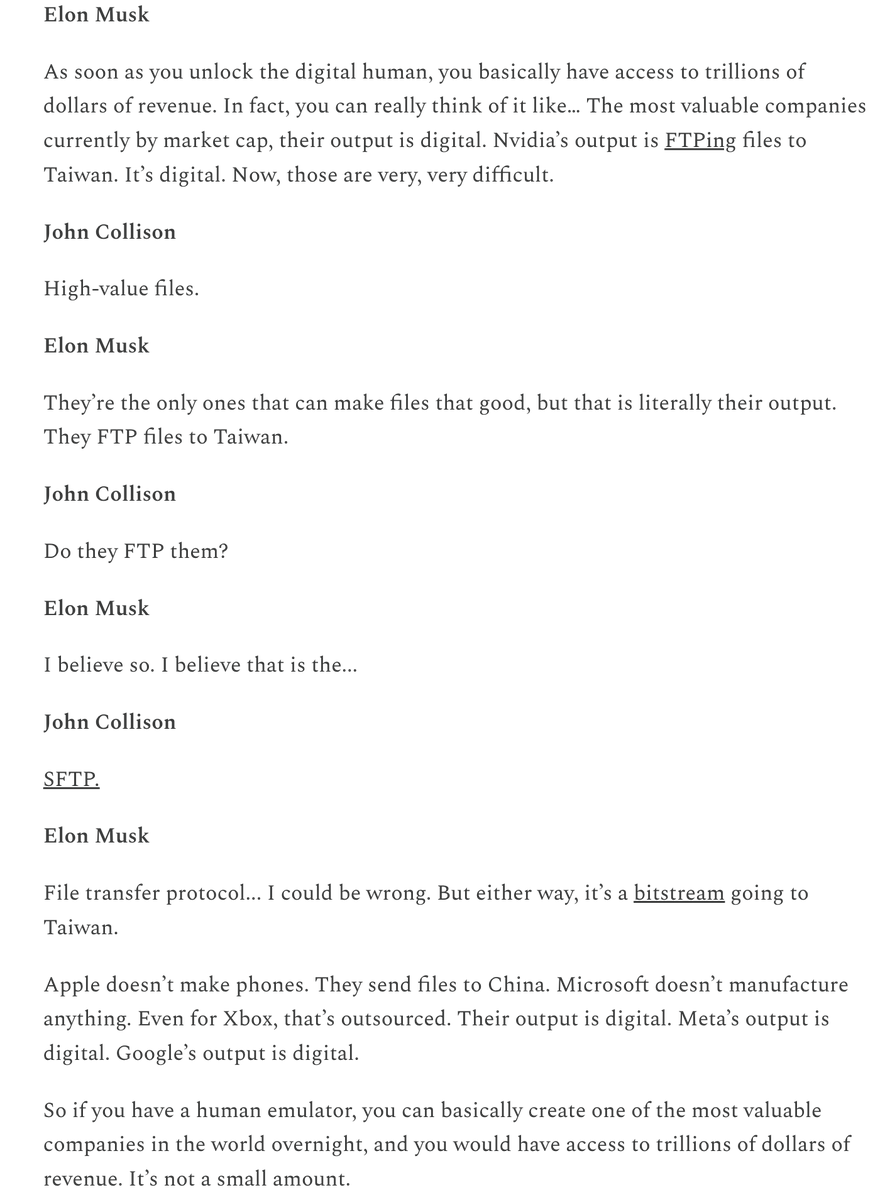
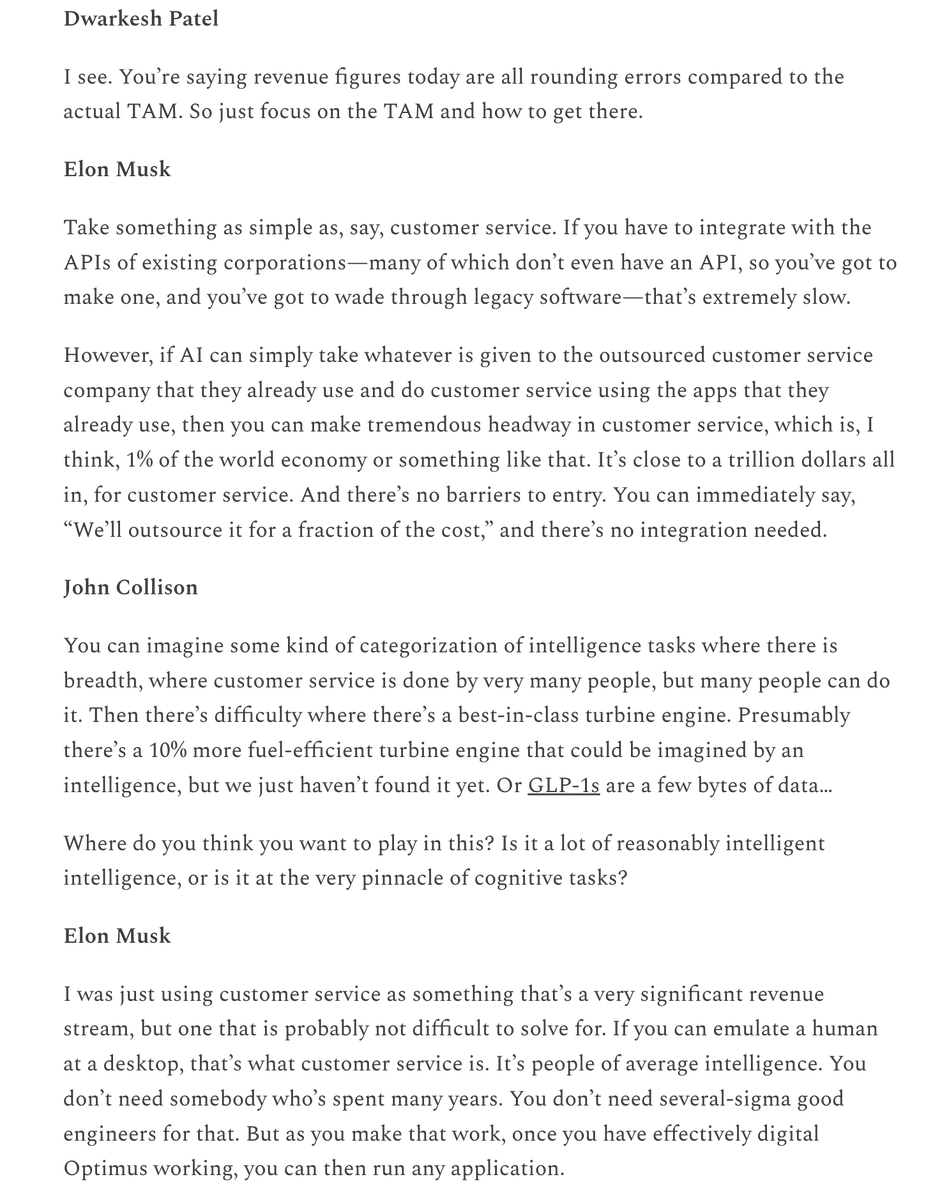
Elon Musk on Cheeky Pint: "Nvidia’s output is FTPing files to Taiwan. It’s digital. Now, those are very, very difficult. They’re the only ones that can make files that good, but that is literally their output. They FTP files to Taiwan."
Sar Haribhakti tweet mediaSar Haribhakti tweet media
English
15
14
357
43.3K
Vaibhav Aggarwal retweetledi
Jay Alto
Jay Alto@theJayAlto·
you pity the moth confusing a lamp for the moon, yet here you are confusing a screen for the world
English
806
36.4K
190.9K
11.5M
Vaibhav Aggarwal retweetledi
Marc Randolph
Marc Randolph@marcrandolph·
Nobody knows anything... True of Hollywood, true of Silicon Valley, true of anywhere innovation takes place. No one knows if your idea will work or not before you actually collide it with reality and try it out. So please… just start.
English
125
148
1.2K
129.8K
Vaibhav Aggarwal retweetledi
Peter Kazanjy
Peter Kazanjy@Kazanjy·
Founders: Know your proof points cold. 'We're better' is a claim. 'We deliver 3x more qualified leads' is an argument. 'Here are 5 customers seeing 3x more leads' is proof.
English
8
10
129
27.2K
Vaibhav Aggarwal retweetledi
Brian Halligan
Brian Halligan@bhalligan·
A really nice description of what a CEO is.
Chris Hoffmann@STLChrisH

Favorite excerpt from Brent Beshore's annual letter: What CEOs Are and Aren’t Most people think of a CEO as the person at the top. That’s true in the same way it’s true that the windshield is “at the front” of the car. Technically correct. Also, misses the point. The windshield isn’t the engine. It isn’t the wheels. It doesn’t move anything. But it does determine what the driver can see, what they ignore, and what they slam into at 70 miles an hour. When done well, the CEO job is an arbiter of truth. The CEO stands at the border between the outside world and the inside world, between company mythology and competitive reality. That sounds obvious, but it’s not. I’d argue the norm is delusion, where organizations create realities disconnected from truth, complete with alternate headlines, villains, and heroes, all proclaimed with a shocking level of certainty. So the CEO’s job starts with a basic question: What’s true? Not what’s comforting. Not what’s politically convenient. Not what our dashboards can measure. What’s true? And what should we do about it? But deciding what to do and then doing it, requires a blend of rare attributes. The CEO must be confident enough to pick a direction and humble enough to change it. Optimistic enough to inspire and paranoid enough to prepare. Warm enough to build trust and hard enough to make calls that disappoint people they like and care about. We need to strip away the mystique. In practice, the CEO allocates three things: Attention: If you want to understand a CEO, ignore their strategy deck and read their calendar. Where attention goes, energy flows. Where energy flows, money follows. And where money follows, the organization slowly becomes something different, usually without anyone noticing until it’s obvious. This is why the CEO’s attention is so expensive. It’s why it’s so easy to waste. There are a thousand “important” meetings that are actually just elaborate ways to avoid the one meeting that matters. There are a thousand “urgent” problems that are actually just the company asking the CEO to temporarily soothe anxiety. A CEO’s attention is the company’s flashlight. Point it at the right things and companies transform. Point it at the wrong thing long enough and the wrong thing becomes the thing. People: The CEO builds the team that builds the team. I’ve learned that a healthy company isn’t built by a heroic CEO. It’s built by a great team operating with clarity, trust, speed, and accountability. The CEO’s role is to create that environment, protect it, and, when necessary, make the painful personnel decisions that preserve it. This sounds straightforward until you live it. Then you realize you’re not moving boxes on an org chart. You’re messing with people’s dignity, livelihoods, and families. You’re also messing with the morale of everyone who stays. Every hire is a bet. Every promotion is a signal. Every tolerated behavior becomes a de facto policy. The CEO becomes, whether they like it or not, the embodiment of culture. It’s not what they say they value, but what they practically reward, punish, ignore, and allow. Money: This is the CEO’s most difficult job because it’s often the one they’re least trained for, that seems the most glamorous, and is extremely impactful over time. Most CEOs come up through some form of excellence in sales, operations, engineering, or product. Then one day they wake up and realize the biggest decisions they make are capital allocation decisions: reinvest or distribute, grow or consolidate, buy or build, add headcount or automate, bet on the future or play it conservative. Capital allocation is where strategy stops being a noun and becomes a verb. It is where vision gets an audit. And it’s also where a CEO can quietly ruin a business while looking busy. It’s remarkably easy to confuse action with progress, and reinvestment with wisdom. Oftentimes the best capital allocation decision is painfully boring: Do fewer things, do them better, and keep your powder dry. But, that’s not what gets applause. In our world, with long-term owners, permanent capital, and no forced exit timetable, this is where the CEO job gets simpler. We don’t need theater. We don’t need growth for growth’s sake. We don’t need to hit a narrative for the next fundraising cycle or quarterly call. We can play offense when the opportunity is real and defense when it isn’t. We can say “not now” without pretending it’s “never.” This brings me to what might be the most misunderstood part of the CEO role: The CEO is the Chief “No” Officer. Every yes is a no to something else. Every strategy is a pile of exclusions. Every commitment is a tradeoff. The organization will always ask for more: more initiatives, more products, more meetings, more hires, more exceptions, more complexity. Increasing complexity is the default setting of life, and companies are not exempt from natural order. A CEO has to become comfortable being the person who disappoints people in the short term so the company doesn’t disappoint everyone in the long term. This is where I’ve personally struggled, both as a leader and as an owner. I want to be helpful, agreeable, and liked. I can easily slip into short-term people pleasing at the expense of leading well. Sometimes I’ve confused my progress anxiety for insight. I’ve wandered into decisions too early because “someone should do something.” I’ve also learned slowly and painfully that a CEO can add enormous value simply by refusing to add noise. Clarity is kindness, but often feels like inaction to busy people. A lot of CEO work is invisible. It’s pressure management. It’s absorbing emotion without spreading it. It’s knowing what you think and how to say it with grace. It’s carrying the weight of uncertain outcomes while still asking the team to move forward decisively. This is why, in our portfolio, we care less about a CEO’s charisma and more about their character and judgment. We’ve found that the best CEOs have a rare combination of humility and intensity. They don’t need to be the smartest person in the room, but they do need to be the clearest. They don’t need to have all the answers, but they do need to be willing to make the hard call.

English
5
12
177
98.5K
Vaibhav Aggarwal
Vaibhav Aggarwal@hellovaibhava·
"Beijing has been preparing for Cold War without eagerness for waging it, while the US wants to wage a Cold War without preparing for it." - @danwwang. Recommended reading. danwang.co/2025-letter/
English
0
0
0
78
Vaibhav Aggarwal retweetledi
Paul Graham
Paul Graham@paulg·
If I could send my 18 year old self a message, it would have three parts: 1. Prestige is often mistaken. Follow curiosity instead. 2. There's no way to avoid hard work. It's not sufficient, but it is necessary. 3. Don't take your parents for granted.
English
214
1K
11.5K
546.8K
Vaibhav Aggarwal retweetledi
John Arnold
John Arnold@johnarnold·
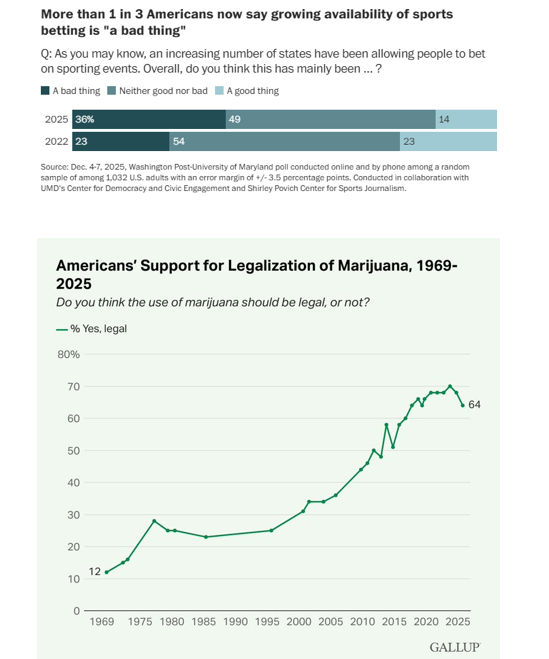
Voters and legislators believed they were legalizing the historical, lower-harm versions of both marijuana and sports betting. But, once legal, market innovation produced more addictive and harmful versions. Public support for both is eroding as the harms become clearer.
John Arnold tweet media
English
45
92
471
122.2K
Vaibhav Aggarwal retweetledi
dharmesh
dharmesh@dharmesh·
Agreed. Here's the advice I give my son (who is 14): Some of the most valuable skills are systems thinking, functional decomposition (being able to tackle large problems by breaking them down) and building instinct for how to abstract away complexity for others. This is not going to change. Those things will be even more important in the age of AI.
Pratham@Prathkum

Most of coding was never about writing code. AI is just making this more obvious. You no longer need to recall syntax, function structure, boilerplate code, or even API endpoints. That’s the easy part and AI is very good at it. The hard part was never typing. It was always thinking. And it still is.

English
92
240
2.4K
399.5K
Vaibhav Aggarwal retweetledi
Will Manidis
Will Manidis@WillManidis·
if you look at outlier success across history, its shocking how much of it is driven by simply staying in the game for decade after decade tech hates this: you have to be doing your biggest and best thing at every moment. the truth is you simply need to stay around the table
English
27
31
684
29.6K
Vaibhav Aggarwal retweetledi
Prof. Feynman
Prof. Feynman@ProfFeynman·
The joy isn’t in knowing — it’s in figuring out.
English
100
803
4K
148.5K
Vaibhav Aggarwal retweetledi
Yasmine Khosrowshahi
Yasmine Khosrowshahi@yasminekho·
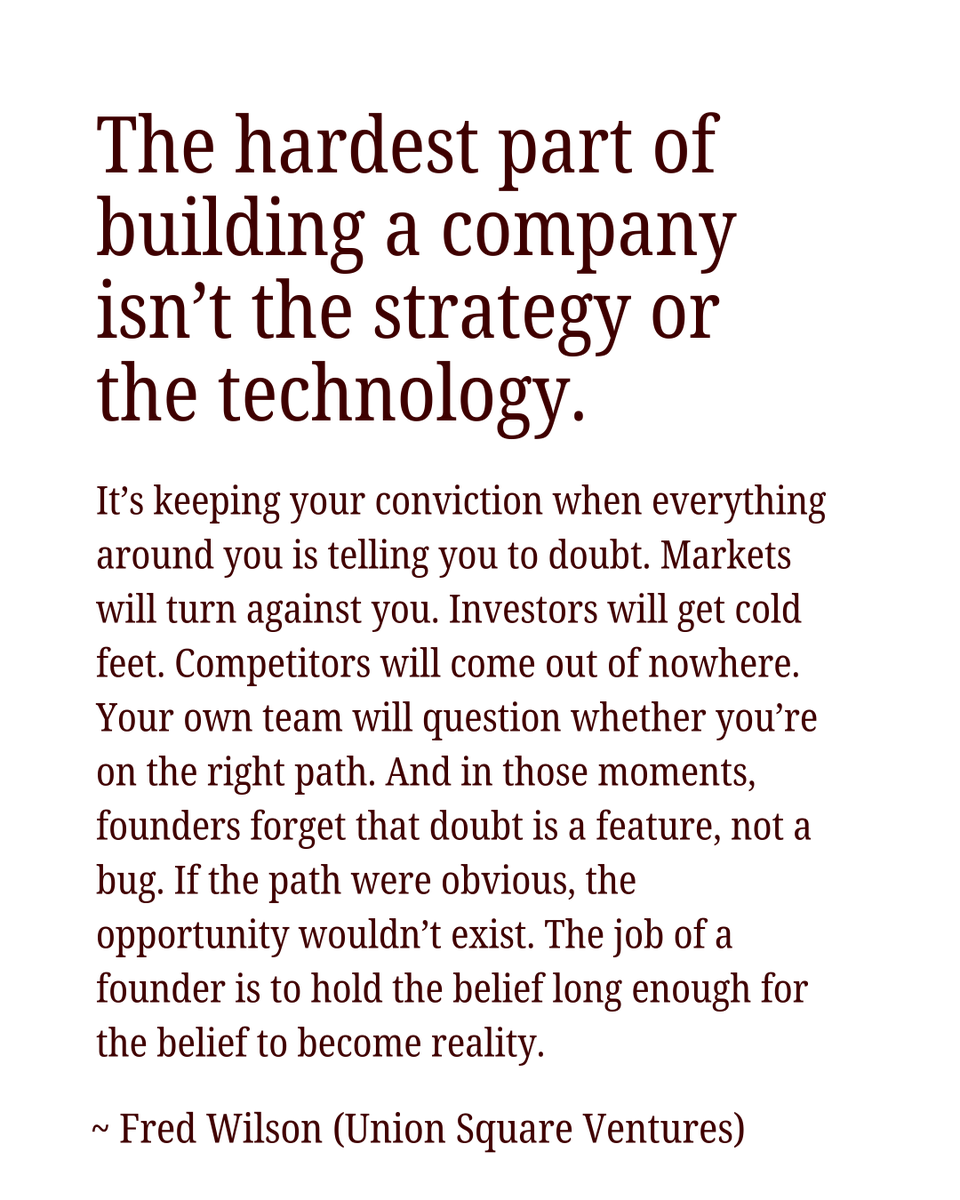
Fred Wilson literally revealed the most important trait of a successful founder:
Yasmine Khosrowshahi tweet media
English
56
365
2.4K
125.2K
Vaibhav Aggarwal retweetledi
kepano
kepano@kepano·
one strategy is to keep doing your thing way longer than anyone thought you would
English
82
439
4K
206.7K
Vaibhav Aggarwal retweetledi
Brian Armstrong
Brian Armstrong@brian_armstrong·
One of my favorite lessons I’ve learnt from working with smart people: Action produces information. If you’re unsure of what to do, just do anything, even if it’s the wrong thing. This will give you information about what you should actually be doing. Sounds simple on the surface - the hard part is making it part of your every day working process.
English
1.3K
6.2K
46.9K
4.8M
Vaibhav Aggarwal retweetledi
Andrej Karpathy
Andrej Karpathy@karpathy·
Sharing an interesting recent conversation on AI's impact on the economy. AI has been compared to various historical precedents: electricity, industrial revolution, etc., I think the strongest analogy is that of AI as a new computing paradigm (Software 2.0) because both are fundamentally about the automation of digital information processing. If you were to forecast the impact of computing on the job market in ~1980s, the most predictive feature of a task/job you'd look at is to what extent the algorithm of it is fixed, i.e. are you just mechanically transforming information according to rote, easy to specify rules (e.g. typing, bookkeeping, human calculators, etc.)? Back then, this was the class of programs that the computing capability of that era allowed us to write (by hand, manually). With AI now, we are able to write new programs that we could never hope to write by hand before. We do it by specifying objectives (e.g. classification accuracy, reward functions), and we search the program space via gradient descent to find neural networks that work well against that objective. This is my Software 2.0 blog post from a while ago. In this new programming paradigm then, the new most predictive feature to look at is verifiability. If a task/job is verifiable, then it is optimizable directly or via reinforcement learning, and a neural net can be trained to work extremely well. It's about to what extent an AI can "practice" something. The environment has to be resettable (you can start a new attempt), efficient (a lot attempts can be made), and rewardable (there is some automated process to reward any specific attempt that was made). The more a task/job is verifiable, the more amenable it is to automation in the new programming paradigm. If it is not verifiable, it has to fall out from neural net magic of generalization fingers crossed, or via weaker means like imitation. This is what's driving the "jagged" frontier of progress in LLMs. Tasks that are verifiable progress rapidly, including possibly beyond the ability of top experts (e.g. math, code, amount of time spent watching videos, anything that looks like puzzles with correct answers), while many others lag by comparison (creative, strategic, tasks that combine real-world knowledge, state, context and common sense). Software 1.0 easily automates what you can specify. Software 2.0 easily automates what you can verify.
English
555
1.5K
12.4K
2.1M