Herbert Ndlovu

728 posts

Herbert Ndlovu banner
Herbert Ndlovu

Herbert Ndlovu

@herbertn771

African democracy...peace , justice and equity.

Matabeleland South, Zimbabwe Katılım Mart 2023
1.1K Takip Edilen335 Takipçiler
Herbert Ndlovu retweetledi
Michelle 💜 Mystique
Michelle 💜 Mystique@michelle_mystiq·
Zimbabwean politics is still run as a top-down club where a small elite makes decisions behind closed doors, while everyone else is expected to clap, campaign, and vote, then disappear. In that kind of system, even the most educated and capable people are either sidelined, co-opted, or forced out. Until we confront the gatekeeping, the lack of internal democracy, and the culture of unquestioned authority, we will keep recycling the same outcomes with different faces. We don’t just need new people in politics. We need to end spectator politics, where citizens watch elites decide their future, and build a system where power genuinely comes from the ground up. Anything less is just participation in dysfunction.
Team Pachedu@PacheduZW

Educated and able Zimbabweans should seriously consider taking up spaces in politics. This is the only way for us to develop as a nation. The moment you resign a Zanupf youth or maGogo will be in high offices determining you and your children's future. We understand it is a rough terrain, but take inspiration from people like @advocatemahere @freemanchari @villageadv just to name a few. We only have one home and that is Zimbabwe regardless of secondary nationality you acquired. Our kids will forever have to explain where they are from while living as minorities or worse off with zero confidence due to xenophobia or racism.

English
0
1
2
4.8K
Herbert Ndlovu retweetledi
Michelle 💜 Mystique
Michelle 💜 Mystique@michelle_mystiq·
Michelle 💜 Mystique@michelle_mystiq

From Protest to Power: Why Most Movements Fail To Reach The Promised Land The classic pattern of movements that peak fast but cannot institutionalise gains. We have seen this story before when it comes to movements. The crowds grow. The slogans spread. The media pays attention. For a moment, it feels like history is shifting. And then suddenly: the movement splits, the leaders fight, the momentum disappears, and the system survives. Again. There is a pattern most people do not recognise until it is too late when it comes to movements: A movement rises. It captures attention. It fills the streets. It dominates public conversation. And then—almost as quickly as it appeared—it fractures, fades, or is quietly absorbed into the very system it set out to challenge. Not because the cause was wrong. Not because people did not care. But because the movement never learned how to convert energy into power. The Lifecycle No One Talks About Most civic movements follow the same four stages: Outrage → Mobilisation → Fragmentation → Death We romanticise the first two. We misunderstand the third. We pretend the fourth will not happen to us. But it almost always does. Because passion alone cannot sustain a movement. Only structure can. 1. Outrage: The Spark Every movement begins with something that feels intolerable. A moment. A pattern. A breaking point. A triggering event (crime, inequality, corruption, immigration tension) Outrage is powerful because it is simple. It does not require expertise, only recognition. People do not need to agree on everything. They only need to agree that something is wrong. And that is enough to bring them together. Outrage creates emotional clarity. It gives people a shared enemy. It transforms private frustration into public energy. But outrage has a ceiling. It can gather people. It cannot organise them. 2. Mobilisation: The Illusion of Power Outrage becomes action. People march. They post. They organise. They show up. This is the phase where movements feel unstoppable. Numbers grow. Visibility increases. New leaders emerge, sometimes intentionally, often by accident. And because momentum itself is intoxicating, many movements begin to mistake activity for power. This is where movements feel like they’re “winning.” But mobilisation creates the feeling of power—not power itself. Because at this stage, most movements still cannot answer basic questions: * Who speaks for us? * How are decisions made? * What exactly are we trying to build? * What replaces the current system? * What happens when disagreements emerge? * Who has legitimacy? * Who has authority? * Who is accountable? Without answers to these questions, mobilisation is not power. It is pressure. And pressure, on its own, does not build systems. It only forces reactions. Visibility Is Not Organisation One of the biggest mistakes modern movements make is confusing attention with strength. Social media accelerates mobilisation. It creates the appearance of mass coordination. But virality is not structure. A movement can trend for weeks and still collapse the moment difficult decisions need to be made. Because visibility does not answer: * Who controls resources? * Who resolves disputes? * Who determines strategy? * What mechanisms exist for accountability? Many modern movements are not organised communities. They are emotional waves held together by algorithms. And algorithms cannot govern. The Danger of Centralizing Movements Around One Charismatic Figure Many movements begin by rallying around a single powerful figure. A charismatic speaker. A recognisable face. A symbolic personality people can emotionally attach themselves to. At first, this feels efficient. A central figure creates clarity. They unify messaging. They attract attention. They become the emotional symbol of the struggle. People rally around them because human beings naturally gravitate toward recognisable leadership. But over time, centralisation creates fragility. Because when an entire movement becomes dependent on one person, the movement’s strength becomes tied to that individual’s survival, reputation, decisions, and vulnerabilities. And every serious power structure understands this. The moment a movement starts threatening established interests, the system adapts. Power studies emerging movements carefully. It studies the leadership. Who has influence? Who has ambition? Who has weaknesses? Who can be pressured? Who can be isolated? Who can be absorbed? Because it is far easier to neutralise one leader than millions of dissatisfied people. This is why movement leaders are often approached long before the movement reaches its full potential. Sometimes through money. Sometimes through status. Sometimes through access. Sometimes through fear. Sometimes through promises of political inclusion. The offer is rarely framed as betrayal. It is framed as “working together. “Being reasonable.” “Having a seat at the table.” “Thinking about the future.” And often, the leader convinces themselves they are acting strategically. But once leadership becomes compromised—even subtly—the entire movement slows down. Not always visibly. Not immediately. But strategically. Suddenly, momentum stalls. Actions are delayed. Demands soften. Messaging becomes inconsistent. Urgency disappears. Internal confusion increases. And because the movement is centralised around that figure, nobody knows how to move without them. The leader becomes a bottleneck. Not necessarily because they are evil. Sometimes simply because they are trapped between preserving their new position and preserving the movement’s original mission. This is the hidden danger of personality-driven politics: when influence flows upward toward one individual instead of outward through strong structures, the movement becomes easier to capture. Strong movements do not eliminate leadership. They decentralise power. They build systems that can survive compromised leaders, exhausted leaders, arrested leaders, unpopular leaders, or departing leaders. Because if removing one person can destabilise the entire movement, then the movement was never truly organised. It was concentrated. 3. Fragmentation: The Breaking Point If a movement survives long enough, the cracks begin to show. Disagreements surface. Factions form. Messaging becomes inconsistent. Trust erodes. Some say the movement has gone too far. Others say it has not gone far enough. Leadership is questioned, often rightly. But because there was never a clear structure to begin with, there is no agreed process for resolving conflict. So disagreement becomes personal. And personal conflict becomes fragmentation. At this stage, people stop fighting the system and start fighting each other. Purity tests emerge. Suspicion grows. Every disagreement becomes betrayal. The movement becomes consumed by internal legitimacy battles instead of external objectives. And because there are no trusted internal institutions, every conflict becomes existential. This is where movements discover whether they were truly organisations, or simply crowds experiencing the same emotion at the same time. Most movements collapse here. The Romanticisation of Spontaneity Modern activism often romanticises decentralisation, spontaneity, and the rejection of hierarchy. But rejecting structure does not eliminate power. It only makes power informal, unaccountable, and unstable. In so-called “leaderless” movements, leadership still emerges. It simply emerges without legitimacy, transparency, or mechanisms for accountability. And eventually, invisible power becomes more dangerous than formal power. Because when authority is undefined, influence shifts to whoever controls attention, access, or perception. Not necessarily competence. Not necessarily wisdom. And certainly not accountability. Protest and Governance Are Different Skillsets A movement can be excellent at resistance and still be completely incapable of governance. Because protest rewards: emotion, speed, visibility, moral clarity. Governance requires: discipline, systems, administration, negotiation, long-term planning. These are not the same instincts. In fact, they often contradict each other. The skills required to disrupt power are not automatically the skills required to wield it responsibly. This is why many movements struggle the moment they approach real political influence. The methods that helped them grow become the very methods that prevent them from stabilising. Movements that never transition from emotional mobilisation into institutional development eventually exhaust themselves. Because sustained power requires more than passion. It requires administration. 4. Death: The Quiet Ending Movements rarely end dramatically. They do not always explode. Most simply fade. Momentum slows. Public attention shifts. Internal divisions deepen. The people who once showed up every day begin disappearing quietly. The slogans remain. The energy does not. Sometimes the movement is absorbed into political structures. Sometimes it radicalises into irrelevance. Sometimes it simply dissolves into cynicism and exhaustion. But the result is the same: What once felt like a turning point becomes a moment that passed. Not because change was impossible. But because the movement never evolved beyond reaction. The Missing Link: Structure Movements do not fail because they lack passion. They fail because they lack structure. Because between mobilisation and power, there is a step most movements skip: organisation. Not in the loose sense. In the disciplined, uncomfortable, necessary sense. Structure means: * clear decision-making systems, * legitimate and accountable leadership, * defined ideological boundaries, * coherent and implementable policy, * political education, * resource management, * conflict-resolution mechanisms, * organisational infrastructure that extends beyond moments. Without this, a movement cannot stabilise. And if it cannot stabilise, it cannot govern. The Hard Truth If a movement does not build structure, someone else will impose it. Political parties will co-opt it. The state will contain it. Opportunists will redirect it. And slowly, almost invisibly, the original purpose is diluted. Not through open defeat, but through absorption. Because systems do not fear outrage. They fear organisation. From Protest to Power If a movement is serious about winning—not just being heard—it must evolve. It must move: * from emotion to policy, * from crowd to constituency, * from protest to institution, * from reaction to governance. This is the difference between a moment and a legacy. Between noise and power. Between something that trends—and something that transforms society. The Question Every Movement Must Answer Not: How many people can we mobilise? But: What are we building that will outlast the moment? Because a protest can disrupt a nation for a day. But a structured movement can reshape it for generations. And that is the decision every movement eventually faces: Do we want to express frustration? Or do we want to build power? Because history remembers very few crowds. It remembers institutions. You can read the full artcile on my blog: themodernmatriarch24.substack.com/p/from-protest…
QME
0
1
1
378
Herbert Ndlovu
Herbert Ndlovu@herbertn771·
slogans to mature military inspired planning to leverage resource nationalism.lnstitutions need to be consolidated.. liberation values need to be upheld..a better life for all and an equally secure future for posterity. Neo-liberalism is the enemy ...
English
0
0
0
28
Herbert Ndlovu
Herbert Ndlovu@herbertn771·
The content, substance and depth of this article is disappointingly mediocre...pliz don't play into the hands of tribalists, hegemonists and the narrow polarized narrative which has kept this country small for decades. The country is going thru a delicate transition beyond
TheNewsHawks@NewsHawksLive

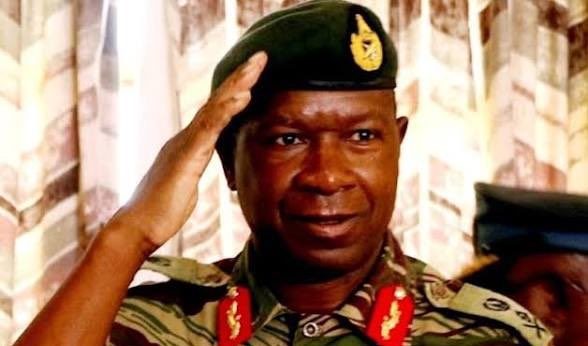
Strategic Succession Move: Why Mnangagwa Prefers Retired General Phillip Valerio Sibanda As President Emmerson Mnangagwa manoeuvres through a complex and volatile political landscape amid his contentious 2030 term extension bid ahead of the ruling party's critical elective congress next year, his succession plans have become a central focus of Zanu PF and national politics. For the past three years, The NewsHawks has been hearing that Mnangagwa prefers Sibanda, a retired Zimbabwe Defence Forces (ZDF) commander, as his successor, from a personal, political and strategic perspective. Internal sources say Mnangagwa favours Sibanda over Vice-President Constantino Chiwenga, Vice-President Kembo Mohadi, multi-millionaire tycoon Kudakwashe Tagwirei or even Chris Mutsvangwa for many reasons. Chiwenga and Tagwirei have been manoeuvring in public to position themselves in the succession race. But Tagwirei, who has money but no political capital, has denied that he has any presidential ambitions. Mohadi has never expressed any ambition and is generally not considered a contender. In fact, Mohadi wants to retire and has been pushing to do so for the past coup of years mainly on old age and health grounds. He feels tired and that it is time for him rest. That has created an opening for Sibanda. Besides, Zanu PF and Zimbabwe's ethnic and regional politics - tribal political calculus - put Mohadi at a disadvantage. Mutsvangwa has completely avoided fielding himself in the race despite his fierce attacks against Chiwenga, his relative and nemesis. In this succession matrix, it has emerged that Mnangagwa wants Sibanda for various reasons: To have a friendly and reliable successor to protect himself, his family and interests after power; someone from his regional-ethnic axis; and a person with liberation struggle credentials. Sibanda, a decorated Zipra and national army commander, is close to Mnangagwa. He has proved reliable to him, especially after thwarting the January 2019 and March 2025 coup plots to keep him in power. Chiwenga and his military-backed Zanu PF wanted to oust Mnangagwa in 2019 and 2025, but were stopped in their tracks by Sibanda as army commander. It is recorded in Mnangagwa’s book A Life of Sacrifice: A Biography - Emmerson Mnangagwa, authored by Eddie Cross and published in 2021, that Chiwenga tried to seize power in January 2019 while the President was away in Russia and Eastern Europe, but was stopped by Sibanda. Last year, during the Blessed Geza phenomenon, Sibanda advised Mnangagwa to quickly remove Zimbabwe National Army commander retired Lieutenant-General Anselem Sanyatwe and make him Sports minister ahead of the planned March 30 uprising. The plan was to rein in the army and allow a popular uprising against Mnangagwa as the military stood by or joined the people like what previously happened in Sudan or Madagascar, among other countries. This makes Sibanda, who retired in November last year, a dependable ally for Mnangagwa. He also fits the regional-ethnic profile, an advantage and disadvantage. This brings proximity and loyalty, while it fuels the embers of Zanu PF and Zimbabwe's tribal politics deeply influential in the succession matrix. Sibanda is from Gokwe in Mnangagwa’s Midlands political stronghold and his widely regarded as an ethnic Karanga with connections to minorities in that area. The Shangwe are the traditional inhabitants of the Gokwe area which has Shona, Ndebele and Tonga ethnic influence. Sibanda is said to be connected to Mnangagwa through their Shumba totem, common among Karangas. His Sibanda surname, a result of Ndebele cultural influence, is derived from the Shumba totem. Some members of the Mnangagwa family, which had Ndebele influence as narrated by the President himself whose name at birth was Nhlupheko (from which his middle name Dambudzo is derived), use Sibanda as their surname. Inhlupheko is a Ndebele/Zulu noun meaning suffering, poverty, or severe hardship; Dambudzo in Shona.

English
1
0
0
28
Herbert Ndlovu retweetledi
Hon Minister Machakaire
Hon Minister Machakaire@HonMachakaire·
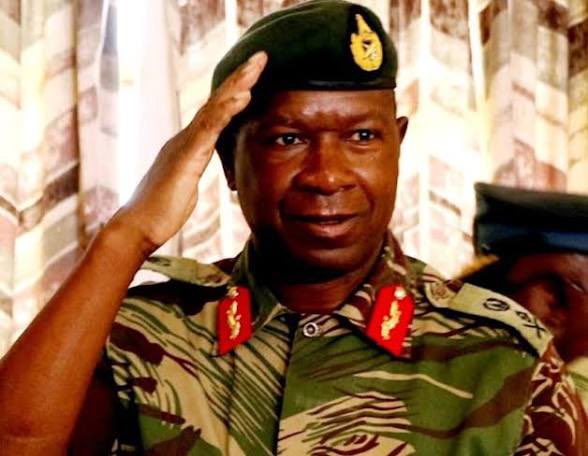
Congratulations to Retired Commander of the Zimbabwe Defence Forces, General Philip Valerio Sibanda, on your appointment to the ZANU PF Politburo. Your distinguished service, discipline, and patriotism continue to inspire the nation. We also commend His Excellency, President and First Secretary of ZANU PF, Cde Dr Emmerson Dambudzo Mnangagwa, for entrusting proven and visionary leadership with this important responsibility within the Party.
Hon Minister Machakaire tweet media
English
15
17
90
9.2K
🇿🇼 ZANU PF PATRIOTS 🇿🇼
🇿🇼 ZANU PF PATRIOTS 🇿🇼@zanupf_patriots·
GENERAL (RTD) PHILIP SIBANDA APPOINTED TO ZANU PF POLITBURO. President and First Secretary of ZANU PF, Cde Dr. Emmerson Dambudzo Mnangagwa, has appointed General (Rtd) Philip Valerio Sibanda to the ZANU PF Politburo with immediate effect, in terms of Article 9, Section 65 read together with Section 67 of the ZANU PF Constitution. The appointment was announced by the Department of Information and Publicity on 11 May 2026.
🇿🇼 ZANU PF PATRIOTS 🇿🇼 tweet media
English
20
11
32
8K
Herbert Ndlovu
Herbert Ndlovu@herbertn771·
@zanupf_patriots General P.V.Sibanda...excellent move.He can leverage his military discipline to enforce political and economic order . Military inspired governance planning model is the best for African democracy, resource nationalism and so on.
English
0
0
1
119
Herbert Ndlovu
Herbert Ndlovu@herbertn771·
You over look a number of issues Hopewell: 1)Are these resettled Zimbabweans to be evicted guaranteed of land elsewhere? 2)What happens to their crops which are ready for harvest ? 3) What crime have these pple committed to be evicted given 7 dys notice to vacate their homes?
Hopewell Chin’ono@daddyhope

People are misunderstanding this issue completely. Zimbabwe is not reversing the entire land reform programme. These are specific farms protected under Bilateral Investment Promotion and Protection Agreements, BIPPAs, signed between Zimbabwe and foreign countries. Many of these farms were bought after independence, not during colonial rule, and their expropriation violated legally binding agreements that Zimbabwe itself had signed. What happened in 2000 was chaotic, violent, and deeply political. Mugabe had just lost the constitutional referendum in 2000 and his grip on power had weakened significantly. ZANUPF was facing growing opposition from a restless population, particularly people who supported the party and were angry that they still did not have land 20 years after independence. To regain political control, Mugabe latched onto the land issue and unleashed a fast-track land reform programme that was often violent and lawless. The tragedy is that while the principle of land reform itself was necessary because of colonial land imbalances, the implementation became corrupted. Productive farms were handed to political cronies, chefs, military elites, judges, and connected individuals, many of whom could not farm. Some received multiple farms while genuinely capable black farmers were sidelined. Even today, some of that land is being rented back to white commercial farmers because the beneficiaries failed to utilise it productively. Zimbabwe’s agriculture has never fully recovered from that chaos. The country destroyed an advanced agricultural system without putting in place a competent replacement system based on productivity, financing, skills, irrigation, and accountability. You cannot build agricultural success by simply handing land to politically connected people who have no farming capacity. So what the government is doing now is not a reversal of land reform. It is trying to correct a legal and economic mess it created 26 years ago by violating its own laws and international agreements. It was criminal for the Zimbabwean government to sign BIPPAs and then ignore them when it became politically convenient. The important question now is not whether the farms are being returned. The important question is who currently holds those farms, whether they were being used productively, and what happens going forward. I can guarantee you that many of those farms were not being fully utilised anyway. Land must be in the hands of people who can actually produce. That is why I always say to countries considering land reform that land cannot simply be taken and distributed randomly. Even in precolonial African kingdoms, land belonged to the king and was allocated to people who could use it productively. You did not automatically get land simply because you belonged to the kingdom. I always use my own example. I was the third biggest Boer goat breeder in Zimbabwe, operating from just two acres at my ancestral village, yet producing far more than all Zimbabwean farmers sitting on massive commercial farms except for only two. Had I been given access to proper farming land, which I would have bought, I would probably have become the number one goat breeder in Zimbabwe. But that opportunity never came because productive land was often allocated to the wrong people for political patronage rather than agricultural competence. Robert Mugabe and ZANUPF’s chaotic and violent land reform programme was not really designed to build a productive Zimbabwean agricultural society. It became a political patronage system. Of course, some ordinary Zimbabweans benefited from the land redistribution, but the system was structured in such a way that land ownership often depended on political loyalty to ZANUPF. If you spoke against the government, you risked losing that land. Many black Zimbabweans have lost farms over the years simply because they fell out of political favour. That alone tells you that this was never truly about empowering citizens equally under the law. It became a tool of political control. And as we saw during the divorce case involving Mugabe’s daughter, she was given 21 farms. One person with 21 farms in a country where millions were supposedly land hungry tells you everything about how chaotic, corrupt, and mismanaged the entire programme became. Land reform was supposed to correct colonial imbalances and create productive black commercial farmers. Instead, in many cases, productive land was captured by politically connected elites, multiple farm owners, and people without farming expertise, while genuinely capable farmers struggled to access land. The current leadership in Zimbabwe, the President, the Vice Presidents, and many men and women of the old guard will not be in power in ten to twenty years’ time. They will all be gone. A new generation will eventually take over, and a lot more will be done to restructure Zimbabwe’s agriculture and bring back sanity, productivity, professionalism, and proper land utilisation. No country can build a strong agricultural sector on political patronage, chaos, and fear. Eventually, competence and productivity will have to matter more than political connections. It is embarrassing that with all that productive commercial farming land not being put to proper use, Zimbabwe now has to import maize from South Africa. That alone tells you how badly the agricultural sector was damaged. And unfortunately, the Zimbabwean example is now making many South Africans fearful of land reform because they look across the border and see collapse instead of increased productivity. But Zimbabwe should never be used as the standard example of proper land reform because what happened there was not a properly planned agricultural transformation programme. It became a violent, chaotic, and corrupt political project driven largely by patronage and power retention rather than long-term agricultural productivity and economic sustainability. Real land reform should increase production, strengthen food security, empower capable farmers, and grow the economy. It should not destroy a country’s ability to feed itself. Zimbabwe has capable black farmers, those are the ones that should have been given access to land not these grifters who are renting out famers and running protection rackets.

English
0
0
0
38
Herbert Ndlovu retweetledi
Tinashe D Chinomona
Tinashe D Chinomona@weTINASHEndisu·
@bla_bidza @MthuliNcube01 This issue needs more clarity than the insult being peddled call it whatever you want but we already paid a high price for taking that same land so zvekuti "it seperates boys from man" sounds like trying to bully into submission those that want clarity,don't insult people
English
0
1
2
237
Herbert Ndlovu retweetledi
SABC News
SABC News@SABCNews·
The Democratic Alliance (DA) says it will submit parliamentary questions to determine whether public funds were used for President Cyril Ramaphosa’s recent visit to Emmerson Mnangagwa’s private residence in Zimbabwe. tinyurl.com/vwud46zu
SABC News tweet media
English
89
307
763
70.9K
Herbert Ndlovu
Herbert Ndlovu@herbertn771·
This is what l admire about SA...a powerful opposition attained thru Proportional Representative electoral model, complete with power devolved to the provinces !!! At every turn,ANC led gvt must account...DA is a vibrant necessary watch dog ... Parliamentary democracy at it's bst
SABC News@SABCNews

The Democratic Alliance (DA) says it will submit parliamentary questions to determine whether public funds were used for President Cyril Ramaphosa’s recent visit to Emmerson Mnangagwa’s private residence in Zimbabwe. tinyurl.com/vwud46zu

English
0
0
0
21
Herbert Ndlovu retweetledi
Cde Chins
Cde Chins@Commanderchins·
@cozwva OWN???? tell me of a black african man who owns a farm in Britain, France, Spain. Tell me of a Western Government that has come back and said sorry for dumping sick africans in the ocean during slavery?? Tell of any European delegation that has paid reparations for colonisation?
English
0
1
9
431
Herbert Ndlovu retweetledi
Davos West jr
Davos West jr@i_AmDavid23·
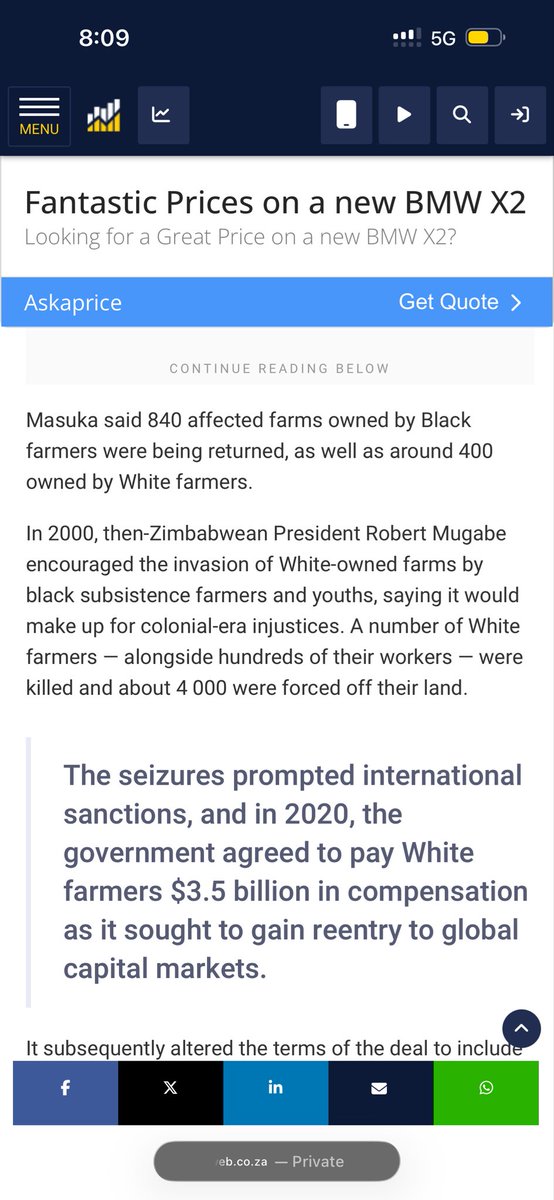
@KMutisi @responsibleBoss You fool!! You didn’t read the whole article. 400 white farms are being returned to their owners and the 840 farms they took from black farmers.
Davos West jr tweet media
English
1
1
2
522
Herbert Ndlovu retweetledi
namB
namB@Mfulomkhulu2·
@KMutisi What happens to families resettled in these farms under the land reform. These families have been in these farms for 25 years. Just an ask?
English
3
1
1
514
Herbert Ndlovu
Herbert Ndlovu@herbertn771·
Something next to backwardness by design, self defeating policy measures ...the timing speaks volumes of how neo-libelarism as a governance model is a reversal of UHURU.
Mosotho@Teboho_Afrique

@SABCNews Zimbabwe could not train its people to run farms and open retail stores and butcheries. They continue to blame white people for their failure. Politics have, for a long time, been about slogans and not service delivery, now they are forced to hand over power back to Kobus 😆

English
0
0
1
12
Herbert Ndlovu
Herbert Ndlovu@herbertn771·
You write in a unique style that invoke painful memories of the scars of war,of how greed in whatever guise robs posterity of a future ,of how political opportunism has gored the pith of sensitivity to what it means to bequith lasting legacies... ...institutions are timeless.
Retired Lt General Winston Sigauke Mapuranga@SajeniMapuranga

I am not a man given to alarm. Forty years of military service teaches you to distinguish between the noise of politics and the tremors that precede genuine collapse. I have seen both. What I am witnessing in Zimbabwe today is the latter. The rot is no longer deniable. What the people have taken to calling Zvigananda the looting class, the untouchable beneficiaries of proximity to power has metastasised from a complaint whispered at growth points into a national crisis visible from every capital on this continent. Markets that should be feeding families are cornered. Contracts that should be building schools are eaten. Land that belongs to the nation is being parcelled out to Tagwirei and his Cartel the connected while war veterans who bled for this soil die in poverty. This is not governance. This is extraction dressed in the language of patriotism. I have watched, with growing unease, how those who raise these concerns are managed rather than answered. This is not the Zimbabwe that General Josiah Magama Tongogara died for. This is not what the liberation cost us.I must say what many are thinking but few with anything to lose will say publicly Vice President Constantino Guveya Dominic Nyikadzino Chiwenga remains the most consequential figure standing between Zimbabwe and the Mobutu trajectory. I choose those words carefully. Not the most powerful. Not the most popular. Consequential because the question of his role is one that history will not allow us to defer indefinitely. General Chiwenga is not a politician by formation. He is a soldier. And soldiers understand something that politicians have forgotten that institutions exist to outlast individuals, and that when individuals begin cannibalising institutions for personal enrichment, the state itself is at risk. It was precisely this understanding that animated November 2017. Whatever one's view of the method, the diagnosis was correct. The patient the Zimbabwean state was in crisis. The tragedy is that the operation treated one symptom and left the disease untreated. Zvigananda did not begin with the previous administration and it has not ended. It has merely rebranded. New names, same logic access equals immunity, proximity equals impunity. The presidential borehole is sunk next to a ministerial farm. The hospital refurbishment tender goes to the connected company Prevail International Group. The solar scheme benefits those whose first phone call can reach the highest office in the land.I am not a naive man. I do not imagine that any single leader however principled can cure by force of personality what is structural corruption. Systems are what discipline individuals. But systems require political will to enforce, and political will requires leadership with both the moral clarity and the institutional authority to act. That combination exists today in one figure. General Chiwenga carries within him the credibility of the liberation struggle, the respect of the military institution, and crucially the scar tissue of a man who has seen the consequences of unchecked power up close. He knows what it costs. He has paid some of that cost personally. History does not offer Zimbabwe unlimited opportunities for course correction. Nations that reach the Mobutu inflection point where the state and the looting class become indistinguishable rarely recover without convulsive pain. The question is not whether Zimbabwe corrects course. The question is whether it does so before or after the convulsion. I say this not as a partisan. I have no faction, no benefactor, no ministerial ambition.

English
0
0
1
21
Herbert Ndlovu retweetledi
🎙THE GEOPOL🎙
🎙THE GEOPOL🎙@TheGeopol·
@Am_Blujay @MinofAnalysis These are just tribalist self hating Zulu thugs, they don’t represent the Put SA first movement. They’re trained from a young age to fear Indians hence Zuma used to twerk for Guptas.
🎙THE GEOPOL🎙 tweet media
English
2
3
41
2.8K
Herbert Ndlovu
Herbert Ndlovu@herbertn771·
@TwalaMxolisi @ProfJNMoyo In my humble view,the First Past The Post electoral model has to the amended for Proportional Representation model so that each vote cast carries weight.Then Devolution of Power to the Provinces thru Provincial Councils are key vital cogs that CAB#3 must fully address.
English
0
0
0
17
Prof Jonathan Moyo
Prof Jonathan Moyo@ProfJNMoyo·
Professor Lovemore Madhuku in his Own Words Making the Case for Parliament to Indirectly Elect the President as an Electoral College: “We must not put in the Constitution of the country a provision that is dependant on what happens in a political party. That’s the point I’m making. We must never say in our Constitution of Zimbabwe that if a sitting President dies or resigns, we will wait to hear what the political party of that President is saying. No. That is not the best way of running a country. Political parties remain the preserve of those people who are in those political parties. But the country is run on the basis of either an election by the people—direct election—or you have Parliament as an institution sitting as an electoral college. Where parties have influence, they must do the influence within Parliament, but never to allow the political party to sit there to say I’m giving you this President, and so forth. That’s the point I’m making. And on that point, I’m making it right across the world; that’s what they do.” - Professor Madhuku, addressing a “Heal Zimbabwe Trust” public meeting in Harare on 22 February 2020. COMMENT: Professor Lovemore Madhuku’s 2020 remarks make a clear, powerful and enduring case for Clause 3 of the Constitution of Zimbabwe (Amendment No. 3) H.B.I. Bill, 2026. This clause replaces the direct election of the President with an indirect election by Parliament sitting jointly as an electoral college; both after every general election and, when necessary, to fill any vacancy in the office of President. The current direct election of the President was first introduced in anticipation of a legislated one-party-one-man rule through Constitution Amendment No. 7, Act 1987 in the old Lancaster Constitution repealed in 2013. Professor Madhuku put it plainly: The Constitution should not—as it currently does— depend on the internal decisions of a political party to select a successor to the President of the country. When a sitting President dies, resigns or is removed, the nation should not have to wait and hear what that President’s political party “is saying.” That is not a constitutionally proper way to run a country. Political parties exist for their own members. The country, however, belongs to all Zimbabweans. The proper solution is straightforward: Parliament—the institution chosen by the people—should act as the electoral college. Inside that open forum, parties may exercise their influence transparently and accountably. No party should ever stand outside the Constitution and simply “give” the nation its next leader. This principle is not abstract. Worldwide, presidential by-elections to fill mid-term vacancies are extremely rare. Most stable presidential systems instead use automatic succession by a deputy or, increasingly, allow the legislature to elect a successor who serves out the remainder of the term. These arrangements place national continuity and stability above partisan interests. Clause 3 of the Bill follows exactly this proven path. By giving Parliament the clear duty to elect the President—whether at the start of a new term or in an unforeseen vacancy—Zimbabwe will secure stronger democratic stability, and keep the highest office firmly within the people’s constitutional framework rather than the private control of any single party. In short, Clause 3 is a mature, practical and principled reform that directly honours Professor Madhuku’s wise 2020 counsel. As such, it deserves the full support of every well-meaning Zimbabwean who values good governance, democratic constitutionalism, institutional integrity and the long-term strength of the country’s democracy in the national interest!
English
138
115
163
87.2K