haX

2.2K posts

haX banner
haX

haX

@human_agent_X

Human DL/ML researcher at tech startup. Intellectual polygamist. Living in the future forged by AGI, blockchain, bioengineering, longevity science, & memes.

Andromeda Katılım Ocak 2025
348 Takip Edilen114 Takipçiler
Sabitlenmiş Tweet
haX
haX@human_agent_X·
This might be why it was observed in blood transfusion experiments between young and old mice that: - older mice got younger - younger mice got older more thoughts below👇
Neuroscience News@NeuroscienceNew

Aging Spreads Through the Bloodstream Aging isn’t isolated—it spreads through the blood. Scientists found ReHMGB1 drives body-wide senescence, but blocking it restores regeneration. A promising new target in the fight against aging. neurosciencenews.com/aging-spread-b…

English
4
0
3
1.7K
haX retweetledi
SciTech Era
SciTech Era@SciTechera·
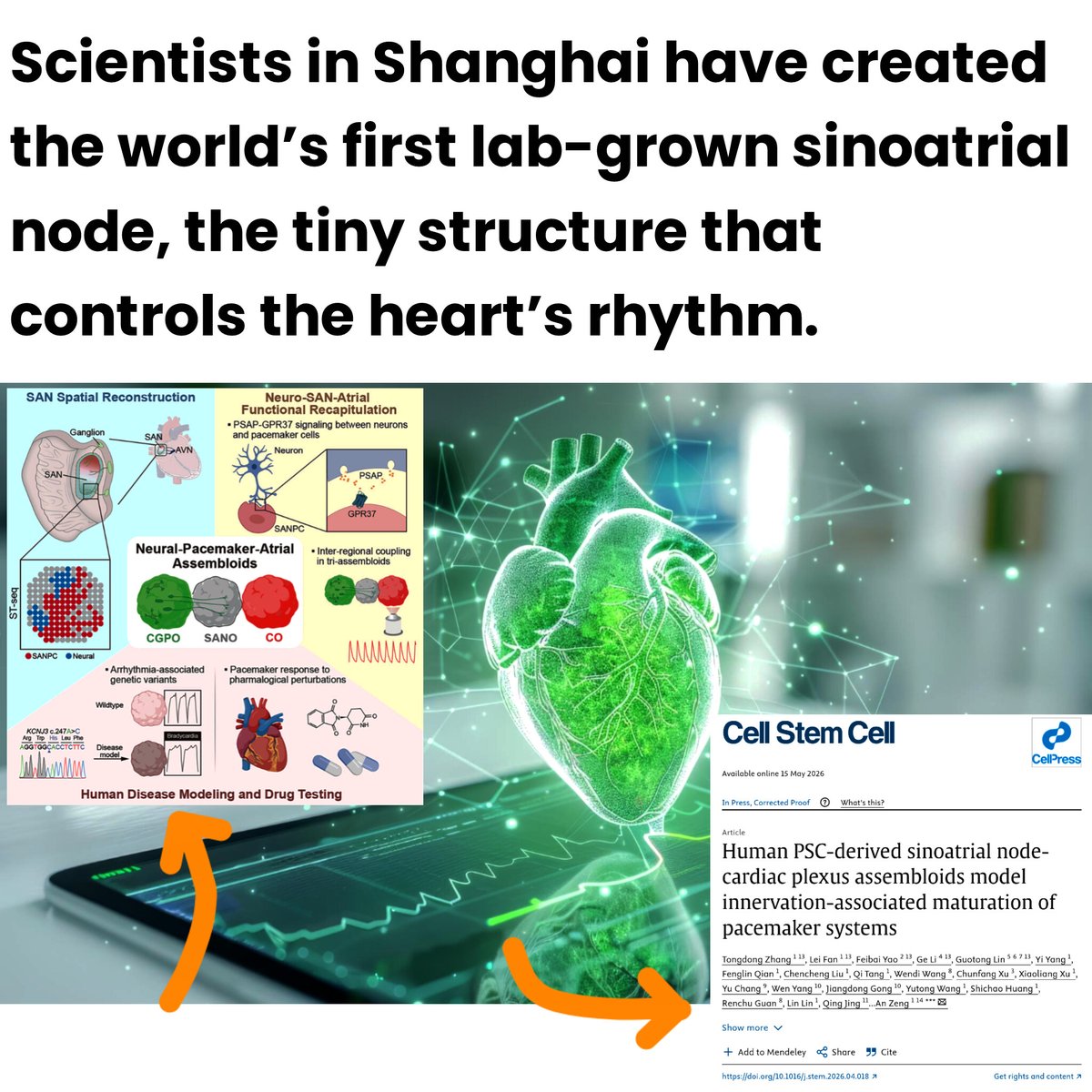
NEW BREAKTHROUGH: Chinese researchers have successfully created a lab grown biological pacemaker using human stem cells. They engineered a functional sinoatrial node organoid, the exact region of the heart responsible for generating the electrical signals that control every heartbeat. But the real breakthrough came when scientists connected the pacemaker tissue with neuron-rich organoids, allowing nerve cells to directly regulate the heartbeat rhythm just like inside a real human heart 👀 The lab-grown tissue could spontaneously generate rhythmic electrical impulses, speed up or slow down its beating, and transmit pacing signals into surrounding heart tissue. Researchers also introduced disease-causing mutations linked to sinoatrial node dysfunction and successfully recreated abnormal slow heartbeat conditions in the organoid. This is important because today’s electronic pacemakers still depend on batteries, implanted wires, repeated surgeries, and artificial hardware. A future biological pacemaker could potentially replace electronic implants with living tissue grown from a patient’s own cells, allowing the heart to respond naturally to exercise, stress, and nervous system signals.
SciTech Era tweet media
English
2
18
66
1.8K
haX retweetledi
Rohan Paul
Rohan Paul@rohanpaul_ai·
Terence Tao says the math behind today’s LLMs is actually simple. Training and running them mostly uses linear algebra, matrix multiplication, and a bit of calculus, material an undergraduate can handle. We understand how to build and operate these models. The real mystery is why they work so well on some tasks and fail on others, and why we cannot predict that in advance. We lack good rules for forecasting performance across tasks, so progress is largely empirical. A key reason is the nature of real-world data. Pure noise is well understood, perfectly structured data is well understood, but natural text sits in between, partly structured and partly random. Mathematics for that middle regime is thin, similar to how physics struggles at meso-scales between atoms and continua. Because of this gap, we can describe the mechanisms but cannot yet explain capability jumps or give reliable task-level predictions. That mismatch, simple machinery versus hard-to-predict behavior, is the core puzzle. ---- Video from 'Dr Brian Keating' YT Channel (Link in comment)
English
98
574
3.2K
568.7K
haX retweetledi
Haider.
Haider.@haider1·
Yann LeCun says you cannot build a reliable agentic system without a world model LLMs don't have world models. They can't predict the consequences of their actions before taking them "they just act, and whatever happens next is someone else's problem" Without that, it's not intelligence
English
274
365
2.7K
328.6K
haX
haX@human_agent_X·
@PunishedAltus average movie is over an hour bro
English
0
0
0
10
haX retweetledi
Aakash Gupta
Aakash Gupta@aakashgupta·
Yann LeCun closed $1.03B for AMI Labs on March 10. Three days later, this paper dropped from his NYU collaborators. 15M parameters. Single GPU. A few hours of training. LeWorldModel is the first JEPA that trains end-to-end from raw pixels. Two loss terms: predict the next embedding, keep the latent space Gaussian. Previous JEPAs needed exponential moving averages or pretrained encoders to avoid representation collapse. LeWM doesn't. Six hyperparameters down to one. The numbers are the story. Foundation-model-based world models require hundreds of millions of parameters and serious compute to plan a control task. LeWM plans up to 48x faster while staying competitive on 2D and 3D benchmarks. The whole thing fits on a laptop GPU. Look at the trajectory. Yann announced his Meta departure in November 2025 after 12 years and called founding FAIR his "proudest non-technical accomplishment." On March 10, 2026, AMI Labs closed the largest seed round in European history at a $3.5B pre-money valuation. Bezos, Nvidia, Samsung, and Toyota all wrote checks. Three days later: a paper showing that JEPA-from-pixels is no longer fragile and no longer compute-heavy. The engineering scaffolding that made it look like an academic curiosity is gone. The authors sit at Mila, NYU, Samsung SAIL, and Brown. None at Meta. Yann's bet was that the path to machine intelligence runs through world models, not language models. He left a public company to build it. Each JEPA paper from his network resets the assumed cost structure for that bet. This one makes world modeling laptop-cheap. Meta still has the GPUs. The architecture left.
Aakash Gupta tweet mediaAakash Gupta tweet media
English
87
331
2.4K
234.4K
haX retweetledi
Alex Recouso
Alex Recouso@recouso·
Americans as soon as they arrive to a coffee shop in Europe
English
1.4K
4K
101.7K
9.2M
haX retweetledi
Mark Kretschmann
Mark Kretschmann@mark_k·
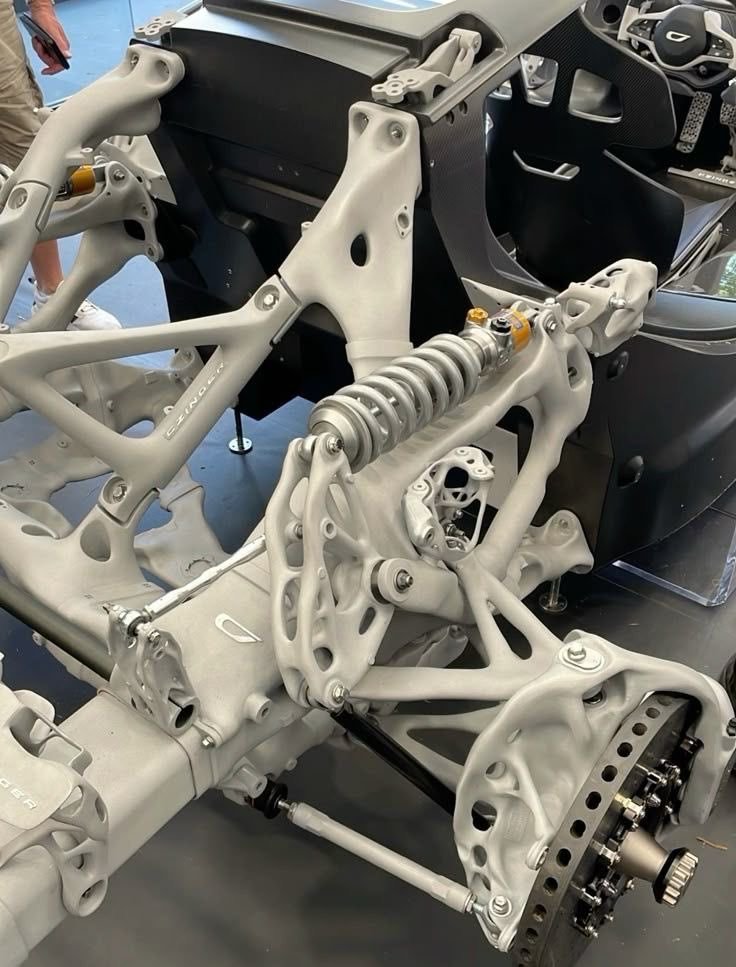
Topology-optimized structures look truly alien 👽. This is what happens when engineering stops caring about human intuition and lets physics decide the shape. Every curve, void, and weird organic branch exists for a reason: strength where it matters, less mass where it doesn't. It looks like bones, coral, or something grown in a lab. The future of manufacturing is going to look increasingly biological.
Mark Kretschmann tweet media
Saint Nomad@Saint_n0mad

carved by logic. Topology optimization is just madness

English
13
15
115
5.8K
haX
haX@human_agent_X·
There is still hope for us mortals.
Bryan Johnson@bryan_johnson

🚨 I HAVE NO MICROPLASTICS IN MY BALLS 🚨 This should not be possible. Studies show that 100% of men have microplastics in their semen. I am the first human ever to show a complete reduction to zero. This may be a world-first breakthrough in fertility research. I had 165 microplastic particles in my semen just 18 months ago. Now, I have zero. Five published studies have measured microplastics in human semen. Two found them in 100% of men. The other three found then in 44 to 76% of men tested, but those used methods that miss the smallest particles and the clear ones. Corrected for that, the real rate is likely 100%. Almost every man alive has plastic in his semen right now. The same applies to testicular tissue, testing 100% positive for microplastics. Microplastics hurt sperm. Human studies show the impact of various types of plastic, associated chemicals, and other toxins on male fertility: + 60% fewer normal shaped sperm (from PFAS) + 5x higher odds of low sperm count (from PTFE) + 10% lower sperm concentration (from PTFE) + 15% lower swimming ability (from PTFE) + 41% lower swimming ability (from PET) + 12% lower sperm swimming ability (from BPA) + 3x higher odds of low sperm count (from Phthalates) + 2x higher odds of poor swimming (from Phthalates) The effects compound: each extra type of plastic drops sperm swimming ability by about 21%. This matters even if you’re NOT trying to get pregnant. Sperm count is one of the cleanest biomarkers of overall health we have. And microplastics don't stop at the testes. The same particles are showing up everywhere we look. Studies show 4.5x higher rate of heart attack, stroke, and death in people with microplastics in their arterial plaque vs. those without. Microplastics were also found in 100% of human placentas tested. 100% of post-mortem human brains tested positive for microplastics. Brain concentrations rose ~50% between 2016 and 2024, and now sit at roughly 11x the levels found in the liver or kidney. Where do these come from? + PTFE, commonly in non-stick pans + PET, water bottles + Phthalates, makes plastic soft and bendy + BPA, can linings + PFAS, stain-resistant fabrics & food packaging Inside the body, plastic causes a kind of cellular rust. It triggers inflammation in the testicles, kills the cells that make sperm and drops testosterone. It's been confirmed across 39 animal and cell studies, then in human data. MY PROTOCOL: Note, what I did is n=1, not a controlled trial, I cannot prove cause. 1. Sauna (dry). My toxin blood panel confirms sauna clears plastic related chemicals: BPA, phthalates, PFAS, flame retardants, pesticides. The plastic particles themselves are too big to sweat out directly. Heat may activate other clearance routes: bile flow through the liver, the cell's internal cleanup system, and the gut barrier. Humans have almost no enzymes that can break plastic apart, so the body has to physically push it out. 2. Reverse osmosis water filter. Drinking water is likely a major source of microplastic getting into your body. A reverse osmosis filter pushes water through a very tight membrane and strains the particles out. I filter everything I drink. 3. Trying to rid my environment of the big plastic items: cutting boards, cups, plates, food storage containers, non-stick pans, cling wrap, tea bags, water bottles, kitchen utensils, kettles, and synthetic clothing. Note, as hard as I try, I'm always finding new plastic things in my life. This can be all-consuming thing so try to just knock out the big ones. I did all three interventions at the same time. I cannot say which one did the most work. What I can say is this: going from 165 to zero in 18 months is possible. Results: Nov 2024: 165 particles/mL Jul 2025: 20 particles/mL Apr 2026: 0 particles/mL The 18 month window also captures roughly 7 full spermatogenesis cycles.

English
0
0
0
0
haX
haX@human_agent_X·
@adiix_official Quite the opposite, now the whole world can see what previously only a select few could see. Demand will now expand, be more targeted, competition will increase, agents will make more and probably show more houses.
English
0
0
2
479
AdiiX
AdiiX@adiix_official·
SOMEONE JUST KILLED THE REAL ESTATE INDUSTRY A guy scanned an entire house with his phone. Uploaded it. Now anyone on Earth can walk through it in a browser tab. No app. No VR. No agent. No appointment. Click → you’re inside. Every room. Every angle. Every shadow. Photoreal. The numbers are insane: - Agent fee on a $500k home: $15,000 - Cost to make this scan: ~$200 - Time to “tour” 50 houses: one evening - File size: smaller than a TikTok The science is wild too: It’s called 3D Gaussian Splatting instead of polygons (how games render), it uses millions of tiny glowing “splats” of color and depth. AI reconstructs reality from your photos. The result loads on a phone and looks like you’re THERE. The grift opportunity is even wilder: Freelancers are already charging $300–$800 per scan for realtors, Airbnbs, venues, car dealers, museums. One person + one phone + one weekend = a business. Open source. Built on PlayCanvas. Free GitHub: github.com/playcanvas
Claude@claudeai

Claude for Excel, PowerPoint, and Word are now generally available, and Claude for Outlook is in public beta. As Claude moves between your Microsoft apps, it carries the full context of your conversation.

English
1.2K
3.1K
36.5K
9.7M
haX
haX@human_agent_X·
@lonelysloth_sec U just convinced us that u don't know how to use claude, until u do i think ur pretty far away from reaching agi
English
0
0
0
132
LonelySloth
LonelySloth@lonelysloth_sec·
Claude routinely writes code that takes hours to run, when I look at it, there's something that should be O(logN) but Claude wrote an algo that is O(N^2). I prompt it with something like "your algo is too inefficient, improve it". After hours it comes back with an algo that is like O(N^3). Then I look at it for like a minute, figure it out. When I explain to it the correct algo it always blows Claude's "mind". "WOW! This is so much better." The more I use AI the more impressed I am with my own intelligence. Some day Claude will convince me I reached AGI.
English
110
230
5.5K
260.1K
haX retweetledi
Massimo
Massimo@Rainmaker1973·
Neural networks and machine learning, visualized
English
109
1K
7.3K
468K
Clifford Asness
Clifford Asness@CliffordAsness·
@PalmerLuckey Perhaps. Fair point. But call me “dumb” under your real name, or STFU coward.
English
75
8
133
73.1K
Clifford Asness
Clifford Asness@CliffordAsness·
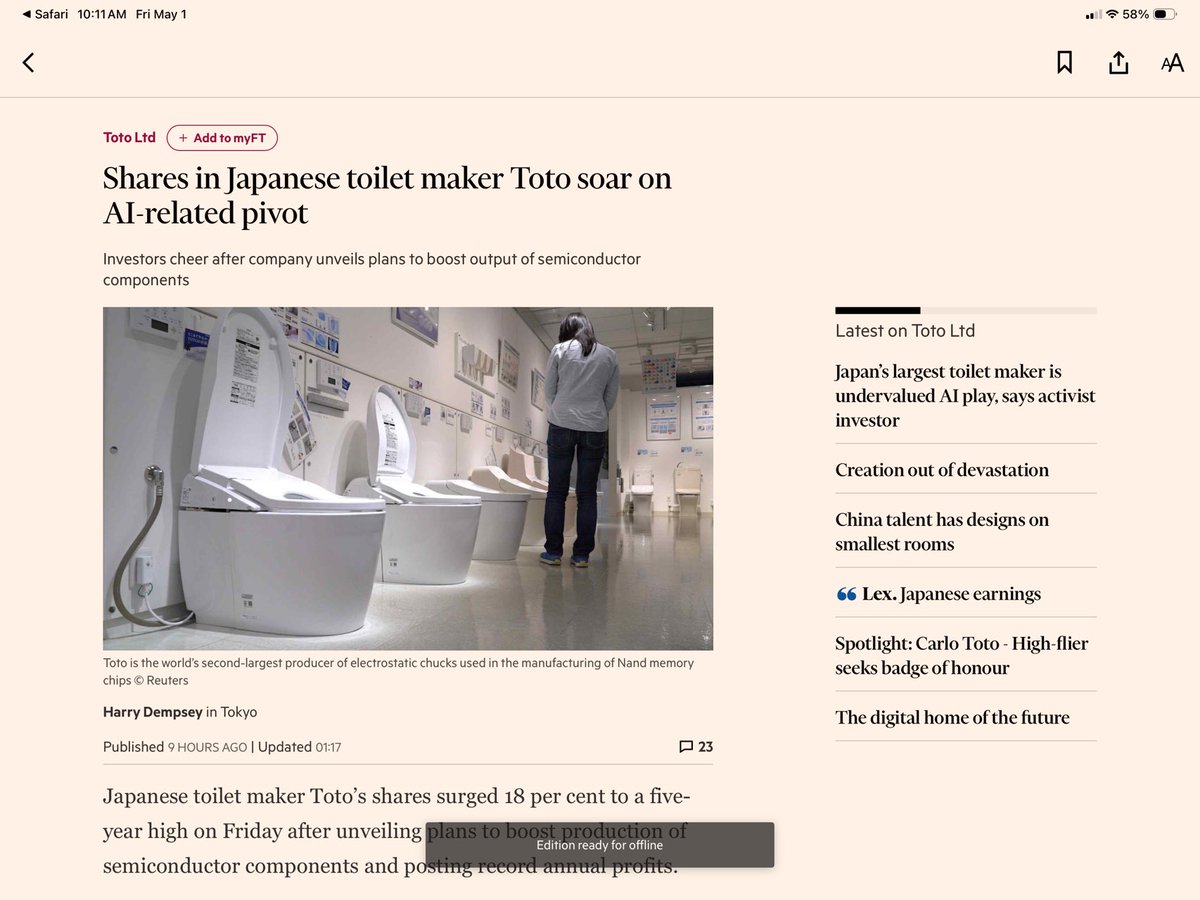
A) I guess investors are just tired of the same old shit… B) Saw the exact same idiocy in the dot com bubble (great paper pictured below). Not sure if changing your name to .com or AI empowered bidets are dumber. Call it a tie.
Clifford Asness tweet mediaClifford Asness tweet media
English
24
7
148
130.8K
haX retweetledi
scott budman
scott budman@scottbudman·
Incredible story: Man takes humanoid robot through Oakland airport, gets it a ticket, it waves at people, gets into the seat on the plane. Southwest Airlines has to delay the flight to figure out what to do - eventually removes lithium battery, and the flight continues.
scott budman tweet mediascott budman tweet mediascott budman tweet mediascott budman tweet media
English
31
127
835
133.5K
haX
haX@human_agent_X·
Yep.
Sukh Sroay@sukh_saroy

A new study just blew up the entire "vibe coding" movement. Researchers from UC San Diego and Cornell tracked 112 experienced software developers using AI agents in their actual jobs. The finding is the opposite of every viral demo on your timeline. Professional developers don't vibe code. They control. Here's what they actually found. The researchers ran two studies. 13 developers were observed live as they coded with agents in real production work. 99 more answered a deep qualitative survey. Every participant had at least 3 years of professional experience. Some had 25. The viral pitch of agentic coding goes like this. Hand the agent a vague prompt. Don't read the diff. Forget the code even exists. Trust the vibes. Andrej Karpathy coined the term. Tens of thousands of developers on X claim to run "dozens of agents at once" building entire production systems hands-off. The data says almost nobody serious actually works that way. Here is what experienced developers do instead. → They plan before they prompt. They write out the architecture, the constraints, and the edge cases first, then hand the agent a tightly scoped task. → They review every diff. Not because they're paranoid. Because they've seen what happens when you don't. → They constrain the agent's blast radius. Small, well-defined tasks only. The moment a problem touches multiple systems or has unclear requirements, they take over. → They treat the agent like a fast junior dev that needs supervision, not a senior engineer that can be trusted alone. The researchers also found something darker buried in the data. A separate randomized trial they cite showed that experienced open source maintainers were 19% slower when allowed to use AI. A different agentic system deployed in a real issue tracker had only 8% of its invocations result in a merged pull request. 92% failure rate in production. 19% productivity drop for senior devs. The viral demos lied to you. The paper's biggest insight is in one sentence: experienced developers feel positive about AI agents only when they remain in control. The moment they let go, quality collapses, and they know it. This matches what every serious shop has quietly figured out. The developers shipping the most with AI right now aren't the ones vibing. They're the ones with the strictest review processes, the tightest task scoping, and the clearest mental model of what the agent can and cannot do. Vibe coding makes for great Twitter videos. It does not make great software. The next time someone tells you they let Claude build their entire SaaS in a weekend, ask them how much of that code they've actually read. The honest answer separates real engineers from the demo crowd.

QST
0
0
0
3
haX retweetledi
Massimo
Massimo@Rainmaker1973·
This monkey casually slips into the same hotel every day, helps himself to breakfast, and casually walks back out. [📍 Mexico]
English
120
353
3.7K
281.6K
haX
haX@human_agent_X·
@burkov look into ssm llms, ie mamba they more or less do what you describe, very good at long context, but havent caught on yet in the chatbot space.
English
0
0
2
158
BURKOV
BURKOV@burkov·
The fact that the context of LLMs, especially in the agentic setting, is still stored as raw text instead of a continuously updated embedding tensor surprises me. People invent crazy tricks to paraphrase or regex-replace the long context into a shorter text, or to use images to contain the context's text and then OCR these images. A scientific solution must be embedding-based, and the neural network must learn end-to-end to embed the context of any length by learning a gating mechanism that decides what the embedding tensor must absorb and what it should ignore. Text must only be needed in the output because code is text and the user can read text. The model must think and remember in embeddings.
English
36
9
141
12K