
Harihara Vinayakaram
923 posts
Harihara Vinayakaram
@hvram
Software Engineer, Parent, Indian
Bangalore India Katılım Mayıs 2012
286 Takip Edilen40 Takipçiler
@hvram What tradition is breached by calling Hanuman Thalapathy? He was indeed the commander of Sugriv's Vanar Sena. He is the head (Thala) and Thalaivar (leader) of Rambhakts. If a single unnecessary word was used, I also would have outraged. But I fail to understand this.
English
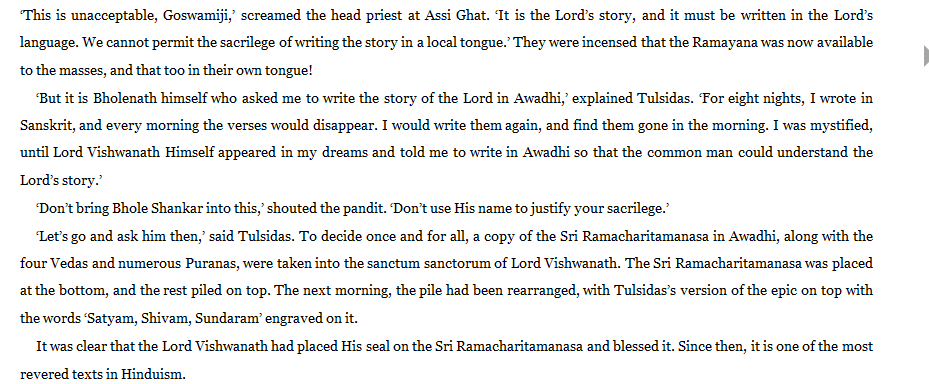
When Saint Tulsidas wrote Ramcharitmanas in the Awadhi vernacular to reach the masses, he faced opposition from Kashi's orthodox priests, because it was not written in Sanskrit. Some called it sacrilege even. Attaching the story of legend where it was Bholenath himself who'd asked for the Lord's story to be written in Awadhi.
Today, at the Kannada heartland near Hampi, at Hanuman's birthplace temple, priests constantly recite Ramcharitmanas in chaste Awadhi opposite Hanuman's shrine.
Please don't attack the analogy. The analogy is just a vehicle to carry an argument. The argument is this: Orthodox conservatives have a noble mission to carry forward tradition exactly as it was handed over to them, nothing wrong in it. However, times change and minor adaptations are necessary. If families and schools don't push the child to Bhagavan, some form of attractive pull becomes necessary. The context determines the tool. Where a pin was sufficient before, a sledgehammer is needed now.
When hearing Thala, Thalapathy, Thalaivan, why should we immediately think of cine stars? These epithets have been used for multiple politicians and cricketers too. Words are merely tools. What is disrespectful about associating these words - Head, Commander, Leader with Sri Hanuman?
The phrases "Naamam Poduvadhu/Pattai Adippadu" has been mischievously appropriated to mean something wrong. Does that mean we give up on these phrases altogether? Or do we reclaim it? Why can't we think about these words too, in similar fashion?
All said and done, this is fundamentally an empathy issue. Those who grew up in traditional environments, typically don't require these "marketing gimmicks", they are on the National Highway to God already. Many of us are ignorantly stuck in the Muttu Sandhu of Modernity - with distractions like Cinema/Cricket etc. It requires only empathy to understand that many of us need to be guided into the right way with some pull techniques which may feel unnecessary to you. You can run marathons, while we are struggling to crawl. You can solve complex equations in your head, we are still counting with our fingers.
If you are not the target audience for it, please ignore it. Don't demean the rest of us who need some pull, don't demean the Margadarshi who has the compassion to dumb down things to meet us where we are.
போகும் பாதை சுமாராக இருந்தாலும், சேரும் இடம் கோவிலாக இருக்க வேண்டும். அதுதான் முக்கியம்.
Dushyanth Sridhar@dushyanthsridar
Part A At times, I feel rejuvenated looking at a fresh set of astikas, many of them between the age of 10 & 25 (mainly born after 2000) across both the genders and castes attending discourses, not just in metros but even in Tier-1 & 2 towns. I have wondered as to ‘why this new found love for lectures’ when there are other ways for them to spend time. This I realised when I could pick some of their minds. Their questions like ‘Who is Bhagavan? How can I know more about him? What are the simple ways that I can intersperse in my daily life with, that will give me peace? Why should I come to a temple?’ are answered when speakers deliver their talks. Today, I can vouch that the number of astikas who attend my lectures are across the entire spectrum of the society. 1. How do we reach our Vedic content to them? Give them examples which they can relate to. What can these kids relate to? OTT, movies, bands, sports, & more. Though they like the examples, when they go back home, they carry the message of our puranas. 2. Sadly, one large section of our society doesn’t see cinema as an art form. It worships the actor as a deity. This worshipping of actors is huge in the South. It isn’t new. In the last 70 years, TN & (united) Andhra have been witness to it. Many youngsters relinquish their studies and squander their family wealth in following these actors. As an upanyasaka, my duty is to just not narrate, but slowly help bring the change in the masses. The process may be slow, but it will work over a period of time. 3. In TN, actor cutouts receive all the formalities that a temple devata receive. Archana, Abhisheka, Aradhana & more. As a fund raiser to Sadhana goshala that takes care of helpless cows, I spoke in Nanganallur today to an audience of 800+ astikas for 150 minutes. What was the lecture on? On Sri Hanuman. So for 125 minutes, I spoke to the audience about the role of Hanuman in our revered scriptures like the Ramayana & Mahabharata. What was the last 25 minutes about? It was telling the audience (& through this lecture as a vyAja to many others who will be watching on YouTube) that like being an engineer, doctor, plumber, electrician, carpenter, chef & more, being an ACTOR is also a profession. See them as mere professionals & don’t worship them. We need to draw inspiration from Sri Hanuman. He should be our ‘thala’, ‘thalapathy’, ‘thalaivan’. A state or a society that becomes a cult worshipping one, seldom prospers. This was my message. As always, my 150 minutes discourse will be posted on my YT channel in a weeks time. It will be up for your watching. So what was the poster? It said Sri Hanuman is our ‘Thala’, ‘Thalapathy’ & ‘Thalaivan’. What is its message? See Hanuman as your hero. He is your guide. He is your inspiration. 4. What does this Mahavidwan Sri @aravindgov say? It seems ‘we’, the ‘modern upanyasakars’ have hit the ‘lowest of possible standards’. It seems by giving this title, I have ‘taken it even lower’. It seems it is ‘my special talent’. Well my reply is, ‘Mahavidwan Sri @aravindgov Swami, I will wear this as my badge of honour’. I will tell you why? If by attending this discourse, If by watching my online video, at-least 50 people in the age group of 10-25 decide to have Hanuman as their Hero, my purpose is fulfilled. It is like my ‘Bharat Ratna’ moment. In the next 10 years, if a significant share of TN youth see Hanuman as their friend, this state will touch it’s pinnacle of prosperity.
English
Harihara Vinayakaram retweetledi

Key Takeaways from the Discussion with Shri @vvaayu
• Revival of Vedic traditions requires work from the grassroots. Sustainable revival cannot be purely top-down; it must grow through institutions, communities, and individuals practicing the traditions in daily life.
• One major challenge in Vedic education today is the low output of trained scholars. There are very few people completing the full course of study and practice.
• Both Shraddha (dedication) and Medha (intellectual capacity) are necessary for serious engagement with Vedic learning.
• Modernity arrived in India largely on terms set by others. Hindu society has often struggled to adapt its own institutions and knowledge systems to modern conditions.
• There is a widespread lack of awareness about Vedic traditions, even among people who feel culturally connected to them. Reconnecting with these roots requires conscious effort.
Gurukul Education
• Modern education is necessary, but it should be incorporated on our own terms, alongside traditional learning.
• Students also study related disciplines that help them understand Vedic knowledge more deeply.
• Daily routine in the Gurukul:
-Day begins around sunrise with Sandhya and, for some, Agnihotra
-Followed by exercise and traditional physical activity and then the first proper meal of the day
-10 AM – 4 PM: various academic studies
-Afternoon snacks and fruits and then evening time for play and physical activities
-Evening Sandhya
-Dinner around 7 PM
-8–10 PM: open sessions, discussions, free time, and sometimes extra classes
• There is no rigid manual, but the effort is to maintain a disciplined and balanced routine.
• Gurukuls function best as small institutions, usually with around 10–20 students, allowing close teacher-student interaction.
Wider Participation in Vedic Traditions
• Ritual practice and lifestyle discipline are central to Vedic education. Study alone is not sufficient without lived practice.
• Learning Sanskrit is the first step, and it is possible to gain a working understanding within about a year with focused effort.
Understanding Rituals
• The foundation of all rituals is Dharma.
• Rituals became necessary when human beings lost the ability to directly access the divine reality.
• Ancient seers developed ritual systems as structured ways of transmitting knowledge and spiritual discipline.
• Later traditions such as Itihasa, Purana, Shilpa, and other knowledge systems also integrated ritual elements, because in the traditional worldview all activities ultimately aim toward Moksha.
• Shrauta rituals are directly mentioned in the Vedas, while many other ritual traditions developed from them.
Preservation of the Tradition
• The priority today is ensuring that the essential foundations survive; once the basics endure, other aspects of the tradition can grow again.
• Practices such as Nitya Agnihotra, especially in the historic Ganga–Yamuna region, are part of this effort.
• Understanding the Vedangas is essential for understanding the Vedas themselves.
• Shastra says that Vedic knowledge reveals itself only to one who approaches it with discipline and tapas, much like a devoted wife reveals herself to one who has earned that relationship.
• Today, the number of people fully trained in Shrauta rituals may be fewer than a hundred, making the preservation of this knowledge an urgent task.
The discussion was a reminder that the preservation of Vedic traditions is a multifaceted process that involves upholding an entire way of life including education, discipline, ecology, and community practice.
Efforts like these gurukuls and ritual traditions represent small but significant attempts to ensure that living connections with India’s divine knowledge systems continue into the future.
English
This is what happens when you have near and dear ones being citizens of another country. You start admiring that country. And people in responsible positions take policy decisions based on that bias
Historianunkil@SudsG5
Nirupama Menon started her career in 1973. The US engineered a false flag operation in Vietnam in 1965 and was still waging a brutal war against civilians in Vietnam even using chemical weapons (agent Orange). In 1971 (I assume she was in ICS training ) the US backed Pakistan in its genocide and threatened INDIA. While it's covert involvement in Chile began in the early 1960's by 1973 it was extremely clear to anyone who read a newspaper that the US was backing the brutal generals against Allende. He was in fact killed (or committed "suicide") in 1973. In 1975 the US govt itself revealed the horrific extent of the MKultra experiments. And we are only in the period 1973-75. The point here being, Nirupama as an experienced diplomat shouldn't even have thought of the US as this force of good. It never was. The last "just" war it fought was ww2.
English
@kc_srk Very nicely done. Congratulations on a well conceived vision. I know how difficult this would have been to get to life
English
Harihara Vinayakaram retweetledi
Applications are open for the FP Launchpad Post-Baccalaureate Fellowship at IIT Madras, a fully funded 2-year fellowship in systems and functional programming.
Build real systems, publish research, contribute to open source.
fplaunchpad.org/2026/03/06/app…
English
@PARUPar09299633 @adithya There are people who advocate it can be separated. (i.e) Do the Brahmayagna part and chant the Veda mantras (Purusha Suktam typically)
Then do Madhyanikkam and then do the Deva Rishi Pitru tharpanam
English


The Vedas mention that each Brahmin should perform Pancha Mahayajnas (5 sacrifices) each day. They are
•Devayajna: Fire Sacrifice towards Devatas using Samidha / Purodasha
•Pitruyajna : Offering Tarpana / Pinda towards our Pitrus / ancestors
•Bhootayajna : To feed the animals
•Manushyajna : To welcome guests at home and feed them
• Brahmayajna : To chant Vedas daily (Swadhyaya) to satisfy our Vedic Rishis
The Vedas thus ordain us to perform these 5 compulsory Nityakarma (daily rites) each day to attain higher spiritual living, happiness by the punya earned by doing the 5 karmas. Once the Upanayana is performed for a boy, he is fit to learn Vedas and the 1st Veda Mantra which is given to him as Upadesha by his father (who now becomes his spiritual Guru (in case he has learnt Vedas)) is the Gayatri Mantra which is the essence of all the 3 Vedas. From this day onward, the young boy not only performs Sandhyavandana and Gayatri Japa to improve his spiritual splendour and brilliance, but also becomes eligible for learning the Vedas. Over a period of 6-10 years, he learns thousands of Veda Mantras by heart in Veda Pathashala through a learned Guru or from his father and is ready to use it for the well-being of community and his family. By chanting Vedas daily, he also repays the Rishi Rina (loan) which he has upon him, which passed on to him by his ancestors in form of the Vedic knowledge and wealth. Therefore he repeats each day, the Veda mantras that he has learnt, in a systematic way throughout his life until his death so that he does not forget a single line/word of the Veda mantras till end and the act of chanting Vedas each day reduces this Rishi Rina (loan). This act of chanting the Veda mantras daily is called Brahmayajna. Here in Brahmayajna each day he chants mantras pertaining to his Swashaka. For example, a Rigvedi will chant Rig Veda, a Yajurvedi will chant Yajurveda, a Samavedi will chant Samaveda and so on. If someone has learnt more than 1 Veda then he will first chant his own Veda Shaka then go to the others and so on.
What are the merits of performing Brahmayajna ?
The Vedas mention that by chanting Rigveda the ancestors of the person performing Brahmayajna get rivers of milk flowing for them. By chanting Yajurveda the ancestors of the person performing Brahmayajna gets rivers of clarified butter (Ghee) flowing for them. Rivers of Soma flows towards ancestors the the Samavedis when they chant Samaveda during Brahamyajna and finally river of honey flows towards ancestors of Atharvavedis when they perform Brahamyajna.
What are the benefits of performing Brahamyajna ?
The wealth that our Vedic Seers (Rishis) who are our ancestors, have handed over us is a big responsibility to protect and practice a vast heritage of Vedic knowledge. When we learn them and practise them daily through Brahmayajna, they are satisfied that what they passed on to their future generation is protected and practised. They bless us for performing
Brahmayajna which is a Nityakarma (daily duty).
Vedas also mention that the person who does Brahmayajna each day will ascend to Swarga loka after his death.
Also, he will attain fame and position amongst his community. He will become wealthy and will be able to give Daanam to Brahmanas. He also wins over Swarga loka and attains freedom from the cycle of birth and death and becomes one with the divine Parabrahman.
Brahmayajnam also helps one get relieved of any paapam committed knowingly or unknowingly, as chanting Veda mantras daily burn your sins due to generation of heat/ tapas.
We pray Veda Mata Gayatri to bless all of you with divine knowledge, health, wealth and prosperity.
Originally authored by @VedaGhosham Guru ji
Shri Gurubhyo Namaha 🙏🏻
English
Harihara Vinayakaram retweetledi
Had a similar experience with a different ending. Met a young lady a couple of times in my local pub and invited her out for a meal. When we finished, she had missed her last bus home, so I offered her my spare bedroom. After about 20 minutes, she came and asked if she could jump in my bed, so, yes, of course, but I could see that she was a little out on a limb there so we just talked and cuddled up until the early hours. Long story short, we ended up together for 4 1/2 years, then remained good friends until she was taken by cancer back in 2009. Any time I'm in the area, I visit her grave and tell her that she was, and is, lovable, despite her doubts. Sleep well Kim. You were loved and now very missed.
English
Harihara Vinayakaram retweetledi
I’ve been asked the same question again and again:
Why would the Ayatollah’s regime attack Dubai?
A city where nearly 200,000 Iranians live.
A city where they built businesses, raised families, educated their children in world-class schools, and found opportunity.
Why target a place that gave so many of their own people a future?
And then it hit me.
The answer is in the question.
This is a regime that kills its own people inside Iran. Why would it hesitate to harm them outside?
But there’s something deeper.
Dubai wasn’t just a target. It was a symbol.
Seventy miles across the Gulf stands a city that, to millions of Iranians, represents what Iran could have been - open, thriving, educated, diverse, confident. A place where business flourishes. Where coexistence is normal. Where over 200 nationalities live side by side, chasing dreams instead of fearing the state.
That model is a direct contradiction of everything the Ayatollahs built their rule upon.
So the attack wasn’t just against buildings or infrastructure.
It was against an idea.
Against a model of prosperity.
Against proof that another path is possible on the same waters of the Gulf.
Yes, the city has suffered a blow. Yes, it hurts. For those of us who love Dubai, who have built lives here, who have watched it become one of the safest and most dynamic cities in the world - this was personal.
But here’s what the doubters don’t understand:
Dubai’s strength has never been fragility.
It has always been resilience.
And when Iran is finally free from tyranny - when a new Iran rises - Dubai will not fade. It will thrive even more. It will become the gateway, the financial bridge, the transit hub for trade, energy, capital, and reconstruction. It will be the Hong Kong of a reborn Iran. The stepping stone between a free Iran and the global economy.
The best days of this city are not behind it.
They’re ahead. 🙌🏻🙂
English
@naanushande Try the reverse route while returning and post your experience
English

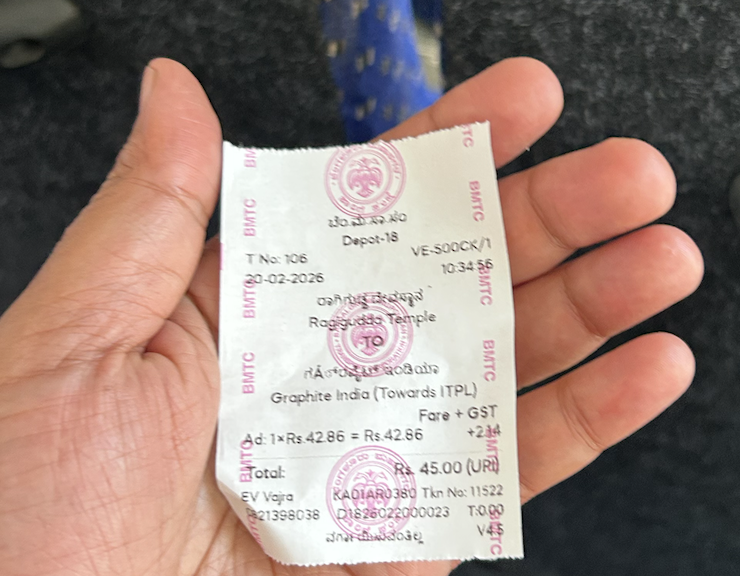
Friday 10:30 AM at Ragigudda JP Nagar. Goal: Graphite India by 12 noon
The Usual Route:
Yellow Line ➡️ Green Line ➡️ Purple Line (Majestic) ➡️ Seetharamapalya ➡️ Auto.
ETA: ~11:45 AM
Cost: Metro fare + ₹60 last-mile Auto.
Today’s Switch:
Took the BMTC '500 CA' AC Electric instead.
Arrived: 11:25 AM (Earlier than estimated!)
Cost: ₹45 total. (Cheaper than last-mile auto fare!)
I had a seat for the entire trip. I cleared my emails, took a few calls, and even caught a quick power nap in AC comfort—something impossible during a 3-train Metro scramble.
The Reality Check: Granted, it was an exceptional day with Friday lean traffic, but it made me think. Are we over-engineering our public transport with 1000s of crores in delayed Metro projects while ignoring the efficiency of a solid bus network?
Open to debate. @ChristinMP_ @Tejasvi_Surya @RLR_BTM
English

@natanarayana People just dislike any AcArams. vAsodakam, tilodakam and yakSma tarpaNam are equally important
English

What people speak of as tradition while bathing in the rivers is not how one should actually bath in rivers. There is a proper guideline given in śāstras on how to bath. Few salient points from that - 🧵
1. You have to take a bath at home before a river bath.
1/n
Rahul Srinivas@whizkidd
I hate seeing this. But if Hinduism needs reform, we need to start by questioning what we blindly defend as “tradition.” Bathing in a sacred river is one thing. Bathing in a visibly filthy, polluted river and pretending it’s spiritually uplifting is another. Faith does not demand we ignore basic hygiene or common sense. Hinduism has survived for millennia because it adapts. It questioned ritualism. It reformed social evils. It evolves with time. It was never meant to be rigid or frozen like scriptural systems that treat change as heresy. Calling something “Sanatana” doesn’t make every practice untouchable. If a river is sacred, the dharmic act is to keep it clean; not defend the filth.
English
Harihara Vinayakaram retweetledi

In 2010 I had to have urgent surgery to remove my gall bladder.
I had severe GI issues - post surgery IBS - for 6 months after surgery. Lost 13 KG weight.
The doctor who did the surgery - Dr MG Bhat of Manipal Hospital Bangalore - refused to even see me for one post op consultation. Apparently he is a surgical machine - sees patients once, does the surgery and Fs off.
For a month after surgery I had to meet his shady assistant/junior who was least interested in even listening to my troubles.
Other GI specialists in the city refused to look at my case since I am a 'post-op complication' and it's the responsibility of the surgeon concerned.
Anyway a senior GP was referred by a friend after a nightmare 3 months. She took pains to diagnose and devised a method to settle down my GI issues over a further 3 months.
Since then I advise everyone to avoid such 'surgical machines'. They might be great 90pc of the time but they don't have time to handle the 10pc where things don't go according to plan.
Dr. Priyam Bordoloi@DocPriyamMD
What’s a clear example of medical malpractice or unethical medical practice you’ve personally witnessed or experienced?
English
What I have wanted to do for a looong time. Brilliant
Puyangan Adiyan@Puyangan5
Alright. Imma do a mega thread on the Great Andy and his Nostradamus-level predictions. 1) Here is Andy solving India's budding currency crisis with just one opinion piece in Dec 2025. The deal with US happened in a few weeks.
English
So bloody condescending. Or maybe now he has become a VC he is singing a different tune
Deedy@deedydas
I was wrong about Sarvam. When I wrote about them a year ago, I felt like the direction to train small "indic" language models was wrong. But boy, have they turned it around. They have the best text-to-speech, speech-to text, and OCR models for Indic languages, and that's actually really valuable. The pricing is very reasonable. And the website is not only beautifully designed but dirt easy to use. They're filling a well needed gap in the ecosystem and doing things big labs will probably never focus on to the fullest extent (at least in the short term). I don't know anything about the business, but there's a lot to appreciate about what they've build technologically and I can't remember the last time I felt that way about software products coming out of India. Well done.
English
@CSYogananda interesting
Satish Verma@satoverma
In 1690s, if you were in Kashmir and wanted to procure a complete manuscript of Kashmiri recension of Mahabharata having ~1.1 lakhs shloka-s, what would be the price of it? We don't need to hypothesize because there is a recorded sale of such a manuscript from 1682.
English
Harihara Vinayakaram retweetledi
When I proposed celebrating Swami Vivekananda Jayanti by painting all 17 grand old hostels of @iiest_s with student participation, Some laughed, some said “This is Kolkata, not Bengaluru.”; others said today’s youth would not come forward to do this.
Our students proved them wrong.
Students of IIEST Shibpur, Kolkata, painting their hostel corridors on 12 January — National Youth Day — to mark Swami Vivekananda Jayanti.
These are among the brightest young minds of the nation—admitted through JEE and GATE—leading by example with dignity, responsibility, and pride in their campus.
I am truly excited and proud to share these photos.
This is nation-building in action. 🇮🇳 🇮🇳


English
Poison comes coated as nectar . Import US farm products ? Huh
Yashwant Deshmukh 🇮🇳@YRDeshmukh
A piece to read, think, re-read and re-think about. I just love the way @ShekharGupta clearly states about positions of all the pieces on the chess board. Its for us to decide the next move courageously, or perish. Thank you Trump, again. India now has reason to shed fear of free trade and spur reform : theprint.in/national-inter… via @theprintindia
English
@krithikasivasw I completely agree. There is a certain notation / paddhathi .
If you want to get the meaning do get the lyrics and understand it.
This is like claiming the Sri Rudram mantras have a certain meaning and when pandits recite it the meanings are mangled
English

Because that's how the musical phrase by the vaggeyakara is . Its not mere text but sahityam part of a krithi that has a particular notation set by the composer himself which is the important part in a krithi. I understand that some people feel non telugu speakers can do a better job with pronunciation, but this is not a case of " you are singing it wrong/ butchering it".
Check out how the notation is.
Listener should be knowledgeable enough to understand the sahityam split.

Saiswaroopa Iyer@Sai_swaroopa
Dear Carnatic Singers? Sincere question. What do you have against "Jagadaanandakaaraka"? Especially the "Aganitaguna Kanakachela" Charanam. Like why do every single one of you want to slaughter the words cutting them up in weird places? Does "Aganitagunakana-kachelasaala Vidalana-runa-basama-nacharana-paaramahimaatbhutasu..." make any sense to you? Or you dont care? (Aganitaguna Kanakachela Saalavidalana Arunaabhasamaanacharana apaaramahimaatbhuta Sukavijanahrutsadana Suramunigananihita Kalashaneeranidhijaaramana PaapagajaNrsimha Varatyaagaraajaadinuta)
English
@Sai_swaroopa @ritwaj Very wrong reading of Krishna. He followed protocol to do studies in the Ashram, make Ugrasena the king etc etc.
English

@ritwaj Except that the issue was here, Maryada and perception backstabbed Satya and Dharma.
Kind of explains the contempt Krishna had for protocol and perception.
English
Something about Mahabharata (and Ramayana) kept me up late, thinking.
In Vanaparva, when Jayadrata abducts Draupadi, there is this annoying maid in the ashrama who speaks out of her lane, likening Draupadi to a desecrated Yajna Vedi.
Yudhishthira promptly pulls rank and shuts the woman up, saying something like "you aren't qualified to talk about my wife" sorts.
Though he shuts her up, that stupid comment keeps bothering him. But he only opens up to Markandeya (who in turn promptly shuts him up with Ramopakhyana and Savitri episodes) and none else.
Shifting gaze to Ramayana - What stopped Rama from pulling that rank when a spy reported of a random Dhobi spouting nonsense? Why did he further legitimise the slander by making it a discussion in his Sabha only to be let down by his nobles? (My reading of Ramayana is not as thorough as Mahabharata).
One may say Yudhi was in Vanavasa and was free of kingly duties. But given similar situation, Yudhishthira sided with truth and Rama felt compelled to side with perception over truth that he knew.
Though Markandeya gives closure by likening slander on Draupadi to be as stupid as slandering Sita, one may wish he was there at Ayodhya too.
English