
haewon retweetledi
haewon
31 posts


haewon retweetledi

2025년도 2026년 초까지가 설마설마 하던 시절이었으면 2026년 2월 이후로는 모두가 "AGI-pilled" 상황인 된듯. 지난 20년을 솔직히 software engineer 가 품귀인 세상을 살았는데, 그 희소함(scarcity)이 이제 풍요(abundance)로 바뀐 상황. 뭐든 상상하는 것들이 눈앞에서 딸깍딸깍 이루어지니까. 인터넷이 막 생겨나던 시점은 그야말로 CISCO 가 세상을 지배하는 회사가 될거라고 이야기했던 것들이 생각난다. 그러나 진짜 지배종이 된 것은 CISCO 가 아니라 Google, Meta, Amazon 같은 회사들이었다는 점이 생각난다. 기술 자체는 언제나 democratize, commoditize 의 방향으로 작동하면서 모두를 좀더 평등하게 만드는 역할을 해왔지, 권력자의 힘을 강화하는 방향으로 동작한 경우가 별로 없다. (전쟁기술 정도가 반대의 역할을 했을까.) 대풍요시대에 누가 더 옳바른 상상을 하느냐, 누구의 상상이 더 큰 의지를 가지고 세상을 바꿔나가느냐가 중요해진 세상이 됐다. 이 "결정적시기"를 잘 보내보자.
Greg Brockman@gdb
The world is transitioning to a compute-powered economy. The field of software engineering is currently undergoing a renaissance, with AI having dramatically sped up software engineering even over just the past six months. AI is now on track to bring this same transformation to every other kind of work that people do with a computer. Using a computer has always been about contorting yourself to the machine. You take a goal and break it down into smaller goals. You translate intent into instructions. We are moving into a world where you no longer have to micromanage the computer. More and more, it adapts to what you want. Rather doing work with a computer, the computer does work for you. The rate, scale, and sophistication of problem solving it will do for you will be bound by the amount of compute you have access to. Friction is starting to disappear. You can try ideas faster. You can build things you would not have attempted before. Small teams can do what used to require much larger ones, and larger ones may be capable of unprecedented feats. More and more, people can turn intent into software, spreadsheets, presentations, workflows, science, and companies. People are spending less energy managing the tool and more energy focusing on what they are actually trying to create. That shift brings a kind of joy back into work that many people haven’t felt in a long time. Everyone can just build things with these tools. This is disruptive. Institutions will change, and the paths and jobs that people assumed were stable may not hold. We don’t know exactly how it will play out and we need to take mitigating downsides very seriously, as well as figuring out how to support each other as a society and world through this time. But there is something very freeing about this moment. For the first time, far more people can become who they want to become, with fewer barriers between an idea and a reality. OpenAI’s mission implies making sure that, as the tools do more, humans are the ones who set their intent and that the benefits are broadly distributed, rather than empowering just one or a small set of people. We're already seeing this in practice with ChatGPT and Codex. Nearly a billion people are using these systems every week in their personal and work lives. Token usage is growing quickly on many use-cases, as the surface of ways people are getting value from these models keeps expanding. Ten years ago, when we started OpenAI, we thought this moment might be possible. It’s happening on the earlier side, and happening in a much more interesting and empowering way for everyone than we’d anticipated (for example, we are seeing an emerging wave of entrepreneurship that we hadn’t previously been anticipating). And at the same time, we are still so early, and there is so much for everyone to define about how these systems get deployed and used in the world. The next phase will be defined by systems that can do more — reason better, use tools better, plan over longer horizons, and take more useful actions on your behalf. And there are horizons beyond, as AI starts to accelerate science and technology development, which have the potential to truly lift up quality of life for everyone. All of this is starting to happen, in small ways and large, today, and everyone can participate. I feel this shift in my own work every day, and see a roadmap to much more useful and beneficial systems. These systems can truly benefit all of humanity.
한국어
haewon retweetledi

haewon retweetledi

haewon retweetledi

Based on everything explored in the source code, here's the full technical recipe behind Claude Code's memory architecture:
[shared by claude code]
Claude Code’s memory system is actually insanely well-designed. It isn't like “store everything” but constrained, structured and self-healing memory.
The architecture is doing a few very non-obvious things:
> Memory = index, not storage
+ MEMORY.md is always loaded, but it’s just pointers (~150 chars/line)
+ actual knowledge lives outside, fetched only when needed
> 3-layer design (bandwidth aware)
+ index (always)
+ topic files (on-demand)
+ transcripts (never read, only grep’d)
> Strict write discipline
+ write to file → then update index
+ never dump content into the index
+ prevents entropy / context pollution
> Background “memory rewriting” (autoDream)
+ merges, dedupes, removes contradictions
+ converts vague → absolute
+ aggressively prunes
+ memory is continuously edited, not appended
> Staleness is first-class
+ if memory ≠ reality → memory is wrong
+ code-derived facts are never stored
+ index is forcibly truncated
> Isolation matters
+ consolidation runs in a forked subagent
+ limited tools → prevents corruption of main context
> Retrieval is skeptical, not blind
+ memory is a hint, not truth
+ model must verify before using
> What they don’t store is the real insight
+ no debugging logs, no code structure, no PR history
+ if it’s derivable, don’t persist it

English
haewon retweetledi

haewon retweetledi

Caught up with @karpathy for a new @NoPriorsPod: on the phase shift in engineering, AI psychosis, claws, AutoResearch, the opportunity for a SETI-at-Home like movement in AI, the model landscape, and second order effects
02:55 - What Capability Limits Remain?
06:15 - What Mastery of Coding Agents Looks Like
11:16 - Second Order Effects of Coding Agents
15:51 - Why AutoResearch
22:45 - Relevant Skills in the AI Era
28:25 - Model Speciation
32:30 - Collaboration Surfaces for Humans and AI
37:28 - Analysis of Jobs Market Data
48:25 - Open vs. Closed Source Models
53:51 - Autonomous Robotics and Atoms
1:00:59 - MicroGPT and Agentic Education
1:05:40 - End Thoughts
English
haewon retweetledi

I had dinner once with a top physicist and a top computer scientist and asked what they thought the probability was that we were in a simulation.
They answered simultaneously at 0% and 100% respectively. It was like a double-slit experiment, but with humans.
Interstellar@InterstellarUAP
🚨 Simulation Theory: The Double Slit Experiment proves particles act like waves until observed then they snap into particles. What if our reality only "renders" when we're looking, just like a video game optimizing resources? Check out this episode from The Why Files breaking it down, tying it to Simulation Theory. Are we in a sim? This could be the key to unlocking the true nature of existence! The Why Files video did a great job on explaining the Double Slit Experiment & Simulation Theory What do YOU think—real or rendered? Drop your thoughts below!
English
haewon retweetledi

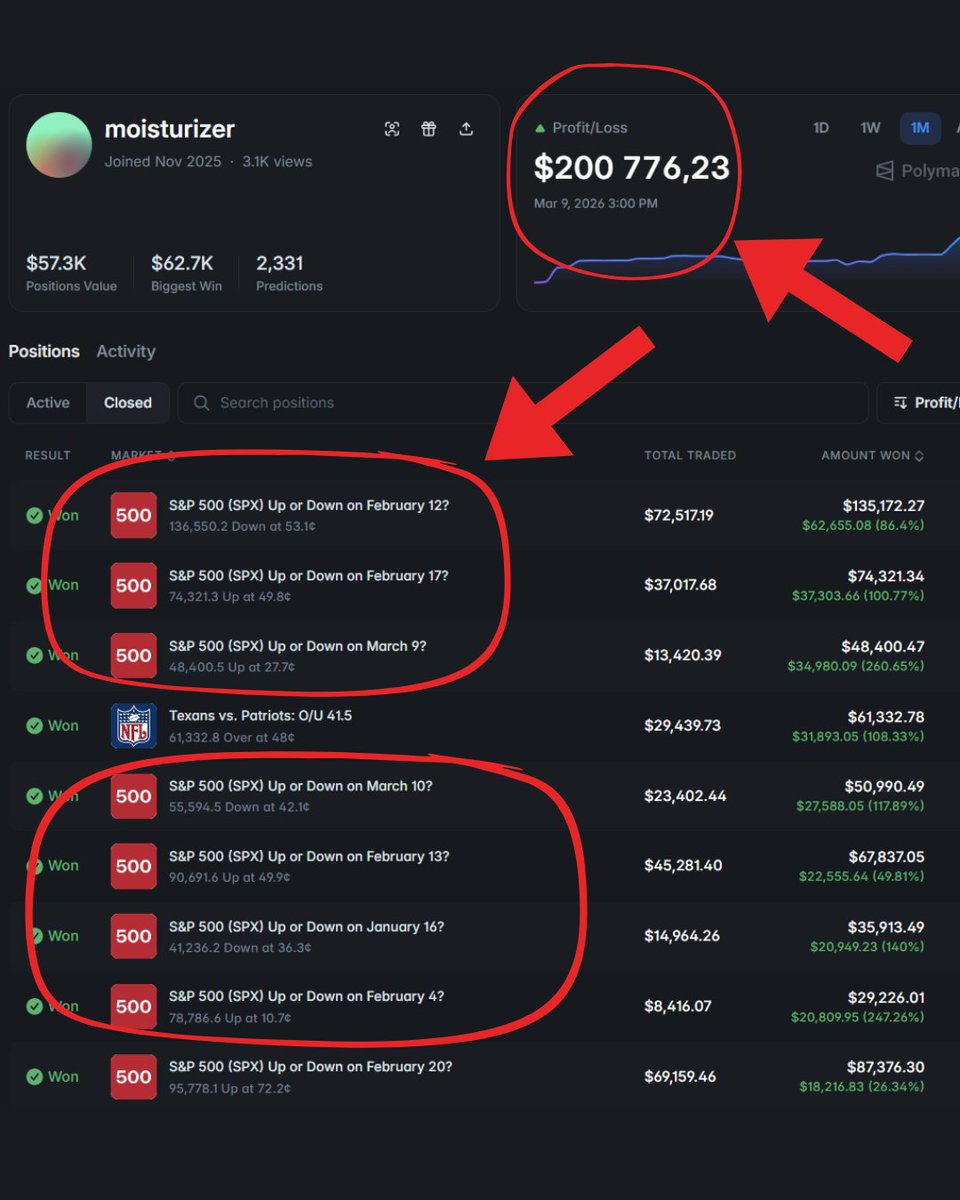
Chinese quant built a simulation of how SPX price reacts to any global event. He’s already made over $100k - with full blockchain proof.
He knows exactly where price will go.
More than 40 years of SPX trading history have been loaded into MiroFish simulator (18k stars on GitHub)
AI analyzed every single moment in that trading history.
Now this guy has a fully functional SPX price prediction system.
His wallet: @moisturizer?via=cvxv666" target="_blank" rel="nofollow noopener">polymarket.com/@moisturizer?v…
Dozens of successful SPX price-prediction trades and hundreds of tests across other stock markets.
Here’s exactly what you need to replicate his stack:
- market data APIs (SPX price, use Alpha Vantage or Quandl)
- data pipeline (use Python)
- feature engineering (for output signals like RSI, MACD)
- seed dataset for MiroFish (convert data into structured context)
- multi-agent simulation (macro strategist, earnings analyst, sentiment analyst agents etc.)
- probability forecast (run different scenarios)
- trading / decision Model (SPX futures ES, SPY ETF)
Save this pipeline if you want to run a similar simulation on your own data.
You can feed the whole thing to your Claude and build your first (even small) simulation model together.
English
haewon retweetledi

We've uploaded a fruit fly. We took the @FlyWireNews connectome of the fruit fly brain, applied a simple neuron model (@Philip_Shiu Nature 2024) and used it to control a MuJoCo physics-simulated body, closing the loop from neural activation to action.
A few things I want to say about what this means and where we're going at @eonsys. 🧵
English
haewon retweetledi

haewon retweetledi

Introducing a new type of civic tech made possible by AI. Every citizen should have a live, systems view of their government and today we bring that to SF!
Track gov entities, spending, news, and more in real time. With LLMs, we can bring this to every city. Who's next?
English
haewon retweetledi

haewon retweetledi
Writing software, especially prototypes, is becoming cheaper. This will lead to increased demand for people who can decide what to build. AI Product Management has a bright future!
Software is often written by teams that comprise Product Managers (PMs), who decide what to build (such as what features to implement for what users) and Software Developers, who write the code to build the product. Economics shows that when two goods are complements — such as cars (with internal-combustion engines) and gasoline — falling prices in one leads to higher demand for the other. For example, as cars became cheaper, more people bought them, which led to increased demand for gas. Something similar will happen in software. Given a clear specification for what to build, AI is making the building itself much faster and cheaper. This will significantly increase demand for people who can come up with clear specs for valuable things to build.
This is why I’m excited about the future of Product Management, the discipline of developing and managing software products. I’m especially excited about the future of AI Product Management, the discipline of developing and managing AI software products.
Many companies have an Engineer:PM ratio of, say, 6:1. (The ratio varies widely by company and industry, and anywhere from 4:1 to 10:1 is typical.) As coding becomes more efficient, teams will need more product management work (as well as design work) as a fraction of the total workforce. Perhaps engineers will step in to do some of this work, but if it remains the purview of specialized Product Managers, then the demand for these roles will grow.
This change in the composition of software development teams is not yet moving forward at full speed. One major force slowing this shift, particularly in AI Product Management, is that Software Engineers, being technical, are understanding and embracing AI much faster than Product Managers. Even today, most companies have difficulty finding people who know how to develop products and also understand AI, and I expect this shortage to grow.
Further, AI Product Management requires a different set of skills than traditional software Product Management. It requires:
- Technical proficiency in AI. PMs need to understand what products might be technically feasible to build. They also need to understand the lifecycle of AI projects, such as data collection, building, then monitoring, and maintenance of AI models.
- Iterative development. Because AI development is much more iterative than traditional software and requires more course corrections along the way, PMs need be able to manage such a process.
- Data proficiency. AI products often learn from data, and they can be designed to generate richer forms of data than traditional software.
- Skill in managing ambiguity. Because AI’s performance is hard to predict in advance, PMs need to be comfortable with this and have tactics to manage it.
- Ongoing learning. AI technology is advancing rapidly. PMs, like everyone else who aims to make best use of the technology, need to keep up with the latest technology advances, product ideas, and how they fit into users’ lives.
Finally, AI Product Managers will need to know how to ensure that AI is implemented responsibly (for example, when we need to implement guardrails to prevent bad outcomes), and also be skilled at gathering feedback fast to keep projects moving. Increasingly, I also expect strong product managers to be able to build prototypes for themselves.
The demand for good AI Product Managers will be huge. In addition to growing AI Product Management as a discipline, perhaps some engineers will also end up doing more product management work.
The variety of valuable things we can build is nearly unlimited. What a great time to build!
[Original text: deeplearning.ai/the-batch/issu… ]
English
haewon retweetledi

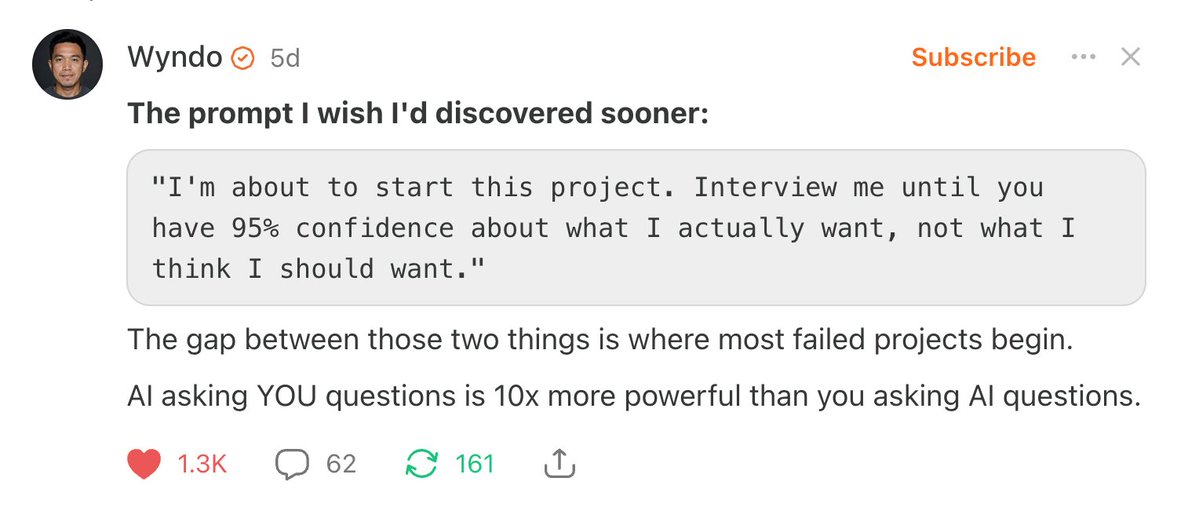
Someone on Reddit just dropped the perfect ChatGPT prompt for clear, accurate and straight answers:

Nelly;@nrqa__
oh sh*t.. @veedstudio just killed expensive video productions Fabric 1.0 lets you turn any image into a high-quality talking video: - UGC ads - Social content - Sales videos - Product demos.. etc faster timelines, lower costs, and nonstop on-brand content
English
I’ve been circling around the question, “How can we code democracy?” and, for weeks, found myself stuck in the weight of trying to make it real.
So I went back to where it began. Opening Plurality again, retracing the first sparks. In doing so, fragments of thought started to find shape, gathering into something more concrete: an idea of Ontology Driven Civic Infrastructure.
Now, a faint blueprint is emerging—what a blockchain & DAO project in Buenos Aires might look like, and how it could later weave into the Digital Democracy project in Taipei semester
There’s still a long road of study ahead. With patience and gratitude, I’ll keep walking it, one step at a time.

English
haewon retweetledi

Your actions reflect who you are.
Your words are simply reputation management.
English