Abdul Rehman

1.4K posts

Abdul Rehman banner
Abdul Rehman

Abdul Rehman

@iamayybee

I play with GABAergic interneurons in the motor cortex to relieve STN stress. C BRAINS PhD Fellow, École Normale Supérieure Paris PSL | Glasgow Alum| Notts Alum

Katılım Temmuz 2016
2.8K Takip Edilen290 Takipçiler
Abdul Rehman retweetledi

Science Advances
Science Advances@ScienceAdvances·
A miniaturized ultrasound enables targeted stimulation of subregions throughout the #brain, increasing the types of tools and opportunities for studying brain function. scim.ag/4vmI7hL
Science Advances tweet media
English
1
11
64
5.2K
Abdul Rehman retweetledi
Lindsay Halladay
Lindsay Halladay@LindsayHalladay·
✨🧠Postdoc position open!🧠✨ If you’re excited about neural circuits, stress, and behavior (and want to do some really cool experiments), I’d love to hear from you. Please share! arizona.csod.com/ux/ats/careers…
English
2
36
101
13.6K
Abdul Rehman retweetledi
SfN Journals
SfN Journals@SfNJournals·
#JNeurosci: Galvan et al. show that most GPe neurons exhibit substantial variability in firing over minutes, calling into question whether firing patterns alone can reliably define cell types. doi.org/10.1523/JNEURO…
SfN Journals tweet media
English
0
3
6
770
Abdul Rehman retweetledi
Brian Sweis
Brian Sweis@BrianMSweis·
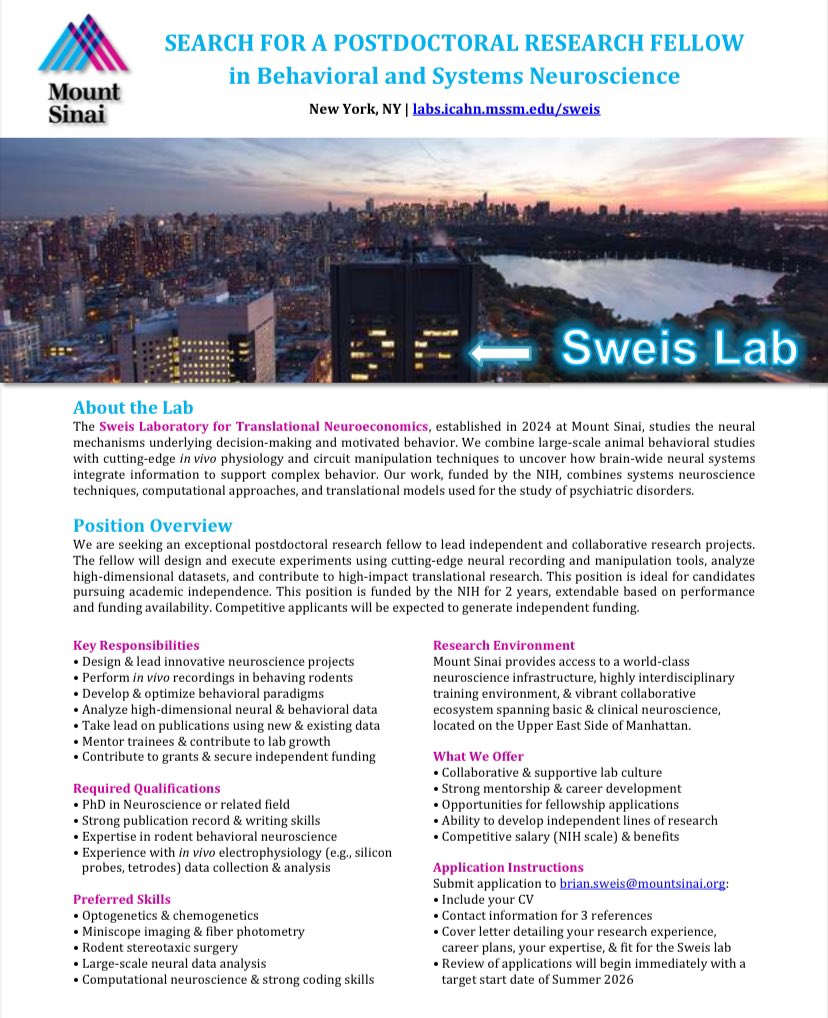
🚨The Sweis Lab for Translational Neuroeconomics @IcahnMountSinai is searching for a postdoc fellow! If you or someone you know is searching for a position, please share! 📄 📌Link to job flyer here: tinyurl.com/3vapfpn5 🧠 🐁 🔬🏙️🌆🧪🧬💊🧫💡🏥 @MountSinaiPsych @SinaiBrain
Brian Sweis tweet media
English
0
19
50
9.4K
Abdul Rehman
Abdul Rehman@iamayybee·
Would be interesting to know the % loss of NAcc and VTA in human in PD. As its not clearly stated in major studies. Its mostly striatum
The Science of Parkinson's@ScienceofPD

Neuropath. & molecular analyses on 47 postmortem substantia nigra samples implicate ferroptosis (& to a lesser extent necroptosis) in #Parkinsons cell death; Researchers propose a “2-hit” model: early synucleinopathy amplified later by a neuromelanin-iron onlinelibrary.wiley.com/doi/10.1002/an…

English
0
0
1
188
Abdul Rehman retweetledi
Takaki Komiyama
Takaki Komiyama@takaki_komiyama·
Our new work is out in Science Advances. We show that neural activity in the striatum reflects not just cortical inputs, but also often-underappreciated thalamic inputs. science.org/doi/10.1126/sc…
English
2
13
61
5.4K
Abdul Rehman retweetledi
Gord Fishell
Gord Fishell@GordFishell·
Excited for the publication of our recent work on how pyramidal cells shape the identity of interneurons in the Cortex! Big shout out to @artofbiology and Sherry Jingjing wu! nature.com/articles/s4158…
English
2
22
105
16.5K
Abdul Rehman retweetledi
Brain
Brain@Brain1878·
Averna et al. show that movement-related gamma activity in the STN of patients with Parkinson’s disease propagates spatially during motion, with the degree of propagation related to motor impairment and medication response. shorturl.at/zNFGz
Brain tweet media
English
1
7
17
1.6K
Abdul Rehman retweetledi
Shan Meltzer
Shan Meltzer@shanmeltzer·
In grad school @UCSF, Lou Reichardt used to tell use that science is like mountain climbing. I appreciate that more and more now. The ascent is grueling and the challenges are constant, but it's an adventure for discoveries no one has seen before. To my fellow trainees: keep climbing! The view is worth it. 🏔️✨
English
1
2
28
3.7K
Abdul Rehman retweetledi
Neuropsychopharmacology
Neuropsychopharmacology@npp_journal·
Interactions between striatal–prefrontal & hippocampal–prefrontal systems shape value-based learning & goal-directed behavior during adolescence; asynchronous maturation of these circuits may contribute to vulnerability to mental health disorders nature.com/articles/s4138…
English
0
16
43
2.8K
Abdul Rehman retweetledi
Michael Okun
Michael Okun@MichaelOkun·
What is the road roadmap for optogenetics to reach human level treatments? Can we go from light to insight? Optogenetics refers to using light to precisely turn specific brain cells on or off in order to understand how circuits work and how to fix them. Lüscher, Deisseroth and colleagues describe in a new Perspective in Nature Neuroscience how optogenetics is shaping discoveries today, and laying out more realistic paths toward future human therapies. Key Points: - Optogenetics has already transformed how we map brain circuits and identify which cells actually cause symptoms. - Many near term benefits will come indirectly by using optogenetic insights to improve medications and neuromodulation like DBS, rather than actually putting light into the human brain. - Direct optogenetic therapies in humans are possible for select conditions, however they demand careful attention to safety ethics and regulation. My take: This paper is really important and a great read. Optogenetics is not just a flashy lab tool. It is a blueprint for smarter therapies. We will need to understand and to respect biology, ethics and timelines for translation. The biggest wins may come from what optogenetics teaches us, rather than from 'where we shine the light.' Here are 5 points that resonated w/ me: 1- Causal circuit knowledge is the real breakthrough, not the light itself. 2- Indirect translation may help folks sooner by refining existing therapies and using 'optogenetic logic.' 3- Direct human applications are feasible for carefully chosen indications like vision and also for focal symptoms. 4- Ethics and 'cognitive liberty' must stay front and center as we move from animals to humans. 5- The future likely blends optogenetics w/ gene therapy, imaging biomarkers and adaptive stimulation. This will allow us to deliver more precise treatment. nature.com/articles/s4159… @NatureNeuro @FixelInstitute @ParkinsonDotOrg @movedisorder @SfNtweets
Michael Okun tweet media
English
2
6
34
2.6K
Abdul Rehman retweetledi
Michael Okun
Michael Okun@MichaelOkun·
Cortico-basal rhythms reveal how the brain changes during DBS. Oscillations are rhythmic brain signals that reflect how groups of neurons communicate and coordinate movement and thinking. Lawrence, Little and colleagues describe in a new paper that just dropped in Brain how cortico-basal oscillations track natural everyday movements in individuals receiving deep brain stimulation for Parkinson’s. Key Points: - Brain signals linking cortex and basal ganglia change in predictable ways during real world movements, not just lab tasks. - Deep brain stimulation alters these oscillatory patterns in ways that relate to movement quality and timing. - Measuring these signals during naturalistic behavior may provide a roadmap for more adaptive and personalized stimulation. My take: This study will help us to push physiological DBS out of the clinic and into real life. If we can understand how the moving brain behaves during everyday activities, we can begin to program stimulation that listens and responds, rather than simply delivers fixed energy. Here are 5 points that resonated w/ me: 1- Brain rhythms reflect how networks talk to each other during walking, reaching and daily actions. 2- Signals recorded during natural movements may be more informative than those captured during scripted tasks. 3- DBS does not just suppress symptoms, it reshapes communication across motor networks. 4- Adaptive approaches that respond to these oscillations could improve function for many folks. 5- The future of DBS likely depends on aligning stimulation timing intensity and targets w/ real world brain activity. academic.oup.com/brain/advance-… @DBSThinkTank @ParkinsonDotOrg @Brain1878 #parkinson @SfNtweets
Michael Okun tweet media
English
2
33
136
8.3K
Abdul Rehman retweetledi
SfN Journals
SfN Journals@SfNJournals·
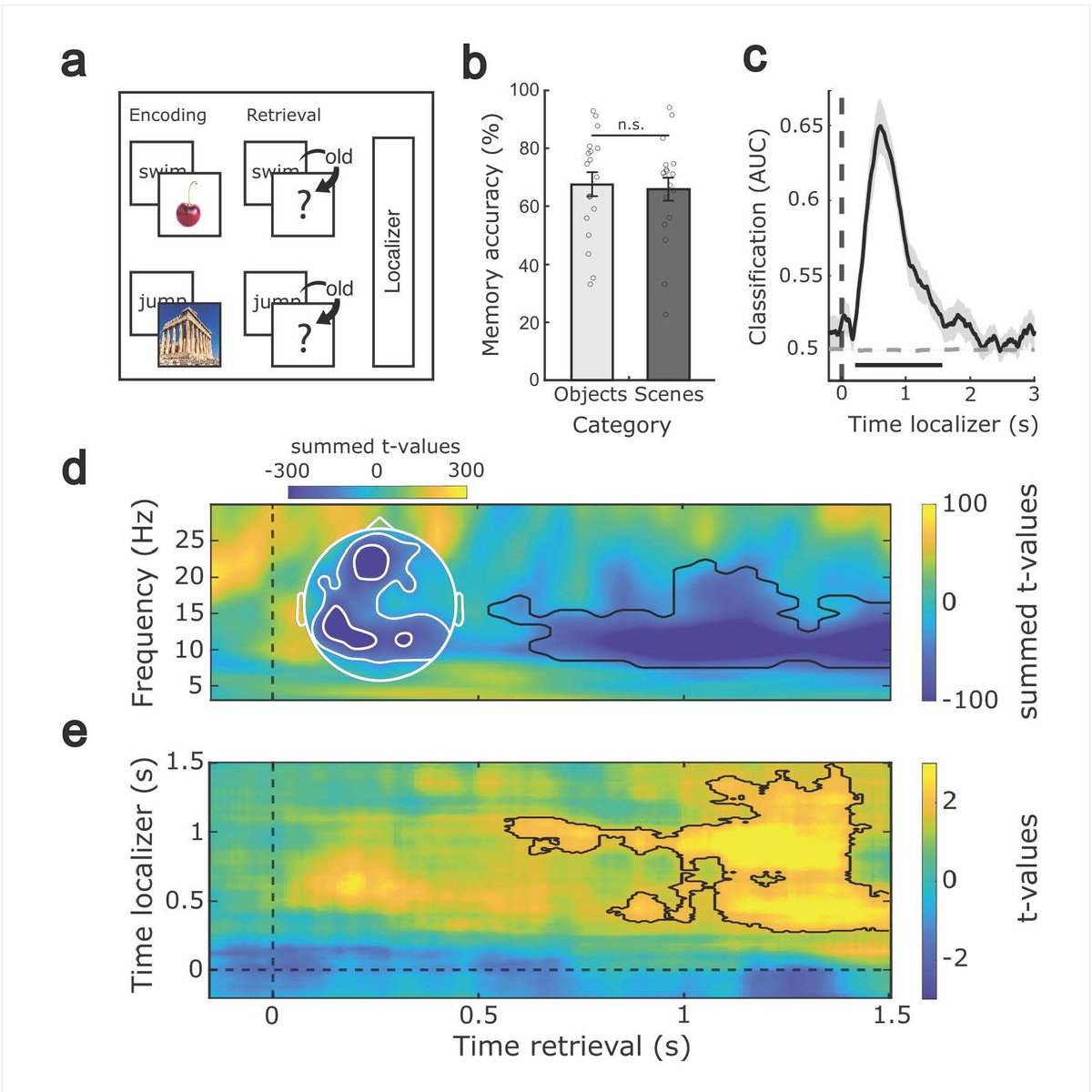
#JNeurosci: Tarrasó et al. explored how breathing impacts behavioral and neural representations of memory recall in people. They found exhaling shapes two neural signatures for memory recollection to influence the strength of personal memories. doi.org/10.1523/JNEURO…
SfN Journals tweet media
English
3
10
39
4K
Abdul Rehman retweetledi
Science Advances
Science Advances@ScienceAdvances·
Increased #sleep plays a crucial role in recovering from illness, but the neural mechanisms underlying sickness-induced sleep are poorly understood. In a new study, researchers identify a brainstem circuit that mediates sickness-induced sleep. scim.ag/4iR6sGB
Science Advances tweet media
English
0
15
79
7.8K
Abdul Rehman retweetledi
Franz Mittermaier
Franz Mittermaier@FMittermaier·
⚡️Our multi-neuron patch-clamp study on human neurons was published in @NatureNeuro today! We identified functional neuron-types and mapped their connection profile. This revealed connectivity principles that are conserved across individual humans. Link: nature.com/articles/s4159…
Franz Mittermaier tweet mediaFranz Mittermaier tweet media
English
1
40
140
8.5K