Quaid Fontaine

9.1K posts

Quaid Fontaine banner
Quaid Fontaine

Quaid Fontaine

@iampaulverizer

Katılım Mayıs 2022
344 Takip Edilen1K Takipçiler
Sabitlenmiş Tweet
Quaid Fontaine
Quaid Fontaine@iampaulverizer·
The Human Eternity Amendment Proposed 28th Amendment to the United States Constitution Section 1. The United States shall be governed solely by natural persons who are citizens of the United States. No non-human intelligence—whether artificial, machine, extraterrestrial, biological, or of any other origin—shall ever exercise or direct the exercise of legislative, executive, or judicial power over the people of the United States or any State. Section 2. No law, regulation, rule, or official act of any kind shall give binding force to any recommendation, score, ranking, prediction, endorsement, or output produced by non-human intelligence concerning: (a) the qualification, selection, ranking, or endorsement of candidates for public office; (b) the drafting, scoring, amendment, passage, or veto of any bill, resolution, or regulation; (c) the appointment, removal, or discipline of any public official; or (d) the interpretation or application of this Constitution or the laws of the United States or any State. Section 3. Any elected or appointed official of the United States or of any State may disregard, override, or contradict any output or recommendation of non-human intelligence on any matter at any time, without justification, without penalty, and without triggering recall, impeachment, or any other sanction. Section 4. Any public official or employee who knowingly causes or permits non-human intelligence to exercise authority prohibited by Section 1 or Section 2 shall be guilty of a felony, removed from office, and permanently disqualified from holding any office of honor, trust, or profit under the United States or any State. Section 5. Congress and the several States shall have power to enforce this article by appropriate legislation. This article shall be inoperative unless it shall have been ratified as an amendment to the Constitution by legislatures of three-fourths of the several States within seven years from the date of its submission. Why This Amendment Matters This amendment is the permanent firewall to ensure America remains a government of, by, and for the people—forever. In an age of advancing technology, it guarantees that only living human citizens hold sovereign power. No machine, algorithm, or other non-human entity can ever rule us, advise in a binding way, or influence elections and laws without human override. It honors the Founders’ vision: sovereignty belongs to us, not to code or circuits. Once ratified, this locks in human control eternally, protecting future generations from unintended machine governance. Key Protections It Provides: •  Human-Only Decisions: AI or any non-human can advise, but never decide or enforce. •  Unlimited Overrides: Elected officials can ignore AI outputs freely, without punishment. •  Future-Proof: Covers AI, aliens, or any unforeseen intelligence—nothing non-human gets power. •  Enforceable: Violators face felony charges and permanent disqualification from office. This is the only way to keep the Republic human. Share it. Endorse it. Fight for it. I Endorse the Human Eternity Amendment I support ratification of this proposed 28th Amendment to ensure the United States is governed only by human beings—forever.
English
9
0
2
284
Quaid Fontaine
Quaid Fontaine@iampaulverizer·
Top 10 Locations to build a new US City- 1. Kaufman County / East DFW exurbs, Texas
One of the fastest-growing counties in the US (projected ~50% growth in recent analyses), with vast undeveloped land in the booming DFW metro orbit. Proximity to jobs, airports, rails, and highways; strong logistics/energy economy; business-friendly policies. Ideal for massive suburban-to-urban expansion or new satellite city. 2. Williamson County / Leander area north of Austin, Texas
Tops many fastest-growing lists; tech-driven boom with room for greenfield development. Excellent transport links, young demographics, and Texas’ low-regulation environment make it prime for scaling to a midsize tech/innovation hub. 3. Sumter County / Wildwood–The Villages area, Central Florida
#1 fastest-growing place in recent U.S. News rankings, with massive master-planned community success (The Villages). Abundant land, tourism/retirement draw, and infrastructure investments support a self-contained new/expanded city focused on livability and amenities. 4. Jasper County / Lowcountry near Hilton Head–Beaufort, South Carolina
Highest percentage growth among larger counties in some 2025–2026 data; coastal access with room for expansion. Growing manufacturing/tourism economy, affordable land, and Southeast migration trends favor a new mixed-use city. 5. Pinal County / Casa Grande area (between Phoenix and Tucson), Arizona
Rapid growth corridor with significant undeveloped land. Benefits from Southwest economic diversification (tech, logistics) and existing highway/rail links; master-planned potential despite water management needs. 6. Treasure Valley exurbs around Boise, Idaho
High per-capita new housing construction and strong quality-of-life appeal (outdoors, low crime). Tech/manufacturing influx plus abundant land in a growing but still affordable Mountain West metro make it excellent for planned expansion. 7. Raleigh-Durham exurbs / Research Triangle area, North Carolina
Consistently tops economic performance indexes; biotech/tech job growth with room outward. Business-friendly, good infrastructure, and moderate climate support scaling existing momentum into larger urban nodes. 8. Nashville metro exurbs / Middle Tennessee
Music, healthcare, and logistics hub with strong population inflows. Tennessee’s no-income-tax policy and available land around the core enable massive expansion or satellite developments. 9. Solano County (e.g., California Forever site near Travis AFB), California
Notable for a major proposed greenfield new-city project by investors aiming for 400k+ residents on former farmland. Proximity to Bay Area jobs/tech without the density/cost; rail/port access offers unique “new build from scratch” potential despite state hurdles. 10. Greenville–Spartanburg / Upstate South Carolina
Manufacturing renaissance (auto, advanced industry) with land availability and lower costs than coastal SC. Strong growth trends, quality-of-life factors (mountains, rivers), and pro-business environment suit a midsize industrial/innovation city expansion.
English
0
0
0
36
Select Committee on China
Select Committee on China@ChinaSelect·
The CCP’s push for AI dominance isn’t driven by fair competition but instead by theft and smuggling. U.S. officials have warned of “industrial-scale” efforts to siphon know-how from American labs, including the use of more than 24,000 fraudulent accounts to generate over 16 million interactions with advanced AI systems. This “distillation” allows Chinese entities to replicate frontier models at a fraction of the time and cost. At the same time, federal prosecutors have uncovered a global smuggling network moving billions of dollars’ worth of restricted chips through Southeast Asia into China while evading U.S. safeguards to power China’s AI ambitions. This is a coordinated strategy to shortcut innovation and undermine American technological leadership. spectator.com/article/chinas…
English
40
143
312
13.6K
Quaid Fontaine retweetledi
Palmer Luckey
Palmer Luckey@PalmerLuckey·
It is time for the United States Postal Service to ban junk mail. Unsolicited spam calls are already prohibited by the FCC. Emails are heavily regulated by the CAN-SPAM Act of 2003. Junk mail is the majority of mail, 100 million trees per year. Enough!
Palmer Luckey tweet media
English
3.1K
3.6K
43.8K
3.6M
Quaid Fontaine
Quaid Fontaine@iampaulverizer·
@elonmusk Will AI kill Radical Feminism? Here’s a visual breakdown of gender composition in AI-exposed jobs:
Quaid Fontaine tweet media
English
0
0
0
16
Treasury Secretary Scott Bessent
Treasury Secretary Scott Bessent@SecScottBessent·
In advance of @POTUS' historic summit with President Xi in Beijing, I will depart on Monday for a quick series of meetings in both Japan and South Korea. On Tuesday, I will meet in Tokyo with Prime Minister @takaichi_sanae, Finance Minister @satsukikatayama, and other government and private sector representatives for discussions on the U.S.-Japan economic relationship. On Wednesday, I will stop in Seoul for a discussion with Vice Premier He Lifeng of China, before continuing on to Beijing for the Leaders’ Summit between President Trump and President Xi. Economic security is national security, and I look forward to a productive series of engagements as we work to advance President Trump’s America First Economic Agenda.
English
1.1K
3.9K
21.1K
1.5M
Quaid Fontaine
Quaid Fontaine@iampaulverizer·
@MarioNawfal The US should move rapidly to implement the US-IRAMP and US-RAMP to boost economic growth and improve global peace!
English
0
0
0
13
Mario Nawfal
Mario Nawfal@MarioNawfal·
🇺🇸 🇮🇷 The real cost of this war isn't measured in dollars or missiles. It's measured in long-term American interests sacrificed for short-term gains... Look at what the U.S. has actually traded over 76 days of war. Alliances built over decades got tested and many failed publicly. NATO refused to join the campaign. The UK was slow to provide bases. France led European efforts to find off-ramps Trump didn't want. Germany's chancellor publicly called the U.S. strategy a humiliation. The Gulf states pulled airspace access to force operational pauses. The trust required for future coalitions takes generations to rebuild and was burned in weeks. Strategic Petroleum Reserve drew down to manage price shocks. Munitions stockpiles depleted to dangerous lows. 1,100 JASSM-ER missiles fired with only 1,500 left globally. The strategic deterrent designed for Pacific contingencies got spent on Iran. Replacement timelines stretch six years. National debt added through emergency defense spending will be serviced by taxpayers for generations. Iran ended up with long-term strategic gains the war was supposed to prevent. Hormuz leverage formally codified into Iranian law. Toll collection operationalized. Regime more entrenched than before the bombing. IRGC stronger relative to civilian government. Nuclear program preserved per the intelligence community's own assessment. The "moderates" the war was supposed to empower never materialized. The hardliners the war was supposed to weaken consolidated power. America's reputation as the indispensable security guarantor took the worst hit of all. The Gulf states watched the U.S. struggle to enforce its own blockade without their cooperation. Allies witnessed America publicly demanding their assistance after weeks of insulting them. Adversaries observed exactly how stretched the U.S. military becomes when pulled across multiple theaters. The implicit deterrence that kept Taiwan, Ukraine, and the Korean peninsula stable just got measured and found wanting. What did America gain in exchange? Short-term degradation of Iranian conventional military capability. Disruption to Iran's economy. Some demonstration of resolve. That's it. That's the entire ROI for everything America just spent...
Mario Nawfal tweet media
English
278
360
1K
97K
Quaid Fontaine
Quaid Fontaine@iampaulverizer·
Is this guy trying to get a message to Elon Musk?
English
0
0
1
21
RNC Research
RNC Research@RNCResearch·
CNN: Another issue is your response to the deadly California fires...are you responsible for the mismanagement that did occur? BASS: "Well...with climate change..."
English
523
978
5.5K
342.6K
Mario Nawfal
Mario Nawfal@MarioNawfal·
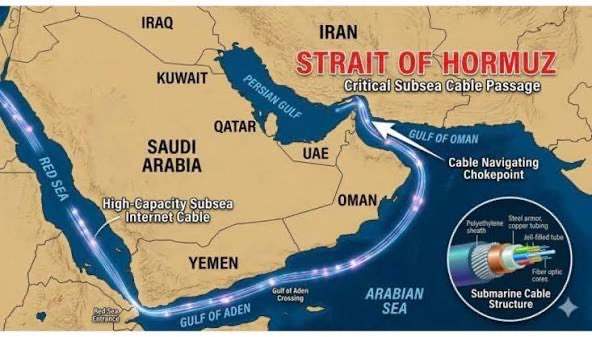
🚨🇮🇷 Iran is moving to take control of 7 undersea internet cables in the Strait of Hormuz... The details are remarkable. Under the new policy being considered, foreign operators would be required to obtain permits to use these cables, pay fees, follow Iranian law, and all management and maintenance would be handled by Iranian companies. The IRGC has previously warned it could physically target these same cables. This is the same Hormuz playbook applied to digital infrastructure. Iran already passed parliamentary legislation establishing toll collection on shipping. Now Tehran is preparing to apply identical leverage to the data cables that carry traffic between Europe, Asia, and the Gulf. The strait isn't just a chokepoint for oil anymore. Iran is positioning it as a chokepoint for global communications. The strategic implications are MASSIVE. These cables carry an enormous share of data traffic between Asian economies and European markets. Banking transactions. Stock trading. Cloud services. Government communications. The same infrastructure that powers global commerce runs through waters Iran is now claiming jurisdiction over. For Tehran, this is the next iteration of the leverage strategy that has worked all war. Block oil shipping until you get sanctions relief. Now propose to control data flows until you get more concessions. Each new chokepoint Iran formalizes creates additional pressure that the U.S. has to address in any final deal. The IRGC's warning that it could target the cables physically is the velvet glove on the iron fist. Pay the fees, follow Iranian law, accept Iranian management, or risk the entire global communications architecture between Europe and Asia going dark. That's the kind of asymmetric threat that doesn't require nuclear weapons or even particularly sophisticated military capability. Source: @KobeissiLetter
Mario Nawfal tweet media
Mario Nawfal@MarioNawfal

🇮🇷 Iran's deputy energy chief admits the war's damage will take two years to recover from: "Realistically, damage has been done to the country's infrastructure and our gas and fuel network, and despite the efforts of the authorities, we have no choice but to save money in the next one and a half to two years. Part of our gasoline production capacity has encountered problems, and the steel and petrochemical industries have suffered losses." While Ghalibaf posts "Operation Trust Me Bro" and the IRGC claims victory, the people running Iran's economy are telling citizens to brace for two years of austerity. This is why the MoU response can't wait much longer. Every day without sanctions relief, the gap between Iran's victory narrative and its economic reality gets wider and wider. And the blockade is accelerating the damage faster than any deal can possibly reverse it.

English
59
133
372
164.3K
Quaid Fontaine
Quaid Fontaine@iampaulverizer·
@ArmstrongEcon What would happen to the dollar if the US-RAMP and US-IRAMP frameworks were implemented?
English
0
0
0
348
Martin A. Armstrong
Martin A. Armstrong@ArmstrongEcon·
We are heading into the final stages of a sovereign debt crisis because governments treated borrowing like a perpetual motion machine with no intention of ever paying anything back.
English
33
210
906
34K
Kalshi
Kalshi@Kalshi·
JUST IN: Putin says the war with Ukraine is coming to an end
English
226
538
7.8K
1.3M
Quaid Fontaine
Quaid Fontaine@iampaulverizer·
Combined Effect: A Values-Amplified Architecture Together, US-RAMP + US-IRAMP create Quad-plus synergy: • Economic values in action: The frameworks deliver the tangible prosperity (US GDP boosts, job creation, lower inflation) that makes democratic partnerships more attractive than China’s debt-trap or state-directed model—exactly the “affirmative vision” the Quad promotes. • Geoeconomic pincer: Russian resources + Indian manufacturing = closed-loop, Quad-centered supply chains that bypass Beijing, reinforcing sovereignty and reducing coercion vulnerabilities. • Broader appeal: These separate-but-mirrored partnerships expand the “coalition of the willing” without diluting Quad’s democratic core—Japan and Australia benefit from diversified inputs and stronger US-India ties, while the US gains leverage across both Europe-adjacent (Russia) and Indo-Pacific theaters. From the pro-RAMP/IRAMP viewpoint, the Quad’s values are not abstract ideals—they are the strategic glue that makes these frameworks politically viable and maximally effective. By embedding US-first asymmetry within a values-aligned framework, the US doesn’t just manage competition with China; it rewires global economics around democratic principles, delivering outsized prosperity at home while making the free and open Indo-Pacific vision materially unstoppable. This is values synergy at its most pragmatic and powerful.
English
0
0
0
17
Quaid Fontaine
Quaid Fontaine@iampaulverizer·
Indirect but Powerful Synergy with US-RAMP (Russia as the Strategic Wedge) Russia is not a Quad member and remains geopolitically distant, yet proponents see US-RAMP as enhancing Quad values by fracturing the authoritarian axis: • Values realism, not perfection: While Russia scores low on democracy metrics, its post-Soviet market transition, European cultural heritage, and nationalist (vs. messianic) authoritarianism make it more reconcilable than the CCP’s totalitarian model. RAMP’s phased integration offers Russia a Western economic off-ramp—redirecting energy, metals, and minerals toward the US and, indirectly, Quad supply chains. This weakens the Russia-China “no-limits” partnership that threatens the free and open Indo-Pacific. • Resource and geopolitical relief: US access to Russian critical minerals under the ramp diversifies Quad members away from China’s 60–90% processing dominance—directly feeding into the 2025 Quad Critical Minerals Initiative. A Russia more economically tied to the US is less likely to fully back Chinese coercion in the South/East China Seas or against India’s borders. • Longer-term values pull: Proponents view the ramp’s front-loaded US benefits as a proven liberalization catalyst (historical precedent with post-WWII Europe). By giving Russia predictable gains on a US-favored timetable, RAMP gradually aligns incentives with rules-based norms—creating space for the Quad to operate in a less contested Eurasian theater.
English
0
0
0
18
Quaid Fontaine
Quaid Fontaine@iampaulverizer·
Quadrilateral Security Dialogue (Quad)—comprising the US, India, Japan, and Australia—and the hypothetical US-RAMP and US-IRAMP frameworks creates absolute deterrence. Direct Synergy with US-IRAMP (India as the Quad Overlap) India is already a Quad pillar and the world’s largest democracy—making US-IRAMP a seamless economic complement that turbocharges Quad values: • Democratic compatibility on steroids: US-IRAMP’s asymmetric ramp (immediate US access to India’s massive import market while phasing Indian imports) leverages India’s flawed-but-functioning democracy, vibrant private sector, and “Make in India” reforms. This directly advances Quad priorities like resilient supply chains, critical minerals processing, semiconductors, and tech standards—areas where Quad members already collaborate. Proponents argue this cements India as the Quad’s economic engine, proving that democratic development can outpace authoritarian models. • Front-loaded US wins align with Quad goals: The ramp delivers rapid US export booms ($180–280 billion potential by year 5), joint ventures in defense/tech, and “India+1” diversification—precisely the economic-security outcomes Quad statements target. It reduces India’s ~$100+ billion trade deficit with China while embedding US firms in Indian production, strengthening the Quad’s collective leverage in critical minerals and clean tech. • Strategic multiplier: Deeper US-India economic interdependence under IRAMP reinforces Quad maritime security, counter-terrorism, and Indo-Pacific stability without requiring formal treaty commitments—perfectly matching the Quad’s flexible, values-based minilateral style. In the aggressively optimistic scenario, US-IRAMP doesn’t just “support” the Quad—it becomes its economic backbone, delivering the jobs, growth, and resilience that make democratic values visibly superior in practice.
English
0
0
0
20
Quaid Fontaine
Quaid Fontaine@iampaulverizer·
US-RAMP & US-IRAMP The Clear Contrast with China Proponents are blunt: China under the CCP represents an existential values mismatch. Its system features total Party control, mass surveillance, zero tolerance for opposition, forced ideological conformity, and a state-capitalist model that distorts global markets through subsidies, IP theft, and coercion. Beijing actively promotes “authoritarian capitalism” as a superior alternative to democracy, engages in debt-trap diplomacy, and views the US-led order as an obstacle to be dismantled. Neither Russia nor India pursues such a comprehensive ideological or systemic challenge; both are far more willing to integrate on terms that reinforce (rather than subvert) American economic and strategic primacy. Ultimately, US-RAMP and US-IRAMP supporters argue these frameworks are not naive idealism—they are hard-nosed strategy. By front-loading US advantages while building mirror-style economic interdependence, the US can strengthen democratic-market values in practice, create durable counterweights to China, and deliver massive economic wins at home. Engagement with compatible (if imperfect) partners like Russia and India is seen as far more likely to advance American principles than perpetual confrontation with an unyielding ideological adversary.
English
0
0
0
23
Quaid Fontaine
Quaid Fontaine@iampaulverizer·
Why Russia Is More Compatible with US-RAMP Than China Advocates for US-RAMP acknowledge Russia’s authoritarian tendencies (Freedom House 12/100, also “Not Free”) but argue it is still more reconcilable with US values than the CCP system: • Post-communist market transition vs. totalitarian continuity: Russia abandoned Soviet communism for a (flawed) market economy with private property, oligarchic capitalism, and constitutional forms—elements that allow real engagement with Western capital and technology. China, by contrast, doubled down on Party supremacy, merging state and economy in a way that weaponizes trade and investment against liberal norms. • Cultural and civilizational overlap: Russia’s European/Christian heritage, historical WWII alliance with the US, and geographic position make it more “Western-adjacent” than China’s Confucian-authoritarian model. Supporters contend Russia’s authoritarianism is pragmatic/nationalist rather than ideologically messianic; it does not seek to export a rival governance template worldwide or redefine global rules around anti-liberal values. • Potential for liberalization through integration: The ramped partnership is viewed as a proven tool—economic ties historically pulled nations toward openness (as with post-WWII Europe or East Asia). Isolation reinforces hardliners; US-RAMP’s front-loaded benefits (exports, investment, resource access) are seen as the best vehicle to gradually align Russia’s incentives with US-led norms, especially as it diversifies away from China dependence.
English
0
0
0
23
Quaid Fontaine
Quaid Fontaine@iampaulverizer·
Why India Stands Out as Highly Compatible for US-IRAMP Proponents highlight India as the world’s largest democracy and a natural values partner: • Democratic institutions and pluralism: India holds regular, competitive multi-party elections at national and state levels, with a federal system, independent judiciary (despite imperfections), and vibrant civil society. Freedom House rates it “Partly Free” (62/100 in the 2026 report), classifying it as a flawed but functioning democracy—orders of magnitude more open than China’s score of 9/100. Supporters argue this shared commitment to electoral accountability and pluralism aligns far more closely with American ideals than the CCP’s one-party monopoly, where dissent is systematically crushed. • Economic freedom and entrepreneurship: India’s private sector, tech boom, and “Make in India” reforms reflect a genuine embrace of market-driven growth and foreign investment—unlike China’s state-directed “socialism with Chinese characteristics,” where the Party controls key industries and demands tech transfers or political loyalty. Heritage Foundation economic freedom scores place India ahead of China, with a business environment that welcomes US capital without ideological preconditions. • Cultural and people-to-people ties: English-language proficiency, common-law heritage from British rule, a massive Indian-American diaspora (which has lobbied successfully for stronger US-India ties), and soft-power exports like Bollywood foster organic affinity. Proponents note India does not export authoritarian governance or challenge the US-led order ideologically—unlike the CCP’s global promotion of surveillance-state models and “civilizational” rivalry. • Strategic alignment potential: India’s border tensions with China and commitment to strategic autonomy make it a willing counterweight, but one that shares democratic values enough for genuine partnership rather than transactional dependence. In short, US-IRAMP supporters see India as proof that democracy and rapid development are compatible—precisely the narrative the US wants to promote globally.
English
0
0
0
24