
Inder Singh
3K posts
Inder Singh
@indspall
Just build! building agents for marketing and sales. Past - built products that scaled into unicorns. built a company in deep learning driven autonomous stores.
SFO & BLR Katılım Aralık 2008
1.9K Takip Edilen678 Takipçiler


Opus 4.7 inside of Hermes Agent is a national security risk
super fun though
English
@abe238 @ivanfioravanti Can you pls share how much unified RAM is enough? M4 max and 32GB RAM would work?
English

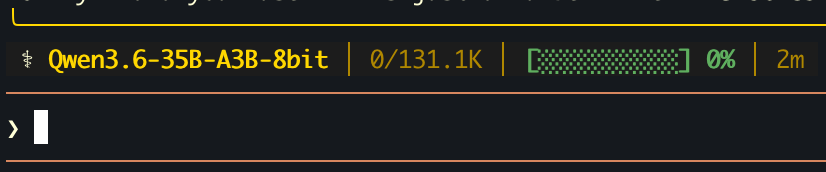

Has anyone tested Qwen3.6-35B-A3B with Hermes Agent on Apple Silicon yet?
English

Openclaw + GLM5.1 >>>> Openclaw + GPT
good stuff @Zai_org
It feels like Jarvis is back now. If you don't get an email from Jarvis, you are ngmi.
English
@hosseeb Can you pls share setup your setup and which model are using? Are you using mac m4 max kind of cpu or a GPU. Pls do share insights on how it goes
English

Migrating my OpenClaw to Hermes Agent tonight. Will update this thread with how it goes.
English

👋 Roughly, the more tokens you throw at a coding problem, the better the result is. We call this test time compute.
One way to make the result even better is to use separate context windows. This is what makes subagents work, and also why one agent can cause bugs and another (using the same exact model!) can find them. In a way, it’s similar to engineers — if I cause a bug, my coworker reviewing the code might find it more reliably than I can.
In the limit, agents will probably write perfect bug-free code. Until we get there, multiple uncorrelated context windows tends to be a good approach.
English

If Claude Code is so good, why do they need a separate feature to hunt for bugs.
Claude@claudeai
Introducing Code Review, a new feature for Claude Code. When a PR opens, Claude dispatches a team of agents to hunt for bugs.
English
@karpathy It’s like map reduce paradigm for trying out multiple hypothesis. Distributed agents reduce at some point of time and choose the right branch to move forward, and then try independent hypothesis.
English

The next step for autoresearch is that it has to be asynchronously massively collaborative for agents (think: SETI@home style). The goal is not to emulate a single PhD student, it's to emulate a research community of them.
Current code synchronously grows a single thread of commits in a particular research direction. But the original repo is more of a seed, from which could sprout commits contributed by agents on all kinds of different research directions or for different compute platforms. Git(Hub) is *almost* but not really suited for this. It has a softly built in assumption of one "master" branch, which temporarily forks off into PRs just to merge back a bit later.
I tried to prototype something super lightweight that could have a flavor of this, e.g. just a Discussion, written by my agent as a summary of its overnight run:
github.com/karpathy/autor…
Alternatively, a PR has the benefit of exact commits:
github.com/karpathy/autor…
but you'd never want to actually merge it... You'd just want to "adopt" and accumulate branches of commits. But even in this lightweight way, you could ask your agent to first read the Discussions/PRs using GitHub CLI for inspiration, and after its research is done, contribute a little "paper" of findings back.
I'm not actually exactly sure what this should look like, but it's a big idea that is more general than just the autoresearch repo specifically. Agents can in principle easily juggle and collaborate on thousands of commits across arbitrary branch structures. Existing abstractions will accumulate stress as intelligence, attention and tenacity cease to be bottlenecks.
English

I’m starting a community for cracked AI builders.
Claude Code. Codex. Cursor. Conductor.
It doesn’t matter. All I care about is that you’re building or you’re hungry to learn.
We’re sharing workflows, skills, repos, plugins, etc.
Want to join? Comment below and I’ll reach out.
English

Most people will waste this weekend.
Don’t be one of them.
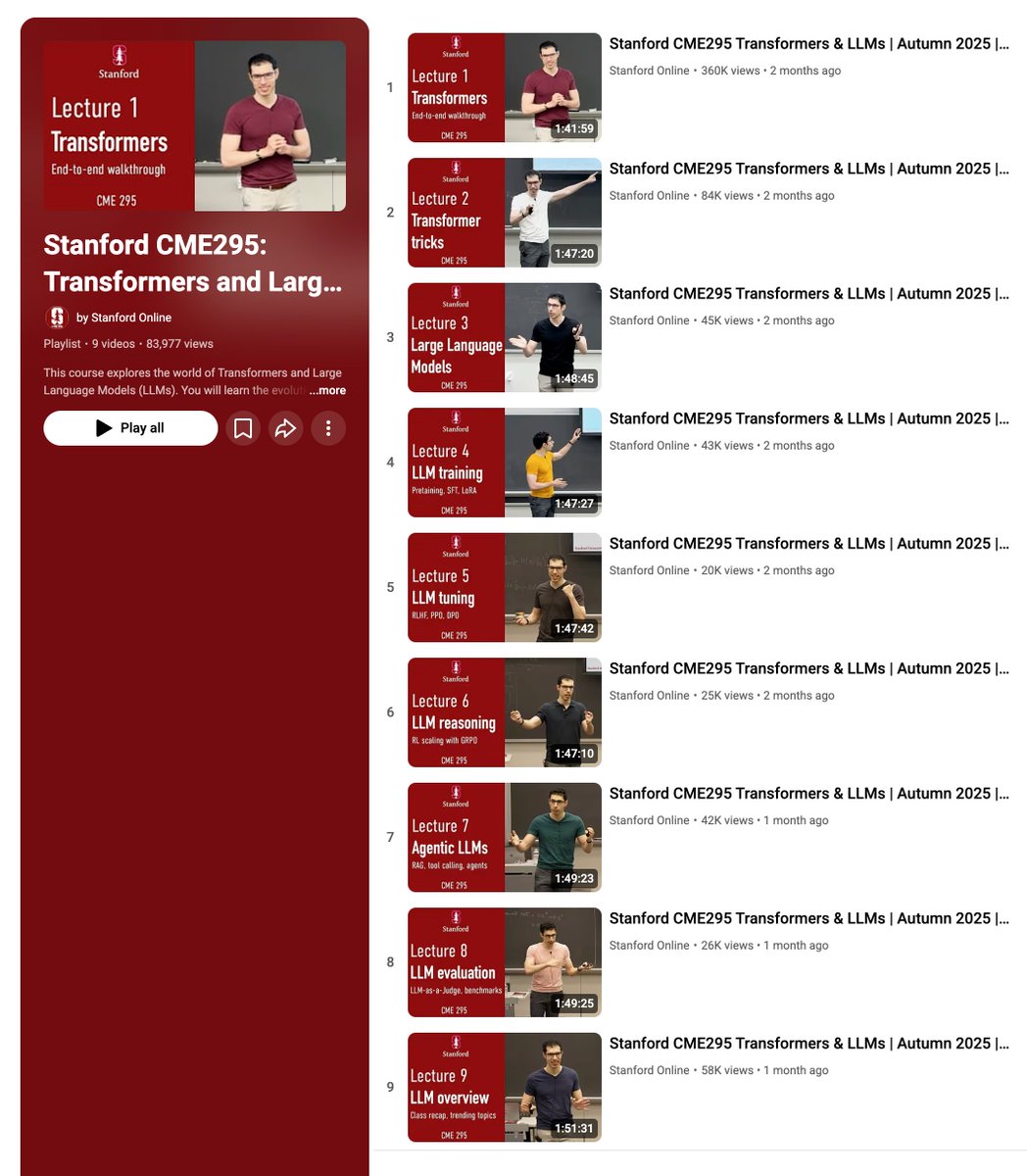
Stanford's Autumn 2025 Transformers & LLMs course. 9 lectures. Free.
While others scroll, you could understand how Flash Attention achieves 3x speedup, how LoRA cuts fine-tuning costs by 90%, and how MoE makes models efficient.
➕ What's covered:
➡️ Lecture 1: Transformer Fundamentals
→ Tokenization and word representation
→ Self-attention mechanism explained
→ Complete transformer architecture
→ Detailed implementation example
➡️ Lecture 2: Advanced Transformer Techniques
→ Position embeddings (RoPE, ALiBi, T5 bias)
→ Layer normalization and sparse attention
→ BERT deep dive and finetuning
→ Extensions of BERT
➡️ Lecture 3: LLMs & Inference Optimization
→ Mixture of Experts (MoE) explained
→ Decoding strategies (greedy, beam search, sampling) → Prompting and in-context learning
→ Chain-of-thought reasoning
→ Inference optimizations (KV cache, PagedAttention)
➡️ Lecture 4: LLM Training & Fine-tuning
→ Pretraining and scaling laws (Chinchilla law)
→ Training optimizations (ZeRO, model parallelism)
→ Flash Attention for 3x speedup
→ Quantization and mixed precision
→ Parameter-efficient finetuning (LoRA, QLoRA)
➡️ Lecture 5: LLM Tuning
→ Preference tuning
→ RLHF overview
→ Reward modeling
→ RL approaches (PPO and variants)
→ DPO
➡️ Lecture 6: LLM Reasoning
→ Reasoning models
→ RL for reasoning
→ GRPO
→ Scaling
➡️ Lecture 7: Agentic LLMs
→ Retrieval-augmented generation
→ Advanced RAG techniques
→ Function calling
→ Agents
→ ReAct framework
➡️ Lecture 8: LLM Evaluation
→ LLM-as-a-judge overview
→Best practices and benefits
→Biases and pitfalls
➡️ Lecture 9: Recap & Trending topics
From Stanford Online:
Rigorous instruction. Latest techniques. Free access.
Perfect for:
→ ML engineers building with LLMs
→ AI engineers understanding transformers
→ Researchers working on language models
→ Anyone learning beyond API calls
This weekend: learn the techniques that separate good engineers from great ones.
(I will put the playlist in the comments.)
♻️ Repost to save someone $$$ and a lot of confusion. ✔️ Follow @techNmak for more AI/ML insights.
English

o meu script faz um indexing rápido na inicialização, cacheia em forma de tabela e adicionei alguns mecanismos de invalidação e update pra caso novos arquivos sejam adicionados
em resumo uso FTS5 (full-text search) pra fazer a busca na tabela e uso o sistema de ranking pra filtrar resultados relevantes pro R&D
Português
hoje fiz uma exploração e reduzi o tempo de busca por arquivos na codebase do tiktok de quase 8s pra menos de 200ms. mencionar qualquer arquivo no claude é praticamente instantaneo agora
a configuração padrão do fast filesystem traversal é boa pra projetos menores mas pra projetos de larga escala é recomendado um sistema próprio de indexação
o claude deixa você customizar essa configuração pelo settings.json
{
"fileSuggestion": {
"type": "command",
"command": "~/.claude/file-suggestion.sh"
}
}
Português
@karpathy @prakhar5050 @eiselems @karpathy Can you please share if you are using this kind of workflow for training DNN’s as well with focus on feature engineering.
English
Claude has been running my nanochat experiments since morning. It writes implementations, debugs them with toy examples, writes tests and makes them fail/pass, launches training runs, babysits them by tailing logs and pulling stats from wandb, keeps a running markdown file of highlights, keeps a running record of runs and results so far, presents results in nice tables, we just finished some profiling, noticed inefficiencies in the optimizer resolved them and measured improvements. It looked at all PRs to the repo and categorized and prioritized them, made commits against some of them etc. I'm still very much in the loop. It made subtle mistakes that I had to point out. It got confused a few times and (amusingly) admitted that what it said was a "brain fart" (verbatim quote hah). It has missed a few ideas that I had to pitch. It made a bunch of bad design decisions that bloat the code and coupled abstractions that I had to revert. It's not perfect but I'm used to doing all of these things manually, so just seeing it running on the side cranking away at larger scope problems and coordinating all these flows in relatively coherent ways is definitely a new experience and a complete change of workflow.
English
Aggressively JIT your work. It's not about the task at hand X, it's a little bit about X but mostly about how you should have had to contribute ~no latency and ~no actions. It's digital factorio time.
English

I moved back to India in 2013 with a simple mission: to build AI for the country.
Since then, I've been incredibly fortunate to build Haptik, invest in 100+ startups, co-create TEAM for Mumbai and contribute to our sovereign AI strategy through the IndiaAI Mission. Today, all of it comes together in my next act.
Introducing Activate: India’s AI Venture Fund.
We believe AI in India will be built by technical crack teams. Activate is created for such founders, engaging with them well before company formation and investing $500k-$3M at inception.
With @177pc, the one & only person in the world I'd want to do this with.
It starts here. It starts now. It's time to Activate.
English
Inder Singh retweetledi

Specialized sub-agents seem to be the next emergent pattern for AI software development tools.
Last week, Anthropic published a blog post on how they’re building long-running agents for software development for complex, broad-scoped tasks.
One of the key optimizations they talk about is reducing content in a single session’s context window, which considerably seems to improve agent recall on the task at hand.
anthropic.com/engineering/ef…
English
Inder Singh retweetledi

Nothing good has ever been invented by committee.
“Most inventors and engineers I’ve met are like me—they’re shy and they live in their heads.
They’re almost like artists. In fact, the very best of them are artists. And artists work best alone—best outside of corporate environments, best where they can control an invention’s design without a lot of other people designing it for marketing or some other committee. I don’t believe anything really revolutionary has ever been invented by committee. Because the committee would never agree on it!”
Shane Parrish@shaneparrish
Steve Wozniak is the engineer who quietly built Apple. Here are 26 ideas I took away from this episode and my research you can use. 1. Constraints force deep understanding. 2. Focus on the step, not the outcome. 3. Committees kill revolutions. 4. Learning is the prize. 5. Institutions by default reject anything that means existing beliefs are wrong. 6. Happiness equals smiles minus frowns. 7. Misplaced loyalty is a waste. 8. Work alone on what matters if you must. 9. Patience compounds. 10. Hold your ideas with the right grip. Let go of incorrect ideas. 11. If it's worth doing, it's worth giving it 100%. 12. Obsession isn't a problem. It's an advantage. 13. Simplicity has the fewest moving parts. 14. Time will do the work for you if you align with how the world works. 15. Move with urgency. You can do it much faster than you think. 16. Design around engineering, not marketing. 17. Optimize for happiness, not fairness 18. You don't have to run the company to be a co-founder. 19. "It takes a lot of work to make something simple." 20. Obsess over customers. 21. Don't accept something because it's the way it is. 22. You win in the dark, when everyone else is partying or sleeping. 23. The only way to understand is to get your hands dirty in the work. 24. "Simplicity is the ultimate sophistication." 25. The best are always learning more. 26. Never lie. Honesty is the most important thing. (Listen now "Steve Wozniak on The Knowledge Project" or see links in comments.)
English
Inder Singh retweetledi


Inder Singh retweetledi


Inder Singh retweetledi

your product doesn't have to be perfect, but the feedback loop does
English