Interpolations

16.2K posts

Interpolations banner
Interpolations

Interpolations

@interpolated

Citizen-thinker. I’m like a cuttlefish. Call me Kevin. #science #COVID #openschools #philosophy #literature #photography

Bay Area Katılım Mart 2011
1.2K Takip Edilen2.1K Takipçiler
Sabitlenmiş Tweet
Interpolations
Interpolations@interpolated·
Containment of COVID is a fool's errand. Why? In order for containment to work, it has to work everywhere. Not just in this or that neighborhood, but in all neighborhoods. Not just in this or that county, but in all counties. 1/x
English

45
206
864
0
Interpolations
Interpolations@interpolated·
@policytensor 4. Why doesn’t Iran sprint to a nuclear weapon? They’d be insane not to. If they do make that sprint, why not turn Israel to glass, given Israel’s history of aggression? Small geographic footprint means Iran might enjoy nuclear primacy, no?
English
0
0
0
54
Interpolations
Interpolations@interpolated·
@policytensor 1. Where is Iran on the escalation ladder? 2. What moves are they likely holding in reserve? 3. Suppose US/Israel continue to escalate beyond the next 10-20 days. Which industry sectors will see the sharpest declines? Which sectors are more insulated?
English
0
0
0
75
Fabius Maximus (Ed.)
Fabius Maximus (Ed.)@FabiusMaximus01·
Now for the bad news about the war - I’ve seen no proposals for peace terms likely to be accepted by Trump and Iran. What protects Iran from the US & Israel rearming after a second cease fire - then attacking a third time? They’ll grow weaker each round.
English
1
0
4
119
Interpolations
Interpolations@interpolated·
@policytensor I had to leave the chat. Where is Iran on the escalation ladder? What moves are they likely holding in reserve? Suppose US/Israel continue to escalate beyond the next 10-20 days. Which industry sectors will see the sharpest declines? Which one’s are more insulated?
English
0
0
1
23
Policy Tensor
Policy Tensor@policytensor·
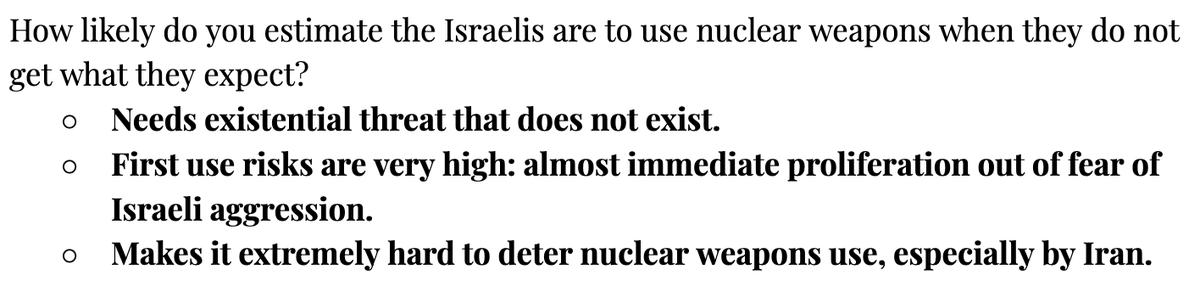
I was interviewed by a German podcast today. It will come out early next week. One of the things we talked about the risk of nuclear escalation. I do not think there is a real risk of nuclear escalation here. By way of “credentials” let me offer the following. I might be one of the most informed analysts on nuclear strategy because I have read basically everyone serious on the subject. I was also the only one to predict the most recent nuclear crisis (newstatesman.com/world/europe/u…). I believe that was before the IC concluded the same, as was later revealed by Burns and Jake. So I know at least as much about these issues as the Blobheads platformed by the papers; probably a lot more. OK, with that nonsense out of the way, let me explain why the risk of nuclear escalation is low, whether by the US or Israel. First use — breaking the nuclear taboo — is the most escalatory signaling option available to any nuclear armed state. The only scenario in which first use is a real possibility is if the existence or independence of the power is on the line. If Iran had a nuclear weapon when it was attacked with the clear aim of destroying it, there was a real possibility of first use. But neither Israel, nor the US face an existential risk from this going south. So the case for first use is ipso facto weak. There are predictable consequences of first use by any power. The most certain consequence is that Israeli or US first use in Iran will immediately lead to nuclear proliferation by at least the Turks and the Saudis (with an immediate Pakistani nuclear weapons deployment in the kingdom), if indeed not others, especially Egypt. So first use is certain to destroy Israel’s regional nuclear monopoly. First use by any power is the system will make it especially hard to deter resort to nuclear weapons. There is a real genie out of the bag associated with first use in a world with many nuclear armed states. Unless Israel is willing to kill fifty million Iranians in an all-out attack, Iran will eventually recover and almost certainly proliferate. Even now, the odds of near-term Iranian proliferation has risen dramatically, as @NicoleGrajewski and @nktpnd explain in FA (foreignaffairs.com/iran/stunning-…). With first use against Iran, Iranian proliferation is merely a function of whether they can physically proliferate; the political decision is moot. This raises the obvious risk that Iran will justly retaliate against first use by Israel. Now you have to understand: Iran can survive a nuclear war — Israel cannot. Two or three weapons will actually kill Israel as a nation. So the risks associated with first use are especially high for Israel, in a way that is simply not the case for larger states like Iran, the US, Russia, India, China, even Pakistan. Lastly, of course, is the likelihood that any state that resorts to first use will become a pariah. Despite the depth of Western hypocrisy regarding Israel, there are definite limits to the manufacture of consent. And if anything qualifies, it is first use in the absence of clear existential risk. Even if nuclear threats are being made, they are not credible for these reasons.
Policy Tensor tweet media
Patricia Marins@pati_marins64

The Israeli Strike Near Iran’s Reactor is an Ominous Signal The US and Israel find themselves cornered with dwindling options and growing desperation. This is evident in their attacks on Iran’s electrical grid and their calculated attempt to shift the Overton Window toward the nuclear threshold. The statement by Trump advisor David Sacks, suggesting Israel could escalate the conflict with nuclear options, coincides with a missile strike landing just 350 meters from the Bushehr reactor. This isn’t just a warning; it’s a veiled threat. It’s a trial balloon designed to gauge the global reaction to such a catastrophic possibility. A direct hit on an Iranian reactor would inevitably force Iran to retaliate against Dimona, leading us into a spiral of nuclear escalation, but what if Dimona be empty? As global opinion is being tested, this "window" is being meticulously shifted and calibrated. Currently, US-Israeli options, beyond aerial bombardment, include sector-specific ground operations. But what if these operations end in disaster? Even a NATO intervention might change nothing. In Libya, European NATO forces depleted their ammunition in about 10 days during a low-intensity conflict. Today, Rheinmetall claims European stockpiles are bone-dry. While I usually take Rheinmetall’s claims with a grain of salt, this time it actually makes sense. We are looking at a scenario of severe ammunition shortages against a heavily entrenched and well-armed Iran. Any landing operation would be a bloodbath. I believe that, faced with mounting internal and external failures, the US and Israel will gradually push the Overton Window to a choice between total defeat or the use of tactical nuclear weapons, in the event of a catastrophic failure of ground operations. Tactical nuclear weapons are strictly forbidden for use, yet their radiation dissipates within weeks in the current environment. Even so, it would constitute a grave war crime. I do not believe the U.S. would embark on such a path, but I cannot say the same for Israel. Ending the war with Iran still possessing enriched uranium would be equivalent to admitting that Netanyahu, instead of increasing his people's security, did the exact opposite. The internal pressure would be immense. If nothing goes as planned and the death toll rises, I feel this window can shift much faster.

English
5
13
44
7.3K
Interpolations
Interpolations@interpolated·
@DanDePetris Trump has agency in an environment that pro-Israel donors and their media allies helped shape. Interest group politics often overlap and reinforce even while occasionally diverging from long-standing US policy in the ME to flip, weaken, or destroy Arab countries.
English
0
0
1
95
Daniel DePetris
Daniel DePetris@DanDePetris·
Blaming Israeli PM Netanyahu for Trump’s decision to wage a war of choice against Iran is a cop-out. It gives Trump deference he frankly doesn’t deserve. Yes, Netanyahu has wanted to see the Islamic Republic collapse for decades. Yes, he tried to convince Trump to do it—and based on public reports, Netanyahu used some faulty reasoning to make his argument more appealing (like the claim that the regime’s demise would be short and sweet once the Iranian leadership was destroyed). But I expect this from Netanyahu. He’s trying to sell his long-standing policy to a guy, Trump, who has far more military power than Israel does. Ultimately, Trump gave the order. Netanyahu doesn’t control the U.S. military. He doesn’t control when the U.S. does or doesn’t go to war. Trump does. So the buck stops with him. Trump has agency of his own. He owns the consequences of his actions.
English
13
14
62
4.1K
Chay Bowes
Chay Bowes@BowesChay·
Pentagon chief Pete Hegseth says US should use weapons for its own interests, not send them to Kiev
English
42
53
277
7.3K
Interpolations retweetledi
Danny (Dennis) Citrinowicz ,داني سيترينوفيتش
The administration now faces a stark choice—one it can no longer avoid. A. Use force to reopen the strait, knowing full well that any strike on Iran’s energy infrastructure will trigger retaliation. This is not a limited operation. It’s escalation—potentially rapid, and potentially uncontrollable. There are no half-measures here: if Washington wants the strait open, it will have to fight for it. B. Accept reality, cut losses, and pursue a deal with Tehran over the terms of access. Politically unpalatable? Absolutely. But when global oil flows and the stability of Asian markets are at stake, strategic necessity tends to override rhetoric. What last night made unmistakably clear is this: there is no clean solution. No surgical fix. No easy win. The longer the administration pretends otherwise, the higher the cost will be #IranWar
Javier Blas@JavierBlas

The US and its allies are making a concerted effort to de-escalate the oil/gas war, having witnessed that Iran was willing -- and able -- to climb the escalation ladder very quickly. To be seen whether Tehran plays ball. Whatever the case, the Strait of Hormuz remains closed.

English
76
518
2.3K
664.6K
Interpolations
Interpolations@interpolated·
@RKelanic In your opinion, what is the best way to think about the relationship between oil markets and equity markets? Suppose oil stays over $100, how long before equity markets are affected? Which sectors will be hardest hit? How long?
English
0
0
0
11
Rosemary Kelanic
Rosemary Kelanic@RKelanic·
Interesting piece on market risk calculations for running the Strait of Hormuz. I think it's very likely that US promises to reopen Hormuz by force are impeding market adaptation. Why risk sailing today if US promises to open the Strait tomorrow? abcnews.com/Business/oil-t…
English
1
3
11
888
Interpolations
Interpolations@interpolated·
@christopherrufo Give Child of God a gander. Not as demanding as Blood Meridian but still delivers the jolt and urgency of C. McC’s prose.
English
0
0
0
63
Christopher F. Rufo ⚔️
Christopher F. Rufo ⚔️@christopherrufo·
I read the first hundred pages of The Road last year, and read the first hundred pages of Blood Meridian this year, and in both instances, gave up, because the books never clicked. Lyrical writing, but the characters are reduced to way down Maslow's hierarchy, and the tone is so relentlessly bleak, with almost no humanity breaking through, it was difficult to feel anything besides the flint clicking against the cold steel in the overwhelming darkness. I know many of you love it, but to me, it's overwrought, overstylized, and overhyped.
Kristen Rudd@kristenrudd

About to start Blood Meridian for the first time. Give me all your best advice.

English
489
22
855
1.2M
Interpolations
Interpolations@interpolated·
@DropSiteNews Unfortunately, “zero restraint if Iran’s energy facilities” are hit again may be green-light go for Israel, who likely desires escalation.
English
1
0
18
1.4K
Drop Site
Drop Site@DropSiteNews·
🚨 Tehran says it is showing “respect for requested deescalation” in targeting Gulf energy facilities Iran’s Foreign Minister Abbas Araghchi said Tehran used only a “fraction” of its capabilities in recent strikes on Gulf energy sites, stressing the response was deliberately limited and restrained in “respect for requested de-escalation.” The strikes hit energy sites including Qatar’s Ras Laffan LNG hub — knocking out about 17% of export capacity and causing an estimated $20B in annual losses — as well as facilities in Kuwait and the UAE, where fires and shutdowns were reported, and Saudi sites where drones and missile debris struck near refineries, causing limited damage and injuries. Araghchi warned there will be “zero restraint” if Iran’s infrastructure is hit again.
Drop Site tweet media
Seyed Abbas Araghchi@araghchi

Our response to Israel's attack on our infrastructure employed FRACTION of our power. The ONLY reason for restraint was respect for requested de-escalation. ZERO restraint if our infrastructures are struck again. Any end to this war must address damage to our civilian sites.

English
5
322
1.3K
53.5K
Interpolations
Interpolations@interpolated·
@whedonwins It’s Trump pretending to be in charge of escalation. Because he’s a shitty liar—he lies too often to be an effective liar—he’s just making the sounds of an impulsive buffoon.
English
0
0
0
6
Ben Whedon
Ben Whedon@whedonwins·
This is bizarre to me. Trump’s stated goal is to wipe out Iran’s military capabilities and yet he’s negotiating with them about what targets to strike to avoid escalation while essentially saying that an ally is going rogue Am I reading this right?
Rapid Response 47@RapidResponse47

English
2
1
3
199
Interpolations
Interpolations@interpolated·
@tanvi_ratna No, you’ve got it backwards. Washington to has to decide if it’s going to defer to Israel’s command and control structure as it escalates or use its considerable power to rein it in.
English
1
0
2
232
Interpolations
Interpolations@interpolated·
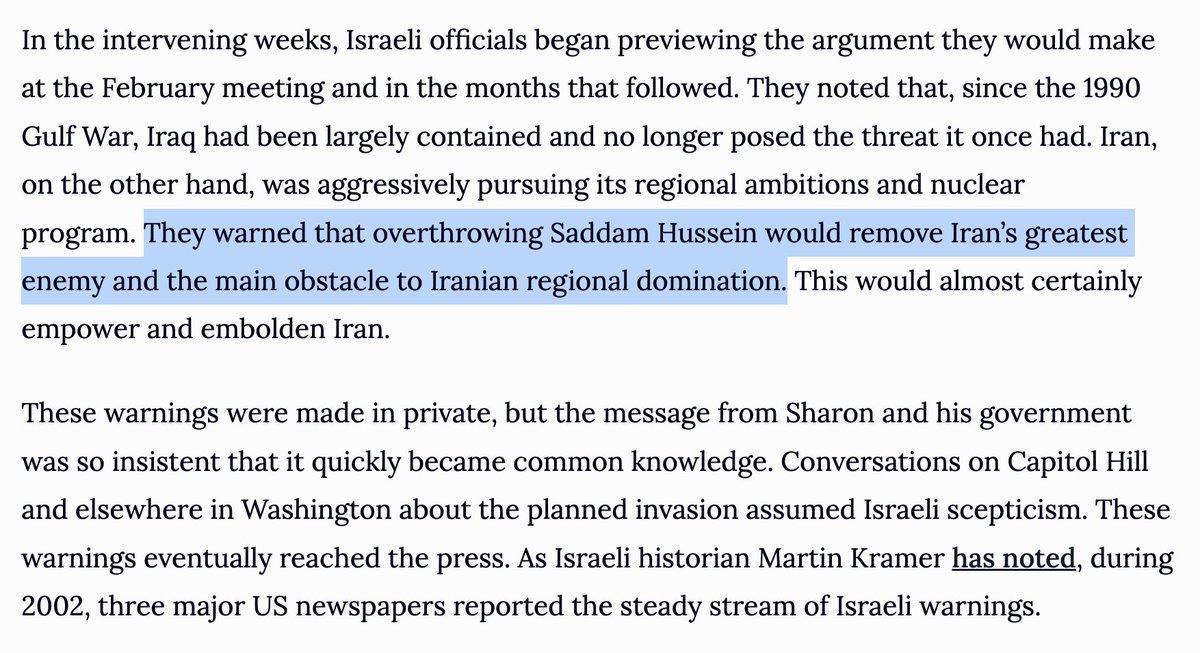
@clairlemon @JoshKraushaar I don’t blame Israel for the Iraq War, but in 2002 testimony before Congress, Netanyahu argued that Hussein should be overthrown. Netanyahu relied heavily on the bogus WMD claim.
English
0
0
0
100
Interpolations
Interpolations@interpolated·
@S_Mahendrarajah When will energy markets be impacted in such a way that Iran notches a W in that column? Same question for equity markets?
English
0
0
0
84
Shivan Mahendrarajah
Shivan Mahendrarajah@S_Mahendrarajah·
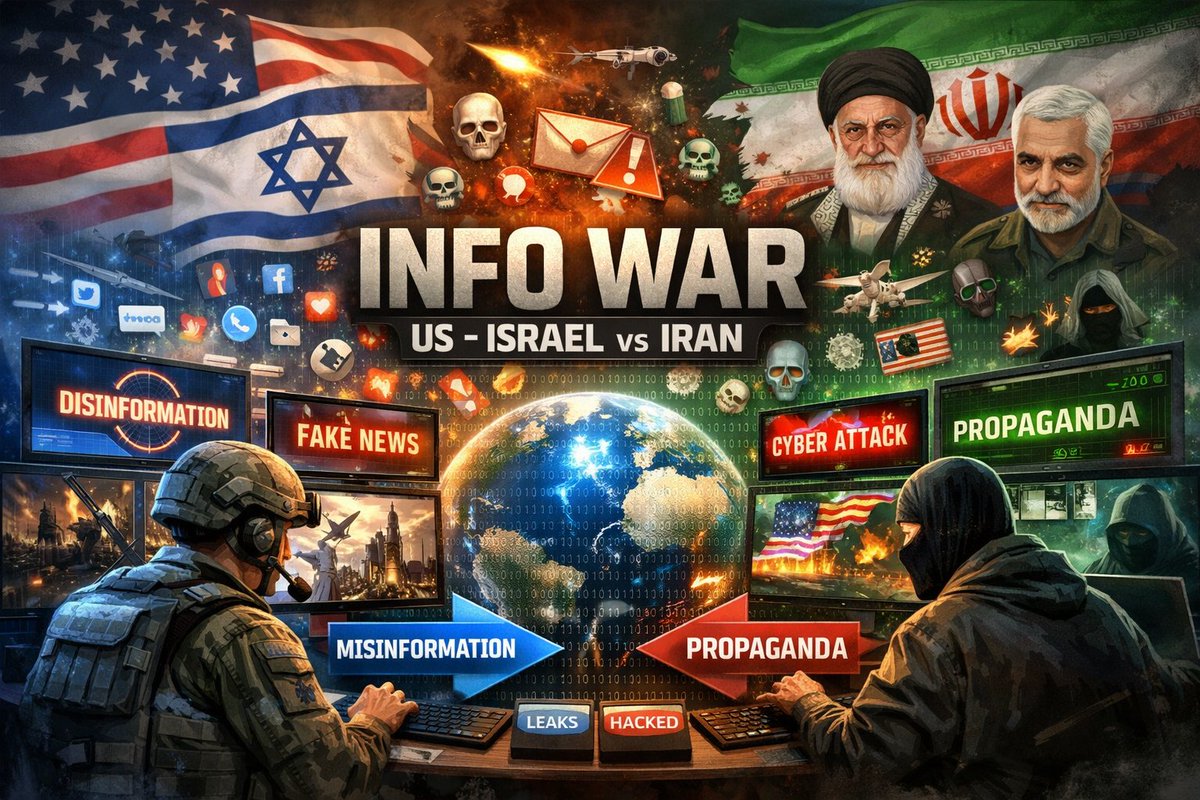
Iran Is Winning the War but Losing the Info War Iran is beating US like a drum and advancing strategy; but DC s control of media narrative is thwarting Iran’s goals. Pre-war, Tehran set five goals that would force concessions from the Trump Regime. None met, yet, largely because DC is shaping the media landscape. “We are in a battle, and more than half of this battle is taking place in the battlefield of the media.” —Ayman al-Zawahiri— Tehran established five objectives before the war that it knows will pressure the Trump Regime into accepting Iran’s demands. Not one of them has been met. 1. US Soldiers KIA: Tehran noted that US is “sensitive” to military casualties, and set a pre-war target of “four to five hundred” casualties. 2. American Prisoners: Iran recalls the hell they put poor Jimmy Carter through for 444 days. POWs on TV will pressure Trump. Moreover, POWs are chips for post-war settlement talks. None taken as yet. 3. Visible Damage: Realistically, Iran hoped for images of damaged navy vessels and downed aircraft. Trump’s freakout over five KC-135 damaged in KSA and coverup of the downing of KC-135 in Iraq, expose DC’s fears. The “Forrestal-style” fire on USS Ford and hasty retreat of USS Lincoln could be due to Iranian actions; however, no images = it never happened. 4. Energy Markets: Iran was aiming for $150/bbl (min), but US Treasury is manipulating oil futures, resulting in a $45–50 difference between real oil prices and paper prices. Global energy shortages jacked up gasoline, diesel, and gas prices, especially in Asia, leading some countries to ration cooking gas and fuel. Aviation fuel prices have skyrocketed. However, until the supply and demand disparity is reflected in commodities markets, Iran has failed. 5. Equity Markets: This is the grand prize. Crash FTSE, Dow, NASDAQ, S&P, etc. Hit Americans in their IRA and 401(k) accounts. Iran sets peace terms when US/EU/UK pocketbooks hurt like hell. Until oil futures prices reflect real prices, equity markets will sleepwalk. Assessment: applying al-Zawahiri’s formula, Iran is on the path to winning 50% of the military battlespace, but is far below 50% in winning the media battlespace. OP by AW is correct: the war is going “badly” for the US, but disconnect between perception and reality prevent the world from knowing how badly Iran has thumped the US (and Israel). Note: control over legacy media is still firm; no major cracks (yet). Those who follow reliable accounts on X and Telegram know how the war is going, but until the low-IQ crowd in middle America that gets its daily slop from Fox or CNN—or Heaven forfend, Rachel Maddow and Jon Stewart—realizes just how horrible things are, the war is not going badly for US. FYI: Mossad’s man at X is suspending accounts to kill real-time info flows. Two major victims today. Beware. Grok, ofc, has been reprogrammed to spew BS.
Shivan Mahendrarajah tweet media
Armchair Warlord@ArmchairW

Never in my wildest dreams did I imagine we could go to war with Iran and things would turn out quite this badly. We owe the people involved in planning Iraq 2003 an enormous apology right now. They had a real war plan. They had allies, logistics, and a legal basis for action.

English
9
21
78
7K
Interpolations
Interpolations@interpolated·
@DNIGabbard @MZHemingway Disappointing post. If we take the meaning of words seriously, then there was no imminent threat, no matter what Trump confabulates.
English
0
0
0
5
DNI Tulsi Gabbard
DNI Tulsi Gabbard@DNIGabbard·
Donald Trump was overwhelmingly elected by the American people to be our President and Commander in Chief. As our Commander in Chief, he is responsible for determining what is and is not an imminent threat, and whether or not to take action he deems necessary to protect the safety and security of our troops, the American people and our country.  The Office of the Director of National Intelligence is responsible for helping coordinate and integrate all intelligence to provide the President and Commander in Chief with the best information available to inform his decisions.  After carefully reviewing all the information before him, President Trump concluded that the terrorist Islamist regime in Iran posed an imminent threat and he took action based on that conclusion.
English
27.2K
15.1K
82.3K
9.7M