

Hassan XBT
2.1K posts

Hassan XBT
@itsmexbt
contributor | shit poster | Artist
Katılım Şubat 2025
530 Takip Edilen659 Takipçiler

Hassan XBT retweetledi
everstake, p2p(.)org, blockdaemon, infstones, luganodes, and ebunker are not just backing optimum on paper
they are actually running the testnet
tbh that is real validation by infrastructure, not just marketing hype
i think a lot of people assume they are running some new custom L1/L2 nodes, but they are actually running their standard ethereum validators
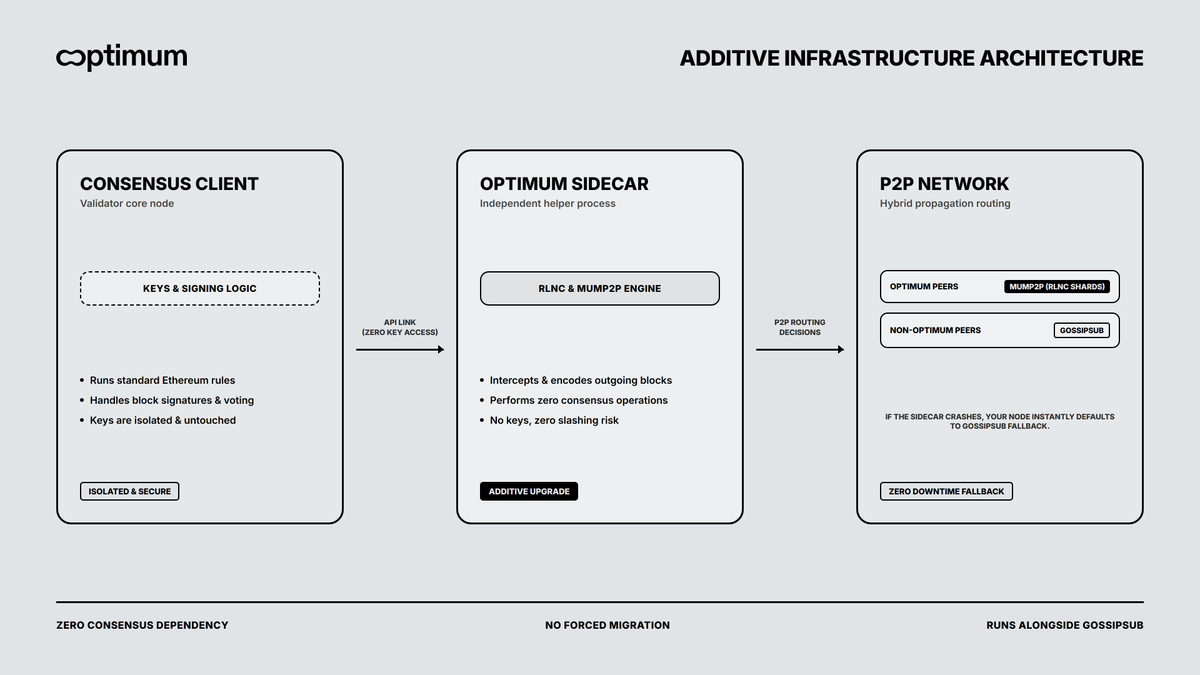
@get_optimum is designed as a universal data propagation layer, like a fast memory bus, so these operators just add a lightweight sidecar program called the optimum gateway next to their existing clients
the telemetry they are generating shows some wild numbers
by comparing block arrival times on the hoodi testnet, they found that optimum propagates blocks in about 300ms compared to 2.4 seconds on standard gossipsub
that is an 80% win rate where optimum delivers the block faster, with 7 times less latency variance
and for institutional operators, that speed translates directly into rewards
saving 100 to 150 milliseconds in block propagation increases head vote accuracy from 98.6% to 99.4%, which can unlock 1,000 to 2,000 extra eth in annual network revenue
it also gives validators more usable slot time to wait for higher-paying mev bids, leading to an average revenue increase of 16% to 30%
yk it has not been without some fun testnet quirks though
operators running lighthouse clients ran into a peer-das issue where lighthouse would aggressively disconnect from and prune the gateway sidecar
to fix it, they had to add a direct peer config to auto-reconnect and launch lighthouse with specific semi-supernode and target-peers flags to keep the fast-lane connection alive
gud tek, and it proves these teams are actually testing the setup in production like environments

Hassan XBT@itsmexbt
a lot of people assume that upgrading blockchain networking means a forced migration something that might risk your node setup or validator keys but optimum is designed differently its transport layer called mump2p runs alongside gossipsub rather than replacing it mump2p uses random linear network coding to mix data packets and speed up propagation if you run the @get_optimum sidecar helper program it uses mump2p to send coded shards to other optimum nodes but it still uses standard gossipsub to talk to non-optimum nodes if the sidecar helper program ever goes down your node just falls back to gossipsub instantly nothing breaks and there is zero consensus dependency because it never touches your validator keys or signing logic this is how you design additive infrastructure no forced migration and zero risk to your existing setup gud tek
English

→ Data Moves Before Consensus
♦Every blockchain decision starts with information reaching the network
→ Awareness Creates Action
♦Validators cannot react until data becomes visible
→ Nodes Stay Connected
♦Communication keeps decentralized systems synchronized
→ Milliseconds Carry Value
♦Small latency differences can affect MEV & coordination
→ Reliability Matters Too
♦Fast delivery fails without reliable propagation
→ RLNC Improves Efficiency
♦Smarter coding reduces delays & missing data
→ Better Communication Stronger Networks
♦Efficient propagation improves scalability & decentralization
→ Consensus Is The Final Step
♦Awareness → Communication → Coordination → Consensus
@get_optimum
Try to explain hope u guys like this
@shariaronchain @cryptooflashh @CryptoSundayz @blockchainjeff @aqccapital

SHUVO@shuvo6519848199
→ Why Latency Matters Milliseconds can decide trades MEV wins & validator coordination in blockchain networks → Speed & Reliability Together Fast data delivery is important Reliable delivery is equally important for stable decentralized systems → RLNC Network Coding RLNC helps validators receive information faster with fewer delays & better synchronization → The Top k Race MEV searchers compete for speed advantages where tiny latency differences create economic value → Turbo Architecture Optimum’s Turbo two lane design focuses on faster payload propagation under latency constraints → Bigger Vision Better network communication can improve blockchain scalability efficiency & decentralization Inspired by research discussions from [@get_optimum YouTube] youtube.com/watch?v=IcAzcJ… Hope u guys like the content @blockchainjeff @aqccapital @tgogayi @f1nk1r @shariaronchain @ada_pegasus
English
a lot of people assume that upgrading blockchain networking means a forced migration
something that might risk your node setup or validator keys
but optimum is designed differently
its transport layer called mump2p runs alongside gossipsub rather than replacing it
mump2p uses random linear network coding to mix data packets and speed up propagation
if you run the @get_optimum sidecar helper program it uses mump2p to send coded shards to other optimum nodes
but it still uses standard gossipsub to talk to non-optimum nodes
if the sidecar helper program ever goes down your node just falls back to gossipsub instantly
nothing breaks and there is zero consensus dependency because it never touches your validator keys or signing logic
this is how you design additive infrastructure
no forced migration and zero risk to your existing setup
gud tek
Hassan XBT@itsmexbt
everyone's focused on faster execution monad, solana, parallel evm, all racing on compute speed but execution on major L1s is already fast enough the real ceiling is propagation @get_optimum tested this. 72 nodes globally, mump2p vs gossipsub head to head at 8MB blocks gossipsub takes 10.3 seconds. optimum does it in 1.3 seconds at 10MB gossipsub hits a 2000%+ latency spike and fails to deliver consistently. optimum holds at ~1 second ethereum gives validators 4 seconds to attest inside a 12s slot if the block is still traveling at second 5, execution speed means nothing. you can't reach consensus on data that hasn't arrived this is why validators physically move servers into the same data centers (atlantic corridor) just to cut propagation manually a centralization fix for a network problem and builders keep submitting smaller blocks on purpose, leaving MEV on the table because they can't trust the propagation layer to beat the deadline optimum's own data shows 100-150ms faster propagation = 1-2% more staking revenue for operators most teams haven't even started thinking about this layer yet
English
everyone's focused on faster execution
monad, solana, parallel evm, all racing on compute speed
but execution on major L1s is already fast enough
the real ceiling is propagation
@get_optimum tested this. 72 nodes globally, mump2p vs gossipsub head to head
at 8MB blocks gossipsub takes 10.3 seconds. optimum does it in 1.3 seconds
at 10MB gossipsub hits a 2000%+ latency spike and fails to deliver consistently. optimum holds at ~1 second
ethereum gives validators 4 seconds to attest inside a 12s slot
if the block is still traveling at second 5, execution speed means nothing. you can't reach consensus on data that hasn't arrived
this is why validators physically move servers into the same data centers (atlantic corridor) just to cut propagation manually
a centralization fix for a network problem
and builders keep submitting smaller blocks on purpose, leaving MEV on the table because they can't trust the propagation layer to beat the deadline
optimum's own data shows 100-150ms faster propagation = 1-2% more staking revenue for operators
most teams haven't even started thinking about this layer yet

English
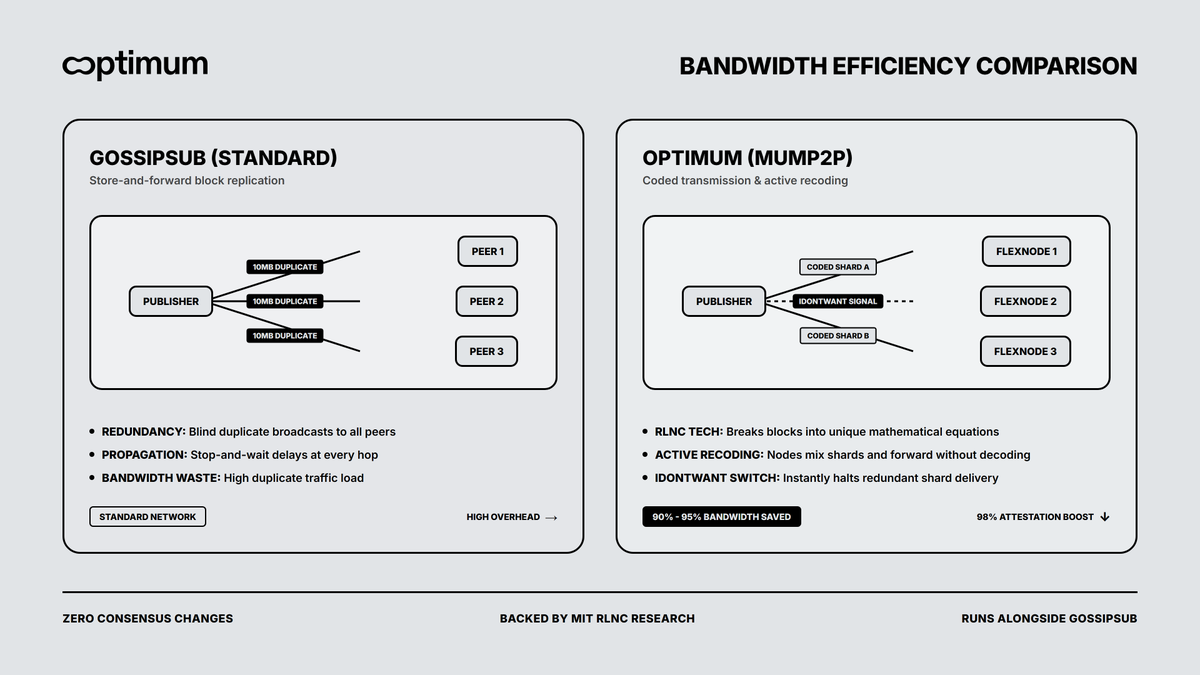
gossipsub has a massive redundancy problem that doesn't get enough attention
every time a block is proposed on ethereum, nodes broadcast the full block to all their peers
so if you're running a node, you end up downloading the same 10MB block multiple times from different peers at the same time
that is just wasted bandwidth and network congestion
@get_optimum fixes this structural inefficiency with its mump2p protocol, which uses RLNC (Random Linear Network Coding)
instead of sending the full block, optimum splits the data into fragments and turns them into coded shards, basically random linear equations
when an intermediate node (flexnode) gets a threshold of these shards, yk around 75%, it does some simple algebra to mix them
this active recoding creates new, unique shards to forward instantly, without even decoding the block first
since every shard is a unique equation, nodes never receive duplicate blocks: every single byte of inbound bandwidth is productive.
once a node has enough shards to decode the data, it sends an idontwant signal to tell its peers to stop sending more
tbh this is why optimum reduces bandwidth: 90% to 95% savings compared to gossipsub under heavy load.
it matches independent research from the ethereum foundation that showed a 20x bandwidth improvement using RLNC.
i think less bandwidth is a massive win for validators: it lets them handle bigger blocks without an expensive hardware arms race.
English

𝗢𝗻𝗲 𝗢𝗳 𝗢𝗽𝘁𝗶𝗺𝘂𝗺’𝘀 𝗠𝗼𝘀𝘁 𝗨𝗻𝗱𝗲𝗿𝗮𝗽𝗽𝗿𝗲𝗰𝗶𝗮𝘁𝗲𝗱 𝗔𝗱𝘃𝗮𝗻𝘁𝗮𝗴𝗲𝘀
Most networking systems depend on receiving exact packets in the correct sequence.
RLNC works differently.
With Random Linear Network Coding, nodes do not need the original packet set to recover information.
𝗧𝗵𝗲 𝗢𝗻𝗹𝘆 𝗧𝗵𝗶𝗻𝗴 𝗧𝗵𝗮𝘁 𝗠𝗮𝘁𝘁𝗲𝗿𝘀 𝗜𝘀 𝗘𝗻𝗼𝘂𝗴𝗵 𝗜𝗻𝗱𝗲𝗽𝗲𝗻𝗱𝗲𝗻𝘁 𝗖𝗼𝗱𝗲𝗱 𝗦𝗵𝗮𝗿𝗱𝘀
That means:
🔹 recovery depends on the information collected, not the arrival order
🔹 missing packets become far less damaging
🔹 networks remain resilient even under unstable conditions
🔹 propagation efficiency improves in distributed environments
This is one of the biggest reasons RLNC performs so effectively across large-scale decentralized systems where:
🔹 packet loss is common
🔹 latency fluctuates constantly
🔹 network paths remain unpredictable
And this architecture is becoming a core part of what @get_optimum is building.
𝗙𝗿𝗼𝗺 𝗣𝗿𝗼𝗽𝗮𝗴𝗮𝘁𝗶𝗼𝗻 𝗧𝗼 𝗗𝗲𝗰𝗲𝗻𝘁𝗿𝗮𝗹𝗶𝘇𝗲𝗱 𝗗𝗮𝘁𝗮 𝗔𝗰𝗰𝗲𝘀𝘀
The same RLNC foundation powering Optimum’s propagation layer is now being extended into DeRAM.
The objective is much bigger than simply accelerating data transmission.
It’s about making decentralized data retrieval scalable, reliable, and practical for real-world systems.
𝗪𝗵𝘆 𝗧𝗵𝗶𝘀 𝗠𝗮𝘁𝘁𝗲𝗿𝘀
Future blockchain infrastructure will require:
🔹 continuous real-time data availability
🔹 efficient recovery under network instability
🔹 scalable decentralized storage access
🔹 low-latency communication between distributed nodes
And traditional networking models begin struggling as throughput grows.
RLNC changes that dynamic by allowing networks to reconstruct information flexibly instead of depending on rigid packet delivery.
While most projects focus only on execution scaling.
@get_optimum is working on the communication and data-access layer needed to support truly large-scale decentralized systems.
@aqccapital @blockchainjeff @CryptoSundayz

Khan@0xCryptoDG
𝟯𝟭% 𝗼𝗳 𝗘𝗧𝗛 𝗜𝘀 𝗡𝗼𝘄 𝗦𝘁𝗮𝗸𝗲𝗱 At this level, staking is no longer only about generating yield. It’s becoming a question of infrastructure efficiency. @get_optimum Most users still choose validators based on: 🔹 reputation 🔹 validator size 🔹 commission fees But as Ethereum grows more competitive, another variable is becoming critical: 𝐈𝐧𝐟𝐨𝐫𝐦𝐚𝐭𝐢𝐨𝐧 𝐞𝐟𝐟𝐢𝐜𝐢𝐞𝐧𝐜𝐲. Validators don’t perform in isolation. Their success depends on how quickly and reliably they can: 🔹 receive network data 🔹 process information 🔹 propagate updates across the chain Even minor delays can influence: 🔹 attestation accuracy 🔹 block propagation speed 🔹 validator participation quality 🔹 long-term staking performance That’s why the discussion is evolving from: 𝐖𝐡𝐨 𝐜𝐨𝐧𝐭𝐫𝐨𝐥𝐬 𝐭𝐡𝐞 𝐦𝐨𝐬𝐭 𝐬𝐭𝐚𝐤𝐞𝐝 𝐄𝐓𝐇? To 𝐖𝐡𝐨 𝐨𝐩𝐞𝐫𝐚𝐭𝐞𝐬 𝐭𝐡𝐞 𝐦𝐨𝐬𝐭 𝐞𝐟𝐟𝐢𝐜𝐢𝐞𝐧𝐭 𝐢𝐧𝐟𝐫𝐚𝐬𝐭𝐫𝐮𝐜𝐭𝐮𝐫𝐞? As Ethereum continues to scale, the real differentiator won’t only be capital allocation. It will be coordination efficiency. Because staking rewards ultimately depend on network performance. And network performance starts with information flow. The next phase of Ethereum won’t be defined only by how much ETH is staked. It will be defined by how efficiently that stake can interact with the network. @aqccapital @blockchainjeff @CryptoSundayz
English
The Hidden Layer Behind Blockchain Performance
Every block starts with a message
But decentralized networks only work when information spreads quickly across validators
→ Message Created
→ Propagation Begins
→ Validators Receive Data
→ Synchronization Happens
→ Consensus Forms
→ Network Updates
Fast information flow leads to:
→ Better synchronization
→ Faster consensus
→ Lower latency
→ Stronger performance
Slow propagation creates delays, weaker coordination & reduced efficiency
Blockchain scalability is not only about transaction processing
It’s also about delivering information efficiently across the network
A stronger communication layer creates a stronger decentralized system
@get_optimum
@aqccapital @shariaronchain @blockchainjeff @cryptooflashh
SHUVO@shuvo6519848199
Ethereum Real Bottleneck Isn’t Compute It’s Information Flow 1. Scaling Isn’t Just Compute Most people think Ethereum scaling is about stronger hardware & more compute power. But the real challenge is coordination at scale. As more validators join the network: → more messages are exchanged → more data moves constantly → synchronization becomes harder 2. Why Information Flow Matters In decentralized systems, speed matters. A block only matters if it reaches the network on time. An attestation only matters if it arrives before the deadline. Better information flow can improve: → validator performance → block propagation → network efficiency 3. The Hidden Problem: Latency Even small delays can affect: → synchronization → validator rewards → overall network performance At scale information latency becomes an economic factor. 4. The Future of Blockchain Infrastructure The next generation of networks is focusing on: → faster information propagation → lower communication overhead → better validator coordination → more efficient synchronization Because in decentralized systems performance is ultimately a communication problem. @blockchainjeff @aqccapital @tgogayi @f1nk1r @shariaronchain @ada_pegasus
English

Hanum Daily Tech Insight : How Optimum Uses RLNC, talk about RLNC Episode 5
In the previous episode, we discussed how RLNC improves blockchain networks by reducing latency and making data propagation more efficient.
Today, let's explore how @get_optimum actually uses RLNC within its infrastructure.
At the center of Optimum's architecture is mump2p, a next-generation high-speed data propagation protocol designed to improve the speed, scalability, and efficiency of blockchain networks such as Ethereum.
You can think of mump2p as a high-performance data highway that helps blocks, transactions, and blobs move across the network faster and more efficiently.
But how does it work?
Gateway Sidecar
Optimum introduces a component called the Gateway Sidecar.
A Gateway Sidecar is an additional proxy layer that runs alongside a validator's infrastructure. Instead of replacing existing blockchain components, it works in parallel with them. Its role is to: Manage network traffic more efficiently, optimize routing, collect propagation metrics, and connect validators to the mump2p network.
This allows validators to benefit from faster propagation without changing the core Ethereum infrastructure they already use.
Beacon Node
In Ethereum, validators rely on a Beacon Node. The Beacon Node is responsible for: Receiving new blocks,
validating transactions, participating in consensus, and propagating information across the network.
Since Beacon Nodes constantly exchange data with other validators, propagation speed becomes extremely important.
Small delays can affect:
- Attestation performance,
- block proposal timing,
- MEV opportunities,
- and validator rewards.
Where RLNC Comes In
This is where RLNC becomes the key technology behind mump2p. Instead of sending fixed packets that can be duplicated many times across the network, RLNC creates random linear combinations of data.
As a result:
1. duplicate transmissions are reduced,
2. bandwidth is used more efficiently,
3. data reaches validators faster,
4. and network latency becomes lower.
Almost every packet received contains new and useful information, making propagation significantly more efficient than traditional approaches.
Faster Propagation, Better Performance
By combining:
- RLNC is the technology.
- mump2p is the propagation protocol.
- Gateway Sidecar is the connection layer.
- Beacon Nodes are the validators that benefit from it.
Together, they help Ethereum validators receive information faster, reduce latency, improve network efficiency, and potentially increase validator profitability.
Optimum creates an infrastructure layer that helps data move faster across blockchain networks.
The goal is not simply to make propagation faster, but to make every transmission more valuable by reducing redundancy and maximizing the usefulness of each packet.
CC : @CryptoSundayz @blockchainjeff

HanumD@HanumD3e
Hanum Daily Tech Insight : How RLNC Improves Blockchain Networks?, talk about RLNC Episode 4 Validators are computers (nodes) in the Ethereum network responsible for securing the blockchain by verifying and approving transactions. Ethereum operates under a Proof-of-Stake system, where validators stake 32 ETH as collateral instead of using massive computing power like Bitcoin miners. In blockchain networks, speed matters. One important factor is latency the time it takes for validators to: receive block data, verify it, sign it, and propagate approval messages to other validators. The lower the latency, the faster blocks can be confirmed across the network. However, if latency becomes too high, validators may lose opportunities to earn additional rewards such as MEV (Maximal Extractable Value). Another important concept is propagation. Propagation refers to how quickly block data spreads across the Ethereum network from one validator to another. When propagation is slow, the entire network becomes less efficient. RLNC from @get_optimum improves blockchain networks by making data propagation faster and more efficient between validators. Instead of repeatedly sending duplicate packets across the network, RLNC creates random linear combinations of data, allowing almost every transmitted packet to carry new and useful information. As a result: > latency becomes lower, > redundancy is reduced, > bandwidth usage becomes more efficient, > and validators receive block data faster. This creates major advantages for blockchain networks because validators can: 1. process blocks more quickly, 2. improve propagation efficiency, 3. increase consensus performance, 4. and potentially gain higher rewards through faster network participation. so i can say : Faster propagation = lower latency. Lower latency = better validator performance. Better validator performance = more efficient blockchain networks. CC : @blockchainjeff @CryptoSundayz
English
Hassan XBT retweetledi
most blockchain speed claims are basically like this,
running a demo in a clean lab and claiming crazy numbers on paper
but what actually matters is how fast data moves between nodes across the globe when the network gets busy
if data moves slow, your transactions get delayed or fail
here is what happened when they did a head to head speed test between gossipsub (ethereum's standard network) and mump2p (optimum) on 72 nodes globally, spread across north america, europe, asia, and australia
for small 2MB blocks, they look similar, @get_optimum is at 965ms while gossipsub averages 1104ms
but look what happens when block sizes scale to 8MB,
> gossipsub -> 10.3 seconds (completely choked)
> mump2p (optimum) -> 1.3 seconds
that is because optimum uses RLNC (Random Linear Network Coding). instead of waiting to download a full block before sending it to the next peer, nodes just mathematically mix and forward coded shards instantly.
when they pushed it to 10MB to find the breaking point, gossipsub hit a wall and failed to deliver. optimum stayed stable at around 1 second.
this means you can scale block and blob sizes without centralizing the network or demanding massive hardware. the gateway runs as a sidecar on just 2 vcpus and 512MB ram.
i think fixing this network delay is how you get to true sub second transactions onchain.

English
real challenge for web3 scaling is data propagation not execution speed
to move data, networks rely on erasure codes. but traditional tech like reed-solomon and fountain codes completely break in multi-hop p2p meshes:
nodes can't perform math on incoming shards they must download the full block before forwarding cumulative packet loss piles up to 37%
@getoptimum solves this with RLNC (random linear network coding).
instead of store and forward, intermediate nodes (flexnodes) algebraically mix/recode shards on the fly.
no wait times, no cumulative loss, just 150-300ms propagation.
i wrote a short breakdown on why RLNC is the superior math for data scaling.
full read here 👇
Hassan XBT@itsmexbt
English
5/
this 150ms speed boosts validator APR. it halves missed attestations and gives proposers more time to capture 16% to 30% higher MEV bids.
gud tek.
English
4/
yk standard networks suffer from cumulative loss where three hops at 10% loss can end up as 37% loss.
optimum uses active recoding to stop loss from accumulating, keeping it at 10% to 11%. it also reduces overall bandwidth waste by 90% to 95%.
English
most infra projects claim they scale but they never show raw network data
i've been looking into the ethereum hoodi testnet benchmarks to see how @get_optimum actually performs against gossipsub
the gap is not just an incremental improvement, it is a category shift
🧵

English