Iván Morales

6.1K posts

Iván Morales banner
Iván Morales

Iván Morales

@ivanmoralesm_

Psiquiatra y psicogeriatra 🧠👵🏽

Ciudad de México Katılım Mayıs 2018
293 Takip Edilen388 Takipçiler
Iván Morales retweetledi
Robert Howard
Robert Howard@ProfRobHoward·
Our new paper in Neurology. What does a positive Alzheimer’s disease biomarker result really mean for someone with mild cognitive impairment? neurology.org/doi/10.1212/WN…
English
5
23
61
7.8K
Iván Morales retweetledi
ItzCarlos
ItzCarlos@Balatreado·
Lo único que hizo el Atlético Madrid esta temporada fue eliminar al Barcelona de 2 competencias.
Español
27
501
11.6K
92.7K
Iván Morales retweetledi
Azucena Uresti
Azucena Uresti@azucenau·
🔴🥩Inicia la carnita asada en el ayuntamiento de Culiacán, Sinaloa, como festejo tras la licencia de Rubén Rocha Moya como gobernador ante los señalamientos de presuntos vínculos con el crimen organizado. 📹@ELDEBATE.
Español
51
872
4.2K
76.1K
Iván Morales retweetledi
Dawit
Dawit@Dawit_Dege·
The Early, The Better 🤭 #ecg #Cardiology
Dawit tweet media
English
38
2.4K
10.5K
157.2K
Iván Morales retweetledi
Progress Bar 2026
Progress Bar 2026@ProgressBar202_·
2026 is 34% complete.
Progress Bar 2026 tweet media
English
46
1.1K
6.2K
135.4K
Iván Morales retweetledi
DiegoNeurociencias
DiegoNeurociencias@diegoneuro·
Importancia de la respiración nasal frente a la bucal. Además de la sincronía límbica, esta respiración favorece la actividad parasimpática, reduce el estrés, mejora la neuroplasticidad, mejora el sueño, y la sensación de bienestar. A respirarar profundamente por la nariz
Sergio Ferrero@calotonterias

La respiración nasal crea una sincronización rítmica de las ondas cerebrales en las áreas de la emoción y la memoria. La respiración bucal no tiene el mismo efecto.

Español
1
8
29
1.2K
Iván Morales retweetledi
R4 🧠
R4 🧠@Rpsiquia·
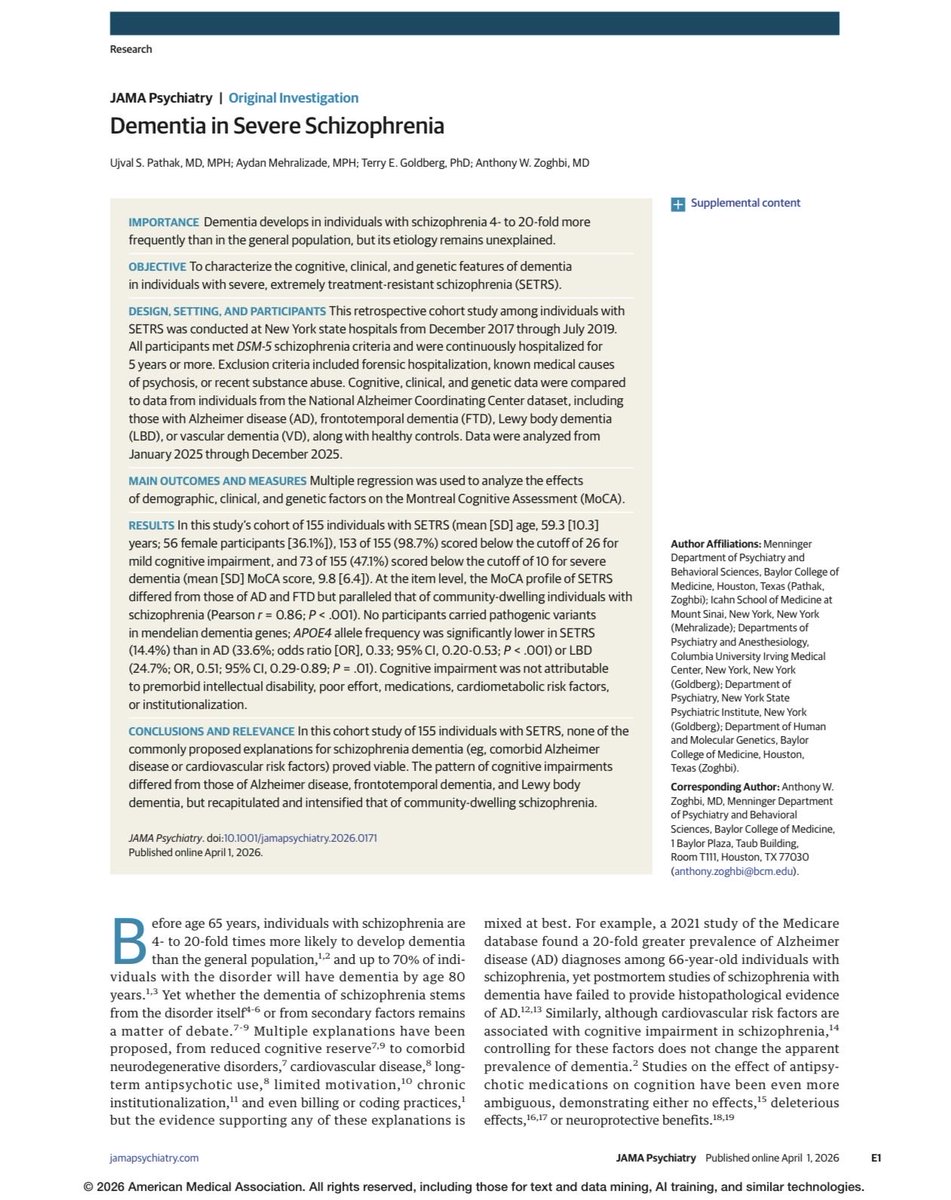
Síntomas de la Esquizofrenia: - Síntomas positivos - Síntomas negativos - Síntomas COGNITIVOS Estudio de N = 155 de pacientes con esquizofrenia severa. El 47.1% de la muestra obtuvo < 10 pts en MoCA. Existe un patrón de deterioro cognitivo particular de la esquizofrenia 🧠
R4 🧠 tweet media
Español
4
49
211
7.6K
Iván Morales retweetledi
El Paido ®️
El Paido ®️@ElPaido·
Framework for pharmacotherapy of depression #fig3" target="_blank" rel="nofollow noopener">thelancet.com/journals/lance…
El Paido ®️ tweet media
English
0
25
106
2.9K
Iván Morales retweetledi
David ImeI
David ImeI@DurvidImel·
2026
David ImeI tweet media
506
15.7K
241.8K
9M
Iván Morales retweetledi
Tyler Black, MD
Tyler Black, MD@tylerblack32·
Quick thread: "How do SSRI's work" 🧵 I've had a few patients ask me how SSRI's work. To be clear, my first answer is "well we know they are supposed to block serotonin reuptake, but it's not that simple and we don't really know." But, if you want the best 2026 science... /1
Tyler Black, MD tweet media
English
28
66
365
52.9K
Iván Morales retweetledi
Héctor Ávila
Héctor Ávila@JHUNTER25·
@porktendencia 1. Tengo la conciencia tranquila, no soy ningún criminal. 2. Voy a pedir licencia para probar mi inocencia huyendo del país.
Español
1
4
270
4K
Iván Morales retweetledi
David Dack
David Dack@DavidDack·
Most runners don’t hate “slow.” They hate what slow says about them. Slow feels like decline. Like you’re not serious. Like you’re the one getting passed. So you start adjusting. Easy days get a little faster than they should be. Not because it helps. Because it looks better. Because you’re still trying to hold onto that identity: strong runner. And this is where it turns. Because now you’re not training… you’re auditioning. For your friends. For your past self. For the version of you that used to feel faster, lighter, easier. And once that happens… easy runs stop being easy. They become something you have to prove. That’s the trap. The idea that slow miles are “junk” sounds harmless. But it quietly strips away the thing that actually builds you. Because most of your progress doesn’t come from the hard stuff. It comes from the boring, repeatable, low-stress miles that don’t look impressive. And when you remove those… you don’t just lose progress. You lose durability. Run too fast too often, and you’re not just limiting endurance — you’re increasing strain and injury risk over time That’s the part people don’t like to admit. It’s not the slow running that holds you back. It’s refusing to run slow enough. Especially in your 40s. Because now recovery isn’t optional. It’s part of the system. And the runner jogging easy on Wednesday… isn’t soft. They might be the only one training in a way that actually survives. I coached a guy who kept apologising for his pace. Every run: “I feel like I’m getting slower.” He wasn’t. He was finally running in a way his body could repeat. Three runs a week. No drama. No “catch-up” sessions. Just showing up. Six months later he raced… and surprised himself. Not because he pushed harder. Because he wasn’t tired all the time. And this is the shift most people miss. Nobody claps for slow miles. Nobody rewards “didn’t get hurt.” But that’s the identity that lasts. You stop being the person who runs when everything lines up. And you become the person who runs… even when life is loud. Be honest. When you speed up your easy runs… are you trying to improve your training or trying to avoid what “slow” makes you feel about yourself?
David Dack tweet media
English
0
7
49
3.2K
Iván Morales retweetledi
Chris Aiken, MD
Chris Aiken, MD@chrisaikenmd·
FDA just approved Auvelity for agitation in Alzheimer's dementia, but... ▪ An earlier version of the drug failed ▪ The FDA left one of the key trials out of its announcement Here's what the published and unpublished trials show: psych-partners.com/auvelity-appro…
Chris Aiken, MD tweet media
English
3
3
15
1.3K